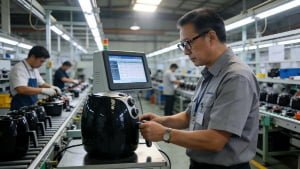
Many buyers compare commercial and household air fryers as if they are just different sizes. In our product work, that mistake often leads to certification gaps, weak product-market fit, and costly sourcing decisions later.
Commercial air fryers should be sourced like foodservice equipment, while household air fryers should be sourced like consumer appliances. I always compare them by intended use, certification path, durability level, factory focus, serviceability, MOQ logic, and the real market where the product will be sold.
When I help buyers compare commercial air fryers and household air fryers, I do not start with capacity, price, or appearance. I start with intended use. That is the most important line in the whole sourcing decision. A household air fryer is built for consumer kitchens, consumer expectations, and consumer retail rules. A commercial air fryer is built for professional use, heavier operating conditions, and a very different standard of acceptance. In real sourcing work, the gap between those two categories is much bigger than many buyers first expect. Household sourcing is usually driven by retail sellability. That means price, feature mix, packaging, user manual, labeling, and return-risk control matter a lot. Commercial sourcing is driven by operational fit. That means durability, cleaning access, maintenance support, spare parts, sanitation, certification scope, and professional kitchen acceptance matter more. I have seen buyers assume that a larger or more expensive household air fryer can serve as a commercial product. I do not think that is a safe assumption. A product can look strong and still be wrong for the intended-use category. That is why I always check factory focus, certification scope, and the real application environment before I compare quotations.
What Makes Commercial Air Fryer Sourcing Different from Household Air Fryer Sourcing?
Commercial air fryer sourcing is different because the product is judged by professional-kitchen standards, heavy-duty use expectations, and commercial compliance requirements. Household air fryer sourcing is judged by consumer use, retail fit, and household safety expectations.
In our sourcing work, I treat household air fryers as consumer products and commercial air fryers as foodservice equipment. That single difference changes how I compare suppliers, certifications, maintenance needs, packaging, and long-term risk.
This is the main idea that guides the whole buying process. A household air fryer usually lives in a consumer world. The buyer wants a product that sells well, looks attractive, fits the target price band, and passes the right household-use certification path. The product may be used once or twice a day. It has to feel easy, safe, and low-risk for home users. It also has to work well with retail packaging, e-commerce pages, and normal return management.
A commercial air fryer enters a different world. It may be installed in restaurants, food stalls, cafés, convenience stores, or other professional cooking environments. The user may run it many times each day. The cleaning routine may be harsher. The operational expectation is much higher. In that setting, the buyer cares more about sanitation-friendly design, continuous or heavy-duty use, metal construction, serviceability, replacement parts, and whether the product is accepted as commercial equipment in the target market.
Here is how I usually separate the two:
| Sourcing Area | Household Air Fryer | Commercial Air Fryer |
|---|---|---|
| Main use setting | Home kitchen | Professional kitchen or foodservice |
| Buying driver | Retail sellability | Operational durability and acceptance |
| Certification focus | Consumer appliance route | Commercial foodservice route |
| Packaging role | Very important | Less central than equipment fit |
| After-sales focus | Return control | Maintenance and spare parts support |
For me, this difference is not a small technical detail. It is the whole sourcing framework.
How to Compare Commercial and Household Air Fryer Suppliers by Factory Capability and Product Focus?
I compare suppliers by asking whether the factory is truly built around household appliances or foodservice equipment. A supplier that is good at household air fryers may not be the right partner for commercial air fryers, even if both products look similar at first.
In our factory evaluations, I look at production focus, engineering depth, material route, test capability, and whether the supplier can support the real intended-use category with confidence and evidence.
This is where buyers need to stay disciplined. I do not like to assume that any factory making air fryers can cover both categories equally well. In practice, many factories are much stronger in one direction. A household appliance factory may be excellent at consumer packaging, feature-driven product planning, private label work, and large-volume retail production. That is useful for household air fryers. But commercial air fryer sourcing often needs different strengths. The supplier may need more experience with stainless construction, heavy-duty components, sanitation-friendly layouts, service access, spare parts planning, and commercial certification handling.
So when I compare suppliers, I ask questions like these: does the factory mainly ship consumer appliance lines, or does it also support foodservice equipment? Does the engineering team understand continuous-use conditions? Can the supplier explain service parts and maintenance design clearly? Can the factory show product focus that matches the intended-use category?
I usually compare supplier capability like this:
| Supplier Checkpoint | Household Air Fryer Supplier | Commercial Air Fryer Supplier |
|---|---|---|
| Product focus | Consumer appliance lines | Foodservice equipment focus |
| Engineering strength | Feature and retail-oriented | Durability and service-oriented |
| Production style | High-volume consumer production | Heavier-duty equipment control |
| QC focus | Appearance, safety, return control | Operational reliability and serviceability |
| After-sales support | Retail support logic | Parts and maintenance support |
A buyer should never choose a supplier just because the product photo looks close. The factory focus has to match the real business use.
Which Certification and Compliance Requirements Change Between Commercial and Household Air Fryers?
The certification path changes because household air fryers are usually assessed as consumer appliances, while commercial air fryers are assessed as foodservice or professional-use equipment. The exact requirements depend on the target market, but the intended-use category must always match the product and factory.
In our export work, I never assume that a household certificate can support a commercial application. I always check whether the exact product, factory, and intended-use scope match the real selling environment.
This is one of the biggest sourcing risks in the category. A buyer may see a powerful or premium-looking air fryer and assume that it can enter a foodservice setting. I do not think that is safe. A household appliance and a commercial kitchen appliance may look similar from the outside, but they are often judged under different rules and expectations. A commercial unit may need a different compliance path related to sanitation, electrical safety for commercial use, and acceptance in professional environments. A household model usually follows a consumer appliance path with household-use labeling, manuals, and retail safety expectations.
I also pay close attention to intended-use wording. If the documentation, certification scope, or product label supports household use only, that is not something I would casually stretch into a commercial claim. The exact scope matters.
I usually compare compliance like this:
| Compliance Area | Household Air Fryer | Commercial Air Fryer |
|---|---|---|
| Intended-use category | Consumer household use | Professional or foodservice use |
| Labeling logic | Consumer labels and warnings | Equipment and operational labeling |
| Certification path | Household appliance route | Commercial equipment route |
| Sanitation focus | Limited | Much more important |
| Installation or use acceptance | Home use | Professional kitchen acceptance |
For me, the main rule is simple. The certificate, the factory, and the product category must all point to the same real use case.
How MOQ, Customization, and Lead Time Differ for Commercial Air Fryer vs Household Air Fryer Orders?
Household air fryer orders usually offer more flexibility in private label, broader packaging customization, and more familiar MOQ structures for retail programs. Commercial air fryer orders may involve different MOQ logic, more technical customization, and lead times shaped by heavier construction and certification needs.
In our sourcing experience, household air fryers are often easier to launch quickly for consumer programs. Commercial air fryers usually require more attention to equipment detail, service structure, and compliance alignment before the order becomes truly ready.
This difference becomes very clear once the project moves from concept to quotation. Household air fryer programs often follow a retail logic. Buyers want logo updates, color box design, user manual changes, carton marks, and maybe some feature or housing adjustments. The MOQ is usually tied to packaging, colored parts, and standard model availability. The lead time often depends on sample approval, packaging artwork, and assembly planning.
Commercial air fryer projects can look different. Customization may focus less on gift-box presentation and more on structure, power setup, stainless layout, cleaning access, accessory compatibility, or service parts. The MOQ may depend more on equipment configuration and parts sourcing than on standard retail packaging. Lead time may also stretch because commercial projects often need more review before release.
I usually compare the order logic like this:
| Order Factor | Household Air Fryer | Commercial Air Fryer |
|---|---|---|
| MOQ style | Retail and packaging-driven | Equipment and parts-driven |
| Customization focus | Branding, packaging, feature mix | Structure, power, durability, service access |
| Lead-time driver | Sampling and artwork release | Technical review and equipment readiness |
| Launch speed | Often faster | Often slower but more controlled |
| Reorder pattern | Retail cycle-based | Project and equipment-demand based |
That is why I always tell buyers not to compare these two categories by MOQ alone. The sourcing structure behind the order is different.
How to Evaluate Durability, Maintenance, and After-Sales Risk Before Choosing Commercial or Household Models?
I evaluate durability by looking at intended-use stress, material route, heating system stability, cleaning exposure, and service access. Household air fryers should be judged by consumer-use reliability and return control. Commercial air fryers should be judged by heavy-duty use, maintenance practicality, and spare-parts support.
In our product work, I treat after-sales risk very differently in these two categories. A household product usually needs low complaint and low return rates. A commercial product needs stable operation and a clear path for service when something wears or fails.
This is where the product’s real life begins. A household air fryer is usually judged by how well it performs in normal home use. Does it heat consistently? Does the coating stay acceptable? Is the basket easy to use? Are complaints likely from noise, appearance, or function drift? These are consumer risk questions.
A commercial air fryer needs a much harder evaluation. I want to know whether it can handle repeated operation, stronger cleaning routines, and a more demanding environment without becoming a service problem too quickly. I also want to know whether the supplier can support replacement parts, maintenance instructions, and service documentation. A commercial product is often less about avoiding any failure at all and more about managing wear and service in a professional way.
I usually compare risk like this:
| Risk Area | Household Air Fryer | Commercial Air Fryer |
|---|---|---|
| Main durability test | Daily home use stability | Heavy-duty operational endurance |
| Maintenance expectation | Low-maintenance consumer use | Repair and service support expected |
| Spare parts need | Limited | Much more important |
| After-sales focus | Returns and complaints | Downtime and service continuity |
| Cleaning demand | Normal home cleaning | Frequent and stronger cleaning cycles |
For me, that is why a large household air fryer still does not become a commercial unit just because it looks strong. The service logic is completely different.
When Importers Should Choose Commercial Air Fryers Instead of Household Air Fryers for Their Market?
Importers should choose commercial air fryers when the real market is foodservice, professional kitchen use, or other environments where operational durability, sanitation acceptance, and service support matter more than retail packaging and consumer features. Household air fryers should be chosen when the market is consumer retail.
In our planning, I choose commercial models only when the intended-use environment truly requires commercial equipment logic. I do not use a commercial product just because it looks bigger, and I do not use a household product just because it is cheaper.
This final choice should come from the market, not from the product photo. If the importer is selling into restaurant supply, foodservice distribution, professional catering, or semi-professional kitchen environments, then a real commercial air fryer is usually the correct route. In that market, buyers will care about operational durability, sanitation-friendly design, certification scope, service parts, and equipment acceptance. A household product may fail commercially even if its feature list looks attractive.
If the importer is selling into supermarkets, online retail, appliance chains, or consumer brand programs, then a household air fryer is usually the right choice. In that world, retail price, feature mix, packaging, manuals, and return-risk control matter much more.
I usually make the choice like this:
| Market Situation | Better Choice | Why |
|---|---|---|
| Consumer retail and e-commerce | Household air fryer | Better retail fit and consumer compliance |
| Restaurant and foodservice supply | Commercial air fryer | Better durability and intended-use fit |
| Price-led home appliance program | Household air fryer | Better assortment logic |
| Professional kitchen equipment channel | Commercial air fryer | Better acceptance and service logic |
| Mixed market with unclear use case | Clarify first | Wrong category creates high risk |
For me, the biggest rule is simple. Do not source by appearance. Source by intended use, certification scope, and the real operating environment.
Conclusion
Commercial and household air fryers should never be sourced as if they are the same product in different sizes. The right choice comes from intended use, compliance path, durability level, and market channel.
FAQ
What is the main difference between commercial air fryer sourcing and household air fryer sourcing?
The main difference is intended use. Household air fryer sourcing is driven by consumer retail needs, while commercial air fryer sourcing is driven by professional-kitchen durability, sanitation, serviceability, and commercial compliance.
Can a large household air fryer be sold as a commercial air fryer?
Not safely by assumption. A large household air fryer may still be a consumer appliance. Buyers should verify that the exact product, factory, and certification scope support real commercial intended use.
Why should buyers compare factory focus when sourcing commercial vs household air fryers?
Because a household air fryer factory may be strong in consumer retail production but weak in foodservice equipment design. Commercial air fryer sourcing often needs stronger capability in durability, serviceability, and professional-use support.
Do certification requirements change between commercial and household air fryers?
Yes. Commercial and household air fryers are usually assessed under different intended-use categories. Buyers should confirm that the compliance path, labeling, and certification scope match the real market and application.
How do MOQ and customization differ for commercial and household air fryer orders?
Household air fryer orders are often more retail-driven, with packaging and branding customization. Commercial air fryer orders often focus more on structure, power setup, service access, and equipment-specific requirements, which can change MOQ and lead time logic.
What after-sales risks matter most for commercial air fryers?
For commercial air fryers, the biggest after-sales risks are downtime, cleaning wear, maintenance difficulty, and lack of spare-parts support. These matter more than normal retail return control in professional-use environments.
When should an importer choose a commercial air fryer instead of a household model?
An importer should choose a commercial air fryer when the end market is foodservice, restaurant supply, or professional kitchen use where operational durability, sanitation acceptance, and service support matter more than retail packaging.