Buying from the wrong air fryer supplier can look cheap at first. Then the returns come, the shipment slips, and the compliance risk lands on your desk when it is already too late.
An air fryer supplier evaluation checklist is a practical tool that helps buyers judge whether a supplier can consistently deliver safe, compliant, and reliable air fryers at scale. It checks factory strength, quality control, certifications, food-contact safety, delivery ability, and the supplier’s stability in mass production.
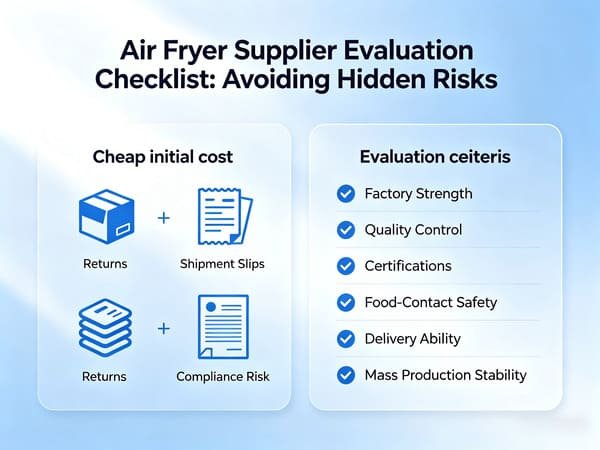
When I speak with importers and brand owners, I notice the same pattern again and again. Many teams ask for a quote first. They compare unit prices first. They talk about packaging first. That sounds efficient, but it often leads them in the wrong order. In our daily work with kitchen appliance projects, I have learned that supplier evaluation should start before price comparison becomes the main discussion. A low quote means very little if the supplier cannot control coating safety, heating consistency, or delivery timing. A good checklist changes the conversation. It helps me move from surface-level claims to real proof. It also helps me see whether a supplier can support not only the first order, but also the fifth and the fiftieth. That is the point buyers often miss. The real purpose is not collecting documents for a folder. The real purpose is to reduce business risk before it becomes expensive.
Which Documents Should You Request Before Shortlisting an Air Fryer Supplier?
A supplier can say many good things in email. The first filter is documents. The right documents show ownership, compliance readiness, quality systems, and whether the supplier can support your market with real evidence.
Before I shortlist any air fryer supplier, I want a core set of documents on the table. I do not ask for them because I enjoy paperwork. I ask for them because documents tell a story long before I visit a factory or approve a sample. In many projects, I have seen polished websites and smooth sales talk hide weak control behind the scenes. A supplier that is serious about long-term cooperation should be able to provide organized records without confusion or delay. That first response already tells me something about how they manage work.
I usually divide the required documents into several groups. The first group is company identity. I want the business license, company registration details, export license status if needed, and basic company profile. I also want the registered company name to match the name used in contracts, quotations, and bank details. If the names shift from one document to another, that is a warning sign. The second group is quality and audit evidence. I want quality system certificates if they have them, internal audit records if available, and any third-party factory audit reports they can legally share. The third group is product compliance. For air fryers, this is critical. I want product test reports, electrical safety reports, EMC reports if relevant, and market-specific certification documents. The fourth group is food-contact safety. Since the basket, tray, coating, and other parts may touch food directly, I want declarations and test evidence for food-contact materials. The fifth group is operational proof. I want production flow charts, equipment lists, monthly capacity data, and inspection process records.
The table below shows the document set I usually consider before moving a supplier into the serious review stage:
| Document Type | What I Check | Why It Matters |
|---|---|---|
| Business license and company registration | Legal name, scope, address, ownership clues | Confirms the supplier is a real legal entity |
| Factory profile | Site details, employee count, production lines | Shows whether their scale matches their claims |
| Quality certificates or audit reports | ISO status, internal quality process, third-party audits | Gives early signs of management discipline |
| Product certification files | Safety and EMC reports, target-market approvals | Reduces risk of market access failure |
| Food-contact declarations and reports | Basket, tray, coating, plastic contact parts | Protects against food safety claims |
| Capacity and equipment list | Assembly lines, aging test, inspection tools | Helps judge delivery ability and consistency |
| Sample inspection records | IQC, IPQC, FQC structure | Shows whether the supplier manages defects systematically |
| Packaging specs and labeling drafts | Carton test, barcode, warnings, manuals | Avoids shipping and labeling mistakes later |
I also pay attention to how the supplier sends these materials. If the files come in a clear folder structure, with names, dates, versions, and matching product models, I already feel more confident. If the supplier sends screenshots, incomplete pages, outdated reports, or unrelated test files from another model, I slow down right away. A careful supplier usually handles documents in a careful way. A sloppy supplier often treats documents as an afterthought, and that habit often appears again in production.
There is also a simple question I like to ask at this stage: “Which of these documents are linked to the exact model I plan to buy?” That question matters because some suppliers send general company certificates and hope the buyer will assume the product is covered. I do not make that assumption. I want model-level relevance whenever possible. In our own product development work, we know how easy it is for small design changes to affect test scope, labeling, or material declarations. So I always look for a direct match between the proposed product and the supporting records.
A shortlist should be earned, not given. If the supplier cannot provide clear basic documents before shortlisting, the problem rarely gets easier later. It usually gets worse.
How to Verify Whether an Air Fryer Supplier Is a Real Manufacturer or Just a Trading Company?
Many suppliers call themselves factories. Some are real manufacturers. Some are traders with good photos. The difference affects price, speed, technical support, quality control, and how problems get solved later.
I do not treat “factory” as a label I can trust on first sight. In the small appliance business, it is common for trading companies to present themselves like direct manufacturers. That is not always a problem by itself. Some trading companies are useful and well organized. But I need to know who is doing what. If I think I am working directly with a producer, but the real production is outsourced to another site I have never checked, then my risk is much higher. I lose visibility. I lose technical speed. I lose control over problem solving.
The first thing I do is compare the company identity against the factory story. I look at the registered address, business scope, and company profile. Then I compare that with production photos, audit reports, test documents, and shipment records. If the supplier says they own the factory, the names and addresses should make sense together. I also ask direct operational questions that traders often answer in a vague way. I ask how many assembly lines they run. I ask which injection, metal, coating, or final assembly steps are in-house. I ask who owns the mold. I ask how they handle incoming inspection and how many QC staff are on the floor. A real manufacturer usually answers with practical details. A trading company often answers in general sales language.
I also look for evidence in the way technical issues are discussed. When I ask about wattage tolerance, thermostat logic, basket coating adhesion, or heating balance, I want specific feedback. I want drawings, test standards, process notes, or engineering comments. In our own product work, I see every day that real production teams think in terms of process windows, material behavior, fixture settings, and defect rates. That mindset is hard to fake for long.
This table shows the signs I compare:
| Check Point | Real Manufacturer Signs | Trading Company Signs |
|---|---|---|
| Factory details | Clear site data, line count, process map | General wording, few specifics |
| Engineering response | Direct technical answers from team | Delayed or vague answers |
| Process ownership | Knows in-house vs outsourced steps | Avoids naming real production site |
| QC explanation | Can explain IQC, IPQC, FQC, aging tests | Talks only about “good quality” |
| Documents | Factory-linked reports and records | Mixed documents from different sources |
| Sampling speed | Can coordinate sample changes quickly | Needs repeated back-and-forth with “factory” |
| Video or audit evidence | Live workshop view, traceable equipment | Only polished marketing photos |
Another useful method is to request a video call that follows your checklist, not theirs. I do not want a tour that only shows the clean reception area and a finished product shelf. I want to see the workshop flow. I want to see raw materials, heating element storage, basket handling, assembly points, testing area, carton packing, and warehouse condition. I want the camera to move in real time. I want to ask questions while the person is walking. This kind of call tells me much more than a brochure.
Then I test communication under pressure. I may ask for a sample adjustment, a packaging revision, or a compliance clarification. The response chain matters. If every answer passes through one salesperson who says “let me check” for everything, I know I may be dealing with a layer rather than the source. If the supplier can bring in engineering, quality, and production people in a clear way, that is a stronger sign of real manufacturing control.
I do not assume trading companies are always bad partners. Some are strong project managers. But I never want confusion about role. If a supplier is a trader, I want that stated clearly. If a supplier is a factory, I want proof. The checklist is how I separate claims from reality.
What Air Fryer Compliance Certificates Matter for Your Target Market?
Compliance is not one global box. The right certificates depend on where you sell, how you label, what materials touch food, and what product claims you make in the market.
This is where many buyers make costly mistakes. They ask a supplier, “Do you have certificates?” The supplier says yes. The buyer relaxes. Then later, they learn those certificates do not match the destination market, the exact model, or the product configuration. I have seen this problem enough times to know that “certificate available” is one of the least useful phrases in sourcing unless it is followed by exact details.
For air fryers, I start with the target market. The United States, the European Union, the United Kingdom, and other regions each have different compliance paths and document expectations. I need to know where the goods will be sold, under whose brand, and whether the product design includes materials or features that trigger extra review. At the basic level, I focus on electrical safety, electromagnetic compatibility where relevant, and food-contact material safety. I also look at labeling, user manual requirements, traceability marking, and packaging compliance where needed.
For food-contact parts, I pay close attention to the basket, tray, inner coatings, liners, handles if contact is possible, and any plastic parts near high heat. In air fryer development, heat exposure is not a small side issue. It changes how materials perform. So I do not stop at generic declarations. I want declarations supported by test evidence when risk is meaningful. I also want to know whether the supplier controls material changes. A compliant sample is not enough if mass production later uses a different coating source or resin grade.
The checklist below shows how I usually think about compliance areas:
| Compliance Area | What I Request | Why I Care |
|---|---|---|
| Electrical safety | Product safety reports and approval records for target market | Prevents unsafe design and customs or retail rejection |
| EMC or similar market needs | Test reports tied to the correct model | Reduces interference and regulatory risk |
| Food-contact material safety | Declarations and test reports for basket, coating, trays, plastics | Protects end users and brand reputation |
| Labeling and manuals | Rating label, warnings, instructions, language checks | Avoids retail and legal issues |
| Material traceability | Supplier declarations, part records, batch link | Supports consistency over repeat orders |
| Change control | Procedure for material or design changes | Prevents hidden deviations after approval |
I also ask one question that reveals a lot: “What will you do if I change the basket coating supplier, plug type, PCB setting, or wattage?” A capable supplier understands that product changes can affect compliance scope. A weak supplier may say, “No problem,” without any review logic. That answer worries me more than a higher quotation.
Another point I never ignore is the date and ownership of reports. I check whether the reports are current enough to rely on, whether they belong to the supplier or another company, and whether the product description matches the actual item I am buying. In our own projects, even a small design update can trigger extra checking. So I treat old reports and “similar model” reports carefully. They can be useful as background, but they are not automatic approval.
Compliance matters because it connects directly to market access, product safety, and brand survival. A shipment delay is painful. A compliance failure is much worse. It can freeze inventory, trigger claims, damage marketplace accounts, or force a recall path no buyer wants to face. That is why compliance should sit near the top of the supplier checklist, not at the bottom.
How to Assess Air Fryer Sample Quality Before Moving to Bulk Orders?
A sample is not only for checking looks. It is a test of product performance, assembly control, user experience, material stability, and whether the supplier can repeat the same result in mass production.
I never treat sample approval as a beauty contest. A nice-looking air fryer sample can still hide weak heating balance, unstable controls, poor coating life, rough assembly, or packaging flaws that only show up after transport. The sample stage is where I try to learn two things at the same time. First, is this product good enough in its current form? Second, can this supplier reproduce this standard again and again when the order volume rises?
I begin with a structured inspection. I check appearance, fit, labeling, accessories, odor, surface finish, plug and cord details, user interface feel, and packaging condition. Then I move to functional testing. I test heating speed, temperature behavior, timer operation, automatic shutoff, basket movement, handle stability, noise level, and general use feel. If possible, I compare more than one sample from the same supplier. One perfect golden sample does not help me much if the second and third units already show variation.
In our development work, I also pay attention to heat consistency and repeat behavior. For air fryers, I want to see whether repeated heating cycles change performance. I want to know whether the outer body gets too hot in some zones, whether the coating shows early weakness, and whether smell or smoke appears beyond a normal level. I also like to inspect internal assembly after sample use when possible. Hidden wiring management, screw control, insulation placement, and airflow design often tell me more than the front panel ever will.
Here is the structure I often use:
| Sample Check Area | What I Look For | Risk If Ignored |
|---|---|---|
| Visual and assembly quality | Gaps, scratches, alignment, finish | High return rates and poor shelf impression |
| Functional performance | Heating, timing, control response | User complaints and review damage |
| Safety-related features | Shutoff, handle security, heat exposure | Product safety risk |
| Material and coating condition | Odor, adhesion, surface stability | Food-contact and durability issues |
| Packaging and manual | Drop readiness, barcode, instructions | Transit loss and customer confusion |
| Consistency across units | Variation between multiple samples | Mass production instability |
I also test the supplier during the sample stage, not just the product. I note how quickly they respond to findings. I note whether they defend obvious defects or investigate them. I note whether they can provide root-cause explanations and corrective actions. In many cases, the way a supplier reacts to a sample issue is more important than the issue itself. Problems can happen. Weak problem solving is the real danger.
One lesson I learned early is this: do not move to bulk orders just because the sample passed a basic use test. Move only when the sample, the supporting records, and the corrective action logic all support each other. A strong supplier can explain why the sample performs as it does, which controls keep it stable, and what checkpoints protect that level in mass production. That is the kind of answer I trust.
Which MOQ, Pricing, and Tooling Terms Reveal the True Cost of an Air Fryer Supplier?
The quoted unit price is only one part of supplier cost. MOQ rules, mold charges, packaging terms, testing fees, spare part policy, and payment structure often decide whether a project is truly viable.
I have seen buyers celebrate a low air fryer quote and then lose margin step by step as hidden cost layers appear. This happens because many sourcing discussions start with a simple question: “What is your best price?” That question is too narrow. The better question is: “What is my total landed supplier cost under realistic business conditions?” That means I need to understand MOQ, tooling, packaging setup, artwork cost, spare parts, testing charges, and the commercial rules behind repeat orders.
MOQ is one of the first signals I study. A supplier may offer a low unit price, but only at a volume that does not fit my launch plan. If I need a lower starting quantity to test the market, then the real price is not the mass quote on the spreadsheet. The real price is the cost structure tied to the order size I can actually place. The same logic applies to color MOQ, packaging MOQ, and component MOQ. Some suppliers look flexible on the main product MOQ but become rigid when the project needs custom color, gift box changes, or plug variations.
Tooling terms matter as well. If a supplier offers OEM or ODM work, I want to know which molds already exist, which new tools are required, who owns them, how maintenance is handled, and whether tool cost can be shared or amortized. In our product projects, this point matters a lot because ownership and access affect long-term leverage. A cheap first deal can become expensive if the buyer later discovers the tooling arrangement creates lock-in without clear protection.
This table shows the commercial terms I review carefully:
| Commercial Term | What I Ask | Why It Reveals Real Cost |
|---|---|---|
| MOQ by model | Base order quantity per model | Shows whether launch volume is realistic |
| MOQ by color or packaging | Minimums for custom finish and box | Exposes hidden setup costs |
| Tooling fee | Amount, ownership, maintenance, life | Affects future flexibility and total cost |
| Sample fee | Refund rule, sample lead time, revision cost | Signals how the supplier supports development |
| Certification or testing fee | Who pays for updates and retests | Impacts launch budget |
| Spare parts and warranty terms | Replacement method and cost | Affects after-sales burden |
| Payment terms | Deposit, balance, OA possibility | Influences cash flow and risk |
| Price validity | Material adjustment rule, validity period | Helps avoid surprises later |
I also check whether the quotation includes or excludes packaging inserts, barcode labels, user manuals, carton upgrades, and accessory packs. These small items can become large cost leaks when the order volume increases. I ask for a line-by-line cost breakdown where possible, not because I expect the supplier to reveal every internal number, but because I want to see whether they understand the project clearly.
A useful habit is to compare three pricing layers: sample stage cost, first production order cost, and repeat order cost after volume stabilizes. These numbers are often different, and that is normal. What matters is whether the supplier explains the path clearly. A reliable partner makes the cost logic visible. A weak one uses a low entry quote to win attention and leaves the hard details for later.
The true cost of a supplier is not just what appears in the quote sheet. It is the cost of getting a stable product to market, keeping it compliant, protecting delivery, and avoiding expensive surprises after launch.
What Quality Control and Delivery Capabilities Should an Air Fryer Supplier Prove?
Promises about quality and lead time are easy to make. A strong air fryer supplier must prove process control, inspection discipline, defect response, production planning, and the ability to ship on time under repeat order pressure.
This part of the checklist is where I look for operational truth. A supplier may have attractive samples and complete documents, but if their quality control is weak or their delivery planning breaks under pressure, the business still fails. In the air fryer category, small process variation can lead to visible defects, performance drift, packaging damage, and customer complaints that spread fast in retail and e-commerce channels. That is why I want proof, not reassurance.
I begin with the control structure. I ask how they handle incoming quality control for key parts such as heating components, baskets, coatings, plastics, PCB assemblies, cords, and packaging materials. Then I ask what they inspect during production. I want to know whether there are clear in-process checkpoints for assembly, electrical function, appearance, and safety-critical items. Finally, I ask about final inspection and aging test logic. A supplier that cannot explain the flow from IQC to IPQC to FQC is asking me to trust luck.
I also look at defect handling. I want to know how they record nonconforming units, who decides disposition, how rework is controlled, and how corrective action is followed. In our own operations, I know that defect handling is where discipline shows itself. A supplier can have forms and still be weak. What matters is whether those forms connect to action, training, and prevention.
Delivery capability should also be tested in a practical way. I ask for normal lead time, peak season lead time, monthly output by model type, and how they manage material planning. I want to know whether they rely heavily on outside suppliers for critical parts, and if so, how they protect continuity. Then I compare their claimed capacity against their equipment, staffing, and line setup. If the numbers do not fit together, I trust the floor reality over the sales promise.
Here is the capability map I usually use:
| Capability Area | Proof I Expect | Why It Matters |
|---|---|---|
| Incoming quality control | Inspection standards, records, supplier checks | Prevents bad parts from entering production |
| In-process control | Checkpoints, work instructions, patrol inspection | Reduces variation during assembly |
| Final inspection and testing | Function tests, appearance standard, aging test | Protects shipment quality |
| Reliability and failure handling | Test plans, defect logs, CAPA process | Shows whether issues are solved at root |
| Traceability | Batch code, date code, material link | Helps control recalls and repeat issues |
| Production planning | Line loading, material plan, schedule control | Supports on-time delivery |
| Shipment performance | Historical on-time data if available | Shows execution, not only intention |
| Communication rhythm | Clear updates during production | Reduces blind spots for the buyer |
One thing I pay close attention to is whether the supplier can connect quality and delivery instead of treating them as separate topics. Poor scheduling often creates quality problems because production teams rush. Poor quality often creates delivery problems because rework consumes time. A capable supplier understands that these two systems affect each other every day. When I hear a supplier speak honestly about this link, and show how they manage it, I become much more confident.
I also value transparency when capacity is tight. I do not need perfect numbers. I need honest ones. If peak season is crowded, I want that said clearly. If one coating source has longer lead time, I want that stated early. Buyers can plan around reality. They cannot plan around vague optimism.
The best suppliers prove quality and delivery through records, process discipline, and calm communication. That is what I look for before I approve them for scale.
Conclusion
An air fryer supplier evaluation checklist helps me look past claims and judge real factory strength, compliance control, sample quality, true cost, and delivery reliability before I commit to bulk business.