Are you worried about customs seizing your air fryer shipment? Selling non-compliant electrical appliances risks huge fines and product recalls that can destroy your brand overnight.
The certifications required for importing air fryers depend on your target market. Importers must verify electrical safety, electromagnetic compatibility, restricted substances, and food-contact materials. Proper certification protects your business from legal liability and marketplace rejection.

Navigating international compliance does not have to be a guessing game. Let us break down the exact documents and safety standards you need to secure a smooth supply chain.
What Air Fryer Certifications Are Required for Importing Air Fryers Into the EU?
Does the European market seem too strict for your new appliance brand? Missing a single directive can lead to immediate border rejection and wasted shipping costs.
To import air fryers into the EU, you need CE compliance. This includes the Low Voltage Directive (LVD), Electromagnetic Compatibility (EMC) Directive, and RoHS Directive. Additionally, all components touching food must meet strict EU food-contact material regulations.
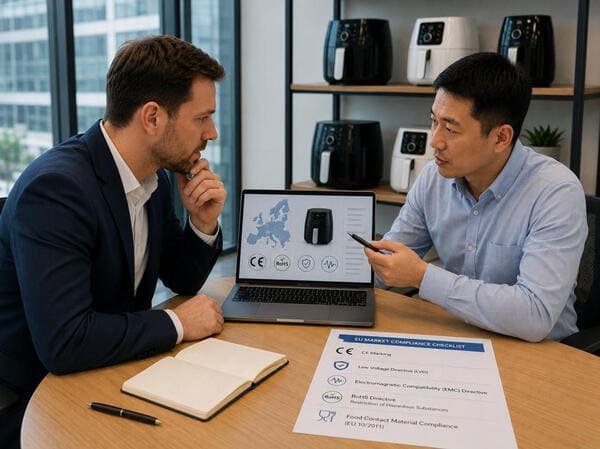
Selling in the European Union requires meticulous attention to regulatory details. The CE mark is mandatory1, but it is not a single test. It is a comprehensive framework. For an electrical heating appliance like an air fryer, the Low Voltage Directive (LVD) ensures electrical safety, preventing shock hazards. The EMC Directive guarantees that the appliance does not emit electromagnetic interference that could disrupt other devices in a European home.
Furthermore, the RoHS Directive restricts hazardous substances like lead and cadmium2 in the electronic components. You cannot overlook the physical parts of the fryer either. The frying basket, the baking rack, and the non-stick coating directly touch food at high temperatures. Therefore, these specific materials must pass EU food-contact safety tests to prove they do not leach harmful chemicals into the user’s meal.
In our production process, we maintain strict documentation for every component. We help buyers evaluate these requirements early. Providing clear test reports and a valid Declaration of Conformity ensures that your shipments clear European customs without unnecessary delays or expensive storage fees.
What Air Fryer Certifications Are Required for Importing Air Fryers Into the US?
Are you planning to sell on Amazon or major US retail shelves? Without the right safety marks, platforms will refuse to list your product entirely.
Importing air fryers into the US requires electrical safety certifications like UL or ETL. If the model has digital controls, FCC compliance is necessary. The FDA regulates food-contact materials, and you must also consider CPSC product safety responsibilities.
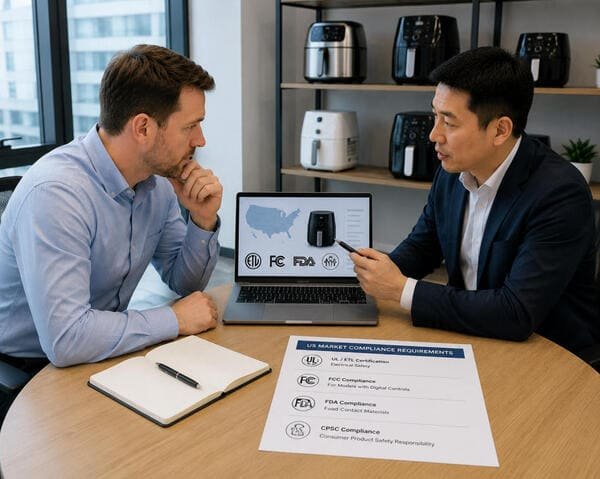
The United States market prioritizes consumer safety and strict liability. Unlike the EU’s CE marking system, the US relies heavily on Nationally Recognized Testing Laboratories3 for electrical safety. You should look for models that carry a UL or an ETL listing. These marks prove that the heating elements, wiring, and thermal fuses have been rigorously tested against fire and electrical shock risks. Because air fryers use high heat, minimizing fire hazards is critical to meet Consumer Product Safety Commission expectations.
If you select a digital air fryer with touch panels, Wi-Fi connectivity, or complex circuit boards, it emits radio frequency energy. In this case, FCC compliance becomes a mandatory legal requirement4. Additionally, any part of the air fryer that touches food—such as the non-stick coating, the metal basket, and internal plastic trays—must comply with FDA food-contact standards.
We strongly suggest checking these details before paying any deposits. Our engineering communication ensures we match the correct testing protocols to your chosen model, helping you avoid listing suspensions on platforms like Amazon or Walmart.
Which Air Fryer Food-Contact Material Tests Should Importers Verify?
Do you know what chemicals might leach into food when your fryer heats up? Toxic materials lead to severe health claims and permanent brand damage.
Importers must verify food-contact material tests for the basket, tray, and non-stick coating. You need FDA test reports for the US, LFGB testing for Germany, or general EU food-grade compliance. The test must match the exact coating material used.

Electrical safety gets most of the attention, but chemical safety is equally vital. An air fryer operates by circulating very hot air around food, meaning the internal basket and its coating endure extreme thermal stress. If the factory uses cheap, unverified non-stick coatings, toxic compounds can migrate into the food5.
Depending on where you sell, the required food-contact material tests differ. The US requires FDA compliance, focusing on specific extraction limits. In Europe, the general EU framework applies, but countries like Germany require the much stricter LFGB standard. LFGB tests check for a wider range of heavy metals and chemical migrations6.
During our packaging discussion and component selection phase, we clearly identify which coatings are used. It is crucial that the test report provided to you matches the exact material on your final product. A generic report for a different model is useless and leaves you legally exposed. A responsible supply chain ensures that the materials inside the mass-produced goods remain identical to the materials that passed the laboratory tests.
How Can Importers Check Whether Air Fryer CE, RoHS, UL, ETL, or FCC Certificates Are Valid?
Did your supplier send you a PDF certificate that looks a bit strange? Fake or expired documents are a fast track to seized inventory.
To check certificate validity, compare the company name, product model, and voltage on the document with your actual order. Verify the certificate number directly through the issuing laboratory’s official online database. Ensure the standard tested is current and applicable.

A piece of paper with a CE or ETL logo is not enough proof. Buyers must actively verify the authenticity of every compliance document. The first step is simple reading. Check the applicant company name on the test report. Does it match the factory you are paying? If it does not, you need a clear, documented explanation of the relationship.
Next, look at the exact model number, voltage, and power rating. If you customize the plug, change the heating element, or alter the control board for your private label, the old certificate may no longer cover your specific version.
The most reliable verification method is to contact the issuing testing laboratory, such as SGS, TUV, or Intertek. Most of these organizations maintain public online databases where you can input the certificate number7. If the number does not exist, or if the report shows a different product, you have uncovered a major risk. Additionally, for buyers outside the US and EU, checking for a Chinese CCC certification8 is a smart move. The 3C mark is a mandatory domestic quality standard in China, and it serves as an excellent baseline indicator that the factory understands structured quality control.
What Import Documents Should Buyers Request From an Air Fryer Supplier Before Shipment?
Are your goods ready to ship, but you lack the right paperwork? Missing documents will trap your products at the port, incurring daily storage fees.
Before shipment, buyers should request the Commercial Invoice, Packing List, Bill of Lading, and a valid Declaration of Conformity. You must also secure complete laboratory test reports, food-contact material certificates, and accurate product labels matching the target market rules.
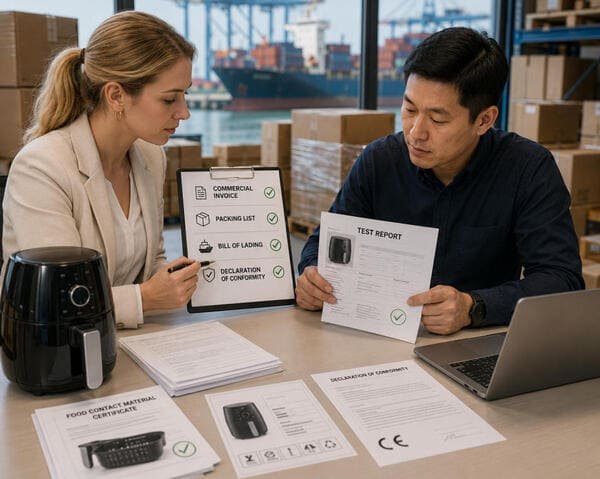
Customs clearance requires an organized set of documents that prove what your goods are, what they are worth, and that they are safe to enter the country. Standard shipping documents include the Commercial Invoice, the Packing List, and the Bill of Lading. However, for regulated electrical appliances like air fryers, standard shipping files are just the beginning.
You must ask your factory for a formal Declaration of Conformity9 if importing to the EU or UK. This document is a legal statement from the manufacturer or importer that the goods meet all relevant safety directives. Alongside the DoC, you need the actual laboratory test reports for electrical safety, EMC, RoHS, and food-contact materials10.
Do not wait until the goods arrive at the destination port to ask for these files. Our sample review and pre-production meetings always cover documentation needs. Collecting and verifying these files before you pay the final balance ensures you have leverage to fix any issues. Proper paperwork is the key to a smooth, predictable supply chain.
Which Certification Red Flags Can Delay Air Fryer Customs Clearance or Marketplace Approval?
Have you ever had a shipment blocked because of a minor label error? Ignoring certification warning signs can ruin your entire sales season.
Red flags include mismatched model numbers on test reports, expired certificates, and missing safety warnings on the physical product labels. Additionally, if a supplier hesitates to share full test reports or provides documents from unknown labs, delays are likely.
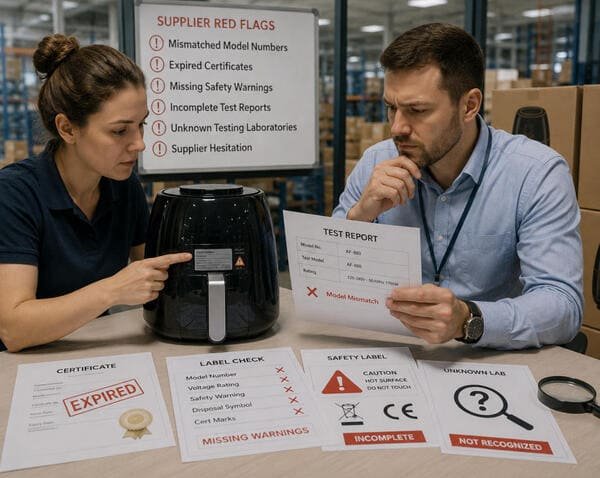
Certification is essentially a risk-control system. When this system breaks down, your business pays the price. One of the biggest red flags is an incomplete product label. Customs agents and marketplace reviewers will check the physical rating label on the appliance.11 If it lacks the correct voltage, wattage, manufacturer details, or mandatory safety icons like the crossed-out wheelie bin for RoHS, your product can be rejected immediately.
Another major warning sign is a supplier who only provides the first page of a test report. A real, valid test report for an air fryer is often fifty to over a hundred pages long, detailing internal photos, wiring diagrams, and thermal test results. If the factory refuses to share the full document, they might be hiding failed tests or unauthorized component substitutions.
Furthermore, beware of certificates that do not match your customized order. If you upgrade a 1500W model to 1700W, the old safety certificate is invalid. We help clients navigate these technical boundaries so that every shipment arrives legally compliant and ready for retail shelves.
FAQ About Air Fryer Certification
Do I need a new air fryer certification if I only change the product color?
Generally, changing the external plastic housing color does not require a completely new electrical safety certification. However, if the new color dye affects the plastic’s flammability rating or if you change the internal non-stick coating color, you might need updated material safety tests to remain compliant.
Can an OEM air fryer manufacturer use one CE certificate for multiple different models?
No, a CE certificate is specific to the product’s internal design, heating element, and control system. If the models share the exact same internal components and only differ in minor cosmetic ways, they might be grouped in one report. Otherwise, each distinct model needs its own testing.
How long does it take to get ETL certification for a new private label air fryer?
If we are modifying an existing model or building a new internal structure, obtaining a new ETL certification usually takes around 6 to 8 weeks. This timeline depends on the testing laboratory’s schedule and whether any design adjustments are required after the initial thermal and safety evaluations.
Why does Amazon ask for an ISO 17025 lab report for my air fryer?
Amazon requires test reports from ISO 17025 accredited laboratories because this standard proves the lab is technically competent and independent. We can help arrange testing through recognized testing labs to ensure your compliance documents are accepted by major e-commerce platforms.
Is the Chinese CCC certification useful if I import air fryers to Europe or the US?
While CCC is legally required only for the Chinese domestic market, it is a very strong indicator of quality. A factory that maintains CCC certification undergoes strict annual audits and follows standardized quality control, which provides an excellent safety baseline for international buyers.
Who pays for the food-contact material testing for a custom air fryer?
If you are purchasing a standard model, we usually provide the existing food-contact reports. If you request a custom non-stick coating or unique basket material for your private label, the buyer typically covers the cost of the new specific laboratory testing required for their target market.
Conclusion
Proper air fryer certification is a vital risk-control tool, not just customs paperwork. Verifying exact models, valid tests, and market rules ensures safe products and a profitable supply chain.
-
"Certification mark – Wikipedia", https://en.wikipedia.org/wiki/Certification_mark. The source explains the CE mark as a regulatory framework required for products sold in the European Union, detailing its role in ensuring compliance with safety, health, and environmental protection standards. Evidence role: definition; source type: encyclopedia. Supports: The CE mark is mandatory for products sold in the European Union and represents compliance with specific regulatory frameworks.. ↩
-
"RoHS Directive – Department of Toxic Substances Control", https://dtsc.ca.gov/universalwaste/rohs-directive/. The source outlines the RoHS Directive’s role in limiting hazardous substances in electronic products, including lead and cadmium, to ensure environmental and consumer safety. Evidence role: mechanism; source type: government. Supports: The RoHS Directive restricts hazardous substances like lead and cadmium in electronic components to ensure safety and environmental compliance.. ↩
-
"Current List of NRTLs | Occupational Safety and Health Administration", http://www.osha.gov/nationally-recognized-testing-laboratory-program/current-list-of-nrtls. Nationally Recognized Testing Laboratories (NRTLs) are certified by OSHA to test and certify products for safety standards, including electrical safety. Evidence role: definition; source type: government. Supports: The United States relies heavily on Nationally Recognized Testing Laboratories for electrical safety.. ↩
-
"Equipment Authorization | Federal Communications Commission", https://www.fcc.gov/engineering-technology/laboratory-division/general/equipment-authorization. FCC compliance is required for devices emitting radio frequency energy to ensure they meet electromagnetic interference standards. Evidence role: mechanism; source type: government. Supports: FCC compliance becomes a mandatory legal requirement for air fryers with Wi-Fi connectivity or complex circuit boards.. Scope note: The source may focus on general FCC compliance rather than specific requirements for air fryers. ↩
-
"Investigation into the migration potential of coating materials from …", https://pubmed.ncbi.nlm.nih.gov/17364936/. This source explains how certain non-stick coatings can release toxic compounds under high temperatures, supporting the claim about chemical migration risks. Evidence role: mechanism; source type: research. Supports: If the factory uses cheap, unverified non-stick coatings, toxic compounds can migrate into the food.. Scope note: The support may focus on specific types of coatings rather than all non-stick materials. ↩
-
"Assessment of heavy metals migrated from food contact plastic …", https://pmc.ncbi.nlm.nih.gov/articles/PMC10558900/. This source outlines the scope of LFGB testing, confirming its focus on heavy metals and chemical migrations in food-contact materials. Evidence role: definition; source type: government. Supports: LFGB tests check for a wider range of heavy metals and chemical migrations.. Scope note: The source may not directly compare LFGB to other standards like FDA compliance. ↩
-
"Public Inspection: Nationally Recognized Testing Laboratories …", https://www.federalregister.gov/public-inspection/2026-10273/nationally-recognized-testing-laboratories-intertek-testing-services-na-inc-application-for. The source provides information on how testing laboratories maintain public online databases for certificate verification. Evidence role: mechanism; source type: institution. Supports: Testing laboratories like SGS, TUV, or Intertek maintain public online databases for certificate verification.. Scope note: The support may not cover all testing laboratories globally, as practices can vary. ↩
-
"China Standards for Trade – International Trade Administration", https://www.trade.gov/china-standards-trade. The source explains the significance of the CCC certification as a mandatory domestic quality standard in China and its role in quality control. Evidence role: definition; source type: government. Supports: Checking for a Chinese CCC certification is a smart move for buyers outside the US and EU, as it indicates structured quality control.. ↩
-
"Preparing technical documentation – Your Europe – European Union", https://europa.eu/youreurope/business/product-requirements/compliance/preparing-technical-documentation/index_en.htm. The source confirms that a Declaration of Conformity is a legal requirement for importing regulated goods into the EU or UK, specifying its role in compliance with safety directives. Evidence role: definition; source type: government. Supports: A Declaration of Conformity is a legal statement required for importing regulated goods into the EU or UK.. ↩
-
"[PDF] Setting up an electrical testing laboratory in a developing country – IEC", https://iec.ch/system/files/2019-09/content/media/files/setting_up_an_electrical_testing_laboratory.pdf. The source outlines the necessity of laboratory test reports for compliance with electrical safety, EMC, RoHS, and food-contact material standards, particularly for regulated goods. Evidence role: mechanism; source type: institution. Supports: Laboratory test reports for electrical safety, EMC, RoHS, and food-contact materials are required for regulated goods.. Scope note: The source may not specify the exact testing protocols or standards for each category. ↩
-
"Marking of Country of Origin on U.S. Imports", https://www.cbp.gov/trade/rulings/informed-compliance-publications/marking-country-origin-us-imports. This source explains the role of customs agents and marketplace reviewers in verifying product compliance through physical rating labels. Evidence role: mechanism; source type: government. Supports: Customs agents and marketplace reviewers check physical rating labels for compliance.. ↩