Air fryer manufacturers and suppliers in China operate within a mature export-driven supply chain that supports OEM and ODM production for global brands, importers, and retailers. Production hubs such as Guangdong and Zhejiang integrate tooling, assembly, certification, and packaging to serve North American and European market requirements at scalable volumes.
Supply chain fragmentation can lead to mismatched certifications, inconsistent samples, or unclear MOQ structures if supplier capability is not properly verified before order confirmation.
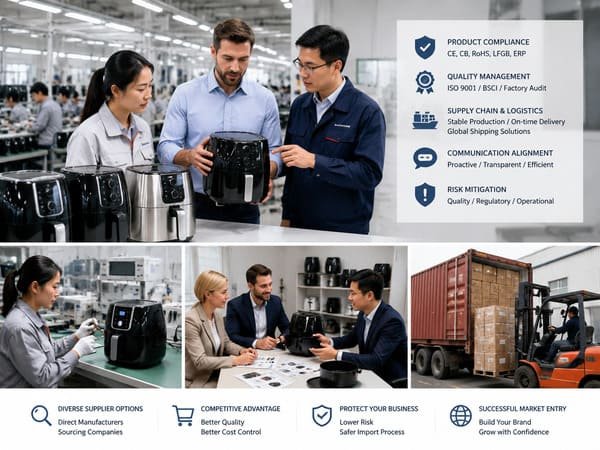
China’s air fryer industry is built on regional specialization and export-oriented manufacturing clusters. This article helps evaluate OEM/ODM capability, MOQ logic, compliance standards, quality control systems, sample validation, and total landed cost structure for importing air fryers into the US market.
OEM & ODM Capabilities, Custom Design and Private Label
OEM and ODM air fryer suppliers in China typically support private label branding, structural customization, and functional upgrades such as digital control panels and smart connectivity. Capability level depends on factory tooling ownership, engineering support, and experience with export compliance for target markets like the US and EU.
Misjudging OEM capability may result in unstable product design, delayed tooling, or certification mismatch between sample and mass production units.
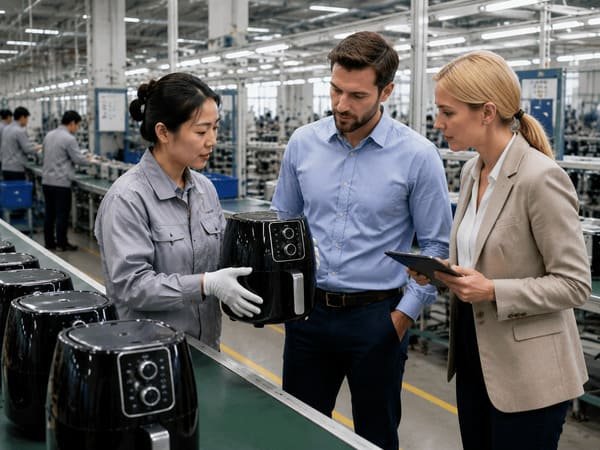
OEM and ODM capability is a major sourcing decision point. In China, OEM refers to branding and minor modifications on existing models1, while ODM includes structural design, airflow system changes, basket design, or PCB control board customization.
Practical evaluation points:
- Engineering capability: in-house R&D vs outsourced design
- Mold ownership: existing molds reduce cost and lead time
- Control system: mechanical vs digital vs smart Wi-Fi integration
- Packaging design: export carton strength and retail-ready boxes
- Certification alignment: UL/ETL scope matching final SKU
Risk considerations:
- ODM projects increase MOQ and tooling cost
- Sample may differ from mass production if subcontracted
- Smart features (Wi-Fi/app control) require FCC and software validation
China’s OEM clusters such as Guangdong Zhongshan and Foshan specialize in volume production2, while Zhejiang suppliers often act as trading-integrated manufacturers managing multiple factories. Buyer communication via WhatsApp or WeChat often improves response speed and reduces specification misunderstanding during early RFQ stages, improving trust and iteration efficiency.
MOQs, Lead Times, Production Capacity and FOB Pricing
MOQ and pricing structures for air fryer OEM orders depend on customization level, packaging complexity, certification requirements, and production scheduling. Standard models usually require lower MOQ, while private label or ODM development increases batch requirements due to tooling and material setup costs.
Incorrect MOQ assumptions can lead to hidden tooling fees, delayed production scheduling, or inflated unit cost at low volumes.
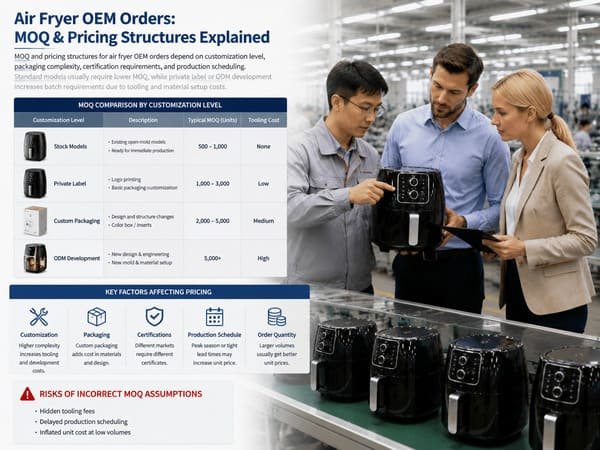
MOQ is not a fixed number in Chinese manufacturing3; it reflects production economics. A standard catalog model with logo printing may require a relatively low MOQ, while full ODM design requires higher volume due to mold amortization and assembly line adjustment.
Key cost drivers:
- Mold and tooling amortization
- Color customization and plastic injection setup
- Packaging design and print runs
- Certification testing per SKU
- Component sourcing (heater, PCB, motor)
Lead time structure:
- Sample confirmation stage
- Packaging approval stage
- Material procurement
- Mass production scheduling
- Pre-shipment inspection window
FOB pricing considerations:
FOB pricing typically includes factory cost and loading to port, but does not include freight, insurance, or destination handling. Buyers should evaluate:
| Factor | Lower-Risk Supplier | Higher-Risk Supplier |
|---|---|---|
| MOQ clarity | Transparent per model | Flexible but unclear |
| Pricing breakdown | Itemized cost structure | Single lump sum |
| Lead time | Based on schedule | Vague estimates |
| Sample accuracy | Matches production | Prototype-only sample |
Production hubs in Guangdong and Ningbo often integrate multiple supply chain layers4, which supports flexible MOQ negotiation but requires careful verification of actual manufacturing ownership.
Quality Control, Certifications, and Compliance (UL/ETL, Energy Ratings)
Quality control and certification compliance for air fryers depend on target market requirements and product configuration. US-bound products often require UL or ETL safety alignment, FCC for electronic components, and energy efficiency considerations depending on retail channel requirements.
Certification mismatch or incomplete testing can result in customs delays, retail rejection, or product recalls.
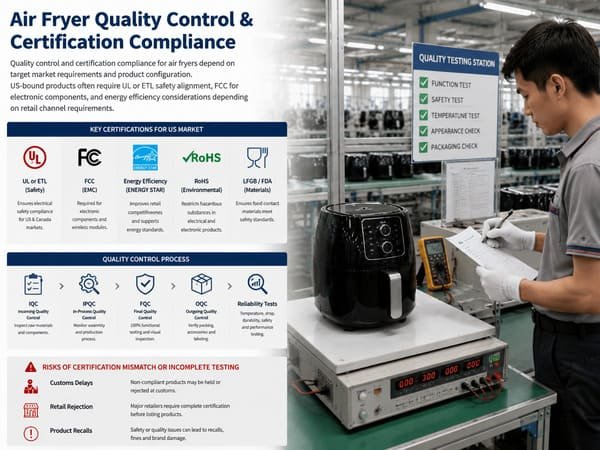
Quality control in air fryer manufacturing is multi-stage and includes incoming material inspection, in-line production checks, and final pre-shipment inspection. Each stage reduces defect risk before export.
QC structure:
- Incoming components (heating element, PCB, plastics)
- Assembly line function testing
- Heating and temperature uniformity testing
- Coating durability and odor checks
- Final packaging inspection
Certification considerations:
- UL/ETL: electrical safety compliance for US retail
- FCC: required for Wi-Fi or smart control models
- Energy standards: depends on retail or government programs
- Model matching: certificate must match SKU exactly
Risk points:
- Generic certificates not linked to product model
- Sample passed but mass production drift
- Packaging weakness causing shipping damage
- Missing third-party inspection before shipment
Buyers often reduce risk by requiring pre-shipment inspection and carton drop testing.5 In mature OEM regions like Foshan and Zhongshan, QC systems are more standardized due to export volume experience, while trading-integrated suppliers may require stricter buyer-side inspection control.
Samples, Warranty, After-Sales, and Spare Parts Support
Sample evaluation and after-sales structure define long-term supplier reliability in air fryer sourcing. Samples must reflect mass production materials, heating performance, and packaging standards to ensure production consistency and retail readiness.
Sample mismatch or unclear warranty terms can lead to cost disputes and replacement delays after shipment arrival.
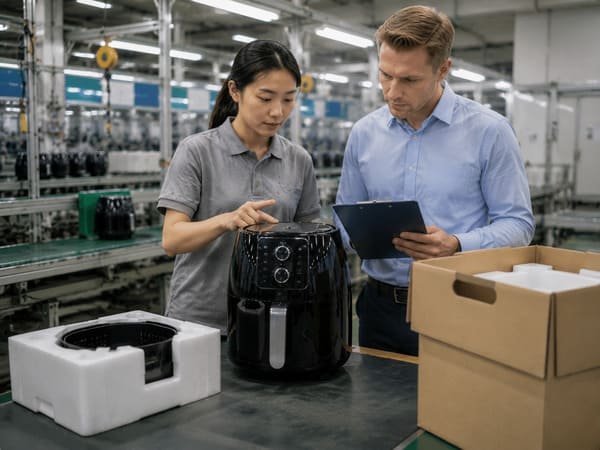
Sample verification is not limited to appearance; functional and compliance alignment must be confirmed before production approval. Buyers often underestimate the difference between prototype samples and mass production units.6
Sample evaluation checklist:
- Heating speed and temperature stability
- Basket coating durability
- Noise level and airflow efficiency
- Control panel responsiveness
- Packaging strength simulation
- Plug and voltage compatibility
Warranty structure considerations:
- Spare part availability (basket, PCB, heating element)
- Replacement policy for defective units
- Warranty period clarity for export shipments
- Repair vs replacement cost allocation
After-sales risk factors:
- Lack of spare part stock planning
- No clear return handling process
- Slow communication channels
- Unclear responsibility for shipping damage
Factories with established export experience often maintain spare parts inventories for fast replacement support.7 However, smaller OEM workshops may rely on component suppliers, which can extend resolution time. Clear agreement on after-sales structure reduces downstream operational friction for importers and distributors.
Shipping, Incoterms, Payment, and Import Considerations for US Buyers
Shipping terms, payment structure, and import compliance define total landed cost and delivery reliability for air fryer imports from China to the US. FOB, CIF, and DDP terms distribute responsibility differently across supplier, freight forwarder, and buyer.
Incorrect Incoterms selection can lead to unexpected customs fees, delays, or uninsured logistics risk.
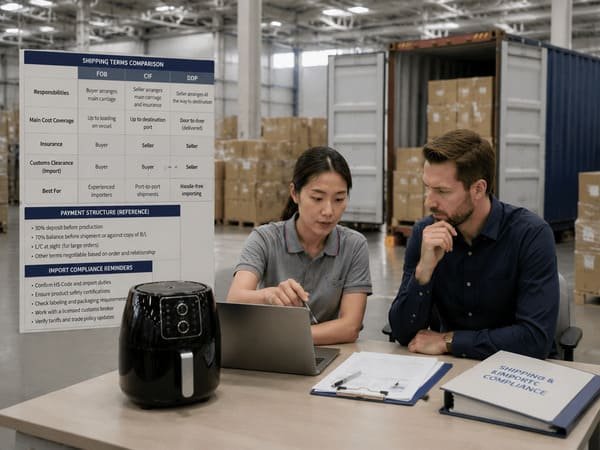
International air fryer sourcing requires coordination between production completion and logistics scheduling. FOB terms are commonly used for US importers to maintain control over freight and customs handling.8
Incoterms overview:
- FOB: factory delivers to port, buyer controls shipping
- CIF: supplier includes freight and insurance to destination port
- DDP: supplier handles full delivery including duties (higher risk of hidden cost)
Payment structure:
- 30% deposit + 70% balance before shipment is common
- Letter of Credit used for larger buyers
- Sample payment often separate from bulk order
Import considerations:
- US customs classification for small appliances
- Voltage compatibility (110V requirement)
- Plug type (US standard NEMA)
- Packaging compliance for retail distribution
Risk considerations:
- Underestimated freight during peak season
- Incorrect HS code classification
- Lack of inspection before balance payment
- Hidden cost in DDP agreements
Many experienced buyers coordinate directly with suppliers through WhatsApp or WeChat to speed up document approval, inspection scheduling, and shipping coordination.9 This communication method improves transparency and reduces delays in cross-border procurement workflows.
FAQ About Air Fryer Manufacturer
Are GE Appliances owned by a Chinese company?
Ownership structures in large appliance brands may include global investment groups and cross-border manufacturing networks, but brand headquarters, product design, and distribution often remain separate from manufacturing locations. Verification should focus on corporate filings and official brand disclosures rather than assumptions based on production origin.
Misunderstanding ownership can lead to incorrect sourcing comparisons. Buyers should separate brand ownership from OEM manufacturing networks when evaluating suppliers.
What is a typical MOQ for air fryer OEM orders from China?
MOQ for air fryer OEM orders from China usually depends on customization level, packaging requirements, and certification scope, ranging from standard catalog quantities to higher volumes for private label or ODM development involving molds, tooling, and production line setup adjustments.
Incorrect MOQ assumptions may increase unit cost or delay production scheduling. Buyers should confirm MOQ per model, not per supplier.
How long do production lead times usually take for customized air fryer orders?
Production lead times for customized air fryer orders typically depend on sample approval, packaging confirmation, material readiness, and order volume, with additional time required for tooling, certification alignment, and peak season scheduling within export-oriented manufacturing environments.
Delays often occur when packaging or samples are not finalized early. Clear approval stages reduce production bottlenecks.
Which certifications do US importers need for air fryers (UL, ETL, FCC, Energy Star)?
Certification requirements for US air fryer imports depend on product design, electrical configuration, and smart features, with safety standards such as UL or ETL commonly required, FCC applicable for wireless functions, and energy-related certifications depending on retail or program requirements.
Missing or mismatched certification can cause customs rejection. Model-specific certificate validation is essential before mass production.
Can Chinese manufacturers provide private label packaging and smart feature integration (Wi-Fi, app control)?
Many Chinese air fryer manufacturers support private label packaging, logo printing, and smart feature integration such as Wi-Fi and app control, depending on PCB capability, software support, and certification readiness for electronic communication functions in target export markets.
Smart features increase compliance complexity. FCC testing and software stability checks are required before export approval.
How do FOB pricing and common incoterms affect total landed cost when importing air fryers to the US?
FOB pricing includes factory delivery to port but excludes freight, insurance, and import duties, while CIF includes shipping to destination port and DDP includes full delivery, each affecting total landed cost calculation and risk distribution between supplier and buyer.
Incorrect Incoterm selection may lead to hidden logistics costs. Buyers should compare full landed cost, not unit price only.
Conclusion
Reliable sourcing depends on verified certification, clear MOQ structure, consistent samples, and controlled logistics terms rather than lowest unit price.
Send Your Inquiry
Clear RFQ details improve quotation accuracy and reduce production risk for air fryer sourcing from China. Buyers may include target market, estimated order quantity, product type, required certifications, plug specification, packaging format, logo or private label requirements, delivery timeline, and inspection expectations.
Providing structured information helps suppliers recommend suitable OEM or ODM solutions, estimate production schedules more accurately, and align certification and packaging requirements before quotation confirmation. AidKitchens supports structured communication for export-oriented kitchen appliance sourcing, improving clarity across sampling, production, and logistics coordination.
-
"OEM vs ODM in China: Develop the Ideal Product for your Brand", https://sino-import-solutions.com/oem-vs-odm/. This source explains the distinction between OEM and ODM in the context of manufacturing, particularly in China, and provides examples of the types of modifications involved. Evidence role: definition; source type: encyclopedia. Supports: In China, OEM refers to branding and minor modifications on existing models.. ↩
-
"Industry in China – Wikipedia", https://en.wikipedia.org/wiki/Industry_in_China. This source provides an overview of manufacturing clusters in China, highlighting Guangdong Zhongshan and Foshan as key regions for volume production. Evidence role: general_support; source type: research. Supports: China’s OEM clusters such as Guangdong Zhongshan and Foshan specialize in volume production.. Scope note: The source may not cover all industries or the latest trends in these regions. ↩
-
"MOQs from chinese factories are destroying my inventory optimization", https://www.reddit.com/r/AmazonFBA/comments/1rxx5bi/moqs_from_chinese_factories_are_destroying_my/. This source explains how MOQ in Chinese manufacturing is influenced by production economics, including factors like mold amortization and assembly line adjustments. Evidence role: mechanism; source type: education. Supports: MOQ is not a fixed number in Chinese manufacturing; it reflects production economics.. ↩
-
"MIT adds China to its SCALE Network", https://news.mit.edu/2016/mit-adds-ningbo-china-scale-network-0216. This source discusses the integration of supply chain layers in Guangdong and Ningbo, highlighting their role in flexible MOQ negotiation. Evidence role: general_support; source type: research. Supports: Production hubs in Guangdong and Ningbo often integrate multiple supply chain layers, which supports flexible MOQ negotiation but requires careful verification of actual manufacturing ownership.. Scope note: The source may not directly address all aspects of supply chain integration in these regions. ↩
-
"Preshipment Inspection | United States Trade Representative", https://ustr.gov/trade-agreements/wto-multilateral-affairs/wto-issues/customs-issues/preshipment-inspection. This source supports the claim that pre-shipment inspections and carton drop tests are common practices to mitigate risks in product quality and shipping damage. Evidence role: general_support; source type: education. Supports: Buyers often reduce risk by requiring pre-shipment inspection and carton drop testing.. ↩
-
"Prototype and Sample: What are the Differences in Manufacturing?", https://www.linkedin.com/pulse/prototype-sample-what-differences-manufacturing-yvette-nguyen-ssjec. This source explains the common discrepancies between prototype samples and mass production units, emphasizing the challenges buyers face in aligning expectations. Evidence role: expert_consensus; source type: education. Supports: Buyers often underestimate the difference between prototype samples and mass production units.. ↩
-
"Accessories, Spare Parts and Tools – export.gov", https://legacy.export.gov/article?id=Sector-Specific-Considerations-Accessories-Spare-Parts-and-Tools. This source discusses how factories with export experience manage spare parts inventories to ensure timely replacements, particularly in international trade contexts. Evidence role: mechanism; source type: research. Supports: Factories with established export experience often maintain spare parts inventories for fast replacement support.. Scope note: The support may vary depending on the specific industry or region. ↩
-
"[DOC] INCOTERMS 2000 Chart of Responsibility – Procurement", https://procurement.uark.edu/_resources/documents/Import_Purchases_and_Procedures.docx. This source explains the prevalence of FOB terms in international trade and their advantages for US importers, particularly in maintaining control over freight and customs processes. Evidence role: expert_consensus; source type: education. Supports: FOB terms are commonly used for US importers to maintain control over freight and customs handling.. ↩
-
"[PDF] Communications Policy – FAMU", https://www.famu.edu/about-famu/policies-and-regulations/bot/pdf-policies/BOTP-2008-01%20Communications%20Policy%204-15-26.pdf. This source discusses the use of instant messaging platforms like WhatsApp and WeChat in international procurement, highlighting their role in improving communication and reducing delays. Evidence role: general_support; source type: research. Supports: Many experienced buyers coordinate directly with suppliers through WhatsApp or WeChat to speed up document approval, inspection scheduling, and shipping coordination.. Scope note: The source may not specifically focus on air fryer sourcing but provides general insights into procurement practices. ↩