Importers should evaluate air fryer brand authorization and private label agreements before ordering by confirming what rights they actually receive, who owns the brand assets, where products can be sold, and what responsibilities are defined in the agreement. A supplier allowing you to sell a product does not always mean you control the brand, sales rights, or product assets.
Problem: Many first-time importers believe that getting permission from a supplier means they are fully protected. However, unclear authorization scope, ownership rights, and agreement terms can create problems after products enter the market.
Agitation: A buyer may invest in marketing, inventory, and customer development, only to discover that the authorization does not cover their sales channel, the supplier cannot legally grant the rights, or important assets such as packaging and design are not clearly owned.
Solution: Before signing any agreement, importers should evaluate brand authorization and private label terms step by step, checking rights, documents, ownership, and responsibilities.
Snippet: Before selling air fryers under a brand or private label model, importers should verify authorization rights, sales scope, asset ownership, and agreement terms to reduce future business risks.
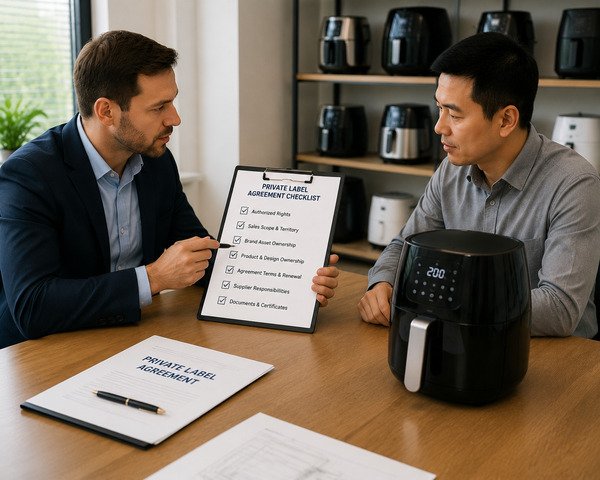
Should I Sell An Existing Air Fryer Brand Or Create My Own Private Label Brand?
Importers should first decide whether they want to sell an existing air fryer brand or create their own private label brand because these two models involve different ownership rights, agreements, risks, and long-term business value.
Selling an existing brand usually requires permission from the brand owner or authorized party, while private label focuses on creating and controlling your own brand identity.
Step 1: Compare Brand Authorization And Private Label Options
Why do this?
Many new importers confuse brand authorization with private label.
They may think:
“I have permission to sell this product, so I own the brand opportunity.”
However, sales permission and brand ownership are different rights.
Understanding the difference helps importers choose the correct agreement before investing money.
Prepare tools:
- Business plan;
- Target market information;
- Sales strategy.
How to do it:
Compare the two options based on:
- Brand ownership;
- Sales control;
- Marketing control;
- Long-term business value.
Example table:
| Decision Factor | Brand Authorization | Private Label |
|---|---|---|
| Brand ownership | Existing brand owner | Importer’s brand |
| Permission needed | Required | Depends on ownership structure |
| Marketing control | Limited by agreement | Higher control |
| Long-term asset | Lower | Higher |
How to judge the result:
Choose based on your business goal.
Brand authorization may fit businesses that want to sell existing products.
Private label may fit businesses that want to build their own brand asset.
How Do I Check Whether An Air Fryer Brand Authorization Covers My Sales Plan?
Importers should check whether the authorization scope matches their actual sales plan because having a brand authorization does not automatically mean they can sell in every country, channel, or market.
A valid authorization should clearly define where, how, and for which products the importer can sell.
Step 2: Review The Authorization Scope Before Signing
Why do this?
Many authorization documents look formal but may have limited scope.
For example:
A buyer plans to sell air fryers on Amazon US, but the authorization only allows sales in another region.
This creates unnecessary risk.
Prepare tools:
- Brand Authorization Letter;
- Sales channel plan;
- Target market information.
How to do it:
Review:
- Authorized countries or regions;
- Approved product models;
- Sales channels;
- Authorization duration;
- Online selling permissions.
Example table:
| Authorization Item | Confirmed |
|---|---|
| Country / Region | ☐ |
| Product models | ☐ |
| Amazon sales rights | ☐ |
| Retail sales rights | ☐ |
| Validity period | ☐ |
How to judge the result:
Good:
The authorization matches your planned market and sales channels.
Need confirmation:
The document does not clearly mention your selling method.
High risk:
The authorization scope is different from your business plan.
How Do I Verify If An Air Fryer Supplier Really Has Brand Authorization Rights?
Importers should verify the source of brand authorization before relying on any document because a supplier may manufacture a product without having the legal right to authorize the brand.
A valid authorization should come from the brand owner or a party that has clearly received authorization rights.
Step 3: Verify The Source Of Brand Authorization
Why do this?
Many first-time importers focus only on whether a supplier provides an authorization letter.
However, the key question is:
“Does this company actually have the right to grant me these sales rights?”
A document alone does not remove the risk if the authorization source is unclear.
Prepare tools:
- Brand Authorization Letter;
- Trademark information;
- Supplier company information;
- Company registration details.
How to do it:
Check:
- Who owns the brand trademark;
- Who issued the authorization;
- Whether the authorized company matches the supplier information;
- Whether the authorization covers your intended products and market.
Example table:
| Check Item | Question |
|---|---|
| Brand owner | Who owns the trademark? |
| Authorization issuer | Who signed the document? |
| Supplier relationship | Is the supplier authorized? |
| Territory | Where is the authorization valid? |
| Validity | When does it expire? |
How to judge the result:
Low risk:
- Brand owner information is clear;
- Authorization source is identifiable;
- Scope matches your business.
Need confirmation:
- Supplier provides documents but ownership relationship is unclear.
High risk:
- Supplier cannot explain who owns or controls the brand rights.
What Should Be Included In An Air Fryer Private Label Agreement?
Importers should make sure a private label agreement clearly defines product responsibilities, brand rights, asset ownership, and commercial terms because paying for production does not automatically mean owning every related asset.
A private label relationship should protect the importer’s ability to build and control their own market presence.
Step 4: Review The Key Terms In A Private Label Agreement
Why do this?
Many new importers focus mainly on:
- Product price;
- MOQ;
- Production time.
However, private label success depends on whether important rights are clearly defined.
Prepare tools:
- Private Label Agreement;
- Product specification documents;
- Design documents.
How to do it:
Review whether the agreement defines:
- Product specifications;
- Brand usage rights;
- Packaging responsibilities;
- Confidentiality;
- Design ownership;
- Market responsibilities.
Example table:
| Agreement Item | Confirmed |
|---|---|
| Product specification | ☐ |
| Brand usage rights | ☐ |
| Packaging responsibility | ☐ |
| Confidentiality terms | ☐ |
| Design ownership | ☐ |
| Market rights | ☐ |
How to judge the result:
Good:
The agreement clearly explains who owns what and who is responsible.
Need confirmation:
Important rights are discussed but not written.
High risk:
Key ownership and responsibility terms depend only on verbal promises.
How Do I Confirm Ownership Of My Private Label Air Fryer Brand Assets?
Importers should confirm ownership of private label assets because a product, logo, packaging design, and marketing materials may have different ownership conditions.
Having your logo printed on an air fryer does not automatically mean you control all related assets.
Step 5: Create A Private Label Asset Ownership Checklist
Why do this?
A common mistake for new importers is assuming:
“I paid for production, so everything belongs to my company.”
In reality, ownership should be clearly defined.
Prepare tools:
- Private label agreement;
- Design files;
- Artwork files;
- Product documents.
How to do it:
Review ownership of:
- Trademark;
- Logo;
- Packaging artwork;
- Product images;
- Product design;
- Molds or tooling if applicable.
Example table:
| Asset | Owner | Confirmed |
|---|---|---|
| Trademark | ☐ | |
| Logo | ☐ | |
| Packaging design | ☐ | |
| Product artwork | ☐ | |
| Product photos | ☐ | |
| Mold / tooling | ☐ |
How to judge the result:
Low risk:
Ownership is clearly written in the agreement.
Need confirmation:
Ownership is assumed but not documented.
High risk:
Supplier retains unclear control over important brand assets.
What Sales Rights Should Be Defined Before Selling Air Fryers Online Or Offline?
Importers should confirm sales channel rights because permission to sell a product does not always mean permission to sell through every platform or distribution channel.
Different markets may have different requirements for brand usage and authorization.
Step 6: Confirm Sales Channel Rights
Why do this?
A buyer may receive permission to sell products but later discover that certain channels are not covered.
Examples:
- Online marketplaces;
- Retail stores;
- Distributors;
- Wholesale channels.
Prepare tools:
- Authorization agreement;
- Sales channel plan.
How to do it:
Check whether the agreement covers:
- Amazon or other marketplaces;
- Your own website;
- Retail stores;
- Wholesale distribution.
Example table:
| Sales Channel | Allowed? | Confirmed |
|---|---|---|
| Amazon | ☐ | |
| Website | ☐ | |
| Retail stores | ☐ | |
| Wholesale | ☐ |
How to judge the result:
Good:
Your actual sales channels are clearly included.
Need confirmation:
The agreement only says “sales rights” without details.
High risk:
Your planned channels are outside the authorization scope.
What Hidden Risks Do First-Time Importers Miss In Brand Authorization And Private Label Agreements?
First-time importers often focus on whether they can sell air fryers, but they may overlook important risks related to brand ownership, authorization scope, asset control, and future business restrictions.
Before signing an agreement, importers should identify risks that may not be obvious from a supplier’s initial explanation.
Step 7: Review Hidden Agreement Risks Before Signing
Why do this?
Many agreement problems do not appear during the first transaction.
They appear later when:
- Sales increase;
- New markets are developed;
- Brand value grows;
- Disagreements happen.
Identifying these risks before signing helps importers protect long-term business interests.
Prepare tools:
- Agreement draft;
- Authorization documents;
- Risk checklist.
How to do it:
Review these questions:
- Who owns the brand trademark?
- Who can authorize sales rights?
- Which countries are included?
- Which sales channels are allowed?
- Who owns product designs and packaging?
- Is exclusivity clearly defined?
Example table:
| Risk Area | Question To Confirm |
|---|---|
| Brand rights | Who owns the trademark? |
| Authorization | Who has the right to authorize sales? |
| Territory | Where can products be sold? |
| Exclusivity | Is any market protection included? |
| Design ownership | Who owns artwork and designs? |
How to judge the result:
Low risk:
- Important rights are clearly written;
- Responsibilities are defined.
Need confirmation:
- The supplier provides general promises but details are missing.
High risk:
- Key rights depend only on verbal communication.
How Should I Compare Different Air Fryer Brand Authorization And Private Label Agreements?
Importers should compare agreements using consistent criteria because the lowest price or simplest agreement does not always provide the best long-term protection.
A clearer agreement usually helps reduce uncertainty about brand rights, ownership, and responsibilities.
Step 8: Complete An Agreement Comparison Table
Why do this?
Different suppliers may provide different agreement formats.
Without a comparison system, buyers may focus only on price and overlook important differences.
Prepare tools:
- Agreement copies;
- Authorization documents;
- Comparison spreadsheet.
How to do it:
Compare:
- Brand rights;
- Authorization scope;
- Territory;
- Sales channels;
- Asset ownership;
- Exclusivity;
- Termination terms.
Example table:
| Criteria | Supplier A | Supplier B |
|---|---|---|
| Brand rights | ||
| Authorization scope | ||
| Territory | ||
| Sales channels | ||
| Asset ownership | ||
| Exclusivity | ||
| Termination terms |
How to judge the result:
Choose the agreement with clearer rights and responsibilities.
Do not judge only by:
- Lower production price;
- Longer authorization period;
- More attractive promises.
Real Example: How Should An Importer Compare Two Private Label Agreements?
Importers should compare private label agreements by looking at ownership and control, not only production costs.
Example situation:
Two suppliers offer similar air fryer products.
Supplier A
Advantages:
- Lower production price;
- Faster response.
Agreement details:
- Logo ownership unclear;
- Packaging ownership unclear;
- No clear design rights;
- No exclusivity terms.
Supplier B
Advantages:
- Slightly higher production cost.
Agreement details:
- Brand ownership defined;
- Packaging rights defined;
- Design ownership confirmed;
- Responsibilities clearly written.
Agreement Comparison
| Evaluation Item | Supplier A | Supplier B |
|---|---|---|
| Production price | Lower | Higher |
| Brand ownership | Unclear | Defined |
| Packaging rights | Unclear | Defined |
| Design ownership | Unclear | Confirmed |
| Long-term control | Lower | Higher |
How to judge the result:
The lower-cost agreement is not always the safer option.
For private label businesses, controlling brand assets and commercial rights may be more important than the initial production cost.
What Should I Confirm Before Signing An Air Fryer Brand Or Private Label Agreement?
Importers should confirm all important brand rights, sales permissions, and ownership details in writing before signing an agreement because unclear terms can create future disputes.
A final checklist helps ensure that important points are not missed.
Step 9: Complete The Final Agreement Checklist
Why do this?
New importers often remember product details but forget commercial rights.
A checklist helps confirm the agreement covers the areas that affect future business control.
Prepare tools:
- Final agreement;
- Authorization documents;
- Internal review checklist.
How to do it:
Confirm:
| Item | Confirmed |
|---|---|
| Brand ownership | ☐ |
| Authorization scope | ☐ |
| Territory | ☐ |
| Sales channels | ☐ |
| Agreement duration | ☐ |
| Logo ownership | ☐ |
| Packaging ownership | ☐ |
| Product design ownership | ☐ |
| Mold / tooling ownership | ☐ |
| Exclusivity terms | ☐ |
| Termination conditions | ☐ |
How to judge the result:
Ready:
Important commercial rights are clearly documented.
Need confirmation:
Important terms are discussed but not included in the agreement.
High risk:
The relationship depends mainly on verbal promises.
FAQ
What Is The Difference Between Brand Authorization And Private Label For Air Fryers?
Brand authorization allows importers to sell products under an existing brand with permission from the brand owner or authorized party.
Private label allows importers to create and control their own brand identity by working with a manufacturer to produce products under their brand.
The key difference is ownership.
Brand authorization focuses on obtaining permission to sell.
Private label focuses on building and controlling a brand asset.
Can An Air Fryer Manufacturer Authorize A Brand If They Are Not The Brand Owner?
Not always.
A manufacturer may produce a product but may not own the trademark or have the right to authorize brand usage.
Importers should confirm:
- Who owns the brand;
- Who issued the authorization;
- Whether the authorization rights are transferred properly;
- Whether the sales scope matches their business plan.
What Documents Should I Check Before Signing An Air Fryer Brand Authorization Agreement?
Importers should review documents that confirm:
- Brand ownership;
- Authorization rights;
- Product scope;
- Sales territory;
- Sales channels;
- Agreement duration.
The goal is not only to collect documents, but to confirm whether the documents support the rights needed for the business.
Who Owns The Logo And Packaging In A Private Label Air Fryer Agreement?
Ownership depends on what is defined in the agreement.
Importers should not assume that paying for production automatically transfers ownership of:
- Logo;
- Packaging design;
- Artwork;
- Product images;
- Product designs;
- Molds or tooling.
These rights should be clearly written.
Do I Need Brand Authorization To Sell Private Label Air Fryers?
Usually, private label and brand authorization involve different ownership structures.
If an importer sells products under their own brand, the key concern is usually ownership and control of the brand assets.
If an importer sells another company’s brand, authorization rights become a key requirement.
The exact requirements depend on the business model, market, and applicable platform rules.
What Is The Biggest Mistake First-Time Importers Make?
Many first-time importers focus mainly on:
- Product price;
- Production cost;
- Minimum order quantity.
However, they may overlook:
- Who owns the brand;
- Who controls the sales rights;
- Who owns product assets;
- What happens if the business relationship changes.
Clear agreements help reduce these uncertainties.
Conclusion
Evaluating an air fryer brand authorization or private label agreement requires more than checking whether a supplier says you can sell the product.
Importers should confirm:
- Who owns the brand rights;
- Whether authorization is valid for their market;
- Which sales channels are allowed;
- Who owns private label assets;
- What responsibilities are defined in the agreement.
For brand authorization, the key question is:
“Do I have the correct permission to sell this brand in my market?”
For private label, the key question is:
“Do I control the brand assets and commercial rights I am building?”
A clear agreement helps importers understand what rights they actually receive before investing in inventory, marketing, and market development.
CTA
If you are reviewing an air fryer brand authorization or private label agreement and have questions about brand rights, sales permissions, or ownership terms, you can contact us through the inquiry form, WhatsApp, or WeChat.
We can help you review unclear points, understand potential risks, and discuss what should be confirmed before moving forward.