When I see a supplier show only certificates, I worry. A nice file can hide weak control, changed parts, and unstable output that later becomes claims, returns, and lost shelf space.
Buyers should ask for a full production evidence chain, not just certificates. The best proof is recent line photos and videos, batch records, traceability for key parts, process-control records, safety test logs, compliance files for food-contact parts, and change-control documents that prove the sample and mass goods are truly the same.
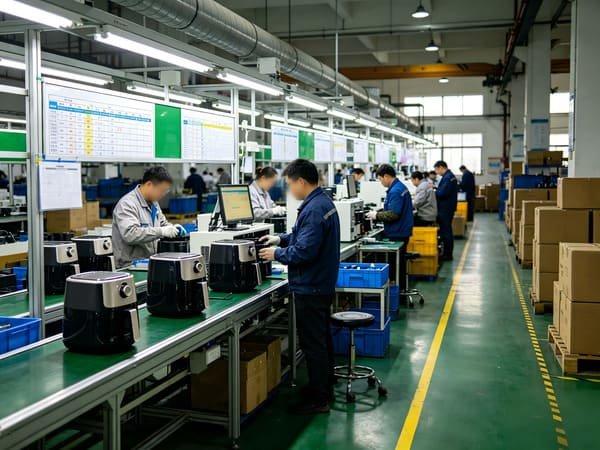
In our daily work, I have learned that the real question is not whether a factory has passed one test before. The real question is whether it can repeat the same approved build every day, on every batch, under real shipping pressure. That is why I always tell buyers to ask for visible proof from the line, written proof from the records, and linkable proof from the parts.
Which Air Fryer Production-Line Photos and Videos Actually Prove In-House Manufacturing?
Many buyers receive factory photos that look good but prove little. I have seen the same workshop image used by different sellers, and that creates real risk.
Useful photos and videos should show the full line, the process flow, the operators, the equipment, the date context, the product model, and the link between parts, assembly, testing, and packing inside one site.
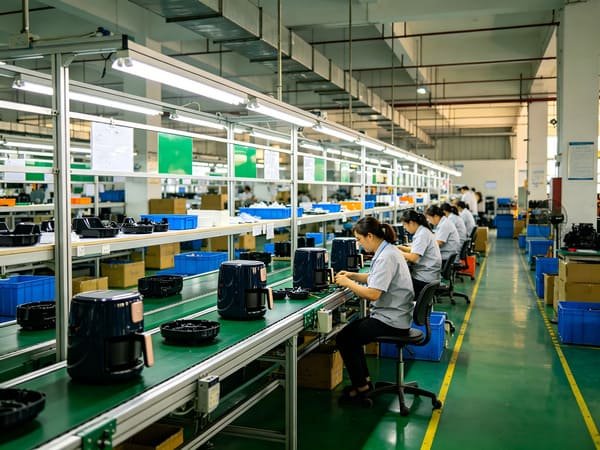
When I review production-line media, I do not focus on polished marketing shots. I look for operational details that are hard to fake. A useful video should walk through material storage, incoming inspection, heating assembly, basket and cavity assembly, electrical test, aging or functional test, final inspection, and packing.1 I want to see the same model number appear across stations. I also want to see workers, work instructions, station labels, and test devices in the same clip. This creates continuity.
Photos also matter, but single images are weak unless they form a sequence. I prefer a dated set that shows one order moving through the line. In our production reviews, I often ask teams to provide wide shots and close shots together. Wide shots show there is a real line.2 Close shots show details like fixture use, label control, and test settings. Buyers should also ask for loading-area photos and finished-carton staging photos. These help confirm that assembly and shipment flow belong to the same operation.
| Evidence type | What it should show | Why it matters |
|---|---|---|
| Wide line photo | Full assembly area, stations, operators | Proves a real workflow exists |
| Close station photo | Fixtures, jigs, work instructions, model tags | Shows process control is active |
| Walkthrough video | One continuous route from parts to packing | Harder to stage or outsource |
| Date-linked clip | Screen, whiteboard, or batch tag with date | Supports freshness of evidence |
| Model-linked image | SKU, carton mark, or nameplate | Connects evidence to your product |
What Process-Control Records Should an Air Fryer Factory Show for IQC, IPQC, FQC, and OQC?
A supplier can say it has QC at every stage, but that statement means nothing without records. Missing records often mean missing control.
Buyers should ask for actual IQC, IPQC, FQC, and OQC records for recent air fryer batches, including first article approval, defect logs, rework notes, test results, release decisions, and inspector signatures.
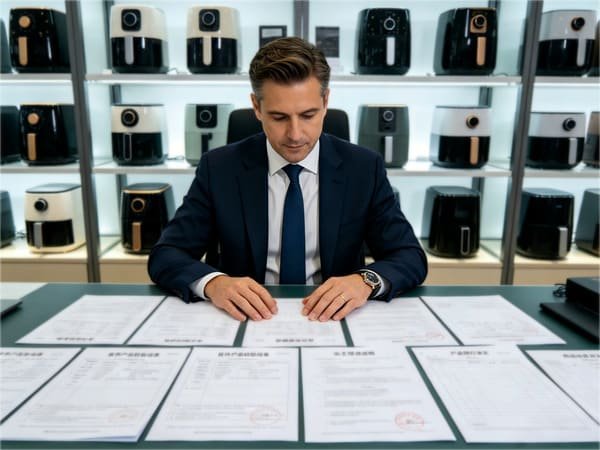
I always view QC records as the factory’s daily truth. IQC should show what happened when key parts arrived.3 For air fryers, that includes heating elements, motors, thermostats, timers, PCB-related parts if used, power cords, baskets, trays, coatings, and plastic housings. The record should show part name, supplier, lot number, sampling result, defect findings, and accept or reject status.
IPQC should show what happened during assembly, not just at the end. I look for first article approval at shift start or model switch, patrol inspection during production, torque or fit checks where needed, wiring checks, appearance checks, and routine function checks. FQC should show a finished-unit review before packing. OQC should show shipment-release review by carton and batch.
The strongest factories do not only show pass records.4 They also show abnormal handling. I trust a line more when I can see how it handled a failed heating lot, a coating issue, or a cord defect. That proves the system works under pressure. In our own process reviews, the most useful question is simple: can the factory show one batch from incoming parts to outgoing cartons without gaps?
| QC stage | Records buyers should request | Main value |
|---|---|---|
| IQC | Incoming inspection report, supplier lot, sampling result | Confirms parts were checked before use |
| IPQC | First article approval, in-line patrol report, defect log | Confirms the process stayed under control |
| FQC | Finished product inspection record | Confirms units met release standard |
| OQC | Pre-shipment inspection, carton review, release note | Confirms shipment consistency |
| CAPA link | Corrective action for repeated defects | Shows the factory learns and fixes |
How Can Buyers Verify Air Fryer Line Capacity, Output Stability, and Peak-Season Readiness?
Capacity claims often sound impressive in meetings. The problem starts when the season gets busy and output drops, lead time slips, and quality gets worse.
Buyers should verify capacity with shift plans, line-balance data, daily output reports, staffing records, equipment availability, and peak-season contingency plans instead of relying on one monthly capacity claim.
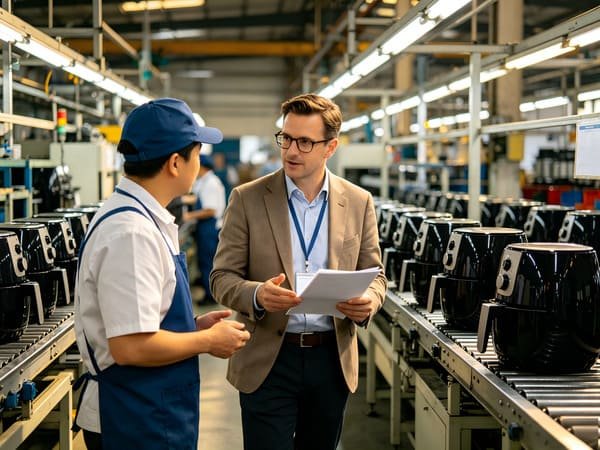
When I assess capacity, I never accept one simple number like “10,000 units per day” without context. I need to know which model, which basket size, which process route, how many shifts, how many workers, and what test time is required per unit. Air fryers vary a lot. Manual assembly content, coating handling, burn-in or function test time, and packaging complexity all affect real output.5
The best way to verify is to ask for three kinds of proof. First, ask for recent daily output reports by line and by model. Second, ask for staffing records and attendance patterns during busy months. Third, ask for downtime and bottleneck data. In real factories, the slow point may be heating assembly, electrical testing, or packing. A serious supplier knows its bottleneck and has a plan.
I also check whether raw materials and key bought-in parts can support the claimed volume. A line is not peak-ready if the heating element supplier, cord supplier, or basket coating source cannot scale.6 In our planning work, peak readiness means more than extra people. It means approved backup sources, reserved tooling capacity, buffer plans for key parts, and clear shipment scheduling.
| Capacity evidence | What buyers should ask for | What it reveals |
|---|---|---|
| Daily output report | Output by line, shift, model | Real run rate, not sales talk |
| Line balance sheet | Takt time and bottleneck station | Process constraint points |
| Staffing plan | Operators by shift and season | Labor readiness |
| Downtime log | Machine stop time and cause | Stability and risk exposure |
| Peak plan | Backup suppliers, overtime rules, extra fixtures | Ability to protect delivery |
What Testing Equipment and Safety Checkpoints Should Exist on an Air Fryer Production Line?
Some suppliers talk about safety, but buyers should be able to see where safety is checked, with what equipment, and how often those checks happen.
A credible air fryer line should have equipment and records for electrical safety, function testing, temperature-related checks, appearance checks, and routine validation of test devices and checkpoints.
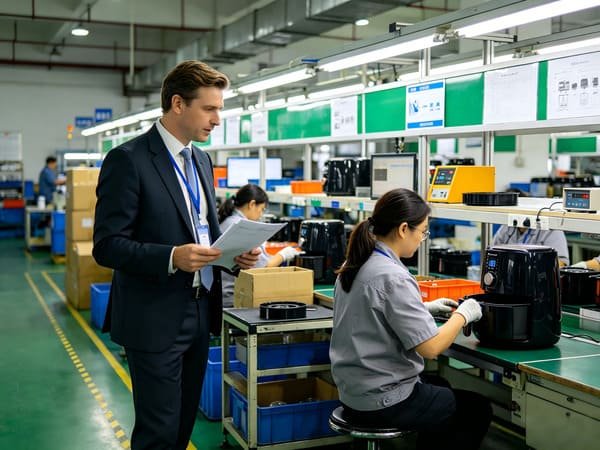
In air fryer production, safety is not one final stamp. It is a chain of checkpoints. I expect to see basic electrical safety tests such as earth continuity7 where relevant, insulation resistance, and high-potential testing according to the product design and market requirement. I also expect function tests for heating, fan or motor operation, timer or control response, abnormal noise, and indicator behavior. Depending on the model, temperature rise checks8 and thermostat response checks may also be part of routine or periodic control.
The key issue is not only the presence of machines. It is whether the machines are actually used, maintained, and linked to the batch. Buyers should ask for calibration status, test standards, sample frequency, and the reject-handling flow. For example, if a unit fails a hi-pot test, where does it go, who reviews it, and how is re-test controlled? In our line management, weak control often shows up not in the first test, but in failed-unit handling.
A good supplier can walk a buyer through each checkpoint from subassembly to packed unit. It can explain why each test exists and which defect or hazard it is meant to catch.
| Equipment or checkpoint | Purpose | What buyers should confirm |
|---|---|---|
| Electrical safety tester | Checks electrical safety performance | Test parameters and records |
| Functional test bench | Confirms heating and operation | Batch-linked results |
| Temperature or thermal check | Confirms safe heat behavior | Standard and frequency |
| Appearance station | Finds cosmetic and assembly issues | Acceptance standard |
| Calibration label or log | Confirms test gear reliability | Valid date and traceability |
Which Material Traceability and Food-Contact Compliance Documents Matter for Air Fryer Components?
Air fryer buyers often focus on plugs, watts, and certificates. They can miss the materials that touch food or handle heat, and that can create serious market risk.
The most important documents cover traceability and compliance for food-contact and heat-exposed parts such as baskets, trays, coatings, silicone parts, plastics, and any component that can affect safety, odor, migration, or durability.
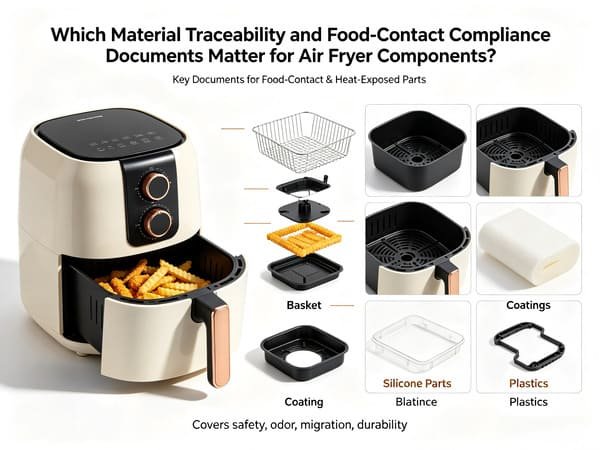
I pay special attention to air fryer food-contact parts because they combine heat, repeated use, cleaning, and direct consumer contact. Buyers should ask for the bill of materials, supplier declarations, material specifications, and compliance reports for baskets, trays, coatings, liners, handles with food-contact risk, and silicone or rubber parts used near food zones. The target market matters. The file should match the destination requirement, not just show a generic pass document.
Traceability is just as important as compliance. A compliance report has limited value if the factory cannot link the tested material to the current production lot. I want to see part code, supplier name, lot number, receiving date, usage batch, and any engineering change record. This is very important for non-stick coatings and plastics because substitution risk is real in mass production9.
In our sourcing reviews, I often ask one direct question: if a customer complaint appears six months later, can the factory trace the basket coating and silicone part back to the exact incoming lot10? If the answer is no, then the risk is still high even if the file set looks complete.
| Component | Documents to request | Why it matters |
|---|---|---|
| Basket and tray | Material spec, food-contact report, lot trace | Direct food contact |
| Coating | Compliance report, supplier declaration, change control | Safety and durability risk |
| Silicone parts | Food-contact file, heat resistance data | Heat and migration concern |
| Plastic housing near heat | Resin spec, compliance statement | Odor, deformation, safety |
| Power cord and thermostat | Supplier lot and certification link | Critical safety parts |
How Should Buyers Confirm That Sample Quality Can Be Repeated in Mass Air Fryer Production?
A beautiful sample can win the order. The hard part is repeating that same quality after tooling wear, material changes, operator turnover, and urgent shipment pressure.
Buyers should confirm repeatability by checking sample sign-off records, golden-sample control, BOM version control, pilot-run data, change-control records, and batch consistency evidence from actual mass production.
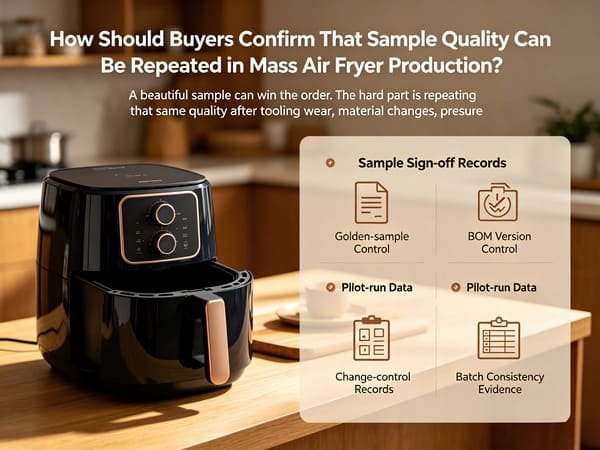
This is the issue I care about most. A certified sample or pre-production sample only helps if the factory can freeze the build and control changes. I always ask for the approved sample record, the signed specification sheet, the controlled BOM, and the revision history. Then I compare that with recent batch records. Are the heating element, motor, thermostat, cord, basket coating, and control parts still the same? If not, where is the engineering review and compliance impact assessment?
Pilot-run data is very useful here.11 A real factory should be able to show early-run yield, defect trends, corrective actions, and the release decision before volume production. I also like to see how golden samples are stored and referenced on the line. If the operator standard only lives in someone’s memory, consistency will fall.
In our projects, repeatability comes from discipline. The sample is only the start. The real proof is that the approved build, approved material, approved test method, and approved workmanship standard all stay connected during mass production. That is why I trust batch records more than promises.
| Repeatability control | What to review | Why it matters |
|---|---|---|
| Approved sample record | Signed sample and spec sheet | Defines the target build |
| BOM control | Version number and revision history | Prevents silent part changes |
| Pilot-run report | Yield, defects, corrective actions | Shows scale-up readiness |
| Golden sample control | Storage, label, access, usage | Keeps workmanship consistent |
| Change-control file | Engineering review after any change | Protects compliance and quality |
Conclusion
When I source air fryers, I trust the supplier that can prove daily control, batch traceability, and sample-to-mass consistency with real records, not the one with the thickest certificate folder.
FAQ
What is the first production-line proof I should ask for from an air fryer supplier?
Ask for one recent evidence chain for the same model: line photos, walkthrough video, QC records, test logs, and shipment records. This gives you a fast view of whether the factory can connect parts, process, and output.
Are certificates enough to prove air fryer manufacturing ability?
No. Certificates only show that a product or system passed a requirement at a certain point. They do not prove current mass-production control, part consistency, or stable daily execution.
Which air fryer parts need the strongest traceability?
Focus on heating elements, motors, thermostats, power cords, baskets, trays, coatings, and silicone parts. These parts carry the highest safety, performance, and complaint risk in mass production.
How can I know whether the factory really performs in-line inspections?
Ask for filled IQC, IPQC, FQC, and OQC forms from recent batches. Check dates, lot numbers, defect notes, signatures, and abnormal handling. Empty templates do not count.
What kind of testing equipment should exist on an air fryer line?
You should expect electrical safety testers, function test benches, temperature-related check methods, appearance inspection stations, and calibration control for the test equipment itself.
How do I verify that my approved sample can be repeated in mass production?
Compare the approved sample file with the current BOM, pilot-run data, change-control records, and recent batch records. The goal is to prove that no hidden part or process change has happened.
What is a warning sign that a supplier may not have true in-house control?
A big warning sign is when photos are generic, videos are cut into fragments, records are blank templates, and the supplier cannot link one batch from incoming parts to outgoing cartons.
Why does food-contact compliance matter so much for air fryers?
Air fryers combine direct food contact and high heat. Baskets, trays, coatings, and silicone parts can affect migration, odor, durability, and consumer safety, so compliance and lot traceability both matter.
-
"Assembly line – Wikipedia", https://en.wikipedia.org/wiki/Assembly_line. This source outlines the key stages in a typical production line, including material storage, inspection, assembly, and testing. Evidence role: mechanism; source type: education. Supports: A useful video should walk through material storage, incoming inspection, heating assembly, basket and cavity assembly, electrical test, aging or functional test, final inspection, and packing.. Scope note: The stages may vary depending on the type of product being manufactured. ↩
-
"Wide Shot: Everything You Need to Know – Nashville Film Institute", https://www.nfi.edu/wide-shot/. This source explains the importance of wide-angle photos in verifying the existence of a functional production line. Evidence role: general_support; source type: education. Supports: Wide shots show there is a real line.. Scope note: The source may not specifically address the use of wide shots in production reviews. ↩
-
"Internal quality control – PubMed", https://pubmed.ncbi.nlm.nih.gov/23996371/. This source explains the role of IQC in ensuring the quality of incoming parts, including typical inspection criteria and documentation practices. Evidence role: definition; source type: education. Supports: IQC should show what happened when key parts arrived, including details like part name, supplier, lot number, sampling result, defect findings, and accept or reject status.. ↩
-
"8-Steps for Abnormality Management: The Art of Focusing on What’s …", https://reverscore.com/8-steps-for-abnormality-management-the-art-of-focusing-on-whats-not-working/index.html. This source discusses the importance of abnormal handling records in quality control systems, emphasizing their role in demonstrating system robustness. Evidence role: expert_consensus; source type: research. Supports: The strongest factories do not only show pass records but also document abnormal handling to prove system reliability under pressure.. ↩
-
"Factors Affecting the Manufacturing Industry Transformation and …", https://pmc.ncbi.nlm.nih.gov/articles/PMC8297225/. This source explains how factors like manual assembly, coating handling, and testing times influence production output in manufacturing environments. Evidence role: mechanism; source type: education. Supports: Manual assembly content, coating handling, burn-in or function test time, and packaging complexity all affect real output.. Scope note: The source may not specifically address air fryer production but provides general insights into manufacturing processes. ↩
-
"The effect of supplier capacity on the supply chain profit", http://dspace.mit.edu/handle/1721.1/103757. This source discusses the importance of supply chain scalability for maintaining production capacity during peak demand periods. Evidence role: mechanism; source type: education. Supports: A line is not peak-ready if the heating element supplier, cord supplier, or basket coating source cannot scale.. Scope note: The source may not specifically address air fryer components but provides general principles of supply chain management. ↩
-
"Electrical safety testing", https://en.wikipedia.org/wiki/Electrical_safety_testing. Earth continuity testing ensures that exposed conductive parts are properly connected to the protective earth system, reducing the risk of electric shock. Evidence role: mechanism; source type: education. Supports: Basic electrical safety tests such as earth continuity are part of air fryer production safety checkpoints.. ↩
-
"Heat Hazard Recognition | Occupational Safety and Health … – OSHA", http://www.osha.gov/heat-exposure/hazards. Temperature rise checks are used to ensure that the appliance operates within safe thermal limits, preventing overheating and potential hazards. Evidence role: mechanism; source type: education. Supports: Temperature rise checks may be part of routine or periodic control in air fryer production.. ↩
-
"Non-stick surface – Wikipedia", https://en.wikipedia.org/wiki/Non-stick_surface. This source discusses the prevalence of material substitution in manufacturing and its implications for product safety. Evidence role: mechanism; source type: research. Supports: Substitution risk is a significant concern in mass production, particularly for materials like non-stick coatings and plastics.. Scope note: The source may not specifically address air fryer production. ↩
-
"FSMA Final Rule on Requirements for Additional Traceability Records", https://www.fda.gov/food/food-safety-modernization-act-fsma/fsma-final-rule-requirements-additional-traceability-records-certain-foods. This source explains the importance of traceability in manufacturing and its role in addressing quality and safety concerns. Evidence role: mechanism; source type: education. Supports: Traceability is crucial for ensuring that materials used in production can be linked to specific lots to address quality and safety issues.. Scope note: The source may not directly address air fryer components but provides general principles of traceability. ↩
-
"Yield learning concept", http://escml.umd.edu/Courseware/YieldLea/YLConcept.htm. Pilot-run data provides insights into early production challenges, including yield rates, defect trends, and corrective actions, as documented in manufacturing process studies. Evidence role: mechanism; source type: research. Supports: Pilot-run data is very useful for understanding early-run yield, defect trends, corrective actions, and the release decision before volume production.. Scope note: The data may vary significantly depending on the industry and product type. ↩