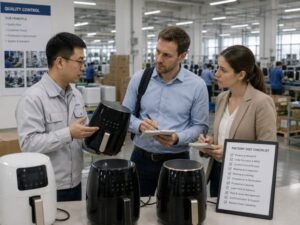
First-time importers can use Google and AI search to find China appliance suppliers, screen supplier websites, record supplier claims, and build a supplier database before sending their first RFQ.
Problem: Many first-time importers want to find China appliance suppliers, but they do not know what to search, how to use AI, which supplier websites to save, or how to organize supplier information.
Agitation: If buyers search randomly, they may collect weak supplier links, confuse supplier claims with verified facts, miss better sourcing channels, or send unclear inquiries that suppliers cannot quote accurately.
Solution: Use AI to prepare search terms and screening criteria, use Google to find supplier websites, then use AI again to organize records into a supplier database before RFQ.
Snippet: First-time importers can find China appliance suppliers by defining their search goal, using AI to create Google search terms, reviewing supplier websites, recording supplier claims, and building a structured supplier database before sending RFQs.
This guide focuses only on supplier discovery, initial screening, and supplier database building before RFQ. It does not replace later supplier verification, sample testing, factory audit, certificate review, payment-risk control, or final purchase decisions.
Who is this guide for?
This guide is for buyers with no China sourcing experience, no local partner, and no existing supplier network who need to independently build a China appliance supplier shortlist.
If you have never visited China, do not know any local sourcing partner, and do not know how to use AI for sourcing, this guide gives you a practical first step. Your goal is not to choose a final supplier today. Your goal is to create a clean supplier database and prepare a shortlist for your first RFQ.
This guide is suitable for:
- Importers
- Wholesalers
- Distributors
- Supermarket buyers
- Online sellers
- OEM or private-label buyers
- Buyers exploring small home appliances from China
At this stage, you should not decide whether a supplier is fully reliable. You should only decide whether the supplier is worth saving, checking again, or contacting in the next RFQ step.
What should first-time importers prepare before searching for China appliance suppliers?
First-time importers should define product category, target market, buyer role, order type, plug, voltage, packaging needs, and search goal before using Google or AI.
Many buyers start with a broad search like “China appliance supplier.” That is not wrong, but it is too broad. Google and AI work better when you give them a clearer task.
Before searching, prepare this simple sourcing brief:
| Search Preparation Item | What to Prepare |
|---|---|
| Product category | Air fryer, blender, electric fan, rice cooker, oven, ceramic hob, vacuum sealer, or other appliance |
| Buyer role | Importer, wholesaler, distributor, supermarket buyer, online seller, or OEM brand |
| Target market | Country or region where the products may be sold |
| Order type | Wholesale, OEM, private label, mixed container, or repeat supply |
| Product level | Entry-level, mid-range, premium, promotional, or supermarket shelf product |
| Market configuration | Plug, voltage, language, packaging, and manual needs |
| Search goal | Build supplier database before RFQ, not place an order immediately |
If you do not know the exact model yet, you can still start supplier discovery. However, you should at least know the product category and target buying scenario.
Why do many first-time importers fail when using AI to find suppliers?
First-time importers often fail because they ask AI for a final supplier name instead of using AI to build search terms, screening criteria, and a supplier database.
A weak AI question is:
Find me the best China appliance supplier.This question is too broad. It does not tell AI your product category, target market, order type, sourcing stage, or what you want to do with the result.
A better AI question is:
I am a first-time importer looking for China small home appliance suppliers before sending RFQs.
My product categories are air fryers, blenders, and electric fans.
Please help me create Google search terms and a supplier-screening checklist.
Do not recommend a final supplier. Focus on building a candidate supplier database.
AI should support your supplier discovery work. It should not be treated as proof that a supplier is real, compliant, capable, or safe to pay.
AI can help you:
- Clarify your search goal
- Generate Google search terms
- Build a supplier screening checklist
- Create a supplier database template
- Compare supplier website information
- Identify missing information before RFQ
AI cannot directly prove:
- Supplier reliability
- Factory identity
- Certificate validity
- Real MOQ
- Production capacity
- Delivery reliability
- Payment safety
- Product compliance
Case Example: How a first-time importer uses AI and Google together
A first-time importer can use AI to prepare search terms, Google to find supplier websites, and AI again to organize supplier records before sending RFQs.
Let’s use a simple case.
Buyer profile:
A first-time importer wants to find China suppliers for air fryers, blenders, electric fans, and rice cookers. The buyer has no China sourcing experience, no local partner, and no existing supplier list.
First-stage goal:
Do not choose a final supplier yet. Build a supplier database and prepare a shortlist for RFQ.
The workflow looks like this:
| Step | Buyer Action | AI Helps With | Google Helps With | Output |
|---|---|---|---|---|
| 1 | Define sourcing goal | Clarify search scope | Not needed yet | Search brief |
| 2 | Generate search terms | Create keyword formulas | Use search terms | Search list |
| 3 | Find websites | Suggest variations | Discover supplier websites | Candidate list |
| 4 | Screen websites | Create checklist | Open and review pages | Save or reject decision |
| 5 | Build database | Create fields and scoring | Provide source URLs | Supplier database |
| 6 | Shortlist suppliers | Compare records | Recheck websites | RFQ shortlist |
This process helps the buyer move from confusion to an organized sourcing task.
Step 1: How should importers ask AI to define the search task?
Importers should ask AI to clarify product scope, buyer role, order type, target market, and supplier-discovery goal before searching on Google.
Use this prompt:
I am a first-time importer with no experience sourcing from China.
I want to find China suppliers for small home appliances such as air fryers, blenders, electric fans, and rice cookers.
Please help me define what information I should prepare before searching on Google.
Focus only on supplier discovery before RFQ.
AI should help you produce a simple search brief, such as:
- Product categories: air fryers, blenders, electric fans, rice cookers
- Buyer role: importer or wholesaler
- Target market: to be confirmed
- Order type: wholesale or OEM
- Search goal: build supplier database before RFQ
- Do not decide final supplier yet
- Mark all supplier claims for later verification
This search brief keeps the task focused.
Step 2: How should importers search Google in four rounds?
Importers should use Google in four rounds: broad supplier search, product-category search, buyer-intent search, and independent-website search.
A first-time buyer should not rely on one Google search. Use several search rounds to collect different supplier types.
Round 1: Broad supplier search
Use broad terms to understand the supplier landscape.
China small home appliance supplier
China appliance wholesale supplier
China kitchen appliance factory
China home appliance manufacturer
China small appliance exporter
Goal: Find general supplier websites and understand common product categories.
Round 2: Product-category search
Use product-specific searches to find suppliers closer to your product needs.
China air fryer factory OEM
China blender wholesale supplier
China electric fan manufacturer bulk order
China rice cooker supplier OEM packaging
China oven supplier for importers
Goal: Find suppliers that match the exact appliance category.
Round 3: Buyer-intent search
Use terms that describe your buying situation.
China appliance supplier for importers
China appliance supplier for distributors
China small appliance supplier for wholesalers
China appliance supplier mixed container
China small appliance supplier OEM private label
Goal: Find suppliers that may understand B2B importer needs.
Round 4: Independent-website search
Use searches that help you find supplier websites outside large platforms.
"China appliance supplier" -Alibaba -Made-in-China
"air fryer factory" "China" "OEM"
"small home appliance supplier" "MOQ"
"China kitchen appliance factory" "wholesale"
"China blender supplier" "OEM packaging"
Goal: Build a broader candidate list, including independent company websites.
What Google search terms should importers use for China appliance suppliers?
Importers should combine appliance product names, supplier roles, China location, wholesale intent, OEM needs, and buyer-stage keywords.
Use these search formulas:
China [product] supplier
China [product] factory
China [product] manufacturer
China [product] wholesale supplier
China OEM [product] manufacturer
China [product] supplier for importers
China [product] factory OEM packaging
China [product] supplier mixed container
China small home appliance supplier
China kitchen appliance factory
China appliance supplier bulk order
Examples:
China air fryer factory OEM packaging
China blender wholesale supplier for importers
China electric fan manufacturer bulk order
China rice cooker supplier OEM color box
China small home appliance supplier mixed container
China kitchen appliance factory for distributors
Do not judge a supplier only because it appears on Google. At this stage, Google helps you find candidates, not verified partners.
Step 3: What should AI help with during supplier discovery?
AI should help importers generate search terms, organize screening criteria, compare website information, and build a supplier database, but it should not verify suppliers.
After you collect search results from Google, use AI as a task assistant. AI can help you think more clearly, but you must still check the source websites yourself.
Use AI for these tasks:
| AI Task | Buyer Benefit |
|---|---|
| Generate search terms | Finds more supplier discovery routes |
| Expand product keywords | Avoids searching only one product name |
| Create website checklist | Helps decide whether a website is worth saving |
| Build database fields | Organizes supplier information |
| Compare supplier records | Helps shortlist before RFQ |
| Identify missing information | Prepares better inquiry questions |
Do not ask AI to make a final supplier decision. Ask AI to help you organize information and prepare the next action.
What AI prompts can first-time importers copy and use?
Importers can use AI prompts for search preparation, keyword generation, website screening, database building, supplier-role comparison, and RFQ preparation.
Copy and adapt these prompts.
Prompt 1: Prepare the search task
I am a first-time importer with no China sourcing experience.
I want to find China suppliers for small home appliances.
Please help me define what information I should prepare before searching on Google.
Focus only on supplier discovery before RFQ.
Prompt 2: Generate Google search terms
I want to find China appliance suppliers using Google.
Please create Google search terms for finding factories, wholesale suppliers, OEM suppliers, and mixed-container small appliance suppliers.
The product categories are air fryers, blenders, electric fans, and rice cookers.
Prompt 3: Screen a supplier website
I found a China appliance supplier website.
Please give me a checklist to decide whether this website is worth saving in my supplier database.
Focus on company identity, product fit, B2B relevance, contact information, OEM information, evidence pages, and warning signs.
Prompt 4: Build a supplier database
Please create a supplier database template for China appliance sourcing.
I need fields for supplier name, website URL, product category, supplier type, contact path, claimed MOQ, claimed OEM options, evidence links, red flags, fit score, and next action.
Prompt 5: Score suppliers before RFQ
I have collected several China appliance supplier websites.
Please help me create a simple scoring system to rank them before sending RFQs.
Do not treat supplier claims as verified facts.
Prompt 6: Compare supplier roles
Compare factory, trading company, and sourcing agent roles for a first-time appliance importer.
Focus on supplier discovery and database building before RFQ, not final supplier verification.
Step 4: How can importers decide whether a supplier website is worth saving?
Importers should save supplier websites that clearly show company identity, appliance categories, B2B order scope, contact path, OEM information, and checkable evidence pages.
When you open a supplier website, do a quick 30-second scan before saving it.
| 30-Second Website Scan | What to Record |
|---|---|
| Clear company name | Copy the exact company name |
| Product category fit | Record which appliance categories match your need |
| B2B wording | Check for importer, wholesale, OEM, distributor, or bulk order language |
| Contact path | Save email, inquiry form, WhatsApp, phone, or contact page if shown |
| OEM or packaging page | Mark OEM as claimed, not verified |
| About or factory page | Save the link for later checking |
| Certificate or document page | Save the link, but verify later by model and market |
| Product pages | Record product names, model information, and category focus |
| Weak or vague content | Mark as red flag if the site only says “best quality” or “best price” |
At this stage, you are not proving the supplier is reliable. You are deciding whether the supplier deserves a place in your database.
What supplier information is only a claim at the discovery stage?
At the discovery stage, MOQ, factory identity, OEM capability, certificates, export experience, and production capacity should be recorded as supplier claims, not verified facts.
This is one of the most important rules for first-time importers:
Discovery stage records claims. Verification stage confirms facts.
Use this table when building your supplier database:
| Supplier Website Statement | How to Record It |
|---|---|
| “We are a factory” | Claimed factory identity |
| “MOQ 1000 PCS” | Claimed MOQ, verify by model later |
| “OEM accepted” | Claimed OEM option |
| “CE / CB / RoHS available” | Claimed certificate, verify by model and market later |
| “Export to Europe / Middle East / Africa” | Claimed export experience |
| “Fast delivery” | Claimed lead time, verify after RFQ |
| “Strong production capacity” | Claimed capacity, verify through evidence later |
| “Best price” | Marketing claim, not a decision fact |
This approach protects buyers from trusting website claims too early.
What warning signs should importers notice during supplier discovery?
Importers should be cautious when supplier websites have unclear company identity, mismatched product scope, vague B2B information, missing contacts, unrealistic claims, or no checkable evidence pages.
Warning signs do not automatically prove a supplier is fake. They simply mean the buyer should be more careful before saving, shortlisting, or contacting the supplier.
Common discovery-stage red flags include:
- Company name is unclear
- Website has products but no company information
- Contact details are missing or inconsistent
- Product range is too broad and unrelated
- Website language is mostly “best quality” and “lowest price”
- No useful product specifications
- No B2B order information
- No OEM, packaging, MOQ, or importer information
- Certificate claims are shown without model or scope
- Factory claims are not supported by useful company pages
- Product images look inconsistent or unrelated
- The website does not explain who it serves
If a supplier has too many red flags, mark it as “check again” or “reject” instead of adding it to the RFQ shortlist.
Should first-time importers search only for China appliance factories?
First-time importers should not search only for factories; they can include factories, trading companies, and sourcing partners if each role is clearly recorded and later verified.
A factory may be suitable for standardized, single-category, repeat orders if the buyer can manage communication, specification control, inspection, documents, and logistics.
A trading company may be useful when the buyer needs multiple appliance categories, mixed container supply, supplier comparison, export coordination, packaging communication, or flexible product sourcing.
A sourcing agent may be useful when the buyer has no China experience and needs local coordination, supplier screening, quality follow-up, or multi-source purchasing support.
The goal of this article is not to decide the final cooperation model. The goal is to build a supplier database that records each candidate’s role clearly.
In your database, use these labels:
Factory
Trading company
Sourcing partner
Brand owner
Platform seller
Unclear
Do not reject a candidate only because it is not a factory. Record the role, then decide later whether that role fits your buying situation.
Step 5: How should importers build a China appliance supplier database before RFQ?
Importers should build a supplier database with company name, website, product category, supplier type, contact path, claimed capabilities, evidence links, red flags, fit score, and next action.
A supplier database is more useful than a folder of random links. It helps you compare suppliers, avoid duplicate records, prepare RFQs, and separate claims from verified facts.
Use this template:
| Field | What to Record |
|---|---|
| Supplier name | Exact company name from the website |
| Website URL | Source page where the supplier was found |
| Source channel | Google, AI, B2B platform, referral, or trade fair |
| Product category | Air fryer, blender, fan, rice cooker, oven, or other appliance |
| Supplier type | Factory, trading company, sourcing partner, or unclear |
| Target buyer | Importer, wholesaler, distributor, supermarket, OEM brand |
| Contact path | Email, inquiry form, WhatsApp, phone, or contact page |
| Claimed MOQ | Record as claim, verify by model later |
| Claimed OEM options | Logo, color box, manual, private label, packaging |
| Market notes | Plug, voltage, language, target country, packaging notes |
| Evidence links | About page, factory page, certificate page, product page |
| Website clarity | Clear, average, or weak |
| Red flags | Unclear company, broad product range, missing contact, or vague claims |
| Fit score | High, medium, or low |
| Next action | Save, reject, check again, or send RFQ later |
The database should prepare you for inquiry. It should not pretend that supplier claims are already verified.
Importers should tag suppliers by product category, supplier role, order type, OEM possibility, market configuration, evidence quality, and RFQ priority.
Tags help you filter suppliers quickly before RFQ.
Useful tags include:
Product: Air fryer / Fan / Blender / Rice cooker / Oven
Role: Factory / Trading company / Sourcing partner / Unclear
Order type: Wholesale / OEM / Mixed container / Private label
Market: EU / US / Middle East / Africa / Latin America / Unclear
Evidence: Factory page / Certificate page / Product page / Weak evidence
Priority: RFQ first / Check again / Hold / Reject
Risk: Unclear company / Broad product range / No contact / Claim needs verification
For example, if a supplier has many air fryer pages, a clear contact page, OEM packaging information, and an about page, you may tag it:
Product: Air fryer
Role: Claimed factory
Order type: OEM
Evidence: Product page + About page
Priority: RFQ first
Risk: Certificate needs verification
This makes the next step much easier.
Step 6: How should importers score and shortlist suppliers before RFQ?
Importers should shortlist suppliers by product fit, B2B relevance, website clarity, contact availability, order information, market notes, and discovery-stage red flags.
Do not send RFQs to every website you find. First, score and clean your database.
Use this simple scoring method:
| Criteria | High Fit | Medium Fit | Low Fit |
|---|---|---|---|
| Product match | Focused appliance category | Related category | Unrelated products |
| B2B relevance | Clear importer, wholesale, or OEM language | Some B2B wording | Mostly retail language |
| Website clarity | Company and products are easy to understand | Some missing details | Very unclear |
| Contact availability | Clear inquiry channel | Limited contact info | No reliable contact path |
| Order information | MOQ, OEM, packing, or bulk order mentioned | Partial order info | No B2B order info |
| Market configuration | Plug, voltage, packing, or market notes mentioned | Some configuration info | No market configuration |
| Evidence pages | About, factory, certificate, or product pages available | Limited evidence pages | No useful support pages |
| Red flags | Few red flags | Some concerns | Many concerns |
A good RFQ shortlist should include suppliers that appear relevant enough to contact, not suppliers that are already proven reliable.
How should importers handle duplicate or inconsistent supplier information?
Importers should group duplicate supplier records by company name, website, contact email, phone number, address, and product pages, while marking inconsistencies for later verification.
When using Google, AI, and B2B platforms together, you may find repeated or inconsistent supplier information.
Common problems include:
| Problem | What to Do |
|---|---|
| Same company has multiple websites | Keep both links and mark “possible same supplier” |
| Brand name differs from company name | Record both brand name and company name |
| AI result has no source link | Do not add unless a source page can be found |
| Website contact differs from platform contact | Mark inconsistency |
| Supplier uses only free email | Record as caution, not automatic rejection |
| Company name changes between website and quotation | Must verify before moving forward |
| Same product photos appear on many websites | Mark as “image duplication risk” |
| Address or phone number is unclear | Save note for later checking |
Do not delete confusing records too early unless they are clearly irrelevant. Instead, mark the uncertainty so you know what to ask later.
When should importers stop searching and prepare the first RFQ?
Importers should stop the first search round when they have a clean supplier shortlist with source links, contact paths, claim notes, red flags, and RFQ-ready information gaps.
Many first-time importers keep searching because they are afraid to contact suppliers. This creates endless research without progress.
You are ready to move from supplier discovery to RFQ preparation when:
- You have searched broad, product-specific, buyer-intent, and independent website terms
- You have saved source URLs for each supplier
- You have removed clearly irrelevant websites
- You have recorded supplier type or marked it as unclear
- You have separated supplier claims from verified facts
- You have marked red flags
- You have tagged product category and order type
- You have created a high, medium, and low fit score
- You know what information to ask in the first RFQ
At this point, the next task is not more searching. The next task is preparing a clear RFQ message.
FAQ
This FAQ answers common supplier-discovery questions before RFQ, especially for first-time importers using Google and AI without a China sourcing partner.
Can AI find real China appliance suppliers for me?
AI can help you find candidate suppliers, but it cannot prove they are real or reliable. Use AI to generate search terms, screening criteria, and database fields, then verify suppliers later.
Should I trust suppliers recommended by AI search?
No buyer should treat AI recommendations as verified proof. If AI suggests a supplier, look for a source website, company name, contact page, product pages, and checkable evidence before saving it.
Should I start with Google or AI first?
Start with AI to define search terms and screening criteria, then use Google to find real supplier websites. After that, use AI again to organize your supplier database.
How many suppliers should I collect before sending RFQs?
There is no fixed number for every buyer. First build a broad list, remove irrelevant suppliers, then create a smaller RFQ shortlist based on product fit, website clarity, B2B relevance, and contact availability.
Can I search if I do not know the exact appliance model yet?
Yes. You can start with product categories such as air fryer, blender, fan, rice cooker, or oven. Exact model details can be clarified later during RFQ and sample discussion.
Should I only save supplier websites with certificates?
No. A certificate page may be useful, but certificate claims still need later verification by model, market, holder, configuration, and current requirements. Do not treat website certificates as final proof.
Is a trading company worse than a factory?
Not always. A trading company or sourcing partner may help with multi-category sourcing, mixed container orders, communication, documentation, and coordination. Record the role clearly and verify value later.
What is the biggest mistake during supplier discovery?
The biggest mistake is collecting supplier names without recording source links, product fit, claimed capabilities, red flags, and next actions. A clean database is more useful than a long unorganized list.
What should I do after building the supplier database?
The next step is to prepare a clear RFQ. Your RFQ should ask about model options, MOQ by product, OEM packaging, plug, voltage, target market, sample availability, quotation terms, and documents that may need later verification.
Conclusion
A first-time importer should use AI and Google to build a supplier database, not to make a final supplier decision too early.
The safest first step is to define your search goal, use AI to generate search terms, search Google in structured rounds, review supplier websites, record supplier claims carefully, mark red flags, and build a shortlist for RFQ.
This process helps buyers move from random searching to organized supplier discovery. It also helps prevent common mistakes such as trusting AI results too quickly, confusing supplier claims with verified facts, or sending inquiries before the buyer knows what information to request.
CTA
If you are building your first China appliance supplier list, you can share your target product category, market, order type, and sourcing questions through our inquiry form, WhatsApp, or WeChat. We can help you clarify search keywords, supplier categories, product fit, and RFQ preparation points before you contact suppliers.