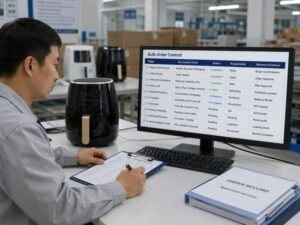
A useful China appliance factory visit should verify whether the supplier can support the buyer’s specific product, order structure, quality requirements, packing needs, and risk level—not simply whether machines, workers, samples, or certificates are visible.
Problem: Many importers visit a factory with a long checklist but still leave without knowing what the visit actually proved. A clean showroom, busy production line, testing equipment, or shipment photos may create confidence without confirming whether the factory can control the buyer’s actual order.
Agitation: When observations are mistaken for proof, buyers may overestimate capacity, quality consistency, order control, or product-market suitability. Important gaps may remain hidden until sample approval, mass production, packing, inspection, payment, or shipment.
Solution: Treat the factory visit as one part of a broader procurement verification process. Decide whether a visit is necessary, define what must be proven, trace real workflows, compare information across departments, verify entity relationships, record unresolved gaps, and choose the next verification step before commitment.
Snippet: Importers should use a China appliance factory visit to verify order-specific capability, trace real production and quality processes, compare evidence across departments, understand what each observation does and does not prove, verify supplier responsibilities, and record unresolved risks before deciding whether to proceed.
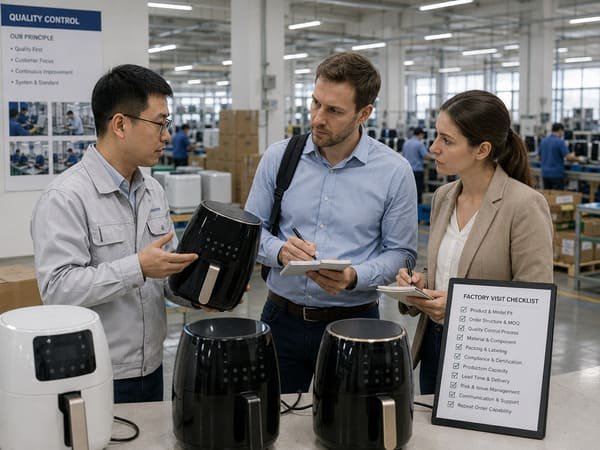
In our daily communication with importers, we often find that buyers arrive with many questions but one deeper uncertainty: after seeing the factory, how can they tell whether what they saw is relevant to their actual order?
The most useful visits are not the ones with the most photos. They are the visits that reduce the right uncertainties and make the next procurement decision clearer.
Is a Factory Visit Always the Best Way to Verify a Supplier?
A factory visit is useful for operational understanding and relationship building, but a third-party audit, remote verification, sample inspection, or local sourcing partner may be more suitable depending on the order and risk level.
Not every sourcing project requires personal travel. The buyer should first ask what decision needs to be supported and which verification method can produce the strongest relevant evidence.
Verification Method Comparison
| Verification method | Better suited to |
|---|---|
| Personal factory visit | Relationship building, product discussion, operational understanding |
| Third-party factory audit | Structured independent capability verification |
| Local sourcing partner | Supplier comparison and ongoing coordination |
| Live video verification | Early screening or lower-risk decisions |
| Sample inspection | Product-specific quality verification |
| Pre-shipment inspection | Finished-order verification |
From the supplier side, factory visits usually work best when buyers already know what they are trying to verify.
A visit is one verification tool, not automatically the only or strongest tool.
When Is a Factory Visit Worth the Time and Cost?
A factory visit is more valuable when order complexity, customization, repeat-order potential, quality risk, or supplier uncertainty makes better verification commercially important.
There is no universal order value at which a visit becomes worthwhile. The decision should consider the possible cost of getting the supplier decision wrong.
Factory Visit Value Factors
| Decision factor | Why it matters |
|---|---|
| Order complexity | More moving parts create more verification needs |
| Customization | OEM details increase execution risk |
| Repeat-order potential | One visit may support a longer relationship |
| Quality failure cost | Defects may create larger downstream losses |
| Supplier uncertainty | More uncertainty increases verification value |
| Number of suppliers | A visit may improve comparison quality |
| Order coordination | Multi-SKU orders may require deeper operational checks |
For simpler, lower-risk orders, remote verification, samples, and inspection may be enough.
For complex or repeatable orders, understanding the supplier’s operating system may justify a deeper visit.
What Should an Importer Actually Prove During a China Appliance Factory Visit?
An importer should prove whether the supplier’s visible operations, records, people, and processes are relevant to the specific product and order rather than simply confirming that a factory site exists.
A useful visit should answer:
- Can the supplier support the required product configuration?
- Does the production process match the product being discussed?
- Can quality issues be identified and controlled?
- Can different departments follow the same approved order information?
- Can packing, SKU, and warehouse details be controlled?
- Is current capacity relevant to the specific order?
- Which important claims still require further verification?
In our conversations with visiting customers, buyers sometimes focus heavily on factory size or machine count. Those observations may be useful, but they do not automatically answer whether the factory fits one specific order.
A stronger visit should end with a clear understanding of what was supported by evidence and what remains unresolved.
What Should Buyers Prepare Before Visiting the Factory?
Buyers should prepare the products, order structure, target market, main risks, unresolved questions, and evidence requests before the visit so the factory tour can focus on real procurement decisions.
A factory visit without a clear objective can easily become a guided walk through a showroom, production line, warehouse, and meeting room.
In our experience, the most useful visits usually begin before the customer arrives. When buyers share their product direction, target market, customization needs, expected order structure, and main concerns in advance, the discussion can focus on what actually matters.
Pre-Visit Decision Checklist
| Prepare before the visit | Why it matters |
|---|---|
| Target product or model | Keeps the visit product-specific |
| Expected order structure | Clarifies single-SKU, OEM, or mixed-order needs |
| Target market | Supports configuration and documentation discussion |
| Plug / voltage needs | Helps verify relevant product versions |
| OEM requirements | Reveals artwork and packing-control needs |
| Main quality concerns | Guides inspection questions |
| Expected shipment structure | Helps assess warehouse and loading capability |
| Unresolved supplier claims | Creates a verification agenda |
| Documents to review | Reduces last-minute evidence searching |
| Departments to visit | Prevents an incomplete tour |
A factory visit without a defined decision objective becomes a tour.
How Can Buyers Tell Whether They Are Seeing Real Capability or a Prepared Presentation?
Buyers can distinguish real capability from presentation by tracing how products, records, production activities, quality checks, packing, and warehouse controls connect to one another.
A polished showroom can be useful, but presentation quality alone does not prove operational depth.
In our factory visits with customers, the strongest questions are usually not:
“Can you make this product?”
They are closer to:
“Can you show how this product moves from specification to production, inspection, packing, and warehouse control?”
Real capability becomes easier to evaluate when the same product can be followed through several operational points.
What Is the Factory Visit Confidence Trap?
The factory visit confidence trap occurs when a strong visual impression is treated as broader proof than the evidence actually supports.
Common Confidence Traps
| Strong impression | What still needs verification |
|---|---|
| Large factory | Whether it fits the required product |
| Busy lines | Whether capacity is available |
| Friendly team | Whether execution is controlled |
| Large showroom | Whether displayed products are actually manufactured |
| Many certificates | Whether the exact model and scope are covered |
| Customer logos | Whether the relationship is current and relevant |
| Shipment photos | Whether the buyer’s own order will be controlled |
In our daily communication with buyers, a positive visit is valuable, but stronger confidence comes from connected evidence rather than atmosphere alone.
What Does Factory Visit Evidence Actually Prove?
Factory visit evidence should be judged by its proof boundary because every observation may support one conclusion while leaving other important questions unanswered.
Factory Visit Evidence Matrix
| What you see | What it may support | What it does not prove | What to verify next |
|---|---|---|---|
| Business license | Legal entity exists | Production capability | Match entity and operating site |
| Showroom | Product range or market direction | Actual manufacturing capability | Trace one product into operations |
| Running line | Production activity exists | Capacity for your order | Check model and current slot |
| QC station | Inspection activity exists | Effective quality system | Trace one quality issue |
| Testing equipment | Testing capability may exist | Routine use or correct scope | Check records and application |
| Test report | A test has been performed | Exact model or current relevance | Verify model and scope |
| Customer visit photo | Previous visitors came | Supplier reliability | Check operational evidence |
| Shipment photo | Goods were shipped | Future order quality | Verify order-specific controls |
| Sample | One unit meets a reference | Mass-production consistency | Link sample to production controls |
| Warehouse stock | Goods are stored | Correct SKU control | Trace carton identity |
In our daily work, buyers sometimes see one strong piece of evidence and unconsciously treat it as proof of several other capabilities.
The more reliable approach is to define what each piece of evidence supports and where its limits begin.
How Can Buyers Compare Current Observation With Historical Evidence?
Buyers should compare what they see during one visit with historical records because a one-day factory visit is only a snapshot of current operations.
Current Observation vs Historical Evidence
| Current observation | Historical evidence |
|---|---|
| Running production | Previous production records |
| Current QC activity | Past corrective-action records |
| Warehouse condition | Previous shipment records |
| Current line condition | Maintenance records where relevant |
| Current sample | Repeat-order records |
| Current packaging | Previous artwork and packing versions |
When customers visit us, current production can explain how work is being done today. Historical evidence helps answer whether similar processes have been controlled over time.
Buyers do not need unlimited access to confidential records, but they can request non-confidential examples where appropriate.
How Can Buyers Trace One Product Through the Factory?
Buyers can trace one product by following its connection from finished sample to packing, quality control, production, components, specification, and order instruction.
One-Product Trace Test
Finished product
↓
Packing specification
↓
Quality control reference
↓
Production process
↓
Main components
↓
Product specification
↓
Order instruction
When customers visit our factory, this is often more useful than looking at every area separately.
A buyer can choose one appliance model and ask:
- Which specification controls this version?
- Which plug and voltage version is it?
- What does QC check?
- Which box belongs to this SKU?
- How is the warehouse carton identified?
- Which production instruction does the line follow?
If the answers connect logically, the buyer learns much more than by simply seeing a finished sample.
How Can Buyers Verify Whether the Factory Fits Their Specific Order?
Buyers should evaluate factory fit based on the actual order type because a factory capable of one production model may not be equally suitable for another order structure.
The key question is whether the operating system matches the buyer’s actual order.
Order-Fit Matrix
| Order type | What should be verified |
|---|---|
| Standard single SKU | Repeat production consistency |
| OEM order | Artwork and version control |
| Multi-SKU order | SKU coordination |
| Mixed container | Synchronization and warehouse control |
| New product | Sample and engineering process |
| Repeat order | Record retention |
| Complex export order | Documentation coordination |
From the manufacturer side, different orders create different operational pressure.
A standard repeat model may depend mainly on stable production and packing. An OEM order may depend more heavily on artwork control, labels, manuals, and version approval. A mixed-container order may depend more on synchronization than on the production speed of one individual model.
How Can Buyers Verify Available Capacity Instead of Theoretical Capacity?
Buyers should verify current model-specific availability rather than relying only on total factory capacity, machine count, or general output claims.
A large production line does not automatically mean the buyer’s order can start immediately.
When customers ask us about capacity, the useful discussion is not only about what the factory can theoretically produce. It is about what is already scheduled, which model is involved, whether critical materials are ready, and what production space is actually available.
Available Capacity Reality Check
Ask:
- What is running today?
- Which models are using the line?
- Which orders are already scheduled?
- Which components may limit output?
- Are packing materials also ready?
- What production space is actually available for this model?
Buyers should verify current availability before treating a general capacity statement as an order commitment.
What Should Buyers Look for on the Production Line?
Buyers should observe whether the line, workers, instructions, materials, product flow, and inspection points appear connected to the product being discussed.
Looking at machines alone gives limited information.
On our production line, the questions that reveal more are usually about workflow:
- What model is running?
- Where does the production instruction come from?
- How are versions separated?
- Where are quality checks performed?
- How are questionable units handled?
- How are completed units identified before packing?
The goal is not to become a production engineer during one visit. It is to understand whether the production flow is controlled enough to support the intended order.
Who Should Buyers Speak With During a Factory Visit?
Buyers should speak with the people responsible for the process being verified rather than relying on one sales contact to answer every operational question.
Who to Ask
| Question | Useful person to ask |
|---|---|
| Commercial terms | Sales or account manager |
| Production schedule | Production manager |
| QC process | Quality manager or inspector |
| Material readiness | Production or purchasing team |
| Packing control | Packing supervisor |
| SKU identification | Warehouse staff |
| Shipment coordination | Shipping or logistics team |
During customer visits, cross-department discussions often give buyers a clearer picture than one long meeting in the conference room.
Why Should Buyers Ask the Same Question in Two Places?
Asking the same operational question to two relevant departments can reveal whether the factory’s internal information is consistent.
For example, ask sales:
Which artwork version is final?
Then ask packing:
Which artwork version are you currently using?
Ask management:
What happens when a defect is found?
Then ask QC:
What happens when this inspection fails?
Consistency between answers is itself useful evidence.
The goal is not to catch people making mistakes. It is to understand whether critical order information moves consistently through the organization.
How Can Buyers Check Whether Different Departments Follow the Same Order Version?
Buyers can check version consistency by asking different departments which approved specification, artwork, inspection standard, packing requirement, and SKU record they follow.
In our daily order preparation, one risk we pay close attention to is version consistency. A buyer may approve a new artwork file by email while another team still holds the previous version.
Cross-Department Version Check
| Department | Ask to verify |
|---|---|
| Sales | Final customer requirement |
| Production | Current production instruction |
| QC | Inspection standard |
| Packing | Final artwork and carton details |
| Warehouse | SKU identification |
| Shipping | Final packing list |
The departments do not always need to use one physical document, but their records should point to the same approved order logic.
If they do not, there may be a version-control risk.
How Can Buyers Test Whether Order Changes Are Properly Controlled?
Buyers can test change control by asking how a revised specification, artwork, carton mark, quantity, or product configuration is approved and communicated to affected departments.
Changes are normal in B2B orders. Uncontrolled changes are the real risk.
In our daily work, a small request can affect more departments than expected.
For example, changing a carton mark may involve artwork, printing, packing, warehouse identification, and loading records.
A useful factory-visit question is:
“When a customer changes one order detail, how do you make sure production, QC, packing, and warehouse teams are all using the new version?”
The answer should show a visible change-control process rather than dependence on memory alone.
What Should Buyers Ask About Production Delays and Order Exceptions?
Buyers should ask how delays are identified, who owns the blocked issue, how downstream effects are assessed, and what information is communicated before the problem affects shipment.
A general question such as:
“Do you deliver on time?”
usually produces a general answer.
A more useful discussion is:
- What usually blocks an order?
- How is the affected SKU identified?
- Who communicates the delay?
- Does the issue affect production only or also packing and loading?
- What buyer approval may be needed?
- How are alternative actions evaluated?
From the supplier side, order exceptions become easier to manage when both sides can identify the exact blocked dependency instead of treating the whole order as one vague delay.
How Can Buyers Tell Whether Quality Control Is a Real Process or Only a Claim?
Buyers can judge a real quality-control process by tracing how defects are identified, recorded, isolated, corrected, rechecked, and released.
A QC department, inspection table, or testing machine may be useful evidence, but those items alone do not prove that quality problems are effectively controlled.
In our daily quality work, the important part is not only finding a defect. What matters is what happens next.
Quality Control Process Check
Look for evidence of:
- inspection criteria;
- result recording;
- defect identification;
- product segregation;
- corrective action;
- reinspection;
- release authority.
The stronger signal is not that QC exists, but that a quality exception moves through a controlled process.
How Can Buyers Trace a Real Quality Exception?
Buyers can trace a quality exception by asking how one recent issue moved from detection to correction and final release without relying on confidential customer details.
Quality Exception Trace
Defect found
↓
Record created
↓
Product isolated
↓
Cause reviewed
↓
Correction made
↓
Recheck completed
↓
Release approved
Useful questions include:
- Who found the issue?
- How was it recorded?
- How were affected units separated?
- Who decided the correction?
- How was rework checked?
- Who approved release?
The goal is to understand whether a repeatable quality-response process exists.
How Should Buyers Compare Samples With Mass-Production Controls?
Buyers should compare the approved sample with the final specification, production reference, inspection criteria, packing details, and market configuration rather than treating the sample as standalone proof.
A good sample is important, but one successful unit cannot guarantee future batch consistency.
When we review samples with buyers, we find it useful to connect the sample to the records that will later control production.
Sample-to-Production Check
Verify:
- model number;
- plug;
- voltage;
- appearance;
- accessories;
- label;
- manual;
- artwork;
- packing;
- inspection points.
The sample becomes more useful when it is part of a controlled reference system.
How Should Buyers Verify Plug, Voltage, Labels, and Market Configuration?
Buyers should verify plug, voltage, labels, manuals, and related configuration against the exact product version and target market before treating the sample as the final bulk-order basis.
From the manufacturer side, one plug or voltage change can affect:
- components;
- power cord;
- rating label;
- manual;
- packing;
- SKU identification.
Buyers should verify which product, documentation, or compliance requirements apply to the specific model, target market, and sales channel rather than assuming one certificate or configuration covers every version.
What Should Buyers Check About OEM Packing and Carton Control?
Buyers should check how artwork, manuals, barcodes, carton marks, SKU identity, and packing versions are approved and controlled before bulk packing.
In our packing preparation, a small carton-mark or barcode change can become much more important once several similar SKUs enter the warehouse.
Useful questions include:
- Which artwork version is final?
- How is approval recorded?
- How are different languages separated?
- How are similar cartons distinguished?
- How does the warehouse identify the correct SKU?
- What happens if artwork changes after printing preparation?
Packing should be treated as part of order control, not only as decoration.
How Can Buyers Evaluate Mixed-SKU and Mixed-Container Capability?
Buyers should evaluate mixed-order capability by checking how the supplier coordinates SKU identity, production completion, packing, inspection, warehouse separation, and loading allocation.
A supplier saying that mixed containers are possible does not fully explain how the process is controlled.
When several models share one shipment, we do not only look at whether every product can be manufactured. We also need to consider whether production completion, packing, inspection, warehouse status, and loading allocation can reach the same shipment window.
Mixed-Order Capability Check
| Control point | What to verify |
|---|---|
| SKU identity | Can similar models be separated? |
| Production status | Are completion dates tracked? |
| Packing | Are different versions controlled? |
| Inspection | Can release status be tracked per SKU? |
| Warehouse | Are cartons clearly separated? |
| Loading | Is allocation planned before shipment? |
This is especially important for buyers sourcing several appliance categories or variants together.
What If the Factory, Supplier, Contract Company, and Payment Account Are Different?
Different manufacturing, contracting, payment, and export entities are not automatically a problem, but buyers should understand the relationships and responsibility boundaries before payment or commitment.
In cross-border trade, the factory producing the goods may not always be the same entity that signs the contract, receives payment, or appears in export documentation.
Supplier Entity Relationship Map
| Role | Key question |
|---|---|
| Factory | Who manufactures the product? |
| Contract party | Who signs the PO or agreement? |
| Payment beneficiary | Who receives the payment? |
| Export entity | Who handles export documentation? |
| Quality responsible party | Who handles defects and claims? |
Buyers should verify:
- who the contractual counterparty is;
- why payment goes to that entity;
- who controls manufacturing;
- who is responsible for product quality;
- who manages export documentation;
- how these roles are reflected in the transaction records.
Different entities are not automatically the problem. Unclear responsibility is the problem.
Factories, trading companies, and sourcing partners may all play legitimate roles in a supply chain. The important question is whether each role creates value and whether responsibility is transparent.
Which Factory Visit Evidence Should Buyers Record Before Leaving?
Buyers should record evidence that supports the procurement decision, unresolved questions, and items requiring later verification rather than collecting photos without context.
A useful visit record may include:
- product references;
- production observations;
- QC process notes;
- packing examples;
- warehouse observations;
- documents reviewed;
- entity relationships;
- unresolved questions;
- follow-up evidence requested.
In our communication with visiting customers, the most valuable follow-up is often not another factory photo. It is a clear record of what still needs to be confirmed.
What Can Customer Photos, Shipment Photos, and Showrooms Actually Prove?
Customer photos, shipment photos, and showrooms can support credibility and commercial activity, but they do not independently prove order-specific quality, capacity, compliance, or future performance.
A customer visit photo may show that buyers have visited before. A shipment photo may show that goods were shipped. A showroom may show product direction and presentation capability.
But none should replace:
- order-specific sample confirmation;
- inspection;
- documentation review;
- capacity verification;
- product-market verification.
Trust should be built from multiple pieces of evidence, not one attractive proof point.
When Is a Factory Visit Not Enough?
A factory visit may not be enough when the order has higher financial, quality, compliance, technical, or operational risk and independent verification is still required.
Depending on the product, order, target market, and risk level, buyers may still consider:
- formal factory audit;
- third-party inspection;
- product testing;
- document verification;
- legal due diligence;
- model-specific compliance review.
A visit is valuable, but it should not be treated as a replacement for every other verification method.
How Should Buyers Record Unresolved Questions After the Visit?
Buyers should record every unresolved issue with the evidence already seen, what remains unclear, who should answer it, and when it must be resolved.
Factory Visit Open-Issue Log
| Issue | Evidence seen | Still unclear | Who should answer | Must verify before |
|---|---|---|---|---|
| Plug version | Sample | Bulk allocation | Supplier | PI confirmation |
| Artwork | Box sample | Final approved version | Buyer / supplier | Printing |
| Capacity | Running line | Available order slot | Factory | Commitment |
| Inspection | QC process | Final criteria | Both sides | Production |
| Packing | Carton example | Final SKU control | Supplier | Bulk packing |
| Payment entity | Bank details | Relationship to contract party | Supplier | Payment |
The visit should make uncertainty more visible, not hide it behind a positive impression.
How Should Buyers Turn Factory Visit Findings Into a Supplier Decision?
Buyers should convert visit findings into a decision based on verified evidence, unresolved risk, order fit, and the level of additional verification required.
Factory Visit Decision Gate
| Decision | Meaning |
|---|---|
| Proceed | Critical evidence supports the next stage |
| Proceed with conditions | Important gaps still require verification |
| Sample first | Product proof is incomplete |
| Audit required | Visit evidence is insufficient for the risk level |
| Do not proceed yet | Critical information remains unresolved |
The factory visit should not force an immediate yes-or-no decision.
A conditional decision is often more commercially reasonable.
For example:
Proceed to sample approval, but do not release mass production until the packing version and inspection basis are confirmed.
That is more useful than simply labeling a supplier “good” or “bad.”
Can This Factory Support Repeat Orders and Long-Term Cooperation?
Repeat-order capability depends on whether the supplier can preserve approved product, artwork, packing, quality, correction, and shipment records while maintaining clear communication over time.
In repeat-order discussions, clear previous-order records can reduce repeated confirmation and make differences easier to identify.
Buyers can ask whether the supplier retains:
- approved model information;
- plug and voltage version;
- final artwork;
- packing details;
- inspection notes;
- corrective-action records;
- previous complaint feedback;
- shipment records.
A factory visit can help evaluate the process, but long-term trust still develops through repeated evidence, transparent communication, and actual performance.
What Should Buyers Send After the Factory Visit Before Requesting a Final Quotation?
Buyers should send a structured follow-up containing the selected products, quantities, target market, configuration, OEM needs, unresolved questions, and evidence still required.
Post-Visit Follow-Up Checklist
Include:
- selected models;
- estimated quantities;
- target market;
- plug / voltage;
- OEM requirements;
- packing details;
- sample requirements;
- inspection expectations;
- mixed-order plan;
- unresolved questions;
- entity clarification if needed;
- documents still required.
In our communication with customers after factory visits, the next steps become much clearer when both sides convert the visit discussion into one written action list.
FAQ
Is Visiting a Factory Enough to Prove It Is a Reliable Supplier?
No. A visit can provide strong operational evidence, but reliability should still be evaluated through order-specific samples, records, inspections, communication, contracts, and actual performance.
Should I Visit the Factory Myself or Hire a Third-Party Auditor?
The better choice depends on the decision objective.
A personal visit is useful for relationship building and operational understanding, while a third-party audit may provide more structured and independent capability verification.
Is a Factory Visit Worth It for a Small Order?
Not always. Buyers should compare the visit cost with the potential failure cost, repeat-order opportunity, product complexity, and alternative verification methods.
What If I Visit One Factory but Pay Another Company?
This is not automatically a problem, but the manufacturing, contracting, payment, and export relationships should be verified and clearly documented before payment.
How Long Should a Factory Visit Take?
The useful duration depends on the products, order complexity, number of departments, and verification objectives. The visit should be long enough to complete the decision tasks rather than follow a fixed universal duration.
Does a Busy Production Line Mean the Factory Has Capacity for a New Order?
No. A busy line proves production activity, not available capacity for a specific model or order.
Current scheduling, materials, model complexity, and packing readiness should still be checked.
Can a Showroom Prove That the Factory Manufactures Every Displayed Product?
No. A showroom can show product range or commercial direction, but buyers should trace relevant products into actual production or supporting operational records.
What Is the Best Question to Ask During a Factory Visit?
One useful question is: “Can you show how this exact product moves from approved specification through production, quality control, packing, and warehouse identification?”
Should Buyers Trust Customer Visit Photos?
Customer photos can support credibility but do not prove production capability, quality consistency, or future order performance.
What Should Buyers Do If Different Departments Give Different Answers?
The inconsistency should be recorded and clarified before commitment because it may indicate communication or version-control risk.
How Can Buyers Check Whether QC Is Really Effective?
Trace one quality exception from detection through recording, isolation, correction, reinspection, and release.
Is a Factory Always Better Than a Trading Company or Sourcing Agent?
No. The best supply-chain role depends on the order structure and risk-control needs.
Factories may create value through manufacturing and process control, while trading companies or sourcing partners may add value through coordination, multi-source purchasing, inspection, communication, documentation, logistics, and risk management.
Conclusion
A successful China appliance factory visit is not about checking the largest number of boxes. It is about choosing the right verification method and reducing the uncertainties that matter before making a procurement commitment.
Before visiting, buyers should decide whether personal travel is actually the best verification path. During the visit, they should distinguish visual impressions from evidence, trace products through real processes, compare answers across departments, understand entity relationships, and separate current observations from historical performance.
The strongest visits answer five questions:
- What did the buyer actually see?
- What does that evidence really prove?
- Does the capability apply to the specific order?
- Who is responsible for production, contracts, payment, quality, and export?
- What still needs verification before moving forward?
From a factory-side perspective, the most useful buyers are not necessarily the ones who ask the most questions. They are the ones who connect their questions to the actual product, order structure, production process, quality risk, responsibility boundary, and next decision.
A factory visit can build confidence, but confidence should come from connected evidence rather than impressions alone.
The goal is not to prove that one supplier is universally “good.” The goal is to determine whether the factory, supplier, trading company, or sourcing partner is suitable for the specific order and whether the remaining risks can be reasonably controlled.
CTA
If you are planning a China appliance factory visit and still have questions about what to verify, which evidence to request, or how to judge whether a supplier fits your order, you can contact us through the page form, WhatsApp, or WeChat.
We can help review the unclear points and discuss what may be worth checking before, during, or after your visit.