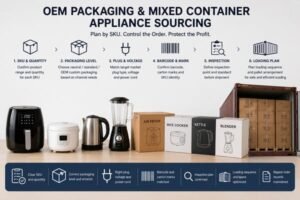
UAE importers can find the right China kitchen appliance supplier by clarifying product categories, separating home appliances from commercial equipment, comparing supplier roles, checking UAE configuration, preparing document questions, and building an RFQ-ready supplier database.
Problem: Many UAE importers, distributors, retailers, and online sellers want to source kitchen appliances from China but do not know which product categories, suppliers, or documents should be checked first.
Agitation: If buyers only search “kitchen appliance supplier” or ask for catalogs, they may receive mixed products, unclear supplier roles, weak document answers, and quotations that are difficult to compare.
Solution: Use this sourcing SOP to define product direction, search suppliers, compare supplier roles, check UAE market fit, manage mixed-category risk, and prepare better questions before sending RFQs.
Snippet: UAE importers should first clarify whether they need home kitchen appliances or commercial kitchen equipment, then build a product direction list, compare China supplier roles, check UAE configuration and document questions, and contact only shortlisted suppliers before RFQ.
This guide is for UAE importers, distributors, appliance retailers, online sellers, and wholesale buyers who want to find kitchen appliance suppliers from China. It is not a supplier ranking list. It is a practical sourcing workflow that helps buyers move from broad search results to an organized supplier and product shortlist.
What are UAE importers, distributors, and appliance retailers really trying to solve?
UAE buyers are not only searching for a supplier; they are trying to choose product categories, supplier roles, UAE configuration, document questions, mixed-category risk, and RFQ-ready sourcing options.
Different UAE buyers have different search intent. A distributor may need several product categories. A retailer may care about packaging and display. An online seller may need photos, specifications, and product differentiation.
| Buyer Type | Real Search Intent | What This SOP Helps Them Complete |
|---|---|---|
| Importer | Can I import this category with proper documents? | Product, supplier, configuration, and document questions |
| Distributor | Can I supply several retail channels? | Product mix, MOQ clues, supplier database |
| Appliance retailer | Can I sell and explain this product in stores? | Packaging, display, spare parts, after-sales questions |
| Online seller | Can I list and differentiate this product online? | Product photos, specifications, labels, packaging |
| First-time buyer | Where do I start? | Search workflow, supplier sheet, first inquiry, RFQ preparation |
The article should help UAE buyers complete a first-stage sourcing task, not only collect supplier names.
Is the buyer looking for home kitchen appliances or commercial kitchen equipment?
Buyers should first decide whether they need home kitchen appliances for retail distribution or commercial kitchen equipment for restaurants, hotels, and project use.
This search term is often confusing. Many “kitchen equipment supplier UAE” results focus on restaurants, hotels, catering kitchens, stainless-steel workstations, installation, and maintenance. But many importers are actually looking for small home kitchen appliances such as air fryers, blenders, kettles, rice cookers, ovens, and vacuum sealers.
| Buyer Need | Better Supplier Direction | Why It Matters |
|---|---|---|
| Retail home appliances | Small kitchen appliance supplier | Focus on consumer packaging and retail channels |
| Distributor stock | Multi-category appliance exporter | Need product range and MOQ coordination |
| Restaurant project | Commercial kitchen equipment supplier | Need installation, durability, and service support |
| Online seller | Product-photo-friendly appliances | Need specifications, packaging, and listing information |
| Private label importer | OEM/ODM appliance supplier | Need artwork, label, manual, and document scope |
Common mistake to avoid
Do not use one search phrase for every buying need. “Commercial kitchen equipment supplier” and “home kitchen appliance supplier” may lead to very different supplier types.
What should UAE importers prepare before searching for kitchen appliance suppliers?
UAE buyers should prepare buyer type, target channel, product direction, buying stage, packaging needs, configuration concerns, and document questions before searching suppliers.
Before contacting China suppliers, create a buyer profile. This helps suppliers understand whether you are a distributor, retailer, online seller, project buyer, or first-time importer.
| Buyer Field | What to Fill In |
|---|---|
| Buyer type | Importer / distributor / retailer / online seller / project buyer |
| Target market | Dubai / Abu Dhabi / Sharjah / UAE-wide / GCC expansion |
| Sales channel | Wholesale / retail / online / supermarket / project supply |
| Product direction | Air fryer / blender / kettle / oven / rice cooker / mixed appliances |
| Buying stage | Product research / supplier search / RFQ / trial order |
| Packaging need | Neutral / color box / Arabic-English label / private label |
| Configuration concern | Plug, voltage, frequency, manual, label, carton |
| Main concern | MOQ / quality / documents / supplier trust / mixed container |
What to do first
- Write down your buyer type and sales channel.
- Choose whether you are searching for one category or mixed kitchen appliances.
- List 3–5 product directions to compare.
- Prepare a supplier database before contacting suppliers.
- Prepare configuration and document questions before requesting prices.
Common mistake to avoid
Do not ask suppliers for a full catalog before defining your product direction. A catalog without a selection method often creates more confusion.
Which kitchen appliance categories should UAE importers compare first?
UAE importers should compare kitchen appliance categories by sales channel, customer use case, packaging needs, after-sales risk, configuration, and supplier availability.
Many UAE buyers do not start with one exact model. They may need to compare several categories before deciding what to source first.
| Product Direction | Possible Products | Buyer Should Check |
|---|---|---|
| Cooking appliances | Air fryer, rice cooker, oven, ceramic hob | Heat safety, plug, carton, product documents |
| Beverage preparation | Blender, juicer, kettle | Motor, blade, jar material, spare parts |
| Food preparation | Food processor, meat grinder, mixer | Accessories, cleaning, packaging, after-sales |
| Food storage and sealing | Vacuum sealer, mini chopper, storage devices | Consumables, bags, spare parts |
| Mixed small appliances | Several categories in one shipment | MOQ, mixed container, supplier coordination |
| Private label appliances | Selected models with brand packaging | Artwork, label, manual, document scope |
These are product direction ideas, not sales guarantees. Buyers should verify customer demand, price positioning, channel fit, and after-sales responsibility before ordering.
How can UAE buyers build a mixed product direction list?
UAE buyers can build a mixed product direction list by grouping appliances by use case, channel fit, risk level, MOQ difficulty, and supplier coordination needs.
A distributor may want several kitchen appliance categories in one sourcing plan. But mixed-category sourcing needs more structure than single-product sourcing.
| Product Role | Example Category | Buyer Purpose |
|---|---|---|
| Entry item | Electric kettle, basic blender | Test price-sensitive channels |
| Core retail item | Air fryer, rice cooker, oven | Support appliance store or retail display |
| Online-friendly item | Digital air fryer, vacuum sealer | Better product photos and listing content |
| Add-on item | Chopper, mini blender, accessories | Support bundle or upsell strategy |
| Brandable item | OEM/private-label appliances | Build long-term brand control |
| Mixed-container item | Several small appliances | Test categories before focusing |
What to do
Start with 3–5 product roles. Ask suppliers to recommend models under each role instead of sending a full catalog without guidance.
Common mistake to avoid
Do not build a mixed-product plan only by choosing cheap items. Mixed sourcing should consider MOQ, packaging, documents, spare parts, and supplier coordination.
Where can UAE buyers find China kitchen appliance suppliers online?
UAE buyers can find China kitchen appliance suppliers through Google, AI search, B2B platforms, supplier websites, trade show directories, referrals, exporters, trading companies, and sourcing partners.
Do not rely on one channel only. A safer method is to collect supplier leads from several sources and compare them in one database.
| Channel | How to Use It |
|---|---|
| Google search | Find supplier websites, product pages, exporters, and sourcing guides |
| AI search | Generate search terms, category lists, checklist questions, and supplier research structure |
| B2B platforms | Compare product listings, MOQ clues, supplier roles, and OEM claims |
| Supplier websites | Review product focus, company identity, and contact channels |
| Trade show directories | Discover manufacturers and exporters by product category |
| Referrals | Get leads from freight forwarders, business contacts, or local buyers |
| Trading companies | Explore multi-category or mixed-container sourcing |
| Sourcing partners | Get help when the buyer cannot visit China or compare suppliers alone |
Common mistake to avoid
Do not contact suppliers before recording them. First save the supplier name, source, product category, role, contact channel, and reason for keeping the result.
How should UAE buyers compare factories, exporters, trading companies, and sourcing partners?
UAE buyers should compare supplier roles by product fit, communication support, transparency, verification ability, mixed-category coordination, and responsibility boundary.
A direct factory may fit clear single-category orders. Exporters, trading companies, and sourcing partners may be useful when the buyer needs multiple categories, smaller trials, mixed shipments, or remote coordination.
| Supplier Role | May Fit When | Buyer Should Check |
|---|---|---|
| Factory | One product category, clear model, stable quantity | Production identity, product depth, sample consistency |
| Exporter | Buyer needs export communication support | Product source, document coordination, responsibility scope |
| Trading company | Buyer needs several related categories | Supplier network, transparency, service value |
| Sourcing partner | Buyer cannot visit China or compare suppliers alone | Service scope, fee logic, verification method |
| Unknown supplier | Early search result only | Must verify identity before serious discussion |
Better buyer perspective
The goal is not to remove every intermediary. The goal is to remove unclear responsibility, weak product fit, and unverifiable claims.
Common mistake to avoid
Do not ask only, “Are you a factory?” Ask what role the supplier plays, what categories they are strongest in, and how their claims can be verified before order decisions.
What risks appear when UAE buyers source mixed kitchen appliance categories?
Mixed-category sourcing creates risks in supplier control, MOQ coordination, document scope, HS code clarity, packaging consistency, and after-sales responsibility.
Mixed kitchen appliance sourcing can be useful for distributors, but it can also create confusion if the buyer treats all products as one simple order.
| Mixed Category Risk | Buyer Should Check |
|---|---|
| Different factories behind one supplier | Who controls quality and documents? |
| Different MOQ per product | Can categories be combined realistically? |
| Different certificates or reports | Are documents model-specific? |
| Different HS codes | Can invoice and packing list be prepared clearly? |
| Different packaging | Will cartons survive shipment and storage? |
| Different spare parts | Who handles replacements and after-sales parts? |
| Different lead times | Can products be consolidated without delay? |
| Different supplier responsibility | Who is accountable if one category fails? |
Common mistake to avoid
Do not assume one supplier can manage all product categories equally well. Ask which categories are their strongest and which categories are sourced through partners.
Which UAE market configuration questions should buyers confirm before price comparison?
UAE buyers should confirm plug, voltage, frequency, manual, label, packaging strength, product marking, spare parts, and barcode needs before comparing prices.
The UAE operates on 230V and 50Hz with Type G plug usage, so buyers should verify configuration for the selected appliance model and sales channel before RFQ or shipment planning. (electricalsafetyfirst.org.uk)
| Priority | Configuration Question | Why It Matters |
|---|---|---|
| 1 | Plug, voltage, frequency | Product usability and customer complaints |
| 2 | Manual and label language | Retail and channel responsibility |
| 3 | Packaging strength | Sea shipment and local distribution |
| 4 | Product marking | Retail, distributor, or channel acceptance |
| 5 | Spare parts | After-sales handling |
| 6 | Barcode or retailer label | Online, supermarket, or distributor requirement |
Common mistake to avoid
Do not compare prices before configuration. A lower unit price may not be useful if the model needs changes, packaging is weak, or spare parts are unclear.
What conformity and import document questions should UAE buyers prepare for verification?
UAE buyers should prepare conformity and import document questions for the selected product, model, target channel, supplier role, and current local requirements before payment or shipment.
MOIAT describes its ECAS service as issuing UAE Certificates of Conformity for products subject to technical regulations, and the service requirements include a valid trade license and a test report from an accredited laboratory. Buyers should verify whether the selected kitchen appliance model falls under current regulated-product requirements before shipment. (moiat.gov.ae)
| Question Area | Buyer Should Ask |
|---|---|
| Product document | What test reports or certificates are available for this model? |
| Certificate scope | Which model, standard, certificate holder, and validity period are covered? |
| Conformity path | Does this selected model need ECAS, CoC, or other conformity discussion? |
| Commercial document | Can the supplier prepare invoice, packing list, and product details? |
| HS code discussion | What HS code does the supplier normally use for this product? |
| Labeling | Can label and manual content match UAE buyer or channel needs? |
| Local verification | What should the UAE importer, clearing agent, or compliance support confirm? |
Common mistake to avoid
Do not accept “we have certificates” as enough. Ask which certificate, for which model, under whose name, for which standard or market, and whether it supports your actual import plan.
What document questions should UAE buyers ask at each sourcing stage?
UAE buyers should ask different document questions during supplier search, RFQ, sample/order, pre-shipment, and local verification stages.
Document questions should be staged. Asking everything too early may slow communication, but asking too late can create import or clearance risk. Trade.gov’s UAE import documentation guidance lists common standard trade documentation such as commercial invoice, certificate of origin, detailed packing list with HS code, import permit where applicable, and bill of entry or airway bill. (trade.gov)
| Stage | Buyer Should Ask |
|---|---|
| Supplier search | What product documents can be discussed later? |
| RFQ stage | Can you provide invoice, packing list, COO details, product specs, carton data? |
| Sample/order stage | Which test reports or certificates match the selected model? |
| Before shipment | What documents are needed for UAE customs and conformity discussion? |
| Local verification | What should the importer, clearing agent, or MOIAT-related process confirm? |
Common mistake to avoid
Do not wait until shipment to ask document questions. The supplier’s ability to prepare product, carton, invoice, packing, and conformity-related information should influence supplier selection.
What should UAE buyers record in a kitchen appliance supplier database?
UAE buyers should record supplier identity, source, role, product categories, UAE fit, mixed-category ability, MOQ clues, packaging options, document readiness, risk signals, and next action.
A supplier database helps buyers compare suppliers instead of relying on WhatsApp chats, screenshots, or memory.
| Field | What UAE Buyer Should Record |
|---|---|
| Supplier name | Company or brand name |
| Source | Google / AI / Alibaba / Made-in-China / referral / website |
| Supplier role | Factory / exporter / trading company / sourcing partner / unknown |
| Product categories | Air fryer / blender / kettle / oven / mixed appliances |
| Main category | What supplier is strongest at |
| UAE fit signal | Mentions UAE, GCC, Middle East, 220–240V, Type G, Arabic-English packaging |
| Mixed category ability | Single category / multi-category / sourcing coordination |
| MOQ clue | Must verify before RFQ |
| Packaging option | Neutral / color box / private label / Arabic-English label |
| Configuration note | Plug, voltage, frequency, label, carton, manual questions |
| Document readiness | Test report, ECAS/CoC discussion, invoice, packing list, COO |
| Trust signal | Product depth, company info, videos, factory or export evidence |
| Risk signal | No company name, vague claims, copied products, unclear contact |
| Contact priority | A / B / C / remove |
| Next action | Record / verify / contact / remove / ask follow-up |
Common mistake to avoid
Do not save only supplier phone numbers. Without product, role, source, risk, configuration, and document notes, you cannot compare suppliers later.
How should UAE buyers judge supplier replies before RFQ?
UAE buyers should judge supplier replies by product relevance, category knowledge, UAE configuration clarity, document readiness, mixed-category coordination, and willingness to answer structured questions.
The first reply is not only about price. It tells you whether the supplier understands B2B sourcing and whether the conversation can move toward RFQ.
| Supplier Reply | What It May Indicate |
|---|---|
| Recommends categories for UAE channels | Better product-fit thinking |
| Explains model differences | Stronger product knowledge |
| Confirms configuration carefully | Better than vague “yes, all can do” |
| Asks about channel, quantity, and packaging | Better B2B communication |
| Explains mixed-category limits | More realistic coordination |
| Only sends catalog | Weak reply; needs follow-up |
| Pushes payment quickly | High-risk signal |
| Claims all certificates without model scope | Must verify before decision |
Follow-up after catalog
Thank you for the catalog.
Please recommend 5–10 kitchen appliance products that may fit UAE wholesale, retail, or online channels.
For each product, please share:
- Product photo
- Basic specification
- Main category and model type
- MOQ clue
- Packaging option
- Plug, voltage, and label configuration options
- Whether private label is possible
- What documents can be discussed for the selected model
- What information you need from us before quotation
Common mistake to avoid
Do not move a supplier to RFQ only because they reply fast. A useful reply should help you compare product fit, configuration, documents, and next quotation requirements.
Who should UAE buyers involve before making supplier decisions?
UAE buyers should involve the China supplier, UAE clearing agent, freight forwarder, compliance support, retail/channel team, and sourcing partner when decisions affect cost, documents, delivery, or risk.
Not every question should be answered by the China supplier. Some questions belong to the buyer, local market, freight forwarder, clearing agent, or compliance support.
| Role | What They Help Confirm |
|---|---|
| China supplier | Product models, MOQ, packaging, export documents, configuration |
| UAE clearing agent | HS code discussion, customs documents, local clearance |
| Freight forwarder | Shipment method, carton volume, freight estimate |
| Compliance support / notified body | ECAS, CoC, or conformity path when needed |
| Retail or channel team | Product fit, packaging, customer expectations |
| Sourcing partner | Supplier comparison, communication, mixed-category coordination |
Common mistake to avoid
Do not expect the China supplier to solve every UAE import question. A supplier can provide product and export documents, but local clearance and conformity responsibility must be confirmed locally.
What should UAE buyers ask before sending a formal RFQ?
UAE buyers should send a product and supplier discovery message before a formal RFQ if they are still comparing categories, suppliers, or market-fit questions.
Many buyers are not ready for RFQ at the first contact stage. A discovery message helps suppliers recommend suitable products and confirm whether they fit your sourcing plan.
Hello, we are a UAE-based importer/distributor looking for kitchen appliance suppliers from China.
We are still building our product and supplier shortlist before RFQ.
Please help confirm:
- What kitchen appliance categories are your strongest?
- Are you a factory, exporter, trading company, or sourcing partner?
- Which products may fit UAE wholesale, retail, or online channels?
- Can you support UAE market configuration for selected models?
- Can you recommend 5–10 products for first-stage comparison?
- What product documents can be discussed later for selected models?
- What information do you need from us before quotation?
Our target market is: [Dubai / Abu Dhabi / Sharjah / UAE-wide / GCC]
Our sales channel is: [wholesale / retail / online / distributor / project supply]
Our current stage is: supplier research before RFQ.
Common mistake to avoid
Do not ask only “send catalog” or “best price.” A better first message asks for category strength, model recommendations, configuration support, document readiness, and quotation requirements.
When has a UAE buyer completed the first supplier-search stage?
A UAE buyer has completed the first search stage when they have product directions, supplier leads, supplier records, useful replies, UAE configuration notes, document questions, and RFQ questions ready.
The first stage is not finished when you collect catalogs. It is finished when your supplier information is organized enough to support RFQ.
Practical completion target
A UAE buyer can move toward RFQ preparation when they have:
- 3–5 kitchen appliance product directions
- 20–50 supplier leads from Google, AI, B2B platforms, and referrals
- 5–10 suppliers worth contacting
- 3–5 suppliers with useful replies
- A supplier database with UAE configuration notes
- Mixed-category risk notes if sourcing several categories
- Document questions for selected product models
- Open questions for local clearing or conformity verification
- A first RFQ checklist
These numbers are practical working targets, not fixed rules. Smaller buyers may need fewer leads. Larger distributors may need a wider supplier pool.
Common mistake to avoid
Do not keep searching forever. Once you have enough organized supplier information, move to RFQ preparation and deeper verification.
When should UAE buyers send us a message to discuss their sourcing questions?
UAE buyers should send a message when they are unsure which product categories, supplier links, Google results, AI answers, mixed-category risks, configuration questions, or document issues are worth moving forward.
You do not need to prepare a perfect RFQ before asking for discussion. If you are still comparing products or suppliers, you can share your current situation.
| Detail to Share | Why It Helps |
|---|---|
| Buyer type | Importer, distributor, retailer, online seller, project buyer |
| Target market | Dubai, Abu Dhabi, Sharjah, UAE-wide, or GCC |
| Product ideas | Shows which kitchen appliance categories you are considering |
| Supplier links | Helps review whether suppliers are worth recording |
| AI or Google search results | Helps identify useful and weak leads |
| Mixed-category questions | Helps check whether one supplier can coordinate several products |
| Configuration concern | Plug, voltage, label, manual, packaging, carton |
| Document concern | ECAS/CoC, test reports, invoice, packing list, COO |
| Current stage | Research, shortlist, RFQ, trial order planning |
Example message
Hello, we are a UAE-based buyer looking for kitchen appliance suppliers from China.
We are still comparing product categories and suppliers.
Our buyer type is: [importer / distributor / retailer / online seller]
Our target channel is: [wholesale / retail / online / supermarket / distributor]
Our current product interest is: [air fryer / blender / kettle / rice cooker / oven / mixed appliances]
Here are some supplier links or search results we found:
- [link]
- [link]
- [AI or Google result]
Our questions are:
- Which suppliers look worth recording?
- Which product categories may be better to compare first?
- What should we ask before RFQ?
- What UAE configuration or document questions should we prepare?
Common mistake to avoid
Do not wait until you have already contacted many unsuitable suppliers. Early discussion can help you organize your search and avoid wasting time.
FAQ
These questions answer common problems UAE importers, distributors, retailers, and online sellers face when sourcing kitchen appliances from China.
Should UAE buyers search for home kitchen appliances or commercial kitchen equipment?
Buyers should first identify their channel. Retailers and distributors usually search for home kitchen appliances, while restaurants, hotels, and central kitchens may need commercial kitchen equipment suppliers.
Should UAE buyers contact factories only?
No. Factories, exporters, trading companies, and sourcing partners may all be useful depending on product range, order size, experience, and support needs. Buyers should evaluate role, transparency, and verification ability.
Which kitchen appliance category should UAE buyers start with?
Start with categories that match your channel. Retail buyers may compare air fryers, kettles, blenders, and rice cookers, while online sellers may prefer products with strong photos, specifications, and packaging.
What if I want several kitchen appliance categories?
Build a mixed product direction list and record category-level risks. Check MOQ, documents, HS code clarity, packaging, spare parts, lead time, and supplier coordination for each category.
Should I ask for price first?
No. First confirm product category, supplier role, UAE market configuration, packaging option, MOQ clue, and document readiness. Price is more useful after the model and requirements are clear.
How do I know if the supplier can support UAE market configuration?
Ask about the selected model’s plug, voltage, frequency, label, manual, carton, and packaging support. These details should be confirmed before RFQ or during RFQ preparation.
What documents should I ask the supplier about?
Ask what test reports, certificates, commercial invoice details, packing list details, certificate of origin details, product information, and conformity-related documents can be discussed for the selected model.
Does every kitchen appliance need ECAS?
Do not assume one rule for every product. Buyers should verify whether the selected product and model are subject to current UAE technical regulations and conformity requirements before shipment. MOIAT’s ECAS service applies to products subject to technical regulations. (moiat.gov.ae)
Should I use AI to find suppliers?
Yes, but use AI for keyword generation, checklist building, category organization, and question drafting. Do not treat AI supplier recommendations as verified supplier facts.
When should I move to RFQ?
Move to RFQ when you have clear product directions, a supplier database, supplier replies, UAE configuration notes, document questions, and specific questions for selected models.
Who should help verify UAE import questions?
A UAE clearing agent, freight forwarder, compliance support contact, or relevant authority should help verify local clearance, duty, conformity, and document questions before shipment.
When should I ask for help?
Ask for help when you are unsure what product category to choose, which suppliers to record, how to judge replies, what document questions to prepare, or what to ask before RFQ.
Conclusion
UAE importers, distributors, retailers, and online sellers can find China kitchen appliance suppliers more safely by following a structured sourcing process. The goal is not to collect random catalogs or chase the lowest price first. The goal is to clarify whether the buyer needs home appliances or commercial equipment, define product categories, compare supplier roles, check mixed-category risks, prepare UAE configuration questions, record supplier data, and organize RFQ-ready questions.
A useful first-stage result should include product directions, supplier leads, supplier records, reply notes, configuration questions, staged document questions, mixed-category risk notes, and open conformity or clearing questions for local verification. Once this information is organized, buyers can move into RFQ, sample discussion, quotation comparison, and deeper supplier verification.
CTA
If you are a UAE importer, distributor, retailer, or online seller trying to find kitchen appliance suppliers from China but still feel unsure where to start, you can send us a message through the inquiry form, WhatsApp, or WeChat.
You can share your target emirate or UAE-wide channel, product ideas, supplier links, Google or AI search results, mixed-category sourcing questions, UAE configuration concerns, supplier replies, or document questions. We can discuss your sourcing situation with you, help organize supplier information, review product-fit and UAE market-fit questions, and suggest the next step before you send RFQs or contact more suppliers.