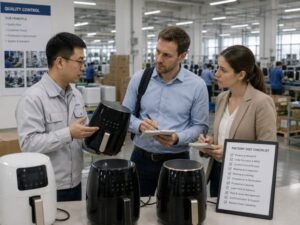
B2B buyers can use AI to clarify product direction, generate supplier search queries, classify results, audit sources, build a supplier database, verify risks, and contact shortlisted China small appliance suppliers with structured questions before RFQ.
AI can make supplier research faster, but it should not be treated as supplier verification. In our sourcing conversations, we often see buyers arrive with long AI-generated supplier lists but no clear way to judge which names are useful. Some links come from B2B platforms, some from blogs, some from social media, and some are only repeated company names without enough evidence. That is why this guide does not teach buyers to “ask AI for more suppliers.” It teaches buyers how to use AI to build a sourcing workflow that can be checked, recorded, and discussed with real suppliers.
Problem: Many importers, distributors, retailers, online sellers, and brand owners now use ChatGPT, Perplexity, Gemini, Google AI, and B2B platform AI tools to find China appliance factories, OEM suppliers, component suppliers, and ready-to-market product partners, but they often do not know how to judge the results.
Agitation: If buyers trust AI-generated supplier names directly, they may contact the wrong company, confuse factories with traders, miss better OEM or parts suppliers, ignore product configuration, overlook document risks, or move toward payment before verification.
Solution: Use this step-by-step AI sourcing SOP to turn AI answers into a practical supplier-search workflow: product direction, supplier type, search prompts, source audit, supplier database, risk checks, first message, and RFQ readiness.
Snippet: Buyers should use AI as a sourcing assistant, not supplier proof. The safe workflow is to prepare buyer inputs, generate search prompts, classify results, audit sources, record suppliers, verify identity, compare supplier roles, and contact only shortlisted suppliers with structured questions.
This guide is for B2B buyers who want to use AI tools to find China small appliance suppliers more effectively. It applies to buyers with no sourcing experience, as well as experienced buyers who already import products but are not yet confident using AI for supplier discovery, comparison, verification preparation, and supplier communication.
What is the complete AI supplier search workflow?
Buyers should follow a 10-step workflow: prepare buyer inputs, clarify product direction, choose AI tools, generate keywords, search by supplier type, classify results, audit sources, build a database, verify risks, and contact shortlisted suppliers.
When buyers ask us why their AI search results feel confusing, we usually find the same problem: they used AI as a search box, not as a sourcing process. A better approach is to move step by step, so every AI answer becomes a record, a question, a verification task, or a decision.
The 10-step AI sourcing workflow
-
Prepare buyer profile
Define target country, sales channel, product interest, supplier type, customization needs, and buying stage. -
Clarify product direction
Use AI to narrow 3–5 product categories or model directions before searching suppliers. -
Choose AI tool by task
Use different AI tools for workflow design, source-linked research, broad reports, search snapshots, and platform discovery. -
Generate supplier search keywords
Create keywords for factories, OEM/ODM suppliers, component suppliers, exporters, trading companies, sourcing partners, and ready-to-market product partners. -
Search by supplier type
Do not search only “China appliance supplier.” Search each supplier role separately. -
Classify AI and web results
Separate factory websites, platform listings, directories, blog articles, social leads, marketplace pages, and unclear results. -
Audit source links
Check whether each AI source actually supports the supplier claim. -
Build supplier database
Record supplier name, source, role, product category, trust signals, risk signals, and next action. -
Clean and score supplier leads
Remove duplicates, unsupported names, weak sources, and unclear identities. -
Contact shortlisted suppliers
Send structured discovery messages before formal RFQ.
Common mistake to avoid
Do not treat AI search as a one-question task. AI sourcing works best when buyers use it as a structured process from buyer profile to supplier shortlist.
What should buyers understand before using AI for supplier search?
Buyers should understand that AI can help discover, organize, and question supplier leads, but it cannot prove supplier reliability, product compliance, factory identity, payment safety, or long-term cooperation ability.
Different AI tools may support search, summarization, source review, query expansion, and research organization in different ways. These functions can support supplier research, but they should not be treated as final supplier proof.
When buyers send us AI supplier lists for review, the first issue is usually not the number of suppliers. The real issue is that many names are not classified. A buyer may mix a factory website, a trading company profile, a marketplace product page, and a sourcing-agent article in the same list. Before judging reliability, we first help separate result types. Only after that can the buyer decide what to verify next.
What AI can help with
AI can help buyers:
- Clarify product direction.
- Generate search keywords.
- Find supplier leads.
- Compare supplier websites.
- Extract product and company information.
- Classify supplier result types.
- Build a supplier database.
- Draft supplier questions.
- Prepare first contact messages.
- Organize RFQ readiness.
What AI cannot prove
AI cannot prove:
- The supplier is a real factory.
- The supplier actually produces the product.
- Certificates match the selected model.
- The price is commercially reasonable.
- Payment is safe.
- Quality will be consistent.
- The product fits the target market.
- Import compliance is satisfied.
- The supplier can deliver on time.
- The supplier will be a reliable long-term partner.
Common mistake to avoid
Do not ask AI, “Who is the best China appliance supplier?” Ask AI to help you create a sourcing workflow, supplier database, verification checklist, and first-message plan.
How should buyers treat every AI supplier answer?
Buyers should treat every AI supplier answer as a lead to investigate, not as supplier proof, because AI confidence, source links, rankings, and fluent summaries do not confirm supplier reliability.
One lesson we repeat to buyers is simple: AI answers should not end the search; they should start the verification. If AI gives a supplier name, the next step is not to trust it or reject it immediately. The next step is to ask: where did this name come from, what source supports it, what product category does it actually show, and what question should we ask the supplier?
How to treat common AI outputs
Supplier name
Treat it as a lead, not proof. Search the company name again and record the original source.
Source link
Treat it as an evidence starting point, not final verification. Check whether the page actually supports the supplier claim.
Supplier ranking
Treat it as an AI-generated opinion, not a procurement decision. Do your own supplier classification.
Certificate claim
Treat it as a verification task. Ask which certificate, which model, which holder, which scope, and whether the document is current.
Factory claim
Treat it as an identity question. Ask for product-specific production evidence, not only general factory photos.
Price clue
Treat it as comparison input, not final landed cost. Confirm trade term, MOQ, carton data, logistics, duties, and other cost factors.
Product recommendation
Treat it as product direction, not demand guarantee. Confirm channel fit, customer fit, and target-market requirements.
AI confidence
Treat it as writing style, not supplier reliability. Trust must come from evidence, records, samples, documents, and performance.
Safe buyer rule
Every AI answer should become one of four actions:
- Record the lead.
- Verify the claim.
- Ask the supplier a specific question.
- Remove the result if it cannot be traced.
Common mistake to avoid
Do not confuse AI confidence with supplier trust. Trust must come from traceable identity, product evidence, documents, samples, inspection, payment controls, and supplier performance.
What should buyers prepare before asking AI to find China small appliance suppliers?
Buyers should prepare target market, product interest, buyer role, sales channel, supplier type, customization needs, import concerns, and buying stage before asking AI to search suppliers.
AI answers become generic when buyer inputs are vague. A buyer who only asks “find China suppliers” may receive mixed results that include factories, directories, agents, blog articles, marketplaces, and unrelated companies.
AI sourcing readiness sheet
Target country
Write the country where the products will be sold or imported.
Buyer role
Choose one:
- Importer
- Distributor
- Retailer
- Online seller
- Brand owner
- Project buyer
- Existing buyer expanding categories
Sales channel
Choose one or more:
- Wholesale
- Retail shop
- Online marketplace
- Supermarket
- Dealer network
- Project supply
- Local appliance store
Product direction
Write your current product interest:
- Air fryer
- Blender
- Kettle
- Rice cooker
- Fan
- Coffee maker
- Food processor
- Vacuum sealer
- Not sure yet
Supplier type needed
Choose what you may need:
- Factory
- OEM supplier
- ODM supplier
- Component supplier
- Ready-to-market product partner
- Exporter
- Trading company
- Sourcing partner
Customization need
Record whether you need:
- Logo
- Color box
- Private label
- Manual
- Plug
- Voltage
- Panel language
- Packaging design
- Product modification
Import concern
Record what may need checking:
- HS code
- Customs documents
- Certificates
- Labeling
- Plug and voltage
- Duty and VAT
- Local standards
- Platform requirements
Current stage
Choose one:
- Product research
- Supplier search
- Supplier shortlist
- Sample request
- RFQ preparation
- Trial order
- Repeat order planning
Prompt to prepare buyer inputs
I am a B2B buyer looking for China small appliance suppliers.
Please help me organize my buyer profile before supplier search.
Ask me for:
- target country
- buyer role
- sales channel
- product interest
- supplier type needed
- customization needs
- import or certification concerns
- current buying stage
After I answer, turn my inputs into a supplier search brief.
Common mistake to avoid
Do not use AI before you define your buying context. AI can only give useful supplier-search guidance when it knows your market, product direction, channel, and buying stage.
Which AI tool should buyers use for each supplier search task?
Buyers should choose AI tools by sourcing task, not by tool popularity, because supplier discovery, source review, query expansion, document organization, and communication drafting are different tasks.
The best AI tool is not always the one that gives the longest supplier list. For B2B sourcing, the better tool is the one that helps the buyer trace sources, structure evidence, prepare verification questions, and move toward supplier communication.
AI tool task map
Workflow and prompt planning
Use AI to build a sourcing process, buyer profile, search plan, supplier questions, and RFQ readiness checklist.
Source-linked research
Use AI search tools to collect web results, compare pages, and trace where supplier names came from.
Broad product or market research
Use AI research tools when you need a broader report on product categories, buyer concerns, channel fit, or sourcing options.
Search result exploration
Use search engines and AI-enhanced search features to see common result types, related queries, and website sources.
Platform-based discovery
Use B2B platforms to find product listings, supplier profiles, and model references, but do not treat platform matching as final verification.
Supplier communication support
Use AI to draft first messages, follow-up questions, RFQ structures, and risk-check questions.
Recommended tool sequence
- Use AI to create the sourcing workflow and prompts.
- Use search engines and AI search tools to see common result types.
- Use source-linked tools to collect supplier and topic leads.
- Use broader research tools for product or market research when needed.
- Use B2B platform tools to find platform-based supplier leads.
- Bring the results back into one supplier database.
- Use AI again to classify, audit, and prepare supplier questions.
- Verify important claims manually before contacting or paying suppliers.
Common mistake to avoid
Do not compare AI tools only by which one gives more supplier names. Compare whether the tool helps you move from search to verification.
How can buyers use AI to clarify product direction before searching suppliers?
Buyers should use AI to clarify product direction before supplier search by comparing category fit, channel fit, customization needs, technical risk, after-sales needs, and supplier type.
Many buyers ask for catalogs because they do not know what product to source next. This often leads to too many models, weak comparison, and no next action. AI should first help the buyer narrow product direction.
Prompt for product direction
I am a B2B buyer looking for small appliance products from China.
My target country is: [country]
My sales channel is: [wholesale / retail / online / distributor / supermarket]
My current product interest is: [air fryer / blender / kettle / rice cooker / not sure]
My buying stage is: [research before supplier contact]
Please help me create:
- 5 possible product directions
- which buyer type each product may fit
- key product configuration questions
- after-sales or spare parts risks
- what supplier type may fit each product direction
Do not recommend suppliers yet. First help me decide what to search for.
Product direction examples
Air fryer
Compare capacity, control type, plug, packaging, carton strength, spare baskets, and after-sales questions.
Blender
Compare motor power, jar material, spare blades, noise, safety, and spare parts.
Kettle
Compare material, heating plate, plug, carton, price position, and document questions.
Rice cooker
Compare capacity, inner pot, heating type, local cooking habits, and channel fit.
Fan
Compare motor, blade size, assembly, spare parts, packaging, and seasonal demand logic.
Vacuum sealer
Compare sealing width, bags, motor, replacement parts, packaging, and support materials.
Mixed kitchen appliances
Compare supplier coordination, MOQ, document scope, shipment complexity, and responsibility boundaries.
Common mistake to avoid
Do not ask AI to find suppliers before you know which product type, product level, and sales channel you are targeting.
How should buyers ask AI to generate supplier search keywords?
Buyers should ask AI to generate keywords by supplier type, product category, customization need, target market, platform, and verification purpose instead of using one broad search phrase.
AI-generated keywords should help buyers search across Google, AI search tools, B2B platforms, supplier websites, social media, and directories.
Prompt for supplier search keywords
Based on my buyer profile, generate supplier search keywords for China small appliance sourcing.
Buyer profile:
- Target country: [country]
- Sales channel: [channel]
- Product category: [product]
- Buying stage: supplier search before RFQ
- Customization need: [OEM / ODM / neutral / private label / not sure]
Group keywords by:
- factory search
- OEM/ODM supplier search
- ready-to-market product supplier search
- component or spare parts supplier search
- exporter or trading company search
- sourcing partner search
- platform search
- verification search
Give me keywords for Google, AI search tools, Alibaba, Made-in-China, Global Sources, LinkedIn, and social media.
Keyword examples
Factory search
China air fryer factory OEM
China blender manufacturer wholesale
China kettle factory export
China small appliance manufacturer
OEM/ODM search
small appliance OEM ODM China
private label kitchen appliance supplier China
China appliance OEM factory for distributors
custom logo air fryer supplier China
Component supplier search
China blender motor supplier
air fryer heating element supplier China
small appliance PCB supplier China
kettle thermostat supplier China
Ready-to-market product search
ready stock small appliances China wholesale
ready-to-market kitchen appliances China
China export ready air fryer supplier
small appliances for distributors China
Verification search
[supplier name] factory
[supplier name] business license
[supplier name] Alibaba profile
[supplier name] Made-in-China
[supplier name] export small appliances
Common mistake to avoid
Do not use only “China appliance supplier.” Break the search into factory, OEM, parts, ready product, exporter, and sourcing partner queries.
How should buyers use AI to search factories, OEM suppliers, parts suppliers, and ready-to-market partners?
Buyers should use AI to search different supplier types separately because factories, OEM suppliers, parts suppliers, exporters, trading companies, and ready-to-market partners solve different sourcing problems.
A buyer who wants a private-label air fryer should not use the same search method as a buyer looking for blender motors or mixed-container appliances.
Supplier type search map
Factory
Search goal: find producers for one product category.
Example direction: air fryer factory China OEM
Must verify: production identity, model depth, QC process.
OEM supplier
Search goal: find private-label support.
Example direction: small appliance OEM private label China
Must verify: logo, packaging, manual, panel, MOQ, sample process.
ODM supplier
Search goal: find design or development support.
Example direction: ODM kitchen appliance supplier China
Must verify: development scope, tooling, sample approval, IP and responsibility boundaries.
Component supplier
Search goal: find motors, PCB, heating elements, housings, accessories, or spare parts.
Example direction: blender motor supplier China
Must verify: compatibility, specifications, testing, and supply stability.
Ready-to-market partner
Search goal: find mature wholesale models that may be closer to launch.
Example direction: ready stock small appliances China
Must verify: stock claim, model stability, packaging, carton data, and documents.
Exporter
Search goal: find export-ready coordination.
Example direction: China appliance exporter Africa
Must verify: product source, document scope, and responsibility.
Trading company
Search goal: find mixed-category sourcing support.
Example direction: mixed container kitchen appliances China
Must verify: transparency, supplier network, and service value.
Sourcing partner
Search goal: find remote China-side support.
Example direction: China appliance sourcing agent inspection
Must verify: service scope, fee logic, verification method, and responsibility boundary.
Prompt for supplier type search
I want to find China small appliance suppliers, but I need to separate supplier types.
Product category: [product]
Target market: [country]
Sales channel: [channel]
Please create separate search plans for:
- real factories
- OEM/ODM suppliers
- component suppliers
- ready-to-market product partners
- exporters
- trading companies
- sourcing partners
For each supplier type, give:
- search keywords
- where to search
- what result type to expect
- what must be verified
- when this supplier type fits
Common mistake to avoid
Do not treat “factory” as the only good supplier type. The right role depends on product clarity, quantity, customization, category complexity, remote support needs, and risk tolerance.
What AI prompt chain should buyers follow from product idea to supplier shortlist?
Buyers should follow a prompt chain that moves from buyer profile to product direction, search keywords, supplier types, result classification, source audit, supplier database, risk check, first message, and RFQ readiness.
A single prompt cannot complete supplier sourcing. Buyers need a sequence that turns one vague sourcing goal into a supplier shortlist that can be contacted.
Prompt 1: build buyer profile
I am a B2B buyer looking for China small appliance suppliers.
Help me create a buyer profile for supplier search.
Ask me for target country, product category, sales channel, customization needs, order stage, import concerns, and supplier type preference.
Prompt 2: clarify product direction
Based on this buyer profile:
[Paste buyer profile]
Help me choose 3–5 product directions before supplier search.
For each product direction, show:
- likely sales channel fit
- supplier type needed
- configuration questions
- quality and after-sales risks
- information to collect before RFQ
Prompt 3: generate supplier search keywords
Based on my selected product directions:
[Paste product directions]
Generate supplier search keywords for Google, AI search tools, Alibaba, Made-in-China, Global Sources, LinkedIn, and social media.
Group by factory, OEM/ODM, component supplier, ready-to-market product partner, exporter, trading company, and sourcing partner.
Prompt 4: classify search results
I found these AI and web search results:
[Paste supplier links, platform pages, social profiles, articles, or AI results]
Classify each result as:
- factory website
- B2B platform listing
- OEM/ODM supplier
- component supplier
- exporter
- trading company
- sourcing partner
- marketplace product page
- blog or directory
- social media lead
- unclear or risky result
For each result, tell me:
- why it belongs to this category
- what information I should record
- what I must verify before contacting
Prompt 5: build supplier database
Create a supplier database template for China small appliance sourcing.
Columns should include:
supplier name, AI tool source, original source link, supplier type, product category, main product, OEM ability, component ability, ready-product ability, target market fit, MOQ clue, document claim, trust signals, risk signals, verification questions, contact priority, next action.
Prompt 6: identify risk signals
Review these supplier records:
[Paste supplier database rows]
Identify possible risk signals, including:
- unclear company identity
- weak product depth
- copied text
- vague certificate claims
- unclear factory/trader role
- no model-specific documents
- payment pressure
- unrealistic claims
- duplicate company records
- no source link
For each risk, suggest what to ask or verify next.
Prompt 7: prepare first supplier message
Write a professional first message to a China small appliance supplier.
I am not ready for a formal RFQ yet. I want to confirm supplier role, product category strength, OEM ability, market configuration, document readiness, sample terms, and what information they need from me before quotation.
Target market: [country]
Product category: [product]
Sales channel: [channel]
Current stage: supplier research before RFQ.
Prompt 8: check RFQ readiness
Review my supplier database and tell me whether I am ready to send RFQs.
Check whether I have:
- clear product direction
- supplier type classification
- 5–10 suppliers worth contacting
- product configuration questions
- document questions
- sample questions
- MOQ and trade term questions
- risk signals recorded
- first contact message prepared
If I am not ready, tell me what is missing.
Common mistake to avoid
Do not keep asking AI for more supplier names when your real problem is missing product direction, weak verification questions, or no supplier database.
How should buyers classify AI supplier search results before trusting them?
Buyers should classify every AI search result before trusting it because AI may return supplier websites, platform listings, directories, social posts, blog articles, marketplaces, or unclear company names.
The classification step prevents buyers from treating every result as a supplier. A blog article may help with checklist ideas, while a social post may be only a lead, and a platform listing may still need identity verification.
AI result classification guide
Factory website
Treat as a possible supplier lead. Verify product depth, company identity, production role, and model-specific information.
B2B platform listing
Treat as a lead source, not proof. Check whether the company identity and product category are consistent outside the platform.
Supplier directory
Use for discovery, then verify independently. Directories often repeat supplier claims without proving them.
AI-generated supplier name
Search again on Google, B2B platforms, and official websites. Remove it if it cannot be traced.
Blog article
Use for checklist ideas or background, not supplier proof.
Social media lead
Ask for company name, website, product model, documents, and formal contact path.
Marketplace product page
Use for product direction, not supplier verification.
News or PR page
Treat as background, not buyer proof.
Unclear company
Record risk or remove it from the shortlist.
Prompt for result classification
Classify these AI supplier search results.
For each result, decide whether it is:
- supplier lead
- product idea source
- background article
- social media lead
- duplicate listing
- unclear result
- risky result
Then tell me what I should record and what I must verify.
Common mistake to avoid
Do not copy AI supplier names into your shortlist until you know what type of source each result comes from.
How should buyers audit AI sources before adding suppliers to a shortlist?
Buyers should audit AI sources by checking source type, company identity, product relevance, recency, product depth, duplicate risk, and whether the AI answer overstates supplier reliability.
A source link is only the beginning of verification. Generative search tools can help users explore sources, but buyers still need to check whether the source actually proves the supplier claim, product capability, or company identity.
AI source audit checklist
Source type
Is it an official supplier website, platform page, article, social profile, directory, or marketplace page?
Company identity
Does the page show company name, address, official contact method, and a consistent identity?
Product relevance
Does the supplier actually show the target small appliance category?
Product depth
Are there multiple models, specifications, manuals, photos, videos, packaging details, or product pages?
Factory claim
Is there production evidence, or only the word “manufacturer”?
OEM claim
Does the page explain logo, packaging, panel, manual, customization, or development scope?
Document claim
Does it name specific documents, or does it only say “all certificates”?
Recency
Is the source current enough to be useful for supplier discovery?
Duplicate risk
Is the same company repeated across many directories or AI outputs?
AI certainty
Did AI turn a weak source into a strong recommendation?
Common mistake to avoid
Do not assume “AI cited a source” means the supplier is reliable. A citation tells you where the information came from; it does not prove supplier quality or cooperation ability.
What supplier information should buyers record from AI and web search results?
Buyers should record supplier identity, AI source, original link, supplier type, product category, product depth, OEM ability, document claims, trust signals, risk signals, verification questions, priority, and next action.
In our own supplier review process, we do not start by asking whether a supplier is “good” or “bad.” We first ask whether the supplier record is complete enough to judge. If the record only has a company name and WhatsApp number, it is not ready. If it has a source link, supplier role, product category, model information, trust signals, risk signals, and next questions, then the buyer can make a more reasonable decision.
Supplier database fields
Supplier identity
Record supplier name, company name, brand name if different, and official contact path.
AI and source record
Record which AI tool, search engine, B2B platform, directory, social media channel, or referral produced the lead.
Original source link
Save the exact website, platform page, article, social profile, or product page.
Supplier type
Classify as factory, OEM supplier, ODM supplier, parts supplier, exporter, trader, sourcing partner, or unclear.
Product category
Record air fryer, blender, kettle, rice cooker, fan, coffee maker, component, mixed appliances, or other category.
Product depth
Record whether the supplier shows a main category, many models, one listed item, or unclear product depth.
Target-market fit
Record plug, voltage, packaging, label, manual, certification discussion, and country-specific questions.
OEM ability
Record logo, color box, mold, panel, manual, private label, or packaging support.
Component ability
Record motor, heating element, PCB, housing, accessories, spare parts, or compatibility questions.
Ready-product ability
Record mature model, stock product, wholesale-ready model, packaging readiness, and document readiness.
MOQ clue
Record any MOQ clue, but mark it as must verify before RFQ.
Document claim
Record test reports, certificates, commercial invoice, packing list, COO, or other document claims.
Trust signal
Record company information, real product details, consistent identity, sample policy, and inspection openness.
Risk signal
Record no company name, vague claims, copied text, payment pressure, unclear role, or missing source.
Verification question
Record what must be checked before first contact, RFQ, sample order, deposit, or production.
Contact priority
Use A, B, C, or remove.
Next action
Choose verify, contact, ask follow-up, request sample, prepare RFQ, or remove.
Contact priority rules
A priority
The supplier has clear company identity, relevant product category, product depth, contact method, and reasonable next-step questions.
B priority
The supplier may fit, but product depth, role, document scope, or target-market fit needs more checking.
C priority
The supplier is weak but may be kept as backup.
Remove
The result has no company identity, no source, no product relevance, or too many risk signals.
Common mistake to avoid
Do not save only supplier links. Save what the supplier is, why it may fit, what it claims, what is missing, and what to verify next.
What do we usually check first when buyers send us AI supplier results?
We usually check source type, supplier identity, product relevance, supplier role, repeated listings, risk signals, and the next verification question before deciding whether a supplier lead is worth contacting.
When buyers send us AI-generated supplier lists, we do not immediately ask which supplier is the cheapest. We first check whether each result is understandable. This simple review often helps buyers reduce confusion. Instead of asking AI for more names, the buyer can focus on the few leads that are traceable, relevant, and worth verifying.
What we check first
A useful supplier lead should answer:
- Where did this supplier name come from?
- Is the source a supplier website, platform page, directory, article, or social post?
- Does the supplier show the target product category?
- Does the company appear to be a factory, exporter, trader, component supplier, or sourcing partner?
- Are there real product details, or only general marketing claims?
- Is the same company repeated across different websites?
- What information is missing before first contact?
- What question should the buyer ask next?
Common mistake to avoid
Do not ask AI for more names before reviewing the names you already have. A smaller clean shortlist is more useful than a large unclear list.
How can buyers clean duplicate, unclear, or unsupported supplier leads?
Buyers can clean AI supplier leads by merging duplicate company records, removing unsourced names, checking company identity, separating brands from manufacturers, and marking unclear results as must-verify or remove.
AI may repeat the same supplier from different directories, misread a brand as a factory, or generate a supplier name that is not traceable. Cleaning prevents a fake shortlist.
Cleanup rules
- Merge the same company if it appears on multiple platforms.
- Do not count the same company twice because AI found several listings.
- Remove AI-generated names that cannot be traced to a real source.
- Mark “brand only” results separately from manufacturer results.
- Mark WhatsApp-only contacts as high risk until company identity is confirmed.
- Do not treat “manufacturer” wording as factory proof.
- Remove suppliers with no product relevance.
- Mark broad multi-category suppliers as “role unclear” if product depth is weak.
- Check whether the same photos or product text appear across many sites.
- Keep the original source link for every supplier record.
Prompt for lead cleanup
Review this supplier list and clean it.
Please:
- merge duplicate company records
- remove suppliers with no source link
- mark unclear company identity
- separate brand names from manufacturer names
- identify possible trading companies or sourcing agents
- identify suppliers with weak product relevance
- create a clean shortlist with A/B/C/remove priority
Here is my supplier list:
[Paste supplier database]
Common mistake to avoid
Do not build a shortlist based on the number of supplier names. Build it based on traceable identity, product fit, and verification readiness.
What should buyers do if AI supplier search results are poor?
Buyers should improve poor AI supplier search results by narrowing product direction, adding supplier type, using target-market context, searching company names separately, and cleaning duplicate or untraceable leads.
We often see buyers repeat the same AI prompt several times, hoping the next answer will be better. In most cases, the problem is not the AI tool itself. The problem is that the buyer has not given enough sourcing context. Adding target country, product category, supplier type, sales channel, and buying stage usually produces more useful search directions than simply asking AI for “better suppliers.”
Poor AI result troubleshooting
AI gives generic suppliers
Add product category, target market, supplier type, sales channel, and buying stage.
AI gives only B2B platform pages
Search company names separately on Google, B2B platforms, and official websites.
Supplier names cannot be traced
Mark them as remove or must verify.
Results are mostly trading companies
Search with factory, manufacturer, product model, and industrial cluster terms, but still compare whether trading companies may provide useful service value.
AI finds too many unrelated products
Narrow product direction before supplier search.
No component suppliers appear
Search by component name, material, function, specification, and product compatibility.
Suppliers do not reply
Improve first message and buyer profile credibility.
Results repeat across many sources
Merge duplicates and keep original source links.
AI suggests famous brands only
Ask for OEM, ODM, export supplier, or category partner alternatives.
Results are old or weak
Add current year, platform, region, product model, and verification query.
Troubleshooting prompt
My AI supplier search results are poor.
Problem:
[Describe the problem: generic results / only platform pages / no factory websites / no component suppliers / suppliers do not reply / duplicate results]
Buyer profile:
[Paste buyer profile]
Please diagnose:
- what is wrong with my search prompt
- what buyer information is missing
- what better keywords I should use
- what supplier type I should search separately
- what results I should remove
- what my next action should be
Common mistake to avoid
Do not keep repeating the same prompt. If AI gives weak results, improve the buyer input, product direction, supplier type, and verification goal.
How can buyers use AI to identify supplier risk signals?
Buyers can use AI to scan supplier pages, messages, and platform profiles for unclear identity, weak product depth, vague certificate claims, copied content, payment pressure, and role confusion.
AI is useful for risk reading because it can summarize long pages and compare claims. But risk signals are not final conclusions; they are questions to verify.
Supplier risk signals to check
AI gives supplier name without source
Ask where the name came from and whether the source can be traced.
Supplier website has few product details
Ask for model specifications, product photos, packaging details, and company information.
Supplier claims “all certificates”
Ask which certificate, which model, which standard, which holder, and what validity period.
Supplier says “best price”
Ask about trade term, MOQ, carton size, gross weight, CBM, payment terms, and sample terms.
Supplier only uses WhatsApp
Ask for company name, website, platform page, business email, and formal documentation path.
Supplier has many unrelated products
Ask which categories they actually produce, export, or source.
AI repeats the same supplier across sites
Check whether these are duplicate listings or truly separate sources.
Product looks copied
Ask for original specifications, packaging, sample proof, and product-specific documents.
Factory claim has no evidence
Ask for product line evidence, production scope, audit possibility, and model-specific production information.
Payment pressure appears early
Ask why payment is requested before PI, sample approval, identity verification, or formal documents.
Prompt for supplier risk review
Act as a B2B sourcing risk reviewer.
Review this supplier website or message:
[Paste text or link summary]
Identify:
- supplier identity risk
- product fit risk
- factory/trader role confusion
- certificate claim risk
- OEM claim risk
- payment risk
- quality control risk
- after-sales risk
- questions I should ask before RFQ
- whether this supplier should be A, B, C, or remove
Common mistake to avoid
Do not ask AI to decide whether a supplier is reliable. Ask AI to identify what must be verified before you trust the supplier.
How should buyers verify supplier identity after AI finds a supplier lead?
Buyers should verify supplier identity by checking company name consistency, website, platform profile, business license discussion, product depth, contact method, factory role, sample ability, and document readiness.
Supplier identity is the first trust gate. If a buyer cannot confirm who the company is and what role it plays, price comparison is premature.
Supplier identity verification checklist
Company name consistency
Check whether the company name is consistent across website, platform profile, email, invoice draft, and social media.
Website and platform match
Check whether the website, Alibaba page, Made-in-China page, or other platform profile refers to the same company.
Contact method
Check whether the supplier uses business email, official website contact, platform chat, or only personal messaging apps.
Product depth
Check whether the company shows multiple relevant small appliance models, specifications, packaging, and category focus.
Supplier role
Ask whether the supplier is a factory, exporter, trading company, sourcing partner, component supplier, or brand owner.
Production evidence
If the supplier claims to be a factory, ask for product-specific production evidence, not only general factory photos.
Document readiness
Ask what documents can be discussed for the selected product model.
Sample process
Ask whether samples match mass production models and how approved samples are recorded.
Supplier identity prompt
Help me create a supplier identity verification checklist for this supplier:
Supplier name: [name]
Website or platform link: [link]
Product category: [product]
Claimed role: [factory / exporter / trading company / OEM / unknown]
Tell me:
- what identity details to check
- what information looks missing
- what questions to ask
- what should be verified before payment
Common mistake to avoid
Do not treat supplier website, factory video, or platform label as proof by itself. Use them as starting points for identity verification.
How should buyers use AI to compare factories, exporters, trading companies, and sourcing partners?
Buyers should use AI to compare supplier roles by order complexity, product clarity, quantity, customization, category mix, document needs, inspection support, and remote sourcing difficulty.
The goal is not to force direct factory sourcing. The goal is to choose the role that reduces total risk and supports the buyer’s real order.
Supplier role comparison
Factory
May fit when the buyer has a clear product, larger quantity, and repeat-order plan.
Buyer should verify production identity, model depth, QC process, and sample-to-production consistency.
OEM/ODM supplier
May fit when the buyer needs private label, packaging, product design, or customization.
Buyer should verify customization scope, MOQ, sample approval, tooling, and responsibility boundaries.
Component supplier
May fit when the buyer needs motors, heating parts, PCB, housing, or spare parts.
Buyer should verify compatibility, specifications, testing, and supply stability.
Exporter
May fit when the buyer needs export communication and document coordination.
Buyer should verify product source, document scope, responsibility, and shipment coordination.
Trading company
May fit when the buyer needs mixed small appliance categories or lower sourcing complexity.
Buyer should verify supplier network, transparency, service value, and responsibility boundary.
Sourcing partner
May fit when the buyer cannot visit China or compare suppliers alone.
Buyer should verify service scope, fee logic, verification method, and follow-up responsibility.
Ready-product partner
May fit when the buyer wants mature models for faster launch.
Buyer should verify model stability, stock claim, packaging, carton data, and documents.
Prompt for role comparison
Compare these supplier roles for my order:
Target market: [country]
Product category: [product]
Quantity stage: [sample / trial / bulk / repeat]
Customization: [none / logo / packaging / ODM]
Can I visit China? [yes / no]
Do I need mixed categories? [yes / no]
Compare:
- factory
- OEM/ODM supplier
- component supplier
- exporter
- trading company
- sourcing partner
- ready-to-market product partner
For each, explain fit, risk, verification need, and when to use.
Common mistake to avoid
Do not ask only, “Are you a factory?” Ask what role the supplier plays, what value it provides, and how responsibility can be verified.
How can buyers make suppliers take their first message seriously?
Buyers can improve supplier response quality by showing target market, sales channel, product direction, buying stage, realistic questions, and basic company context instead of sending only “catalog” or “best price.”
When we review weak supplier inquiries, the message usually looks too short: “send catalog,” “best price,” or “MOQ?” These messages are easy for suppliers to ignore because they do not show market, channel, product direction, or buying stage. A stronger message does not need to be long, but it should show that the buyer has a real sourcing plan.
Buyer credibility inputs to include
- Target country.
- Buyer role.
- Sales channel.
- Product category.
- Current buying stage.
- Supplier type you are looking for.
- Whether OEM/private label is needed.
- Whether samples or RFQ are the next step.
- Configuration concerns such as plug, voltage, label, manual, packaging.
- What information you need before quotation.
Weak first message
Hi, send catalog and best price.
Better first message logic
We are building a supplier shortlist before RFQ.
Our target market is [country].
Our sales channel is [channel].
We are comparing [product category].
We want to confirm supplier role, model fit, sample terms, OEM support, documents, and carton data before quotation.
Common mistake to avoid
Do not make the supplier guess your buying context. A clearer buyer profile often leads to better replies.
What should buyers ask suppliers after AI builds a shortlist?
Buyers should ask shortlisted suppliers about role, product strength, model recommendations, OEM scope, target-market configuration, sample terms, documents, MOQ clues, carton data, quality control, and next RFQ requirements.
The first message should not be a full RFQ if the buyer is still verifying supplier fit. It should be a discovery message.
First supplier message template
Hello, we are a B2B buyer looking for China small appliance suppliers.
We found your company during AI and web supplier research. We are not ready for a formal RFQ yet. We are building a supplier shortlist and would like to confirm whether your company fits our sourcing needs.
Please help confirm:
- Are you a factory, OEM/ODM supplier, exporter, trading company, component supplier, or sourcing partner?
- What small appliance categories are your strongest?
- Which models may fit our target country and sales channel?
- Can you support market configuration such as plug, voltage, label, manual, and packaging?
- What OEM or private-label support can be discussed?
- Can you provide sample terms before bulk quotation?
- What product documents can be discussed for selected models?
- What MOQ clues, carton size, gross weight, and CBM should we know before RFQ?
- How do you handle inspection, spare parts, defects, and after-sales follow-up?
- What information do you need from us before recommending models?
Our target country is: [country]
Our sales channel is: [wholesale / retail / online / distributor / supermarket]
Our product interest is: [product category]
Our current stage is: supplier research before RFQ.
What a useful supplier reply should include
- Clear company role.
- Relevant product category.
- 3–5 model suggestions.
- Configuration questions.
- OEM scope.
- Sample process.
- MOQ clue.
- Packaging information.
- Carton data.
- Document discussion.
- Quality-control method.
- Next information needed from buyer.
Common mistake to avoid
Do not ask only “send catalog and best price.” A better first message helps you judge whether the supplier deserves an RFQ.
Buyers should treat social media and messaging-app leads as early supplier leads, then verify company identity, product model, supplier role, source evidence, documents, and payment safety before serious discussion.
Social media may reveal suppliers that do not rank well on Google, but it also creates identity risk. A video, post, or WhatsApp number is not enough for B2B procurement.
Social lead verification guide
WhatsApp-only supplier
Ask for company name, website, platform page, business email, and formal documentation path.
Short video factory claim
Ask for product line, model specs, company identity, and product-specific evidence.
LinkedIn contact
Ask what company the person represents and what role the company plays.
Facebook stock post
Ask for model, quantity, location, packaging, document scope, and company identity.
Reddit recommendation
Treat it as general advice or personal experience, not supplier proof.
“Factory direct” claim
Ask for production scope, product-specific evidence, and whether inspection is possible.
Telegram or group seller
Ask for official company identity, website, and product documents before continuing.
Marketplace chat lead
Ask for company profile, model details, PI process, and sample terms.
I found this supplier lead on social media:
[Paste post, message, or profile summary]
Help me identify:
- what supplier identity information is missing
- what product information is missing
- what risk signals appear
- what questions I should ask before continuing
- whether to record this as A, B, C, or remove
Common mistake to avoid
Do not keep supplier information only inside WhatsApp, Facebook, LinkedIn, or chat screenshots. Move every serious lead into your supplier database.
What final outputs should buyers have after using this AI sourcing SOP?
Buyers should finish this AI sourcing SOP with a buyer profile, product direction list, supplier type map, keyword list, classified search results, source audit notes, supplier database, risk checklist, first message, and RFQ readiness checklist.
The goal is not simply to “learn about AI sourcing.” The goal is to produce working documents that help the buyer move from AI search to real supplier communication.
Final output checklist
By the end of this SOP, buyers should have:
- Buyer profile sheet.
- Product direction list.
- Supplier type map.
- Supplier search keyword list.
- AI result classification sheet.
- AI source audit notes.
- Supplier database.
- Duplicate cleanup list.
- Risk signal checklist.
- Supplier identity verification questions.
- Supplier role comparison notes.
- First supplier message.
- Social media lead verification questions.
- RFQ readiness checklist.
- Clear next action for each shortlisted supplier.
Output quality standard
A useful supplier shortlist should answer:
- Who is the supplier?
- Where did the lead come from?
- What supplier type is it?
- What product category does it fit?
- What claims need verification?
- What risks are visible?
- What should be asked before RFQ?
- Should the supplier be contacted, watched, or removed?
Common mistake to avoid
Do not finish AI sourcing with only a list of names. Finish with a clean, classified, and action-ready supplier database.
When should buyers stop asking AI and move to real supplier communication?
Buyers should stop asking AI for more suppliers when they have clear product directions, classified supplier leads, a clean database, verification questions, first contact messages, and 5–10 suppliers worth contacting.
AI sourcing has a completion point. If the buyer keeps asking AI for “better suppliers,” they may avoid the real work: contacting, verifying, sampling, and comparing supplier responses.
AI search completion standard
You are ready to move from AI search to supplier communication when you have:
- 3–5 product directions.
- Supplier type search plan.
- Search keywords for each supplier type.
- 20–50 supplier leads from AI, Google, platforms, and social media.
- Duplicate and unsourced leads cleaned.
- A supplier database.
- 5–10 suppliers worth contacting.
- Supplier role classification.
- Source audit notes.
- Risk signals recorded.
- Supplier identity verification questions.
- Product configuration questions.
- OEM/ODM questions.
- Parts or component questions if needed.
- Ready-to-market product questions if needed.
- First supplier message prepared.
- RFQ readiness checklist.
These are practical working targets, not fixed rules. A smaller buyer may need fewer leads, while a larger distributor may need a wider search pool.
Stop-rule prompt
Review my AI supplier search progress.
Tell me whether I should:
- continue searching with AI
- clean my supplier database
- contact shortlisted suppliers
- prepare RFQ
- verify identity first
Here is my current progress:
[Paste product directions, supplier count, supplier database summary, and open questions]
Common mistake to avoid
Do not use AI to delay real supplier communication. Once the shortlist and questions are ready, the next answer must come from suppliers and verification actions, not more AI suggestions.
When should buyers ask for help instead of relying only on AI?
Buyers should ask for help when AI results are confusing, supplier roles are unclear, product categories are mixed, identity verification is difficult, document questions are uncertain, or the buyer cannot manage China-side follow-up remotely.
AI can organize information, but it cannot visit factories, inspect samples, verify documents in full context, negotiate responsibility, or manage production follow-up by itself.
Help may be useful when
Buyer cannot visit China
Remote verification, video calls, factory check, and inspection coordination may be needed.
Supplier roles are unclear
A supplier may claim factory, OEM, exporter, or sourcing partner status, but the buyer may not know how to verify responsibility.
Product categories are mixed
Small appliances may come from different factories, which can create MOQ, document, and quality-control complexity.
OEM or parts sourcing is involved
Customization and component sourcing require more technical and sample-based verification.
AI results conflict
Different AI tools may recommend different suppliers, categories, or search paths.
Payment or deposit risk appears
Buyer should verify formal documents, company identity, and payment details before sending money.
Documents or compliance are uncertain
Local import rules, standards, certificates, labeling, and customs questions should be checked by relevant local professionals or authorities.
Common mistake to avoid
Do not wait until payment is made or goods are finished before asking for help. Early review is usually more useful than late dispute handling.
FAQ
These questions answer common concerns B2B buyers have when using AI to find China small appliance suppliers.
Can AI find reliable China suppliers?
AI can help find supplier leads, but it cannot prove reliability. Buyers should verify company identity, product scope, sample consistency, documents, payment terms, and inspection readiness before trusting a supplier.
Which AI tool is best for supplier search?
There is no single best tool. Buyers should choose AI tools based on the task: workflow planning, source review, query expansion, product research, platform discovery, or supplier communication preparation.
Should I trust suppliers recommended by ChatGPT, Perplexity, Gemini, or Google AI?
No. Treat AI-recommended suppliers as leads. Search each company separately, check the original source, verify product relevance, and ask supplier-specific questions before contacting or paying.
Can AI tell whether a supplier is a real factory?
AI can help identify signs that a supplier may or may not be a factory, but it cannot prove factory identity alone. Buyers should verify through company records, production evidence, audit options, product depth, and supplier responses.
Should I search only for factories?
No. Factories, OEM suppliers, ODM suppliers, component suppliers, exporters, trading companies, sourcing partners, and ready-to-market product partners may all fit different buying situations.
What should I do if AI gives too many supplier names?
Classify the results, remove duplicates, audit sources, record supplier fields, and prioritize only 5–10 suppliers for first contact.
How do I know if an AI source is useful?
A useful source should help identify company name, product category, supplier type, product depth, contact method, or verification questions. A weak source may only be a directory, blog, social post, or unsourced AI claim.
Can AI prepare supplier messages?
Yes. AI can draft first messages, RFQ questions, follow-up questions, and risk-check questions. Buyers should still customize messages based on target market, product, and supplier type.
When should I stop asking AI and contact suppliers?
Stop when you have product directions, search keywords, a clean supplier database, 5–10 shortlisted suppliers, verification questions, and a first message. The next step is real supplier communication.
Can AI replace a sourcing agent or China-side partner?
No. AI can support research and organization, but a sourcing partner may still help with supplier checks, sample review, factory visits, inspection follow-up, production communication, and risk control.
Should I use AI for OEM or private label sourcing?
Yes, but use AI to prepare questions about logo, color box, manual, panel, mold, MOQ, sample approval, certificate scope, and production consistency. Do not assume a supplier can support OEM until verified.
Can AI help find parts or component suppliers?
Yes. Buyers can use AI to generate component search terms for motors, heating elements, PCB, housing, accessories, and spare parts. Compatibility, specifications, testing, and supply stability must still be verified.
What should I do if suppliers do not reply?
Improve your first message. Add target country, buyer role, product direction, sales channel, buying stage, and clear questions. Avoid sending only “catalog please” or “best price.”
What is the final goal of AI supplier search?
The final goal is not a long list of names. The goal is a clean supplier database, 5–10 qualified leads, verification questions, and a first message ready for real supplier communication.
Conclusion
B2B buyers can use AI to find China small appliance suppliers more effectively if they treat AI as a sourcing assistant, not a supplier-verification authority. The correct workflow is to prepare buyer inputs, clarify product direction, generate supplier-type keywords, search across AI tools and platforms, classify results, audit sources, build a supplier database, clean duplicates, identify risks, verify supplier identity, and contact only shortlisted suppliers.
The goal is not to keep asking AI for more names. The goal is to reach RFQ readiness: clear product direction, known supplier type, organized supplier records, verification questions, first contact message, and a shortlist that can be tested through real supplier communication, samples, documents, inspection, and payment controls.
CTA
If you already have AI search results, you do not need to start from zero. You can send us the supplier names, links, screenshots, or AI answers you found. We can look at them with you and separate useful leads from weak, unclear, duplicated, or risky results.
If you are trying to use ChatGPT, Perplexity, Gemini, Google AI, or B2B platform AI tools to find China small appliance suppliers but still feel unsure how to judge the results, you can send us a message through the inquiry form, WhatsApp, or WeChat.
You can share your target country, product category, AI search results, supplier links, screenshots, supplier claims, OEM questions, component sourcing needs, ready-to-market product ideas, supplier replies, or supplier database. We can discuss your sourcing situation, help organize supplier information, review risk signals, and suggest the next step before you contact suppliers, send RFQs, or pay deposits.