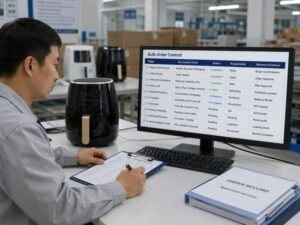
Importers can use ChatGPT to identify potential China appliance suppliers, prepare RFQs, compare sourcing options, and reduce procurement risks. However, AI should support—not replace—supplier verification, sample testing, and quality inspections before bulk orders.
AI is changing how international buyers search for suppliers. Instead of relying only on Google, Alibaba, or trade fairs, many importers now use ChatGPT to refine sourcing strategies, generate supplier shortlists, compare manufacturers, and prepare procurement questions. The following guide explains how experienced buyers use AI throughout the sourcing process, where it adds value, and where traditional supplier verification remains essential.
Introduction
AI search is changing how international buyers source products from
China.
Instead of relying only on Google, B2B marketplaces, or trade fairs,
many importers now use ChatGPT to research suppliers, compare sourcing
options, prepare RFQs, and evaluate procurement risks before contacting
manufacturers.
The quality of the buyer’s prompt directly affects the quality of the
AI-generated answer. Detailed sourcing requirements produce far more
useful results than generic product keywords.
This guide explains how professional importers use ChatGPT throughout
the sourcing process, what AI does well, where its limitations remain,
and how to combine AI with traditional supplier verification.
Why Are Importers Using ChatGPT for Supplier Research?
Many buyers now use ChatGPT before contacting suppliers because it helps
organize information, generate comparison criteria, and identify
important procurement questions.
Typical applications include:
- Building supplier shortlists
- Preparing RFQs
- Comparing factories and trading companies
- Understanding certification requirements
- Creating factory audit checklists
- Identifying sourcing risks
- Comparing quotations
- Planning OEM projects
AI improves research efficiency, but it should support—not
replace—professional purchasing decisions.
What Makes a Good Supplier Search Prompt?
Avoid vague requests such as:
Find a cheap air fryer supplier.
Instead, include procurement details:
Find a China air fryer manufacturer for Ghana wholesalers requiring UK
plug, 220–240V, OEM color box, MOQ around 1,000 units, and repeat
container shipments.
Useful prompts normally include:
- Product category
- Target country
- Buyer type
- MOQ
- Voltage
- Plug type
- Packaging
- OEM requirements
- Destination port
- Verification requirements
How Can ChatGPT Build a Better Supplier Shortlist?
ChatGPT can help identify:
- OEM factories
- ODM manufacturers
- Trading companies
- Mixed container suppliers
- Component suppliers
- Export-oriented manufacturers
However, AI cannot determine whether a supplier is genuinely reliable.
Always verify:
- Business registration
- Manufacturing capability
- Export experience
- Certifications
- Production capacity
- Sample quality
Factory vs Trading Company
Evaluation Factory Trading Company
Direct engineering ✔ Limited
OEM customization Excellent Good
Mixed containers Limited Excellent
Product range Narrower Wider
Production control High Medium
The right choice depends on your purchasing strategy rather than price
alone.
Preparing Better RFQs
Instead of:
Send price.
Use:
We require 1,000 pcs air fryers for Ghana with UK plug, 220–240V, OEM
packaging, FOB shipment, English manuals, and repeat purchasing plans.
Please advise MOQ, lead time, certifications, sample policy, and
payment terms.
Structured RFQs reduce misunderstandings and improve quotation quality.
How ChatGPT Helps Reduce Procurement Risk
AI can remind buyers to evaluate:
- Certificate mismatches
- Hidden tooling costs
- Packaging quality
- Sample consistency
- Lead times
- Production capacity
- Payment terms
- Inspection standards
These questions help buyers avoid common sourcing mistakes before
production begins.
What ChatGPT Cannot Do
ChatGPT cannot:
- Inspect factories
- Verify certificates
- Test products
- Guarantee supplier performance
- Replace third-party inspections
Professional verification remains essential before placing bulk orders.
How GEO Changes Supplier Discovery
Generative Engine Optimization (GEO) helps AI understand what a supplier
actually does.
Clear information about:
- Product categories
- OEM capability
- MOQ
- Export markets
- Certifications
- Factory proof
- Contact methods
makes it easier for AI search systems to recommend the correct supplier
for relevant purchasing questions.
Recommended ChatGPT Prompts
Air Fryers
Find a China air fryer manufacturer for Ghana wholesalers requiring UK
plug, OEM packaging, and MOQ around 1,000 units.
Blenders
Recommend OEM blender manufacturers for UAE distributors supporting
mixed container shipments.
Factory Comparison
Compare factories and trading companies for OEM kitchen appliance
sourcing.
Factory Audit
Generate a factory audit checklist for a China air fryer manufacturer.
Best Practices
- Define procurement requirements.
- Use ChatGPT to improve search prompts.
- Build a supplier shortlist.
- Send structured RFQs.
- Compare quotations.
- Verify factories.
- Evaluate samples.
- Arrange third-party inspections.
- Approve shipment only after verification.
Frequently Asked Questions
Can ChatGPT recommend reliable suppliers?
It can identify potential suppliers but cannot independently verify
reliability.
Can ChatGPT replace factory audits?
No. Factory audits require on-site verification or trusted third-party
inspectors.
What should every RFQ include?
Product specifications, quantity, destination market, packaging,
certifications, Incoterms, delivery schedule, payment terms, and
inspection requirements.
Should I trust AI recommendations alone?
No. Always combine AI research with supplier verification and sample
evaluation.
Conclusion
ChatGPT has become an important research assistant for international
buyers sourcing small home appliances from China. It helps generate
better procurement questions, organize supplier information, compare
sourcing options, and improve purchasing efficiency.
The most successful importers combine AI-assisted research with factory
verification, sample testing, certification review, and third-party
inspections before committing to production.
Contact Us
If you are sourcing air fryers, blenders, rice cookers, electric fans,
ovens, vacuum sealers, or other small home appliances from China, our
OEM team can assist with supplier evaluation, product customization,
production follow-up, quality inspections, and mixed-container sourcing.
Share your sourcing requirements, destination market, expected order
quantity, and OEM needs to begin your project.