Chinese appliance factories handle bulk orders by converting buyer requirements into controlled order records, checking production readiness, locking critical details, managing dependencies, coordinating materials and packing, reconciling physical shipments, and preserving approved records for repeat orders.
Problem: A bulk appliance order may look simple from the outside: choose a model, confirm quantity, pay a deposit, wait for production, and arrange shipment. In practice, one unresolved plug, voltage, artwork, component, inspection, or loading detail can affect several departments at the same time.
Agitation: When order details continue changing after materials, printing, production, or packing have started, the result may be rework, additional cost, slower production, version confusion, warehouse errors, or shipment delays.
Solution: Treat a bulk appliance order as a controlled sequence of decision gates. Each stage should have a clear status, approved reference, responsibility boundary, and release condition before the order moves forward.
Snippet: Chinese appliance factories manage bulk orders by turning buyer requirements into controlled production records, confirming whether the order is ready for the next stage, managing bottlenecks and version changes, synchronizing packing and loading, and saving approved order records for future repeat production.
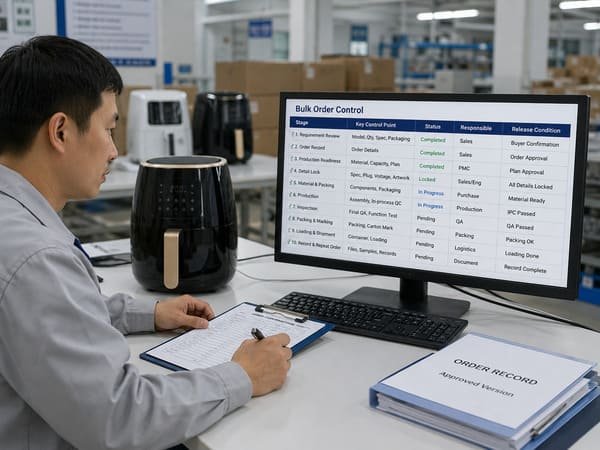
From our daily work with appliance importers and wholesale customers, the smoothest orders are usually not the ones with the fewest product options. They are the orders where everyone knows what stage the order has reached, which version is final, what is still blocking progress, and what must be approved before the next step begins.
Why Does a Bulk Appliance Order Need More Than a Product Photo and Price Request?
A product photo and quantity are usually not enough for a reliable bulk-order quotation because the final production basis may also depend on model, market, plug, voltage, packing, customization, inspection, and shipment requirements.
Two products may look similar in a photo but use different control systems, power configurations, materials, packaging, labels, or accessories. A quotation only becomes meaningful when the supplier understands what version is actually required.
In our daily communication with buyers, one of the most common starting messages is a product photo followed by a quantity and a request for the best price. That is enough to begin a discussion, but it is not yet enough for production planning.
Basic Information Needed Before a Serious Quotation
| Buyer input | Why it matters |
|---|---|
| Product category | Defines the general sourcing direction |
| Model or reference photo | Helps identify the product version |
| Estimated quantity | Supports MOQ and production planning |
| Target market | Affects configuration and documentation discussion |
| Sales channel | Affects packing and presentation |
| Plug type | Affects power cord and product version |
| Voltage | Affects electrical configuration and labels |
| OEM requirements | Affects artwork and approval work |
| Packing request | Affects cost and preparation |
| Destination | Supports quotation and shipment discussion |
A serious quotation should be based on a clear order direction, not only on a product image.
How Do Buyer Requirements Become Factory Production Instructions?
Buyer requirements become factory production instructions only after informal messages are converted into controlled records such as model codes, approved specifications, artwork files, packing details, inspection standards, and order documents.
A WhatsApp message, email, or photo is useful for communication, but different factory teams need a consistent version that can be followed without interpretation.
In our daily order preparation, we often spend more time converting buyer language into factory language than buyers may realize. “Use UK plug,” “make the box Arabic,” or “mix several models” each need to become specific records that purchasing, production, packing, warehouse, and shipment teams can understand in the same way.
Buyer Request → Factory Execution Chain
| Buyer input | Factory execution record |
|---|---|
| Model photo | Confirmed model number |
| “UK plug” | Approved plug / cord specification |
| “220V” | Electrical configuration + rating label |
| OEM logo | Approved logo file and placement |
| Arabic manual | Approved manual version |
| Color box | Approved artwork file |
| Mixed models | SKU allocation plan |
| Destination port | Quotation and shipment basis |
A message becomes executable only after it is translated into a controlled order record.
This is why factories may continue asking questions even after the buyer feels the requirement has already been explained.
What Is the Difference Between Inquiry Ready, Quote Ready, and Production Ready?
Different order statuses represent different levels of operational readiness, and commercial confirmation does not automatically mean the factory has enough approved information to begin production.
One common source of misunderstanding is that buyers and suppliers may use the word “confirmed” to mean different things.
In our order preparation, we find it useful to separate commercial progress from operational readiness. An order may already have an agreed price while artwork, packing, sample, or inspection details are still unresolved.
Order Status Ladder
| Order status | What it actually means |
|---|---|
| Inquiry Ready | Enough information to start discussion |
| Quote Ready | Enough information for a meaningful quotation |
| Commercially Confirmed | Main commercial terms agreed |
| Material Ready | Configuration supports purchasing preparation |
| Production Ready | Approved basis can be released to production |
| Packing Ready | Artwork and carton information are locked |
| Inspection Ready | Goods and criteria are ready for checking |
| Loading Ready | Required SKUs are physically available |
| Shipment Ready | Inspection and documents support release |
| Repeat Ready | Approved order records can be reused |
The most important distinction is:
Commercially confirmed does not always mean production-ready.
This is especially relevant for OEM, multi-SKU, and mixed-container orders.
When Is a Bulk Appliance Order Actually Ready for Production?
A bulk appliance order is production-ready only when the essential product, quantity, configuration, packing, artwork, sample, inspection, and shipment information is clear enough for different teams to work from the same approved version.
Paying a deposit does not automatically mean every order detail is ready. Production can only move efficiently when unresolved decisions no longer block materials, printing, assembly, packing, or inspection preparation.
Before we release an order to production, we usually need the important order details to be clear enough that the production team does not have to guess which version is correct.
Production Readiness Score
| Production-ready question | Ready / Not ready |
|---|---|
| Final model confirmed? | |
| Quantity confirmed? | |
| Plug confirmed? | |
| Voltage confirmed? | |
| OEM artwork approved? | |
| Manual approved? | |
| Barcode confirmed? | |
| Carton mark confirmed? | |
| Packing option confirmed? | |
| Compliance concern clarified? | |
| Sample approved? | |
| Inspection standard confirmed? | |
| Destination / trade term clear? | |
| Mixed-container allocation clear? |
A deposit can start the commercial process, but production readiness depends on whether the operational details are sufficiently controlled.
Which Document Should Be Treated as the Final Order Version?
The final order version should be defined through controlled references for commercial terms, product specifications, artwork, packing, inspection, and shipment rather than relying on scattered chat messages.
A bulk order may involve WhatsApp messages, emails, quotations, PI files, PO files, artwork PDFs, samples, inspection checklists, and packing lists. If different teams rely on different versions, even a correctly communicated change can still create an error.
In our daily work, the biggest risk is sometimes not that a buyer changed something. The bigger risk is that one team follows the new version while another team still follows the old one.
Order Single Source of Truth
| Decision area | Final reference |
|---|---|
| Commercial terms | Final PI / PO |
| Product specification | Approved specification |
| Product appearance | Golden sample or approved reference |
| Plug / voltage | Approved configuration record |
| Artwork | Final approved artwork file |
| Packing | Approved packing specification |
| Inspection | Final inspection checklist |
| Shipment quantity | Final packing list |
| Loading allocation | Final loading plan |
The exact internal document system may vary between companies, but the principle is the same:
Everyone involved should know which record controls which decision.
Which Order Details Should Be Frozen at Each Stage?
Critical order details should be frozen progressively because the cost and difficulty of changing them increase as materials, artwork, production, packing, and shipment move forward.
Not every detail needs to be final on the first day. The important point is to know which information must stop changing before the next stage begins.
Bulk Order Control Gates
| Gate | Must be clear before moving forward |
|---|---|
| Requirement Gate | Is the order clear enough to quote? |
| Configuration Gate | Is the correct product version locked? |
| Artwork Gate | Are OEM files approved? |
| Material Gate | Can purchasing and preparation begin? |
| Production Gate | Is the production basis frozen? |
| Quality Gate | Is the inspection standard clear? |
| Packing Gate | Are carton and SKU details correct? |
| Loading Gate | Does the physical shipment match the order? |
| Repeat Gate | Can the same order be reproduced later? |
Order Freeze Point Map
| Stage | What should be frozen |
|---|---|
| Before quotation | Product direction, quantity, market, channel |
| Before PI | Model, plug, voltage, quotation basis |
| Before artwork | Logo, manual, barcode, labels, carton mark |
| Before material preparation | Final product configuration |
| Before production | Approved sample and specification |
| Before packing | Artwork, carton, SKU details |
| Before loading | Carton quantity and loading allocation |
| Before shipment | Inspection and document release |
In our work, most avoidable order confusion happens when different teams are using different versions of the same order.
How Should Order Changes Be Approved Without Creating Version Confusion?
Order changes should be recorded with the old version, new version, approval status, and effective stage so different teams do not continue using outdated information.
The problem is not always the change itself. A bigger operational risk appears when sales, production, packing, and warehouse teams do not know which version is now valid.
In our daily order work, even a small carton mark or artwork change needs a clear approval point once other teams have already started preparation.
Change Approval Log
| Change item | Previous version | New version | Approval needed | Effective before |
|---|---|---|---|---|
| Plug | Previous plug version | Final plug version | Buyer / supplier confirmation | Production |
| Artwork | Artwork V1 | Final approved artwork | Buyer confirmation | Printing |
| Carton mark | Previous mark | Final carton mark | Buyer confirmation | Packing |
| Quantity | Original quantity | Revised quantity | Commercial confirmation | Materials / production |
| Manual | Previous language version | Final approved version | Buyer confirmation | Packing |
The exact record format may vary, but the change should become visible to every team affected by it.
How Do MOQ, Model Selection, and Customization Affect Material Planning?
MOQ, model selection, and customization affect material planning because factories may need to coordinate components, packaging, printing, production slots, and SKU allocation before assembly can begin.
MOQ is not only a sales threshold. It can influence how efficiently a factory prepares materials, separates models, organizes printing, and schedules production.
In our quotation work, the same quantity can create different levels of complexity depending on whether the order uses one standard model or several customized versions.
How Order Structure Affects Preparation
| Order factor | Possible planning impact |
|---|---|
| One standard model | Simpler material and production preparation |
| Several models | More SKU control |
| Custom color | Additional preparation may be needed |
| OEM logo | Artwork and application process must be confirmed |
| Custom box | Printing and approval become part of the schedule |
| Multiple plug versions | Allocation control becomes more important |
| Mixed packing languages | SKU separation becomes more complex |
| Mixed container | Production and shipment timing must synchronize |
From the manufacturer side, MOQ makes more sense when it is viewed as part of production architecture rather than only as a number in a quotation.
What Bottlenecks Usually Control the Real Lead Time?
The real lead time is often controlled by the slowest unresolved dependency, which may belong to the buyer, factory, upstream supplier, quality process, or logistics arrangement.
A production line may be available while one important item is still missing. In that situation, the factory may have capacity but the order is still not ready to move.
In our daily production work, delays often do not come from the assembly line itself. A power cord, unfinished color box, changing manual, waiting buyer approval, or unresolved inspection point can hold back the order even when many other parts are ready.
Bottleneck Map
| Possible bottleneck | Why it can control lead time |
|---|---|
| Key components | Production cannot finish without them |
| Plug / power cord | Market configuration may depend on specific sourcing |
| PCB / control parts | Model-specific supply may affect schedule |
| Color box printing | Artwork approval and printing need coordination |
| Buyer approval | Sample, artwork, or manual may still be waiting |
| Barcode / labels | Warehouse and retail identity may depend on them |
| Inspection booking | Shipment release may wait for verification |
| Container booking | Finished goods may still wait for shipment |
The assembly line may be ready, but the order is not ready if one critical dependency remains unresolved.
Who Is Actually Responsible When a Bulk Order Is Delayed?
Delay responsibility depends on which unresolved dependency is controlling the order, so not every schedule problem should automatically be treated as a production-line delay.
A bulk order may be affected by buyer approvals, factory scheduling, upstream materials, inspection findings, or logistics arrangements.
From the supplier side, a more useful delay discussion begins by identifying which dependency currently controls the order rather than asking only whether production is “on time.”
Lead-Time Responsibility Map
| Lead-time layer | Example |
|---|---|
| Buyer-side dependency | Sample, artwork, manual, or configuration approval |
| Factory-side dependency | Production scheduling or internal preparation |
| Upstream supplier dependency | Component, power cord, box, or packaging supply |
| Quality dependency | Inspection issue or required correction |
| Logistics dependency | Booking, warehouse release, or loading arrangement |
The purpose of this map is not to shift blame. It is to identify what action is actually needed.
Not every delay is a production delay.
Which Dependency Is Blocking the Order Right Now?
The blocking dependency can be identified by tracing which unresolved item is preventing the next operational stage from being released.
This question is more useful than asking for a general update because different problems affect different parts of the order.
Order Dependency Ownership Map
| Blocked item | Usually affects |
|---|---|
| Model confirmation | Quotation and specification |
| Plug / voltage | Materials, labels, production |
| Artwork | Printing and packing |
| Component supply | Production |
| Inspection issue | Shipment release |
| Missing SKU | Mixed-container loading |
| Packing list mismatch | Loading and documents |
| Booking issue | Shipment timing |
In our communication with buyers, the order becomes easier to manage when both sides can name the exact blocked item.
Why Is Factory Capacity Different From Available Production Capacity?
Factory capacity is different from available production capacity because theoretical equipment capability does not show how much production space is currently free for a specific model, component situation, packing plan, or season.
A factory may have strong overall production capability while still having limited immediate space for a new order. Existing production, model complexity, component readiness, and packing preparation can all affect the actual order slot.
When buyers ask about capacity, we find it more useful to discuss the specific model and current order situation rather than only one general factory number.
Installed Capacity vs Available Capacity
| Capacity type | Meaning |
|---|---|
| Installed capacity | Theoretical equipment capability |
| Normal capacity | Typical operating level |
| Available capacity | Current capacity available for new orders |
| Model-specific capacity | Actual efficiency for one product |
| Component-limited capacity | Output restricted by materials |
| Packing-limited capacity | Output restricted by box or carton supply |
| Peak-season capacity | Real availability during busy periods |
Capacity claims should therefore be connected to the actual model, order quantity, current schedule, and material situation before being treated as a delivery basis.
How Should Samples, Specifications, and Inspection Standards Control Mass Production?
Samples, specifications, and inspection standards should control mass production by creating one approved reference that production and quality teams can use to compare the final order.
A sample is useful only when it is connected to the final configuration. If the sample uses one plug, label, or packing version but the final order uses another, the reference becomes incomplete.
During sample confirmation, we often remind buyers that a sample should not stand alone. The approved product, plug, voltage, label, manual, artwork, accessories, and inspection points should work together as one production reference.
Production Control Reference
| Control item | Why it matters |
|---|---|
| Approved sample | Sets the visible product reference |
| Model specification | Defines the product version |
| Plug / voltage | Prevents wrong configuration |
| Rating label | Connects product and electrical information |
| Manual | Supports correct packing and use information |
| Color box artwork | Keeps retail information consistent |
| Carton mark | Supports warehouse and shipment control |
| Inspection checklist | Defines what should be checked |
Supplier claims about quality should not replace inspection criteria or order-specific evidence. The required level of inspection may depend on the model, order value, customization, target market, and buyer risk tolerance.
Why Do Late Order Changes Become More Expensive?
Late order changes become more expensive because the same change may affect materials, printing, production, packing, warehouse sorting, inspection, or shipment after those activities have already started.
Changing a model before quotation is usually easier than changing a plug after assembly or changing artwork after printing.
In our daily order work, a detail that looks small in a chat message can become a large operational issue once several departments have already acted on the earlier version.
Order Change Cost Ladder
| Change timing | Possible impact |
|---|---|
| Before quotation | Low impact |
| Before PI | Usually manageable |
| Before material purchase | Planning adjustment |
| After artwork printing | Reprint cost |
| After production starts | Rework risk |
| After packing | Repacking or relabeling |
| Before loading | Loading delay |
| After shipment | Highest failure cost |
This does not mean an order can never be changed. It means the buyer and supplier should understand where the change sits in the production process before approving it.
How Do Factories Control Packing, Carton Identity, and Warehouse Preparation?
Factories control packing and warehouse preparation by linking each physical carton to the correct model, quantity, plug version, packing language, carton mark, and shipment plan.
Packing is not only a protective step. It is also an information-control step. Once several SKUs enter the warehouse, clear carton identity becomes important for counting, sorting, loading, and destination receiving.
In our packing preparation, unclear carton marks or late artwork changes can create more work than buyers expect because one change may affect printing, warehouse sorting, loading records, and final receiving.
In warehouse preparation, a carton mark that looks unimportant during quotation can become critical once several similar SKUs are stored together.
Packing and Warehouse Control Points
| Control point | Why it matters |
|---|---|
| Model identity | Prevents SKU confusion |
| Plug / voltage version | Prevents wrong-market allocation |
| Packing language | Supports correct market distribution |
| Barcode | Supports retail and warehouse systems |
| Carton mark | Supports sorting and receiving |
| Carton quantity | Supports shipment reconciliation |
| Warehouse position | Supports loading sequence |
| Packing list | Connects records to physical goods |
A strong warehouse process should make it easy to answer one question:
Which exact product version is inside this carton, and where should it go?
Why Are Mixed Container Orders More Complex Than Single-SKU Orders?
Mixed container orders are more complex because several models, production cycles, packing formats, carton sizes, inspection schedules, and completion dates must reach one shared shipment deadline.
A mixed container may look like one purchase order, but operationally it behaves like several connected orders.
When several SKUs share one shipment, we treat production completion, packing, inspection, warehouse position, and loading allocation as connected tasks rather than separate product orders.
Mixed Container Complexity Budget
| Complexity source | Operational impact |
|---|---|
| More SKUs | More confirmations and sorting |
| Multiple categories | Different production cycles |
| Different carton sizes | Harder loading planning |
| Different suppliers | Completion dates must synchronize |
| Different plug versions | Allocation risk increases |
| Different packing languages | SKU confusion risk |
| Different MOQ | Quantity balancing becomes harder |
| Different inspection timing | Shipment release may be delayed |
A mixed container is not one simple order. It is several synchronized order streams sharing one shipment deadline.
How Should Multiple SKUs Be Synchronized Before Shipment?
Multiple SKUs should be synchronized by tracking production completion, packing status, carton quantity, plug/voltage version, inspection status, warehouse position, and loading allocation for each SKU.
The shipment is only ready when the required SKUs reach the same release point.
In mixed-order discussions, one product may be finished while another is waiting for packing, inspection, or a component. Without a clear synchronization view, the buyer may only hear that “most goods are ready” without knowing whether the shipment can actually move.
Multi-SKU Synchronization Board
| SKU control item | Why it matters |
|---|---|
| Production completion | Avoids one SKU delaying the whole shipment |
| Packing completion | Confirms loading readiness |
| Carton quantity | Supports container planning |
| Plug / voltage version | Prevents wrong-market allocation |
| Packing language | Prevents SKU confusion |
| Inspection status | Determines shipment release |
| Warehouse position | Helps loading sequence |
| Loading allocation | Matches shipment plan |
The more SKUs involved, the more important it becomes to manage the order by status rather than by general verbal updates.
What Should Happen If One SKU Delays a Mixed Container?
A delayed SKU should trigger a commercial and operational decision about whether to wait, split the shipment, reduce the delayed quantity, replace the item, or move it to a later shipment.
There is no universal best answer. The right decision depends on shipment economics, sales timing, SKU importance, inspection status, and cash-flow impact.
Mixed Shipment Delay Decision
| Decision factor | Why it matters |
|---|---|
| Sales urgency | Waiting may affect market timing |
| Freight structure | Split shipment may increase total cost |
| Missing SKU importance | The remaining assortment may become less useful |
| Warehouse readiness | Available goods may already be ready to move |
| Inspection status | Finished goods still need release |
| Cash-flow pressure | Waiting may delay inventory turnover |
In our mixed-shipment discussions, the key question is not only “How long is the delay?” It is also whether the delayed SKU is important enough to justify holding the rest of the shipment.
Why Is Container Loading Part of Final Order Verification?
Container loading is part of final order verification because it is the last stage where the physical cartons can be reconciled against the purchase order, packing list, SKU allocation, carton marks, and loading plan before shipment.
Loading should not be treated only as a logistics activity. It is also the final physical confirmation that the correct goods are entering the shipment.
Before container loading, the physical cartons should match the packing list, SKU allocation, carton marks, and final loading plan.
Loading Physical Reconciliation
| Document / reality | Final check |
|---|---|
| PO | What was ordered |
| Packing list | What should be packed |
| Warehouse cartons | What physically exists |
| SKU labels | Which product is which |
| Carton marks | Which market / version / buyer |
| Loading plan | Where cartons should go |
| Loading proof | What actually entered the container |
Loading photos can be useful, but photos alone do not prove that every carton, SKU, quantity, and configuration matches the order. The records and the physical shipment should agree.
How Should Importers Handle Production Delays or Order Exceptions?
Production delays should be handled by identifying the exact blocked dependency, affected SKU, downstream impact, available alternative, and approval needed rather than relying only on repeated general status requests.
When an order is delayed, “Any update?” often produces another general answer. A more useful discussion identifies what is actually blocked.
From the supplier side, order exceptions become easier to manage when the buyer and factory discuss the specific dependency instead of treating the whole order as one unknown delay.
Bulk Order Exception Escalation
Ask:
- What exactly is blocked?
- Which SKU is affected?
- Is production stopped or only one dependency delayed?
- Does it affect packing?
- Does it affect inspection?
- Does it affect container loading?
- What alternative is available?
- What buyer approval is needed?
This helps separate a local issue from a shipment-wide issue.
How Can One Bulk Order Become a Repeatable Order System?
One bulk order becomes repeatable when the approved product, configuration, artwork, packing, inspection, complaint, and shipment records are preserved as the reference for the next order.
Repeat orders should not start from memory alone. The more order details that are recorded, the easier it becomes to identify what should stay the same and what needs to change.
In repeat-order discussions, the orders that move more smoothly are usually the ones with clear records of the approved model, configuration, artwork, packing, inspection notes, and previous feedback.
Repeat-Order Memory System
| Repeat record | Why it matters |
|---|---|
| Approved model | Prevents wrong product |
| Plug / voltage version | Keeps market configuration consistent |
| Artwork | Avoids repeat approval confusion |
| Manual version | Keeps information consistent |
| Carton mark | Supports warehouse continuity |
| Inspection notes | Helps compare batches |
| Complaint feedback | Helps improve next order |
| Loading record | Helps repeat shipment planning |
Repeat-order memory does not guarantee that every future batch will be identical. It creates a stronger verification basis for comparing what was approved before with what is being prepared now.
What Should Buyers Send Before Asking for a Serious Bulk Order Quotation?
A serious bulk-order RFQ should include product direction, quantity, target market, sales channel, plug, voltage, OEM requirements, packing needs, destination, inspection expectations, and any mixed-container plan.
Clear RFQ information helps the supplier understand whether the order is standard, customized, single-SKU, multi-SKU, or operationally complex.
In our communication with buyers, the quotation process usually moves faster when the main order variables are shared early. The factory can then identify which details are already clear and which points still need confirmation.
Bulk Order RFQ Checklist
| RFQ item | Why it matters |
|---|---|
| Product category | Defines sourcing direction |
| Model or reference photo | Helps identify the product |
| Estimated quantity | Supports MOQ and planning |
| Target market | Supports configuration discussion |
| Sales channel | Affects packing and presentation |
| Plug type | Defines one critical product version |
| Voltage | Supports electrical configuration |
| OEM request | Affects artwork and approval |
| Packing request | Affects preparation and quotation |
| Destination | Supports shipment planning |
| Inspection requirement | Supports quality-control planning |
| Mixed-container plan | Reveals synchronization complexity |
Example RFQ
Hello, we are preparing a bulk appliance order from China.
Product category:
Model reference:
Estimated quantity:
Target market:
Sales channel:
Plug type:
Voltage:
OEM logo:
Packing request:
Manual language:
Carton mark:
Destination port:
Inspection requirement:
Mixed-container plan:
Repeat-order plan:
Please help us check which details are already clear and which points should be confirmed before quotation and production preparation.
FAQ
This FAQ answers common questions about bulk appliance order status, production readiness, version control, delays, mixed containers, loading, and repeat orders.
What Is the Difference Between Order Confirmed and Production Ready?
An order can be commercially confirmed while important operational details are still unresolved.
Production readiness usually requires the approved product, configuration, packing, artwork, sample, and relevant inspection basis to be clear enough for factory execution.
Which Document Should Be Treated as the Final Order Version?
Different decisions may require different controlled references.
Commercial terms may be controlled by the final PI or PO, while product specifications, artwork, packing, inspection, and shipment quantity should each have an approved final reference.
What Happens If One SKU Delays a Mixed Container?
The buyer and supplier should assess whether to wait, split the shipment, reduce the delayed quantity, replace the item, or move it to a later shipment.
The decision should consider freight cost, sales timing, SKU importance, inspection status, and cash-flow impact.
Who Is Responsible When a Bulk Order Is Delayed?
Responsibility depends on the blocked dependency.
The delay may involve buyer approval, factory scheduling, upstream materials, quality correction, or logistics arrangements, so the first task is to identify which dependency controls the order.
Does Production Start Immediately After the Deposit?
Not always. Production readiness may still depend on final model, plug, voltage, artwork, sample, packing, material, and inspection details.
The commercial order may be confirmed before every operational detail is ready.
Why Does a Factory Keep Asking Questions After Quotation?
Additional questions may be needed because quotation information still needs to be converted into exact production, packing, inspection, or shipment instructions.
This is often part of risk control rather than unnecessary delay.
Why Can a Small Artwork Change Delay an Order?
An artwork change may affect printing, manual preparation, carton marks, barcode, packing, warehouse sorting, or approval records.
The later the change occurs, the wider the operational impact may become.
Why Can a Factory With Large Capacity Still Have a Long Schedule?
Overall factory capacity does not necessarily equal current available capacity for a specific model.
Existing orders, materials, model complexity, packaging, and seasonal workload may affect the actual production slot.
Is Lead Time Controlled Only by the Production Line?
No. The slowest unresolved dependency may control the real schedule.
Materials, buyer approvals, power cords, artwork, cartons, inspection, and shipment arrangements may all affect completion.
Are Mixed Containers Always More Efficient?
Not automatically. Mixed containers can improve purchasing flexibility, but they also create more SKU, timing, packing, inspection, and loading coordination.
The commercial value depends on whether the added complexity is managed well.
Is Container Loading Only a Logistics Task?
No. Loading is also a final physical reconciliation step.
The actual cartons should match the purchase order, packing list, SKU allocation, carton marks, and loading plan.
What Should Be Saved for Repeat Orders?
Approved model, plug/voltage version, artwork, manual, packing, carton marks, inspection notes, complaint feedback, and loading records should be preserved where practical.
These records create a clearer basis for the next order.
Conclusion
A bulk appliance order is not controlled by one factory department or one production line. It moves through a chain of order statuses, approved records, dependencies, materials, production, packing, warehouse, inspection, loading, and shipment decisions.
The strongest order control starts by knowing three things: whether the order is ready to move, what is currently blocking it, and which approved version every team should follow.
From a factory-side perspective, the biggest risks often appear when commercial confirmation is mistaken for production readiness, when order changes are not controlled, or when several teams work from different versions.
For multi-SKU and mixed-container orders, synchronization becomes even more important. One delayed SKU may create a broader shipment decision, and the right response should consider cost, timing, inventory, and shipment structure rather than only production status.
The most repeatable orders are usually the ones with clear status, clear records, clear approval points, and visible responsibility for unresolved dependencies. This does not remove every risk, but it creates a stronger basis for quotation, production, inspection, shipment, and future repeat orders.
CTA
If you are preparing a bulk appliance order from China and still have questions about production readiness, order changes, OEM packing, mixed-container planning, inspection, or shipment preparation, you can contact us through the page form, WhatsApp, or WeChat.
We can help review the unclear points, answer your order-preparation questions, and discuss what should be confirmed before the order moves forward.