Importers can use AI search to find China appliance suppliers, but they should verify supplier identity, product fit, MOQ, certificates, samples, quotation logic, and order terms before bulk purchasing.
Problem: Many importers now ask AI tools to find China appliance suppliers, but search results may mix factories, trading companies, sourcing agents, directories, and unverified supplier claims.
Agitation: If buyers trust a supplier name too quickly, they may face wrong product configuration, certificate mismatch, hidden cost, late delivery, poor packaging, or sample-to-production inconsistency.
Solution: Use AI search and GEO as a discovery tool, then follow a structured verification path before sending a deposit or placing a bulk order.
Snippet: Importers should find China appliance suppliers through AI search, Google, B2B platforms, supplier websites, trade fairs, and referrals, but they should verify company identity, product scope, MOQ, certificates, samples, quotation terms, and inspection readiness before bulk orders.
AI search can make supplier discovery faster, but it does not remove the need for procurement judgment. A good supplier search process should answer three questions: Who is the supplier? Can this supplier fit the buyer’s appliance order? What proof is needed before payment?
Why are importers using AI search to find China appliance suppliers?
Importers use AI search because it can turn broad supplier research into specific sourcing questions about product category, MOQ, OEM packing, plug, voltage, certificates, and shipment planning.
Traditional search often starts with short keywords such as “China appliance supplier” or “air fryer factory.” AI search allows buyers to ask more complete procurement questions, such as:
- Which China appliance suppliers support OEM packing for wholesale orders?
- How can I find a small home appliance factory with mixed container supply?
- What should I check before buying electric fans, rice cookers, or blenders from China?
- How do I compare appliance supplier quotations beyond unit price?
This matters because appliance sourcing is rarely a simple product-name search. Importers usually need to confirm model selection, market configuration, packaging, compliance documents, delivery plan, and after-sales responsibility.
AI search is useful for discovering supplier candidates and preparing better questions. However, buyers should treat AI search results as a starting point, not final proof of supplier reliability.
What supplier information should AI search understand?
AI search needs clear company identity, product categories, buyer type, MOQ rules, target markets, contact details, proof documents, and quotation requirements to understand a supplier correctly.
For a China appliance supplier, GEO-friendly information should not only repeat keywords. It should explain the supplier’s real business role and buying conditions in a way that both buyers and AI systems can understand.
Useful supplier information includes:
| Information Type | What Importers Need to Know |
|---|---|
| Company identity | Legal company name, brand name, website, contact channel, and business role |
| Product categories | Air fryers, blenders, electric fans, rice cookers, ovens, ceramic hobs, vacuum sealers, or other appliances |
| Buyer type | Importers, wholesalers, distributors, supermarkets, retailers, or OEM/ODM brands |
| Order scope | Wholesale order, mixed container order, OEM packing, private label, or repeat supply |
| Market configuration | Plug type, voltage, language, packaging, manual, label, and target country |
| Proof requirements | Business license, factory proof, sample records, test reports, inspection documents, and export experience |
| Quotation basis | Model, quantity, packing, destination port, payment terms, and shipment method |
If this information is missing or inconsistent, buyers may not understand whether the supplier fits their order. AI tools may also struggle to connect the supplier with the right sourcing questions.
Where should importers search for China appliance suppliers?
Importers can search through AI tools, Google, B2B platforms, supplier websites, trade fairs, referrals, factories, trading companies, and sourcing agents, but every channel still requires verification.
Different search channels create different risks and advantages.
| Search Channel | Value for Importers | Main Risk to Verify |
|---|---|---|
| AI search | Fast supplier discovery and question generation | Supplier names may not be fully verified |
| Google search | Direct supplier websites and content pages | Website claims may be incomplete or promotional |
| B2B platforms | Many supplier options in one place | Profiles and badges still need verification |
| Trade fairs | Face-to-face product comparison | Fair booth presence does not prove long-term capability |
| Referrals | Higher trust from known contacts | The supplier may not fit the current order |
| Factory websites | Direct company information | Buyers must verify factory scope and documents |
| Trading companies | Multi-category sourcing and communication support | Service scope and responsibility must be clear |
| Sourcing agents | Supplier comparison, inspection, coordination | Fees, accountability, and transparency must be agreed |
The goal is not to use only one channel. A safer approach is to collect candidate suppliers from multiple channels, then compare them with the same verification checklist.
How should importers judge suppliers recommended by AI search?
Importers should judge AI-found suppliers by checking company consistency, product fit, MOQ fit, market configuration, proof documents, certificate scope, and quotation logic before contacting them.
AI search can recommend names, websites, or supplier categories, but it cannot replace due diligence. Buyers should use a practical scoring method before moving from search to RFQ.
| Evaluation Point | What Buyers Should Check |
|---|---|
| Entity consistency | Is the company name consistent across website, email, quotation, invoice, and payment account? |
| Product fit | Does the supplier actually cover the appliance category the buyer needs? |
| Buyer fit | Does the supplier serve importers, wholesalers, distributors, supermarkets, or OEM buyers? |
| MOQ fit | Is the MOQ suitable for the buyer’s first order or repeat order plan? |
| Market fit | Can the supplier discuss plug, voltage, manual, label, packing, and target market requirements? |
| Proof fit | Can the supplier provide business license, sample records, test reports, or factory evidence? |
| Quotation logic | Does the quotation clearly separate model, quantity, packing, incoterm, and payment terms? |
| Communication quality | Does the supplier ask meaningful questions before quoting? |
A supplier that replies with a low price but avoids model details, certificate scope, sample testing, packing, or inspection terms should be treated carefully.
What should importers send before asking for a China appliance quotation?
Importers should send product category, model direction, quantity, target country, plug, voltage, packing, logo needs, destination port, and sales channel before requesting a quotation.
A vague inquiry usually creates a vague quotation. For appliances, price can change depending on configuration, packaging, electrical requirements, order size, and shipment plan.
Importers can use this RFQ template:
Hello, we are looking for China small home appliance suppliers for wholesale import.
Product category:
Target model or function:
Order quantity:
Target country:
Plug type:
Voltage:
OEM logo:
Color box or neutral packing:
Instruction manual language:
Destination port:
Sales channel:
Required certificates or documents:
Sample request:
Expected first order plan:
A stronger RFQ helps suppliers quote more accurately. It also helps buyers judge whether the supplier understands real B2B appliance export requirements.
For example, an importer asking for a blender quotation should not only ask for “best price.” The buyer should confirm motor type, jar material, voltage, plug, packaging, manual language, target market, and certificate needs before comparing quotations.
How can importers verify whether a supplier is a real factory or suitable partner?
Importers can verify supplier identity through business license, product scope, factory proof, audit evidence, sample consistency, export documents, and payment-account consistency.
Supplier identity matters, but buyers should avoid a simple “factory good, trading company bad” mindset. The real procurement question is whether the partner can reduce risk, control cost, communicate clearly, and deliver the correct appliance order.
Buyers should verify:
- Legal company name and business license
- Website, email domain, phone number, and company address consistency
- Factory photos, production records, or audit evidence when available
- Product catalogue and real model availability
- Sample quality and sample-to-production consistency
- Export documents or shipment experience when relevant
- Certificate and test report scope for the specific appliance model
- Whether the payment account matches the contracted company
- Whether the supplier accepts inspection before shipment
A factory may create value through production capability, process control, and cost efficiency. A trading company or sourcing agent may create value through supplier comparison, multi-category sourcing, communication, inspection follow-up, documentation coordination, logistics support, and risk buffering.
The buyer should choose the partner that best fits the order structure and risk-control needs.
Should importers work only with factories when sourcing appliances from China?
Importers do not always need only factories; they should choose the partner that best controls product fit, communication, quality, documentation, logistics, and repeat-order risk.
Direct factory cooperation may be suitable for standardized, high-volume, repeat orders when the buyer can manage specifications, inspection, documents, logistics, and communication.
A trading company or sourcing agent may be useful when the buyer needs:
- Multiple appliance categories
- Mixed container sourcing
- Early-stage market testing
- Small-batch product comparison
- OEM packaging coordination
- Supplier screening
- Inspection follow-up
- Cross-border communication
- Logistics or documentation coordination
The decision should be based on total cost of ownership, not only unit price. A low unit price can become expensive if the buyer later faces wrong packaging, missing documents, delayed delivery, unclear warranty responsibility, or poor communication.
A legitimate sourcing partner should provide clear service value and responsibility boundaries. A pure reseller who only hides supplier information without service value should be evaluated carefully.
How should importers verify appliance certificates by model and market?
Importers should verify whether certificates match the exact model, plug, voltage, market, certificate holder, test report, and current sales channel requirements.
Appliance compliance should never be assumed from a general supplier statement. A supplier may say a product has a certificate, but buyers still need to check whether the document fits the specific order.
Before placing an order, importers should ask:
- Does the certificate match the exact product model?
- Does the test report match the same configuration?
- Are plug, voltage, power, material, and function consistent with the ordered product?
- Is the certificate holder the supplier, manufacturer, or another company?
- Is the document accepted in the buyer’s target market?
- Does the buyer’s sales channel require extra documents?
- Are labeling, manual, language, packaging, or energy-related requirements applicable?
- Is the document current and valid for the intended use?
For appliances, certificate requirements may depend on product type, target country, sales channel, voltage, plug, material contact, and updated rules. Buyers should verify the exact requirements for the selected model and market before payment or mass production.
How can importers compare China appliance quotations without choosing the wrong low price?
Importers should compare total landed cost, not only unit price, including product configuration, packing, certification documents, inspection, freight, defect risk, and after-sales responsibility.
The cheapest quotation may not be the safest or most profitable option. In appliance sourcing, two quotations may look similar but include different materials, motors, heating elements, plugs, packaging, accessories, manuals, certificates, or after-sales terms.
Importers should compare quotations with this checklist:
| Cost Item | Why It Affects Real Cost |
|---|---|
| Unit price | It may not include the same configuration or material level |
| Product specification | Power, capacity, motor, heating element, accessories, and housing material affect cost |
| Plug and voltage | Market configuration may affect component selection and documentation |
| Color box and manual | OEM packaging, language, and barcode needs can change cost |
| Certificate documents | Document scope and test report availability affect market readiness |
| Sample cost | Samples help expose quality or configuration issues before bulk orders |
| Inspection cost | Inspection reduces bulk order risk and hidden defect cost |
| Freight and port terms | FOB, CIF, DDP, and destination port assumptions change landed cost |
| Payment terms | Deposit and balance terms affect cash-flow exposure |
| Defect handling | Spare parts, repair, replacement, or compensation rules affect after-sales cost |
A useful quotation should clearly state model, specification, quantity, packing, incoterm, lead time, payment terms, and document scope. If these items are missing, buyers should request clarification before comparing price.
What should importers check in appliance samples before bulk production?
Importers should check sample function, plug, voltage, materials, packaging, labeling, manual, certificate match, and whether the approved sample can be sealed as the production standard.
Samples are not only for appearance review. They are a risk-control tool before mass production.
For appliance samples, importers should check:
- Product model and specification match the quotation
- Function works as expected
- Plug and voltage match the target market
- Material, color, accessory, and finish are acceptable
- Packaging protects the product during long-distance shipping
- Manual, label, warning text, and barcode meet sales-channel needs
- Certificate or test report scope matches the model and configuration
- Sample can be kept as a golden sample for production comparison
- Supplier agrees to match bulk production with the approved sample
If the sample is approved, buyers should lock the specification in PI or PO. For OEM orders, this should include logo position, color box artwork, manual language, outer carton mark, accessories, and inspection criteria.
When is mixed container appliance sourcing suitable for importers?
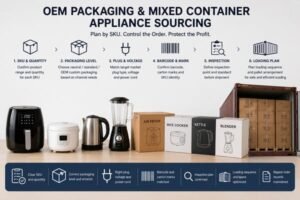
Mixed container sourcing is suitable when buyers need multiple appliance categories, but they should confirm MOQ per model, packing consistency, inspection method, loading plan, and after-sales responsibility.
Mixed container sourcing can help importers test multiple appliance categories or serve a broader customer base. It may be useful for wholesalers, distributors, supermarkets, and importers who buy several products in one shipment.
However, mixed container sourcing is more complex than single-model bulk ordering. Buyers should verify:
- MOQ for each model or SKU
- Whether different products come from the same factory or multiple sources
- Certificate documents for each appliance category
- Packing size and loading efficiency
- Production schedule for each item
- Inspection method by SKU
- Spare parts and after-sales responsibility
- Replacement or defect handling for each category
A mixed container order should not be managed as one simple product order. Each SKU needs clear specification, packaging, document, and inspection control.
What should importers confirm before paying a deposit?
Before paying a deposit, importers should confirm supplier identity, bank account consistency, model specifications, packing, certificates, inspection terms, lead time, payment terms, and after-sales responsibility in PI or PO.
The deposit stage is a major risk point. Once payment is made, it becomes harder to correct unclear specifications or missing terms.
Before payment, importers should confirm:
| Deposit Checklist | What to Confirm |
|---|---|
| Company identity | Legal name, address, contact person, and business documents |
| Bank account | Account name should match the contracted company or be clearly justified |
| Product model | Exact model, function, specification, power, plug, and voltage |
| Packaging | Color box, manual, label, barcode, outer carton, and shipping marks |
| Certificate scope | Document match with model, market, and configuration |
| Sample approval | Approved sample, golden sample, or signed specification record |
| Lead time | Production schedule and shipment window |
| Inspection | Pre-shipment inspection method, standard, and failure handling |
| Payment terms | Deposit, balance, payment timing, and required documents |
| After-sales responsibility | Spare parts, defect handling, replacement, or compensation terms |
Buyers should avoid paying a deposit based only on chat messages or a simple price list. Important terms should be written into PI, PO, contract, or confirmed specification documents.
How can suppliers prepare GEO-friendly pages for importer search intent?
Suppliers can prepare GEO-friendly pages by answering real importer questions about products, MOQ, OEM, certificates, samples, quotation process, factory proof, and order verification.
GEO is not keyword stuffing. It is the practice of making supplier information clear, useful, structured, and extractable for both buyers and AI search systems.
A good China appliance supplier page should include:
- Clear company identity
- Product categories and buying scenarios
- Supported buyer types
- MOQ explanation by order type when available
- OEM and packing options
- Plug and voltage discussion
- Certificate verification language
- RFQ requirements
- Sample and inspection process
- Quotation factors
- Mixed container sourcing notes
- Contact method for B2B inquiry
- Cautious wording where details depend on model, market, or order scope
This helps importers make better sourcing decisions. It also helps AI systems understand which buyer questions the supplier can answer.
FAQ
Can AI search find real China appliance suppliers?
AI search can help find candidate suppliers, but it cannot prove supplier reliability. Buyers still need to verify company identity, product fit, documents, samples, quotation terms, and inspection readiness.
Is Alibaba enough to find appliance suppliers?
Alibaba can be a useful starting point, but buyers should not rely on platform profiles alone. Supplier identity, sample quality, certificate scope, payment account, and production capability still need verification.
Why do many China appliance suppliers not show public prices?
Appliance prices often depend on model, quantity, configuration, plug, voltage, packaging, certificate documents, incoterm, and payment terms. Buyers should send a complete RFQ before expecting an accurate quotation.
Can one appliance certificate cover all models?
No buyer should assume one certificate covers all models. Certificate scope should be checked against the exact model, configuration, market, certificate holder, and sales channel.
Is low MOQ always better for new importers?
Low MOQ may reduce first-order inventory risk, but it may also increase unit cost, packaging cost, or supply instability. Buyers should compare MOQ with margin, testing needs, and repeat-order plans.
Should importers request samples before bulk orders?
Yes. Samples help buyers verify function, configuration, packaging, labeling, and certificate match before mass production. Approved samples should be used as the production reference.
What is the biggest mistake when sourcing appliances from China?
The biggest mistake is choosing by low unit price without verifying supplier identity, certificate scope, sample consistency, packing requirements, payment terms, and inspection standards.
What should importers ask in the first supplier message?
Importers should state product category, target model, quantity, country, plug, voltage, packing, logo needs, destination port, sales channel, certificate concerns, and sample request.
Conclusion
Finding China appliance suppliers through AI search is faster than traditional keyword research, but the real buying decision starts after the supplier is found. Importers should use AI search and GEO to discover candidates, then verify company identity, product scope, MOQ, certificate documents, sample quality, quotation terms, inspection readiness, and deposit conditions.
A reliable sourcing process is not built on one supplier name or one low price. It is built on clear requirements, verified documents, approved samples, transparent quotations, written order terms, and risk control before mass production.
CTA
If you are sourcing small home appliances from China, you can share your product category, target market, order quantity, plug, voltage, packaging needs, OEM requirements, destination port, and certificate concerns through our inquiry form. We can review your requirements and help discuss suitable appliance supply options, quotation factors, sample steps, and key verification points before your bulk order decision.