OEM custom packaging and mixed container appliance sourcing should be planned as one order-control system because SKU quantity, MOQ, packaging level, market configuration, carton identity, inspection, and loading sequence affect the same wholesale order.
Problem: Many mixed container inquiries start with a product list and price request, while SKU quantity, packaging level, plug/voltage version, carton marks, barcode, inspection, and loading details are confirmed too late.
Agitation: If these details are unclear, the order may face wrong packaging, SKU confusion, artwork delay, inaccurate quotation, inefficient loading, warehouse receiving problems, or repeat-order mistakes.
Solution: Treat mixed container sourcing as a structured order architecture. Before quotation, each SKU should be checked by product model, quantity, packaging level, MOQ logic, plug/voltage version, carton identity, inspection point, loading plan, and repeat-order record.
Snippet: OEM packaging and mixed container appliance sourcing from China should be planned by SKU, not only by container. Importers should confirm product range, MOQ allocation, packaging level, plug/voltage, barcode, carton mark, inspection, loading sequence, and repeat-order records before quotation.
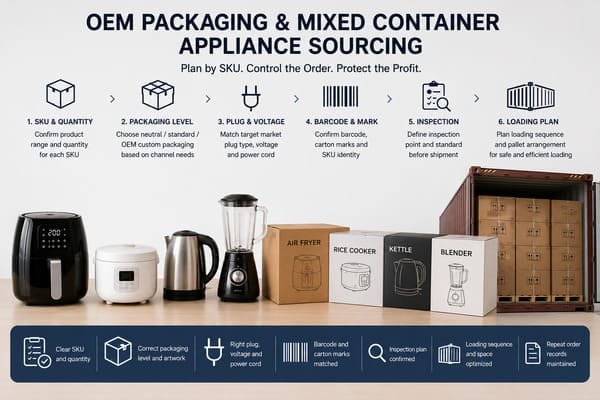
This guide is written for appliance importers, distributors, wholesalers, brand owners, supermarket buyers, and sourcing teams planning mixed container orders from China. It focuses on small home appliance order control, not generic packaging design or basic container shipping.
Why Should Importers Plan OEM Packaging and Mixed Container Orders as One System?
OEM packaging and mixed container orders should be planned together because product range, SKU quantity, MOQ, packaging files, plug/voltage, carton marks, inspection, and loading sequence affect one another before quotation and shipment.
A mixed container order is not simply a way to fill one container with many products. It is an order architecture. Each SKU needs a role, quantity, packaging level, market configuration, carton identity, and shipment position.
In our daily communication with appliance importers, the most confusing mixed container orders are usually not caused by one difficult product. The confusion often comes from too many unclear SKUs, late packaging decisions, missing carton marks, different plug/voltage versions, and no loading sequence before shipment planning.
For example, one order may include air fryers, blenders, fans, rice cookers, water dispenser pumps, or other small appliances. These products may use different carton sizes, different packing strength, different manuals, different labels, and different market configurations. If they are planned only as a “mixed container,” the real order-control work may be missed.
The 5-Lock System for Mixed Container Appliance Orders
A mixed container order becomes easier to control when five things are locked before quotation, production, and loading: product, packaging, market configuration, carton identity, and loading plan.
| Lock | What should be locked | Why it matters |
|---|---|---|
| Product Lock | Product category, model, SKU, quantity | Prevents unclear product range and quotation errors |
| Packaging Lock | Neutral packing, standard box, OEM box, manual, barcode | Prevents packaging mismatch and artwork confusion |
| Market Lock | Plug type, voltage, language, document scope | Prevents wrong market configuration |
| Carton Lock | Carton mark, SKU label, carton size, GW/NW | Helps warehouse receiving, sorting, and repeat orders |
| Loading Lock | CBM, loading sequence, inspection, packing list | Reduces loading confusion and shipment handling risk |
From the supplier side, this system helps turn a mixed product list into a workable order plan. It also helps the importer understand which details must be confirmed before a quotation can be accurate.
Bad Mixed Container Planning vs Good Mixed Container Planning
| Bad mixed container planning | Better mixed container planning |
|---|---|
| Many SKUs without clear quantity | SKU quantity planned before quotation |
| OEM box requested for every product too early | Packaging level decided by SKU maturity |
| Plug and voltage confirmed late | Market configuration checked before pricing |
| Similar cartons without clear labels | Carton mark and SKU label prepared early |
| Product sample approved only | Product, packaging, and loading details checked separately |
| No repeat-order record | Approved SKU data saved for future reorders |
| Price-first inquiry | Requirement-first inquiry |
In our order preparation process, a clear mixed container plan usually saves more time than repeated price negotiation. Price can only be meaningful when the SKU, packaging, market configuration, and loading basis are already clear.
How Should SKUs Be Matched With OEM Packaging, Neutral Packing, or Standard Color Box?
Packaging level should follow SKU maturity, sales route, repeat-order potential, quantity, artwork readiness, and channel requirements instead of applying the same OEM packaging to every item in a mixed container.
Not every SKU should receive the same packaging investment. A core repeat-order SKU may justify OEM color box preparation, while a test SKU may be safer with neutral packing or factory standard packaging first.
From the supplier side, we do not usually suggest making every mixed-container SKU highly customized at the first stage. Too many OEM boxes, languages, barcodes, carton marks, and artwork files can increase preparation time and mistake risk before the buyer has confirmed which products will repeat.
SKU Maturity Ladder
| SKU maturity level | Better packaging decision |
|---|---|
| Test SKU | Neutral packing or factory standard box may reduce early risk |
| Early repeat SKU | Simple OEM logo, sticker, or basic label may be considered |
| Stable repeat SKU | OEM color box may be worth planning |
| Channel-proven SKU | Barcode, carton mark, manual, and packaging consistency become important |
| Brand-core SKU | Custom box, stable artwork, repeat packaging control, and after-sales tracking should be planned |
This approach helps control cash pressure, artwork workload, and packaging waste. It also allows the importer to focus stronger branding on the SKUs that are more likely to repeat.
OEM Packaging Level Decision Table
| Buyer situation | Practical packaging direction |
|---|---|
| Testing a new market | Neutral packing or standard box may be safer |
| Building a repeat brand SKU | OEM logo or custom color box may be worth planning |
| Supplying supermarkets | Barcode, local language, product image, and carton mark need priority |
| Selling through wholesale markets | Strong carton and clear model information may matter more |
| Mixing many low-volume SKUs | Avoid over-customizing every SKU |
| Artwork files not ready | Do not rush printing before final files are confirmed |
| Plug/voltage not confirmed | Do not approve packaging that shows final market information |
| Manual language uncertain | Keep packaging approval open until language is confirmed |
In packaging confirmation, the goal is not to make every box look more customized. The goal is to match packaging cost, risk, channel use, and repeat-order value.
Packaging Is a Sorting System, Not Only a Branding Tool
Packaging in mixed container appliance sourcing is both a branding tool and a sorting system for warehouse receiving, distributor handling, SKU separation, and after-sales tracking.
A color box can support retail presentation, but the carton mark and SKU label are often more important after the goods arrive. At the warehouse, the buyer may need to identify hundreds or thousands of cartons quickly. If the carton identity is unclear, unloading and distribution can become slow or confusing.
| Packaging role | B2B value |
|---|---|
| Brand display | Helps retail presentation |
| Product protection | Reduces damage risk during handling |
| SKU identification | Helps warehouse sorting |
| Channel separation | Helps assign products to the correct distributor or region |
| Plug/voltage version control | Reduces wrong-market allocation risk |
| After-sales traceability | Helps identify which SKU caused complaints |
| Repeat-order memory | Helps reorder the same configuration later |
In our packing discussions, carton marks are often treated as small details at first. In real mixed container handling, they become one of the most useful tools for preventing confusion.
How Can MOQ, SKU Quantity, Plug/Voltage, and Packaging Level Affect Mixed Container Planning?
MOQ in mixed container sourcing should be treated as an allocation problem across model, SKU, packaging type, color, plug/voltage version, barcode, carton mark, and repeat-order plan.
A mixed container does not mean every product can be ordered in any small quantity. Each product model, packaging type, plug/voltage version, color, barcode, or carton mark may affect the preparation basis.
In many quotation discussions, customers ask whether mixed container orders can reduce MOQ pressure. The more practical question is how MOQ should be allocated by SKU. A mixed container can still create MOQ pressure if every item needs a different color box, language, plug version, barcode, or carton mark.
MOQ Allocation by SKU
| MOQ planning layer | What it affects |
|---|---|
| Model MOQ | Whether the SKU can enter the order |
| Packaging MOQ | Whether OEM box preparation is practical |
| Color MOQ | Whether multiple colors increase complexity |
| Plug/voltage version | Whether different market versions need separation |
| Barcode or SKU label | Whether each SKU can be identified correctly |
| Carton mark | Whether channel-specific marks are worth preparing |
| Manual language | Whether different inserts increase preparation work |
| Artwork file | Whether design approval can keep pace with production |
| Repeat-order plan | Whether the packaging investment is likely to be reused |
This is why a simple product list is often not enough for quotation. A supplier may need to check whether each SKU, packaging level, and configuration can be prepared within the requested quantity structure.
Mixed Container Complexity Budget
A mixed container has a complexity budget because every additional SKU, packaging version, language, barcode, plug/voltage version, carton mark, and inspection point increases communication and execution workload.
The goal is not to mix as many SKUs as possible. The goal is to mix the right number of SKUs that can be quoted, produced, packed, inspected, loaded, received, and reordered clearly.
| Complexity factor | Risk if uncontrolled |
|---|---|
| Too many SKUs | Higher communication and inspection burden |
| Too many packaging versions | More artwork and printing error risk |
| Different plug/voltage versions | Wrong market allocation risk |
| Different manual languages | Packing mix-up risk |
| Similar carton appearance | Warehouse receiving confusion |
| Different carton sizes | Lower loading efficiency |
| Too many low-quantity SKUs | MOQ and repeat-order difficulty |
| Late barcode confirmation | Retail or warehouse system delay |
| Unclear carton marks | Distributor receiving problems |
From our production and packing side, a simple mixed container with clear SKU identity is usually easier to control than a complicated container with many low-quantity customized items. This does not mean customization is bad. It means customization should match order maturity.
Do Not Brand Every SKU Too Early
Early-stage mixed container orders should avoid over-branding every SKU before product demand, sales route, packaging files, plug/voltage, and repeat-order potential are clear.
For a new market test, neutral packing or factory standard packaging can sometimes reduce early risk. For a repeat SKU, OEM color box or brand packaging may become more reasonable. The better decision depends on whether the SKU is likely to continue, whether the sales channel needs branded presentation, and whether the buyer is ready with final artwork files.
A useful rule is:
Test first
→ identify repeat SKUs
→ upgrade packaging level
→ lock artwork
→ build repeat-order records
This keeps the mixed container flexible without losing the option to build a brand later.
Why Are Carton Marks, Barcode, SKU Labels, Inspection, and Loading Sequence Risk-Control Tools?
Carton marks, barcode, SKU labels, inspection, and loading sequence are risk-control tools because they connect production packing with warehouse receiving, distributor sorting, shipment claims, after-sales tracking, and repeat-order accuracy.
For mixed container orders, the buyer receives cartons, not just product photos. If the cartons do not clearly identify the product, model, SKU, plug/voltage version, quantity, and packing type, warehouse and distribution teams may struggle after arrival.
On the production and packing side, carton marks are not only printing details. They help the buyer, warehouse, distributor, and sales team identify the correct SKU when different appliances are shipped together.
One Carton, One Identity
Every carton in a mixed container should have one clear identity that can be understood during loading, unloading, warehouse receiving, distributor sorting, and repeat-order checking.
| Carton identity item | Why it matters |
|---|---|
| Product category | Helps separate appliance types |
| Model number | Reduces confusion between similar products |
| SKU code | Connects carton with buyer system |
| Quantity per carton | Helps receiving and stock control |
| Plug/voltage version | Reduces wrong-market allocation risk |
| Packing type | Separates OEM, neutral, or standard box versions |
| Barcode | Helps retail or warehouse systems |
| Carton number | Helps packing list and claim handling |
| Gross/net weight | Supports logistics and warehouse handling |
| Carton size | Supports CBM, storage, and loading planning |
A clear carton identity is especially important when products look similar, boxes are similar, or one container serves different distributors, stores, or regions.
Product Sample Approval Is Not Packaging Approval
Product sample approval is not enough for OEM mixed container orders because packaging artwork, manual, barcode, rating label, carton mark, SKU label, and loading details also require separate confirmation.
A product sample may be correct, but the packaging can still be wrong. The color box may show the wrong model, the manual may use the wrong language, the barcode may not match the SKU, or the carton mark may not help warehouse sorting.
In our order preparation process, product sample approval and packaging approval are checked separately. For mixed container orders, loading approval should also be checked because the correct products and correct packaging still need to be loaded in the correct quantity and sequence.
| Approval type | What it checks |
|---|---|
| Product sample approval | Product model, appearance, function, plug, voltage |
| Packaging approval | Color box, manual, barcode, label, carton mark, language |
| Loading approval | SKU quantity, carton count, packing list, loading sequence, carton condition |
This three-layer approval helps reduce the risk of assuming that “sample approved” means “shipment ready.”
Mixed Container Loading Risk Table
Loading sequence matters because different appliance cartons may have different sizes, weights, shapes, and protection needs.
| Loading risk | What should be confirmed |
|---|---|
| Heavy cartons pressing light cartons | Loading sequence and stacking plan |
| Long cartons mixed with small cartons | Carton grouping and loading order |
| Fragile components | Inner protection and inspection point |
| Similar carton appearance | SKU label and carton mark |
| Different plug/voltage versions | Market-version mark on carton |
| Different manual languages | SKU separation before loading |
| Carton size changes after OEM box | CBM recalculation before shipment |
| Many small SKUs | Packing list and carton number control |
Before loading, the order should be checked again by SKU, carton count, packing list, and loading sequence. This step is especially important when air fryers, fans, blenders, rice cookers, water dispenser pumps, and other small appliances are shipped together.
Repeat-Order Memory
Repeat-order memory means saving approved SKU, packaging, carton, plug/voltage, barcode, artwork, inspection, and loading information so future orders can repeat the same configuration more easily.
A good mixed container plan should not only complete one shipment. It should also make the next shipment easier.
| Repeat-order record | Why it helps |
|---|---|
| SKU code | Reduces re-confirmation |
| Model number | Prevents wrong model selection |
| Packaging type | Keeps box style consistent |
| Plug/voltage version | Keeps market configuration clear |
| Barcode | Supports retail and warehouse continuity |
| Carton mark | Helps repeat distributor handling |
| Carton size | Supports future CBM planning |
| Approved artwork | Reduces repeated design work |
| Inspection notes | Helps compare future production |
| Loading quantity | Helps plan the next container |
In our daily work, repeat orders become smoother when the first order has clear records. Without these records, the second order may repeat the same communication and create new errors.
What Should Buyers Send Through WhatsApp Before Asking for a Mixed Container Quotation?
A mixed container quotation request should include target market, sales channel, product categories, estimated quantity per SKU, packaging level, plug/voltage, barcode, carton mark, destination port, shipment schedule, and model-selection needs.
A message that only asks for price is usually not enough for mixed container appliance sourcing. The supplier needs to understand the product mix, packaging plan, market configuration, and shipment basis before checking whether the quotation is practical.
When customers send SKU and packaging details early, the discussion becomes clearer. It also helps us check which products are suitable for the same container, which SKUs need OEM packaging, which items should stay standard first, and which details may affect quotation or loading.
Mixed Container Inquiry Template
Hello, we are preparing a mixed container appliance order.
Target market:
Sales channel:
Product categories:
Estimated quantity for each SKU:
Packaging option for each SKU:
OEM logo: yes / no
Box language:
Manual language:
Barcode / SKU label:
Carton mark:
Plug and voltage for each SKU:
Destination port:
Preferred shipment schedule:
Need model suggestions: yes / no
Could you help check whether this product mix and packaging plan is practical before quotation?
This type of inquiry helps the supplier review feasibility before giving a price. It also reduces back-and-forth communication because the key order-control details are already visible.
Mixed Container Readiness Score
A mixed container order is more ready for quotation when product category, SKU quantity, packaging level, market configuration, carton identity, and shipment details have been prepared.
| Readiness question | Ready / Not ready |
|---|---|
| Product categories selected? | |
| Estimated quantity per SKU prepared? | |
| Packaging level per SKU decided? | |
| Plug and voltage per SKU confirmed? | |
| Barcode or SKU label needed? | |
| Carton mark format prepared? | |
| Manual language confirmed? | |
| OEM logo file ready? | |
| Artwork approval person assigned? | |
| Destination port known? | |
| Loading or shipment schedule clear? | |
| Repeat-order record plan prepared? |
If several answers are still “not ready,” the buyer can still start a discussion, but the quotation may need more checking before it becomes final.
Before Quotation Checklist
| Information to prepare | Why it matters |
|---|---|
| Product categories | Defines the mixed container range |
| Model or capacity preference | Helps supplier suggest suitable SKUs |
| Quantity per SKU | Supports MOQ and carton calculation |
| Packaging level | Determines neutral, standard, or OEM preparation |
| Logo and artwork status | Affects packaging lead work |
| Plug/voltage requirement | Supports market configuration check |
| Manual language | Affects packing and user information |
| Barcode or SKU label | Supports retail and warehouse use |
| Carton mark | Supports loading and receiving |
| Destination port | Helps shipment discussion |
| Inspection needs | Supports pre-shipment control |
| Loading schedule | Helps production and shipment planning |
A better inquiry does not need to be long. It needs to provide the right information before quotation.
FAQ
This FAQ answers common questions about OEM packaging, mixed container appliance sourcing, MOQ allocation, SKU control, carton marks, plug/voltage, inspection, loading, and quotation preparation.
Can OEM Packaging and Mixed Container Sourcing Be Planned Separately?
They can be discussed separately, but they should not be controlled separately. Packaging level, SKU quantity, MOQ, carton mark, plug/voltage, and loading plan affect the same order.
Planning them together helps reduce packaging mistakes and shipment confusion.
Should Every SKU in a Mixed Container Use OEM Color Box?
No. Not every SKU needs OEM color box from the first order. Test SKUs may be safer with neutral packing or standard packaging, while stable repeat SKUs may justify stronger OEM packaging.
The decision should depend on sales route, quantity, artwork readiness, and repeat-order potential.
Does Mixed Container Sourcing Always Reduce Cost?
No. Mixed container sourcing may improve product range flexibility, but it does not automatically reduce total cost.
Cost logic may depend on SKU quantity, packaging version, MOQ, carton size, CBM, inspection work, loading efficiency, and communication complexity.
Is MOQ Only One Number for a Mixed Container Order?
No. MOQ should be considered by model, SKU, packaging type, color, plug/voltage version, barcode, carton mark, and artwork preparation.
A container may be mixed, but each SKU still needs a practical quantity structure.
Why Are Carton Marks Important for Mixed Container Orders?
Carton marks help identify SKU, model, quantity, packing type, plug/voltage version, and shipment information during loading, unloading, warehouse receiving, and distributor sorting.
They are not only printing details; they are risk-control tools.
Is Product Sample Approval Enough Before Shipment?
No. Product sample approval is only one layer. Packaging approval and loading approval should also be checked before shipment.
A correct sample can still be shipped with wrong box artwork, wrong manual, unclear carton mark, or poor loading sequence.
When Should Plug and Voltage Be Confirmed?
Plug and voltage should be confirmed before quotation, packaging approval, and mass production.
For appliance orders, plug/voltage may affect product version, rating label, manual, packaging text, carton mark, and document discussion.
What Should Be Checked Before Loading?
SKU quantity, carton count, carton mark, packing list, loading sequence, carton condition, fragile items, heavy carton placement, and plug/voltage separation should be checked before loading.
This is especially important for mixed appliance orders with different carton sizes and product types.
How Can Repeat Orders Become Easier?
Repeat orders become easier when the first order records SKU code, model, packaging type, plug/voltage, barcode, carton mark, carton size, approved artwork, inspection notes, and loading quantity.
These records reduce repeated confirmation and lower the chance of future mistakes.
Conclusion
OEM custom packaging and mixed container appliance sourcing should be treated as one order-control system, not two separate topics. A mixed container order becomes safer and clearer when product, packaging, market configuration, carton identity, and loading plan are locked before quotation and production.
The main decision is not only whether products can be mixed in one container. The stronger question is whether each SKU has the right quantity, packaging level, MOQ logic, plug/voltage version, barcode, carton mark, inspection point, and repeat-order record.
Before asking for a final quotation, the importer should prepare product categories, estimated quantity per SKU, packaging option, plug/voltage, manual language, barcode or SKU label, carton mark, destination port, shipment schedule, and model-selection needs. This makes the discussion more practical and reduces the risk of wrong packaging, SKU confusion, loading inefficiency, and repeat-order mistakes.
CTA
If you are planning an OEM packaging or mixed container appliance order, you can send us your product categories, SKU quantities, target market, plug/voltage needs, packaging ideas, carton mark questions, and destination port through the page form, WhatsApp, or WeChat.
We can help review the product mix, packaging level, MOQ allocation, and loading plan before quotation, so the next discussion becomes clearer and easier to move forward.