A very cheap air fryer quote can feel like a smart buying win. Then the missing details show up, and that “good deal” starts turning into delay, rework, and margin loss.
The cheapest air fryer quote is often the riskiest because it is usually the least complete quote, not the lowest real cost. In practice, low quotes often hide weaker Incoterms scope, thinner packaging, unclear certification responsibility, weaker QC, slower delivery control, or weaker after-sales support. That is why I never compare air fryer quotes by unit price alone.
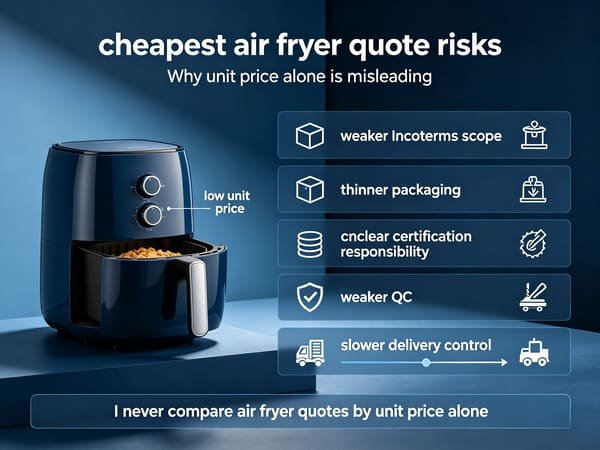
When I review air fryer quotes with buyers, I do not get excited by the lowest number first. I get suspicious first. A low price is not automatically a problem. What matters is whether that low price comes from real factory efficiency or from missing scope. In our work, I often see a quote look strong only because it leaves out the exact things that later create cost and trouble. The real danger is not cheap pricing by itself. The real danger is when the price disguises risk as savings. That is the point buyers need to catch before the deposit is paid.
What Does the Cheapest Air Fryer Quote Usually Leave Out?
A cheap quote rarely says, “I am incomplete.” It usually looks normal on the surface and only becomes risky when you compare the details carefully.
The cheapest air fryer quote often leaves out logistics scope, certification responsibility, packaging level, inspection support, spare parts, or after-sales terms. It may also be quoted under EXW while another supplier quotes FOB or DDP, which makes the low number look better even though the buyer is taking on more cost and more operational risk.
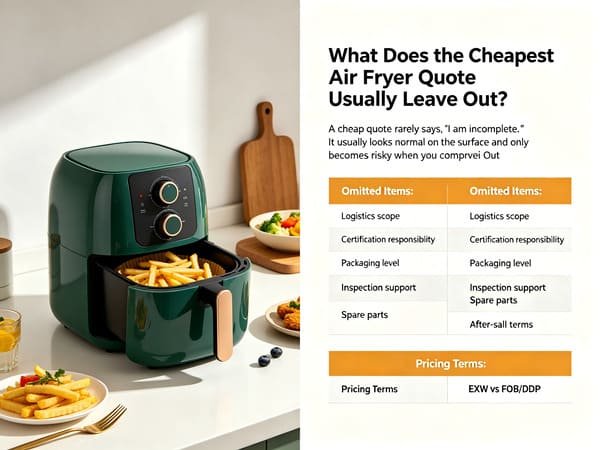
This is why I always read the quote like a scope document, not only like a price sheet. A supplier may show a very low air fryer price, but that number may only cover the product at the factory, with standard internal packing and nothing more. Another supplier may show a higher price, but that quote may already include better export cartons, logo printing, carton marks, and more organized shipment support. If I compare those numbers directly, I learn almost nothing.
In our factory-side discussions, I usually ask six questions immediately when a quote looks unusually low. What Incoterm is it really based on?1 What packaging is included? What certification support is included?2 What QC steps are included? What defect policy is included? What delivery promise is actually being made? These questions often explain the price gap much faster than another round of bargaining.
A cheap quote can still be a good quote. But only after every missing piece is made visible.
| Common missing item | Why it matters |
|---|---|
| Freight or export scope | Changes the true buying cost |
| Retail-ready packaging | Changes sellability and damage risk |
| Certification support | Changes market-access risk |
| Inspection support | Changes defect and delay risk |
| Spare parts | Changes after-sales burden |
| Clear delivery terms | Changes planning reliability |
How Lower Air Fryer Prices Can Signal Quality, Compliance, or Material Risk
A lower price can come from efficiency. It can also come from compromises that are not obvious in the first email.
Lower air fryer prices can signal quality, compliance, or material risk when the quote is built on lower-grade components, thinner packaging, weaker coatings, inconsistent assembly control, or incomplete certification support. A low quote can also reflect a supplier that is underpricing the order and planning to recover margin later through weaker execution or added charges.
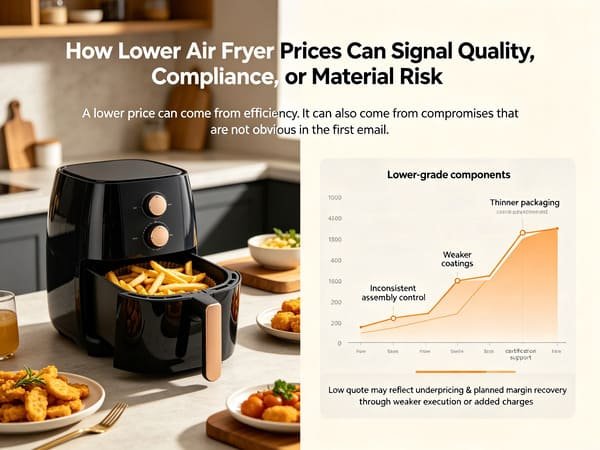
I have seen this pattern many times. Two air fryers look similar in photos, but one uses a different nonstick quality, a lighter basket structure, a less stable control system, or weaker carton protection. On paper, the quote looks excellent. In production, the risk starts to show. That is why I do not trust a low price until I understand the material and control logic behind it.
Compliance risk works the same way. A very low quote may say the product is “ready for North America,” but when I ask for listing details, label artwork, or certification scope, the answers become vague. That is a warning sign. Official certification systems also make clear that certification is not just a logo. Intertek says the ETL Listed Mark is proof of independent testing and certification to applicable standards3, and it also ties into ongoing factory surveillance. UL also explains that its certification marks indicate products have been tested to applicable standards4 and that there are different mark variations by geography and certification type. If a supplier talks about compliance in a very loose way, I treat that as commercial risk, not just technical risk.
A cheap quote becomes dangerous when the savings come from details the buyer cannot see quickly.
| Low-price signal | What I check next |
|---|---|
| Unusually low material cost | Basket, coating, heating parts, plastics |
| Weak compliance wording | Listing scope, mark type, directory record |
| Vague packaging description | Carton strength and retail readiness |
| Very short answers on QC | Process control and defect handling |
Why MOQ, Packaging, and Certification Assumptions Make Low Air Fryer Quotes Misleading
Some quotes look cheaper only because they are built on lighter assumptions than the buyer actually needs.
MOQ, packaging, and certification assumptions make low air fryer quotes misleading because suppliers may quote different order sizes, different branding levels, and different compliance responsibilities. A low quote may assume a bare stock model, a plain export carton, no certification support, and a larger MOQ than the buyer really wants.
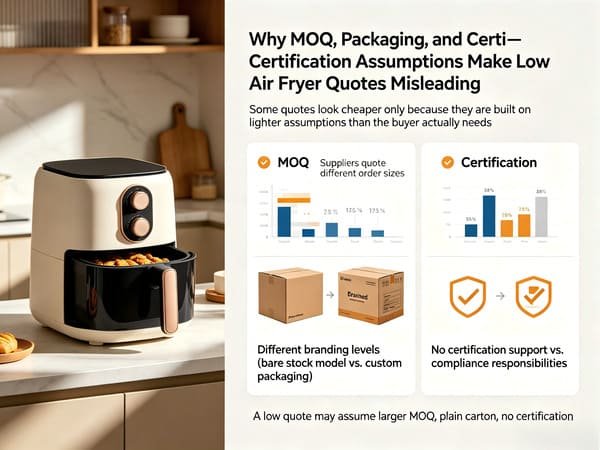
In practice, MOQ changes pricing logic a lot. A supplier may quote a strong unit price, but only at 1,000 units with standard packaging. Another supplier may quote a higher number at 300 units with private-label packaging and more flexible support. If I compare those as if they are the same project, the cheap quote wins only because the assumptions are weaker.
Packaging creates the same distortion. A plain carton and a printed gift box are not the same thing. A simple logo sticker and a clean housing print are not the same thing. Certification assumptions are even more important.5 A quote that assumes no active North American certification support can look very competitive next to one that includes label control and compliance coordination. But that is not a real apples-to-apples comparison.
That is why I always normalize the project first. Same MOQ basis. Same packaging basis.6 Same certification basis. Only then does the quote start to become meaningful.
| Assumption gap | How it distorts the quote |
|---|---|
| Different MOQ | Changes unit-price level |
| Different packaging standard | Changes cost and claim risk |
| Different logo method | Changes branding cost |
| Different certification scope | Changes market-entry risk |
| Different lead-time basis | Changes delivery risk |
How Delivery Delays and Weak Production Control Turn a Cheap Air Fryer Quote into a Costly Order
Many buyers focus on the price they pay before shipment. They forget to price the cost of the shipment arriving late or unstable.
Delivery delays and weak production control can turn a cheap air fryer quote into a costly order because late goods create stock gaps, missed sales windows, and emergency logistics pressure. Weak production control also raises the risk of mixed labels, cosmetic defects, unstable performance, and last-minute rework, all of which destroy the benefit of a low initial quote.
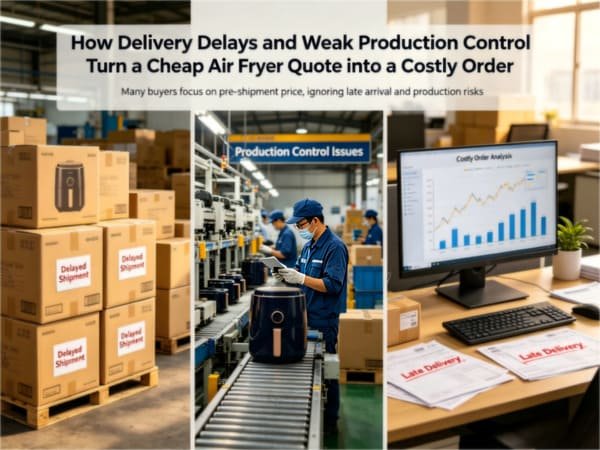
On our side, I think delivery reliability is part of price, even when many buyers treat it as a separate issue. A supplier who quotes cheaply but cannot control purchasing, line planning, or final inspection is not really selling a lower-cost order. The supplier is shifting operational risk to the buyer.
This problem becomes worse when the buyer sells into seasonal campaigns, promotions, or marketplace restock windows. A delayed air fryer order can cost more in lost sales than the buyer saved in unit price.7 Weak production control can do the same thing in a slower way.8 The cargo ships, but defect rates, carton failures, or labeling problems appear later. Then the buyer pays through returns, rework, and customer complaints.
That is why I do not admire a cheap quote until I understand the factory’s execution discipline. Price matters. Control matters more.
| Execution weakness | Cost that may appear later |
|---|---|
| Delayed material planning | Missed lead time |
| Poor line control | Higher defect rate |
| Weak label management | Relabeling and compliance trouble |
| Weak carton control | Transit damage and claims |
| Poor shipment planning | Extra warehousing or emergency freight |
What After-Sales, Defect, and Claim Risks Importers Should Check Behind a Low Air Fryer Price
The quote stage is usually where suppliers promise the most. It is also where buyers should look hardest at what happens when something goes wrong.
Importers should check warranty terms, spare-parts support, defect thresholds, claim handling rules, response time, and replacement or credit policy behind a low air fryer price. A supplier that offers a very low unit price but weak after-sales structure can create much higher total cost once defects, returns, or customer complaints appear.
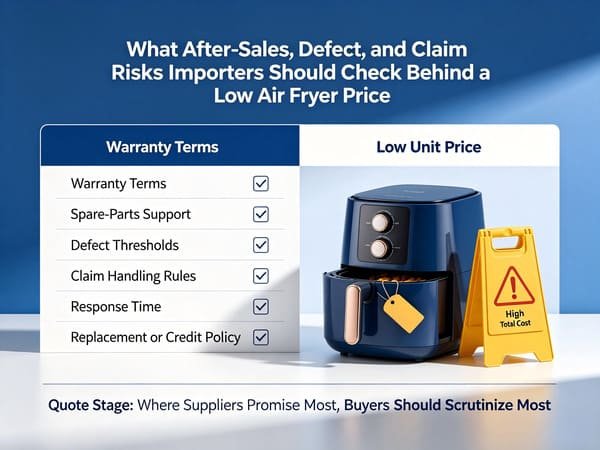
I usually ask simple questions here. What happens if the basket coating fails? What happens if the control panel has a problem rate above expectation? Will the supplier provide spare parts, replacement units, or credit? How fast will they respond? These details matter far more than buyers often realize.
A low quote with no real claim-handling path is risky because the importer ends up carrying the full burden after the goods land. That means internal labor, replacement stock, customer support time, and sometimes brand damage. In my view, after-sales structure is not a bonus9. It is part of the real quote value.
The same goes for defect tolerance. A supplier may talk confidently before the order but become vague when asked about actual claim rules. That is usually a sign that the low price is not supported by a strong service system10.
| After-sales item | Why I check it |
|---|---|
| Warranty period | Sets the claim exposure window |
| Spare-parts support | Reduces replacement cost |
| Defect-response timing | Affects customer handling speed |
| Credit or replacement policy | Shows real supplier responsibility |
| Claim evidence process | Shows whether support is practical |
How to Compare Cheap Air Fryer Quotes Against Total Sourcing Risk Instead of Unit Price
A cheap quote should not be rejected just because it is cheap. It should be tested against total risk.
To compare cheap air fryer quotes correctly, I normalize the specification, MOQ, packaging, certification scope, Incoterm, lead time, QC terms, and after-sales support first. Then I compare landed cost and execution risk together. The best quote is not the lowest visible number. It is the lowest normalized cost with the lowest compliance and delivery risk.
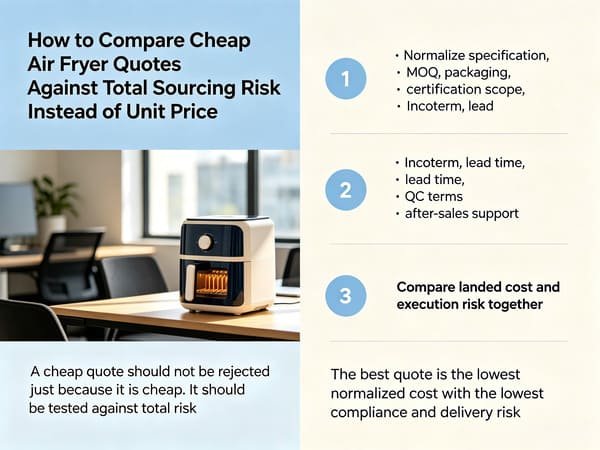
My practical rule is simple. Compare FOB-to-FOB or DDP-to-DDP only. ICC’s Incoterms guidance makes clear that these trade terms define different responsibilities and cost allocations11, so a quote under one term cannot be read as directly equal to another. A supplier that quotes EXW will naturally look cheaper than one quoting FOB or DDP if I ignore scope. That is not savings. That is distortion.
Then I score each quote in two blocks. The first block is normalized commercial cost. The second block is sourcing risk. In the risk block, I look at compliance clarity, packaging strength, QC support, delivery confidence, and after-sales response12. This method usually makes the “cheapest” quote look much less attractive if it is hiding too much risk.
That is the idea I want buyers to remember most: a cheap quote is not scary because it is cheap. It is scary when it disguises risk as a discount.
Conclusion
The cheapest air fryer quote is often the riskiest because it is often the least complete. I trust the best-normalized quote, not the cheapest-looking one.
FAQ
Why can the cheapest air fryer quote be more expensive later?
Because the cheapest air fryer quote may leave out packaging, certification, logistics scope, inspection, or after-sales support. The air fryer unit price can look low at first, but the real air fryer cost rises once those missing items appear later.
Should I trust a very low air fryer EXW quote against a higher FOB quote?
Not directly. An EXW air fryer quote and an FOB air fryer quote do not carry the same cost and responsibility scope. I only compare air fryer quotes after I normalize the Incoterm and make the commercial basis the same.
Can a cheap air fryer quote signal certification risk?
Yes. A cheap air fryer quote may use weak wording around ETL, UL, or other compliance support. I always verify whether the air fryer certification scope, label details, and market coverage are real and current before I treat a low quote as safe.
How do packaging and MOQ make a cheap air fryer quote misleading?
A cheap air fryer quote may assume a bigger MOQ, a plain export carton, or lighter branding than the buyer actually needs. That makes the air fryer quote look better on paper even though it does not reflect the real project scope.
What after-sales terms should I check behind a low air fryer quote?
I check air fryer warranty, spare-parts support, defect thresholds, response time, and whether the supplier offers credit or replacement for real claims. A low air fryer price with weak after-sales support can become a very expensive buying decision.
What is the best way to compare cheap air fryer quotes?
I compare cheap air fryer quotes only after I standardize the air fryer specification, MOQ, packaging, certification scope, Incoterm, lead time, and QC terms. Then I compare normalized cost together with sourcing risk, not just the air fryer unit price.
-
"[PDF] Incoterms and UCC Article 2 – Conflicts and Confusions – SMU Scholar", https://scholar.smu.edu/cgi/viewcontent.cgi?article=1717&context=til. This source explains the role of Incoterms in international trade, including how they define the responsibilities of buyers and sellers regarding shipping, insurance, and tariffs. Evidence role: definition; source type: education. Supports: Incoterms significantly impact the scope and cost of a supplier’s quote.. ↩
-
"Consumer Trust in Food and the Food System: A Critical Review", https://pmc.ncbi.nlm.nih.gov/articles/PMC8536093/. This source outlines the importance of certification in ensuring compliance with market regulations and its impact on product accessibility. Evidence role: mechanism; source type: government. Supports: Certification support is crucial for market access and compliance with regulations.. ↩
-
"ETL Listed Mark | Product Certification – Intertek", https://www.intertek.com/product-certification-marks/etl/. Intertek’s official documentation confirms that the ETL Listed Mark signifies compliance with applicable standards and includes factory surveillance as part of the certification process. Evidence role: definition; source type: institution. Supports: The ETL Listed Mark is proof of independent testing and certification to applicable standards, including factory surveillance.. ↩
-
"UL (safety organization) – Wikipedia", https://en.wikipedia.org/wiki/UL_(safety_organization). UL’s official resources state that its certification marks signify compliance with applicable standards and vary by geography and certification type. Evidence role: definition; source type: institution. Supports: UL certification marks indicate products have been tested to applicable standards and vary by geography and certification type.. ↩
-
"15.403-4 Requiring certified cost or pricing data (10 U.S.C. chapter …", https://www.acquisition.gov/far/15.403-4. This source explains how certification requirements, such as North American compliance, impact supplier quotes and market-entry risks. Evidence role: mechanism; source type: education. Supports: Certification assumptions significantly affect supplier quotes and market-entry risks.. Scope note: The source may focus on specific industries or regions, limiting its general applicability. ↩
-
"How to Read a Packaging Quotation – MOD-PAC", https://www.modpac.com/how-to-read-a-packaging-quotation/. This source discusses how packaging standards, such as plain cartons versus printed gift boxes, influence cost and branding risks in supplier quotes. Evidence role: mechanism; source type: research. Supports: Packaging standards significantly influence cost and branding risks in supplier quotes.. Scope note: The source may not address all packaging types or industries, limiting its scope. ↩
-
"Shipping delays impact global supply chains and exports", https://www.spglobal.com/market-intelligence/en/news-insights/research/shipping-delays-impact-global-supply-chains-and-exports-jul24. This source provides data on the financial impact of delayed shipments on retail sales, particularly in seasonal or promotional contexts. Evidence role: statistic; source type: research. Supports: A delayed air fryer order can cost more in lost sales than the buyer saved in unit price.. Scope note: The data may not specifically address air fryers but applies to general retail goods. ↩
-
"Production control of limited inventory manufacturing systems with …", https://ui.adsabs.harvard.edu/abs/2004cdc…..4…74M/abstract. This source discusses how poor production control can lead to increased defect rates and associated costs for buyers. Evidence role: mechanism; source type: education. Supports: Weak production control can do the same thing in a slower way.. Scope note: The discussion may not cover all forms of production control weaknesses but focuses on defect-related issues. ↩
-
"After-Sales Service | BETA – International Trade Administration", https://beta.trade.gov/article?id=Providing-After-Sales-Service. This source explains the importance of after-sales service in determining the overall value of a supplier’s quote. Evidence role: expert_consensus; source type: education. Supports: After-sales structure is a critical component of the real quote value, not merely an added benefit.. ↩
-
"International Suppliers & Import Guidance | Finance and Treasury", https://finance.princeton.edu/buying-paying/buy-supplies-and-equipment/international-suppliers-import-guidance. This source discusses how low-cost suppliers often lack robust after-sales support systems, increasing risks for importers. Evidence role: mechanism; source type: research. Supports: Low-cost suppliers often fail to provide strong after-sales service systems, which can lead to increased risks for importers.. ↩
-
"Incoterms – Wikipedia", https://en.wikipedia.org/wiki/Incoterms. The source explains the distinctions between Incoterms like FOB, EXW, and DDP, clarifying their implications for cost and responsibility allocation in international trade. Evidence role: definition; source type: institution. Supports: ICC’s Incoterms guidance makes clear that these trade terms define different responsibilities and cost allocations.. ↩
-
"Risk factors in the assessment of suppliers – PMC – NIH", https://pmc.ncbi.nlm.nih.gov/articles/PMC9342744/. The source discusses key factors like compliance, packaging, quality control, delivery, and after-sales service as critical components of sourcing risk evaluation. Evidence role: expert_consensus; source type: education. Supports: In the risk block, I look at compliance clarity, packaging strength, QC support, delivery confidence, and after-sales response.. Scope note: The source may not address all industries or specific buyer contexts. ↩