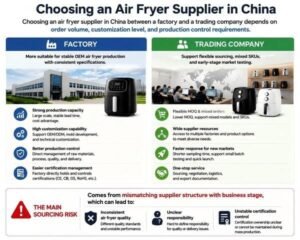
Air fryer procurement contracts should define delivery milestones, delay causes, inspection-linked payment, rework responsibility, freight cost rules, evidence records, and agreed remedies before production starts.
Problem: Air fryer buyers often face late shipments because contracts only mention a general delivery time, without defining when the schedule starts, which approval steps affect production, or who is responsible when delay occurs.
Agitation: A vague delivery clause can lead to missed retail launches, delayed e-commerce campaigns, extra logistics costs, payment disputes, failed inspections, supplier excuses, and difficult breach-of-contract discussions.
Solution: A stronger procurement contract should separate delivery milestones, supplier-caused delays, buyer-caused delays, third-party delays, inspection failure, payment release, freight cost changes, platform protection limits, evidence records, and formal recovery steps before the order is confirmed.
Snippet: Air fryer procurement contracts should clarify delivery time by defining milestone dates, delay responsibility, inspection requirements, payment conditions, freight cost rules, evidence records, and formal remedies before deposit payment or mass production.
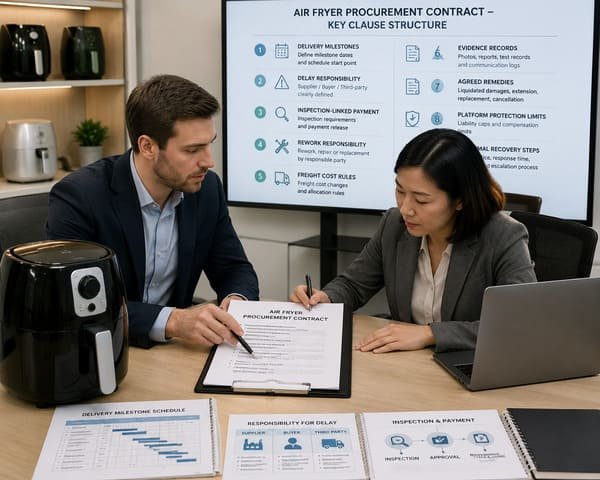
Air fryer procurement is not only a product purchase. It is a timed commercial project involving samples, packaging, labels, production, inspection, payment, shipment booking, loading, and documents. A contract that only says “shipment within 30 days” may look simple, but it often fails when the order becomes delayed.
The goal is not to punish the supplier automatically. The goal is to create a fair, clear, and evidence-based contract structure that helps both sides know what must happen, when it must happen, what proof is needed, and what remedies apply if the schedule fails.
What delivery terms should be clarified in an air fryer procurement contract?
Air fryer delivery terms should define the delivery start point, milestone schedule, final shipment deadline, shipment proof, and responsibility for delay.
A delivery clause should not rely on vague phrases such as “as soon as possible,” “around 30 days,” or “shipment soon after payment.”1 These expressions leave too much room for dispute. The contract should explain exactly when the delivery period starts and which conditions must be completed before mass production or shipment.2
Delivery time should have a clear start point
The contract should state whether the delivery period starts after:
- PI signing
- Deposit receipt
- Product specification confirmation
- Golden sample approval
- Packaging artwork approval
- Barcode and label confirmation
- Manual language confirmation
- All buyer-provided files are received
- Both deposit and sample approval are completed
For a standard air fryer model with standard packaging, delivery time may start after deposit and PI confirmation3. For private label, customized packaging, or market-specific configuration, delivery time may need to start only after sample approval, artwork approval, label confirmation, and all required files are complete4.
Final shipment date should be measurable
The contract should define which event proves delivery or shipment. Depending on the agreed trade term and contract wording, proof may include:
- Factory release date5
- Loading date
- Vessel departure date
- B/L shipped-on-board date6
- Delivery to forwarder warehouse
- Delivery to buyer-nominated warehouse
- Delivery to destination warehouse
A supplier may say production is finished, but production completion is not always the same as shipment completion. If the contract requires shipment before a certain date, the proof should be clearly stated.
Incoterms should not replace delivery responsibility
Incoterms can clarify cost, risk, and logistics responsibility7, but they do not automatically solve production delay, failed inspection, packaging mistakes, payment disputes, or breach responsibility.
For example, “FOB Shenzhen” may clarify when cost and risk transfer around loading at the port8, but it does not automatically explain:
- What happens if production is late
- What happens if inspection fails
- Who pays re-inspection cost
- Who pays air freight difference after supplier delay
- Whether the buyer can cancel after a critical delay
- Whether packaging mistakes extend the delivery date
Incoterms should be written together with, but separated from, production and delay responsibility clauses.
Common mistake to avoid
Do not treat a trade term such as FOB, EXW, CIF, or DDP as a complete delivery responsibility clause. It is only one part of the delivery arrangement.
What delivery milestones should be written into an air fryer procurement contract?
Air fryer delivery time should be controlled by milestone dates, not only by the final shipment date.
Many disputes happen because the contract only states a final delivery time. By the time the final shipment date is missed, the buyer may already have lost the retail window, promotion schedule, or customer delivery plan.
A milestone schedule helps both sides identify delay earlier.9 It also helps determine whether the delay came from supplier production, buyer approval, packaging artwork, inspection failure, freight booking, or an external logistics event.
Delivery milestones to confirm
A strong air fryer procurement contract or PI should include:
- Deposit received date
- Product specification lock date
- Plug and voltage confirmation date
- Golden sample approval date10
- Packaging artwork approval date
- Barcode and rating label approval date
- User manual confirmation date
- Material preparation date
- Mass production start date
- Mass production completion date
- Pre-shipment inspection date
- Rework deadline if inspection fails
- Re-inspection date if needed
- Shipment booking deadline
- Container loading date
- Latest acceptable shipment date
- B/L shipped-on-board date
These milestones do not need to be complicated11, but they should be visible and agreed before production begins.
Why milestone control matters
A final shipment deadline may be too late for risk control. If packaging artwork is delayed, barcode files are not confirmed, basket coating takes longer than expected, or the supplier cannot book shipment, the buyer may only discover the problem near the final deadline.
A milestone schedule makes delay visible earlier and creates a clearer evidence trail.
For example, if packaging artwork must be approved before mass production starts12, then both sides can check whether a delay was caused by late buyer approval, supplier artwork mistakes, unclear packaging requirements, or factory production problems.
Latest acceptable shipment date
If the air fryer order is linked to a promotion, retailer launch, e-commerce campaign, distributor delivery, or seasonal sales window, the contract should include a latest acceptable shipment date13.
This date is different from the estimated shipment date. It represents the point after which the order may no longer serve the intended commercial purpose.
The contract may state what happens if this date is missed, such as:
- Revised shipping plan
- Partial shipment discussion
- Air freight cost allocation
- Discount negotiation
- Order cancellation right
- Substitute model discussion
- Recovery plan requirement
The exact remedy should be reviewed for the specific contract and legal environment14.
Common mistake to avoid
Do not write only “delivery within 30 days” without defining whether the 30 days start from PI signing, deposit receipt, sample approval, packaging approval, or production confirmation.
What date should count as delivery under FOB, EXW, CIF, or DDP?
The delivery date should be defined according to the agreed trade term, shipment proof, and contract wording, not only by the supplier’s production completion date.
Many air fryer delivery disputes happen because the buyer and supplier use the word “delivery” differently. The supplier may think delivery means production is finished. The buyer may think delivery means goods arrive at the destination warehouse. A freight forwarder may focus on pickup or loading date. The contract should remove this ambiguity before production starts.
Why delivery date definition matters
Delivery date affects:
- Whether the supplier is late
- When delay penalties may start
- Whether the buyer can claim expedited shipping cost15
- Whether the buyer can delay balance payment
- Whether the order misses a promotion or warehouse appointment
- Whether the supplier has fulfilled its shipment obligation
For air fryer procurement, the contract should state exactly which date will be used to judge delay responsibility16.
EXW delivery date
Under EXW, the key date is often the date when the goods are ready for pickup at the supplier’s factory or agreed location.
However, the buyer should still define what “ready” means. For air fryer orders, ready for pickup should usually mean:
- Production is completed.
- Goods match the approved specification.
- Packaging is completed.
- Carton marks are correct.
- Inspection has passed if required.
- Pickup quantity is ready.
- Pickup documents are prepared.
- The buyer or nominated forwarder can collect the goods.
A supplier should not treat unfinished goods, uninspected goods, or incorrectly packed goods as ready for EXW delivery if the contract requires inspection or correct packaging before pickup.
FOB delivery date
Under FOB, the key date is usually linked to loading the goods on board the vessel at the agreed port.
For delay responsibility, the contract may define the delivery or shipment date as:
- Container loading date
- Customs release date
- Vessel loading date
- B/L shipped-on-board date
For many B2B buyers, the B/L shipped-on-board date is stronger evidence because it is issued by the carrier and shows when the goods were loaded on board. If the contract uses FOB, it should state whether the supplier’s obligation is judged by booking date, loading date, or B/L date.
CIF delivery date
Under CIF, the supplier usually arranges the main carriage and provides shipping documents. The contract should still define which date matters for delay.
Possible reference dates include:
- Shipment booking date
- Vessel departure date
- B/L shipped-on-board date
- Document delivery date
- Estimated arrival date
If the buyer’s main concern is production delay, the B/L shipped-on-board date may be more relevant than the destination arrival date. If the buyer’s concern is arrival before a sales campaign, the contract should also include a latest acceptable arrival or warehouse delivery date.
DDP delivery date
Under DDP or destination delivery arrangements, the buyer may expect the supplier to deliver goods to the final agreed destination.
The contract should define:
- Exact destination address
- Whether delivery means arrival at port, warehouse, store, or buyer-designated address
- Whether customs clearance is included
- Whether appointment delivery is required
- What document proves delivery
- Who bears delay caused by customs, carrier, or buyer-side appointment failure
For supermarket, distributor, or e-commerce warehouse orders, DDP delivery should be connected to the buyer’s receiving requirements, appointment deadline, and documentation process.
Platform order delivery date
If the order is placed through a B2B platform, the platform may define delivery, shipment, or protection periods in its own rules. That platform definition may not be the same as the buyer’s commercial delivery deadline.
The buyer should check:
- Platform shipment deadline
- Platform delivery confirmation rule
- Order protection period
- Dispute submission deadline
- Required evidence for late shipment
- Whether chat records and PI terms are accepted as evidence
- Whether the platform order terms match the signed PI or contract
Platform protection should be treated as an additional layer, not as a replacement for clear contract wording.
Suggested contract wording direction
The contract should state:
“For the purpose of delay responsibility, delivery date means [specific event], supported by [specific evidence]. Production completion alone shall not be treated as delivery unless the contract expressly defines it as the delivery event.”
The exact wording should be reviewed based on trade term, order value, dispute venue, and legal advice.
Common mistake to avoid
Do not let “delivery date” mean one thing to the supplier and another thing to the buyer. Define the exact event and evidence used to judge delay.
How should delay responsibility be divided between buyer, supplier, and third parties?
Delay responsibility should be divided by cause, evidence, and contract obligations instead of assuming every delay belongs to one party.
In air fryer procurement, late shipment may be caused by the supplier, the buyer, the freight forwarder, customs, inspection failure, unclear artwork, delayed payment, or external events. If the contract does not separate these causes, both sides may argue after the deadline is missed.
A stronger contract should define supplier-caused delay, buyer-caused delay, third-party delay, and shared delay.
Supplier-caused delay
Supplier-caused delay may include:
- Production does not start on the agreed date.
- Raw materials or components are not prepared on time.
- Heating elements, baskets, housings, control panels, plugs, or cords are delayed without prior notice.
- The supplier changes specifications without approval.
- The supplier prints the wrong packaging, barcode, rating label, manual, or carton mark.
- The supplier fails inspection due to product defects or packaging problems.
- Mass production does not match the approved sample.
- Rework is required because the supplier did not follow the confirmed standard.
- The supplier misses the shipment booking deadline.
- The supplier cannot provide shipping documents on time.
- The supplier gives an unrealistic delivery date to win the order.
If delay is caused by supplier-controlled issues, the contract may require the supplier to provide a recovery plan, complete rework, pay re-inspection cost if agreed, offer an agreed discount or delay penalty, or discuss expedited shipping cost according to the contract.
Buyer-caused delay
Buyer-caused delay may include:
- Deposit is paid late.
- Packaging artwork is approved late.
- Product specification is changed after order confirmation.
- Plug, voltage, color, logo, label, or manual requirements are changed late.
- Sample approval is delayed.
- Barcode or packaging files are not provided on time.
- Inspection booking is delayed by the buyer.
- Balance payment is delayed after inspection passes.
- Shipping instructions are unclear or provided late.
- Buyer-nominated forwarder is not arranged on time.
If the delay is caused by buyer-side approval, payment, document, or instruction delay, the supplier may need additional production or shipment time. This should be written clearly so the supplier is not unfairly penalized for delays outside its control.
Third-party or external delay
Third-party or external delay may include:
- Carrier rollover
- Port congestion
- Customs inspection
- Severe weather
- Public holiday logistics congestion
- Freight forwarder delay
- Sudden route disruption
- Force majeure event
- Regulatory or inspection delay outside both parties’ control
These events should not automatically excuse all responsibility. The contract should require timely notice, evidence, mitigation action, and updated delivery planning.
Some delays are mixed. For example, packaging approval may be late, but the supplier may also fail to prepare materials on time. Or production may finish late, then the carrier may roll the vessel.
For shared delay, the contract should require both sides to review the milestone schedule and evidence before deciding responsibility.
Evidence needed for delay responsibility
Useful evidence may include:
- Signed PI or contract
- Deposit payment record
- Artwork approval record
- Sample approval record
- Production schedule
- Supplier production updates
- Inspection booking record
- Inspection report
- Rework report
- Shipment booking record
- Freight forwarder notice
- Loading photos
- B/L date
- Email, WhatsApp, or WeChat communication records
Common mistake to avoid
Do not write a delay penalty clause without also defining delay cause, evidence requirement, notice duty, and buyer-side approval responsibility.
What air fryer-specific issues can affect delivery time?
Air fryer delivery time may be affected by heating components, basket coating, control panels, plug and voltage configuration, packaging artwork, labels, manuals, inspection results, and peak-season production pressure.
A generic delivery clause may not fully protect an air fryer procurement order because air fryers have product-specific production and approval risks. A supplier may quote a normal lead time, but the actual schedule can change if the selected model requires different components, packaging, labels, or market configuration.

Air fryer production may be affected by:
- Heating tube or heating plate availability
- Thermostat supply
- Timer component availability
- PCB or digital control panel supply
- Fan motor supply
- Basket and tray availability
- Basket coating process
- Handle assembly
- Plastic housing color matching
- Control knob or touch panel version
- Plug and cord configuration
These risks may depend on model, quantity, supplier inventory, customization level, and production season. The selected model’s actual production readiness should be verified before relying on a quoted delivery time.
Air fryers may need market-specific configuration, such as:
- Plug type
- Voltage
- Frequency
- Cord length
- Control panel language
- Temperature display format
- Manual language
- Rating label information
- Barcode
- Carton mark
- Packaging language
If these details are not confirmed before production, the supplier may need to stop, revise, reprint, relabel, or rework the order.
Private label air fryer orders often depend on packaging approval. Delay may come from:
- Color box artwork revision
- Logo placement
- Product image correction
- Selling point wording
- Local language translation
- Barcode position
- Rating label position
- User manual layout
- Warranty card
- Gift box or promotional sticker
- Outer carton mark
- Carton strength confirmation
Packaging should be treated as part of the delivery schedule, not as a small design detail.
Air fryer orders may face delay if inspection finds:
- Function failure
- Heating problem
- Temperature inconsistency
- Timer problem
- Control panel problem
- Basket coating defect
- Scratches or visual defects
- Wrong plug or voltage
- Wrong label
- Wrong manual
- Barcode issue
- Packaging damage
- Carton mark mismatch
- Quantity mismatch
The contract should state how inspection failure affects rework, re-inspection, payment, and delivery responsibility.
Peak-season delay risks
Air fryer demand may rise before promotion seasons, retailer campaigns, or holiday sales windows. During peak production periods, suppliers may face tighter capacity, longer material preparation, slower packaging production, and limited shipping space.
If the order is linked to a promotion or retail launch, the contract should include a latest acceptable shipment date and a fallback plan.
Common mistake to avoid
Do not use a generic delivery clause for customized air fryer orders without checking component readiness, packaging approval, label requirements, inspection risk, and peak-season production pressure.
How should order changes affect delivery time and breach responsibility?
Order changes should trigger written confirmation of cost impact, time impact, revised milestones, and responsibility before the supplier changes production.
Many air fryer delays are not caused by one clear breach. They happen because product requirements change after PI confirmation. A buyer may change the plug, voltage, logo, color box, label, manual language, barcode, carton mark, or inspection standard. A supplier may accept the change verbally but fail to update the schedule. Later, both sides disagree about whether the original delivery date still applies.
Buyer change requests should be written
A buyer-side change request should be recorded in writing when it affects:
- Product specification
- Plug or voltage
- Color
- Logo
- Control panel
- Packaging artwork
- Barcode
- Rating label
- User manual
- Carton mark
- Accessories
- Inspection standard
- Shipment method
- Destination or forwarder
The written request should describe exactly what changes and when the buyer requested it.
Supplier should state time and cost impact
Before accepting the change, the supplier should confirm:
- Whether the change is possible
- Whether new materials are needed
- Whether packaging needs reprinting
- Whether sample approval is required again
- Whether inspection standards change
- Whether production must stop
- Whether cost changes
- Whether the delivery date changes
- Whether the previous milestone schedule still applies
A simple “OK, no problem” is not enough for changes that affect production timing or cost.
Revised delivery date should be confirmed
If the change affects delivery time, both sides should confirm a revised delivery milestone schedule.
This may include:
- Revised sample approval date
- Revised artwork approval date
- Revised material readiness date
- Revised production completion date
- Revised inspection date
- Revised loading date
- Revised latest acceptable shipment date
Without this step, the supplier may later claim that the delivery date was extended automatically, while the buyer may believe the original date still applies.
Supplier cannot use every change as an excuse
A buyer-side change may justify extra time for the affected part of the order, but it should not automatically excuse unrelated supplier delay.
For example:
- If the buyer changes the manual language, that may affect manual printing.
- It should not automatically excuse late heating component preparation.
- If the buyer changes carton marks, that may affect carton printing.
- It should not automatically excuse production not starting on time.
The contract should require evidence showing how the change affected the schedule.
Common mistake to avoid
Do not allow product, packaging, or label changes without written confirmation of time impact, cost impact, and revised delivery responsibility.
How should delivery penalties and breach remedies be written safely?
Delivery penalties should be specific, commercially reasonable, capped where appropriate, and reviewed within the governing law and dispute resolution framework.
Liquidated damages can help create pressure for on-time delivery, but they should not be written as if recovery is guaranteed. Enforceability may depend on governing law, dispute venue, contract wording, order value, actual loss, evidence, and legal review.
What a delay penalty clause may include
A delay penalty clause may define:
- Agreed delivery date
- Grace period if any
- Penalty start date
- Penalty calculation method
- Maximum penalty cap
- Whether penalties apply to total order value or delayed goods value
- Whether delay caused by buyer is excluded
- Whether force majeure or third-party delay is excluded
- Whether expedited shipping cost can be claimed
- Whether the buyer can cancel after a critical delay
- Whether remedies require written notice
Example wording for discussion
The following is only a drafting example and should not be treated as legal advice:
“Unless delay is caused by buyer-side approval delay, buyer-side payment delay, buyer-side shipping instruction delay, or a verified force majeure event, if the supplier fails to ship the goods by the agreed shipment date, the supplier shall provide a written recovery plan and may be responsible for agreed liquidated damages calculated according to the contract.”
For important orders, legal counsel should review the final wording.
Penalty should not replace recovery planning
A penalty clause alone does not solve the operational problem. If the order is delayed, the buyer still needs a recovery plan:
- Can production be finished by a revised date?
- Can inspection be arranged earlier?
- Can partial shipment reduce loss?
- Can packaging be prioritized?
- Can shipment be upgraded?
- Who pays extra cost?
- Is cancellation better than waiting?
- Is a substitute model possible?
The contract should support both accountability and practical recovery.
Common mistake to avoid
Do not write an aggressive penalty clause without defining delay cause, evidence, cap, legal review, and recovery process.
How should buyers define critical delay versus recoverable delay?
Critical delay should be separated from recoverable delay because not every late shipment has the same commercial impact.
Some delays can be recovered through a revised production plan, earlier inspection, partial shipment, or expedited logistics. Other delays destroy the purpose of the order because the buyer misses a retailer launch, promotion window, e-commerce appointment, distributor deadline, or seasonal sales period.
Recoverable delay
A recoverable delay may still allow the buyer to use or sell the goods if corrective action happens quickly.
Examples may include:
- Minor production delay with enough buffer
- Packaging revision completed before final shipment
- Short inspection delay with new booking date
- Rework that can be completed before latest acceptable shipment date
- Carrier rollover that does not affect final sales plan
- Partial shipment that covers urgent customer needs
For recoverable delay, the buyer should request a written recovery plan and evidence, not immediately escalate to termination.
Critical delay
A critical delay may make the order commercially less useful or unusable for the intended purpose.
Examples may include:
- Missing a supermarket listing deadline
- Missing a holiday promotion launch
- Missing an e-commerce warehouse appointment
- Missing distributor delivery commitment
- Missing a customer contract deadline
- Missing a seasonal sales window
- Repeated inspection failure close to shipment deadline
- No realistic recovery plan before the latest acceptable shipment date
If a critical delay matters, the contract should define the critical date before order confirmation.
Recovery options before cancellation
Before cancelling, the buyer may consider:
- Partial shipment
- Air freight for urgent quantity
- Sea shipment for remaining quantity
- Rework acceleration
- Substitute model
- Discount for delayed shipment
- Revised customer delivery plan
- Holding goods for next sales window
Cancellation may be appropriate in some cases, but it should follow contract terms, evidence, and legal advice.
Common mistake to avoid
Do not treat every delay the same. Define the latest acceptable shipment date and separate recoverable delays from delays that destroy the order’s commercial purpose.
How should failed inspection and rework affect the delivery deadline?
Failed inspection should affect the delivery deadline based on the cause of failure, the agreed inspection standard, rework responsibility, and whether requirements changed after confirmation.
For air fryer procurement, inspection failure is one of the most important delivery risk points. A supplier may finish production by the agreed date, but if the goods fail inspection, the buyer may still be unable to ship or sell the order.

If inspection fails because of supplier defects
If inspection fails because mass production does not match the approved sample, specification, packaging, label, or agreed quality standard, the supplier should usually be responsible for rework within an agreed time.
The contract may state that:
- Supplier must provide a corrective action plan.
- Supplier must complete rework within a fixed period.
- Rework time does not automatically extend the original delivery deadline.
- Re-inspection cost is borne by the supplier if agreed and if failure is supplier-caused.
- Balance payment is released only after passed inspection, if this was agreed.
- Repeated failure may trigger discount, cancellation, replacement, or other agreed remedies.
The exact remedy should be reviewed by legal counsel for important orders.
If inspection fails because requirements changed
If the buyer changes the inspection standard, packaging requirement, specification, label requirement, or approval criteria after PI confirmation, the supplier may need additional time. In this situation, the original delivery deadline may need to be adjusted by written agreement.
Examples include:
- Logo or artwork changes after packaging production starts
- Plug or voltage changes after sample approval
- Barcode or label changes after printing
- New manual language added late
- Inspection criteria changed after production
Any buyer-side change that affects cost or delivery time should be confirmed in writing.
If inspection fails because the standard was unclear
Sometimes inspection fails because the contract did not define the inspection standard clearly. This can create disputes.
To reduce this risk, the contract should attach:
- Product specification sheet
- Approved sample photos
- Packaging artwork
- Barcode and label file
- User manual version
- Rating label version
- Carton mark
- Inspection checklist
- AQL standard if used
- Critical defect definition
- Major and minor defect examples
Rework deadline
The contract should not only say “supplier will rework.” It should state:
- What must be reworked
- Who approves the rework plan
- How many days the supplier has to finish rework
- Whether re-inspection is required
- Who pays re-inspection cost
- Whether the shipment date changes
- Whether delay penalty continues
- What happens if rework fails again
Common mistake to avoid
Do not treat “production completed” as equal to “delivery obligation completed” if the contract requires inspection, rework approval, and passed pre-shipment inspection before shipment.
How should payment terms be connected with delivery and inspection clauses?
Payment terms should be connected with sample approval, production milestones, inspection results, shipment documents, and delay responsibility.
Many air fryer procurement contracts separate payment, delivery, and inspection clauses. This creates risk. A supplier may request balance payment even though inspection has not passed, or a buyer may delay payment after the supplier has fulfilled the agreed condition.
A stronger contract should explain how payment release matches real order progress.
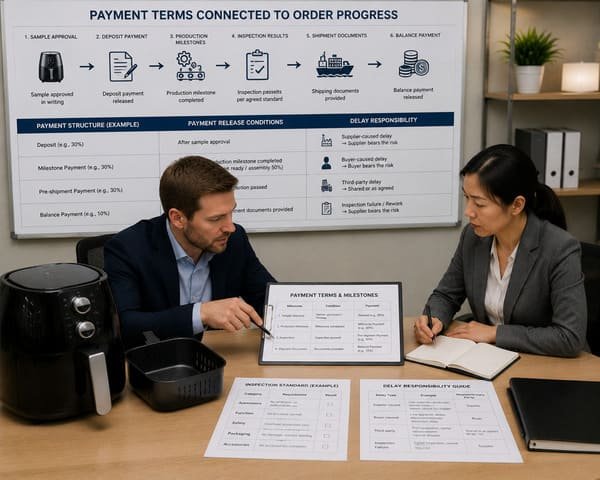
Deposit and production start
The contract should state whether production starts after:
- PI signing
- Deposit receipt
- Specification confirmation
- Sample approval
- Packaging artwork approval
- All buyer-provided files are received
If deposit is late, the delivery schedule may need to move. If deposit is paid but the supplier still does not start preparation, the supplier should provide an updated production plan.
Sample approval and production risk
For customized air fryer orders, sample approval is often a key control point. The contract should state whether mass production can start before sample approval.
For private label or modified products, production before approval may create mismatch risk. If the supplier produces before required approval, the supplier may bear rework risk if the goods do not match the approved standard.
Inspection and balance payment
If balance payment is due after passed pre-shipment inspection, the contract should define:
- Who arranges inspection
- When inspection should be booked
- Which standard is used
- What counts as passed inspection
- What happens if inspection fails
- How quickly payment should be released after passed inspection
- What documents are needed before payment
- Whether supplier photos alone are enough
For higher-risk orders, relying only on supplier photos may be weak. A third-party inspection or buyer-approved inspection process can provide stronger evidence, depending on order value and risk level.
Shipment documents and final responsibility
The contract should also connect payment and shipping documents. Depending on payment structure and trade terms, documents may include:
- Commercial invoice
- Packing list
- B/L draft
- Final B/L
- Certificate or declaration if applicable
- Inspection report
- Loading photos
- Carton mark record
- Shipping advice
The contract should clarify what documents the supplier must provide and when.
Delay penalty and payment adjustment
If a delay penalty, discount, or air freight cost sharing is agreed, the contract should explain how it affects payment.
Possible approaches include:
- Deduct agreed delay penalty from balance payment
- Supplier issues a revised invoice
- Supplier pays air freight difference if delay is supplier-caused
- Buyer releases undisputed amount and holds disputed amount
- Both parties sign a written adjustment before shipment
These options should be reviewed for the specific contract and legal environment.
Avoid conflicting clauses
Payment, delivery, and inspection clauses should not conflict.
For example:
- If balance is due before shipment, inspection timing must still be clear.
- If shipment requires passed inspection, the supplier should not demand shipment release before inspection.
- If inspection booking is delayed by the buyer, the supplier should not be automatically penalized for all resulting delay.
- If inspection fails due to supplier defects, the buyer’s payment hold should not be treated as buyer-caused delay.
Common mistake to avoid
Do not write payment terms, delivery terms, and inspection terms as separate clauses without explaining how they interact when production is delayed, inspection fails, or balance payment is disputed.
What evidence should buyers require before releasing the final balance?
Before releasing the final balance, buyers should require evidence that production, packaging, inspection, quantity, labels, documents, and shipment readiness match the agreed order.
Final balance payment is one of the buyer’s strongest control points. Once the balance is paid, it may become harder to push the supplier to rework defective goods, correct packaging, fix documents, or accept delay responsibility. The required evidence should match the order value, supplier trust level, and risk level.
Production evidence
Before final balance, buyers may request:
- Production completion confirmation
- Finished quantity record
- Unfinished quantity record if partial production exists
- Production photos with date
- Model number confirmation
- Plug and voltage confirmation
- Control panel version confirmation
- Basket and accessory confirmation
- Approved specification comparison
Photos alone may not be enough for higher-risk orders, but they can support the evidence file when combined with inspection and documents.
Packaging and label evidence
For air fryer orders, packaging errors can create retail, customs, platform, and after-sales problems. Buyers should check:
- Color box version
- Product image on package
- Logo placement
- Barcode position
- Barcode scan result if needed
- Rating label
- Plug and voltage label
- Manual language
- Warranty card if applicable
- Carton mark
- Shipping mark
- Carton quantity
- Carton condition
If packaging is customized, the supplier should confirm that mass production packaging matches the approved artwork.
Inspection evidence
If the payment term is linked to pre-shipment inspection, final balance should usually not be released before the agreed inspection condition is met.
Inspection evidence may include:
- Inspection booking confirmation
- Inspection checklist
- Passed inspection report
- Defect photos if any
- Rework report if inspection failed
- Re-inspection report if needed
- Supplier corrective action plan
- Buyer approval of unresolved minor issues if any
If inspection fails due to supplier defects, the buyer should not treat supplier production photos as a substitute for passed inspection unless both sides agree in writing.
Quantity and packing evidence
Before balance payment, buyers should confirm:
- Total order quantity
- Packed quantity
- Carton quantity
- Units per carton
- Carton size
- Gross weight
- Net weight
- CBM
- Packing list draft
- Pallet details if required
- Mixed model packing plan if relevant
This matters because carton data affects shipping cost, warehouse receiving, and retail planning.
Shipment evidence
Depending on trade term and payment structure, buyers may request:
- Booking confirmation
- Forwarder contact confirmation
- Loading plan
- Container number if available
- Seal number if available
- Loading photos if available
- B/L draft
- Shipping advice
- Commercial invoice
- Packing list
For FOB orders, the buyer should confirm whether balance payment is due before loading, after inspection, after booking, or after B/L draft. The contract should not leave this unclear.
Supplier bank account confirmation
Before releasing final balance, buyers should re-check:
- Beneficiary name
- Bank account number
- Bank name
- SWIFT code
- Supplier legal entity
- Whether the bank account matches the PI or contract
- Whether any bank account change is verified through a safe channel
Unexpected bank account changes should be treated as a high-risk signal and verified carefully.
Unresolved issue list
Before payment, the buyer should create a short unresolved issue list:
- What issues remain?
- Are they critical, major, or minor?
- Has the supplier agreed to fix them?
- Is there a discount, replacement, or rework plan?
- Is the issue accepted by the buyer?
- Does the issue affect delivery, resale, compliance, or customer use?
- Is the acceptance recorded in writing?
This prevents the supplier from later saying that payment means all issues were accepted.
Common mistake to avoid
Do not release the final balance only because the supplier says the goods are ready. Require agreed evidence for production, packaging, inspection, quantity, labels, documents, and shipment readiness before payment.
How should buyers handle extra freight cost requests after supplier delay?
Extra freight cost requests after supplier delay should be reviewed by delay cause, trade term, original freight agreement, written approval, and supporting evidence.
A common air fryer procurement dispute happens when the supplier misses production or shipment timing, then asks the buyer to pay extra logistics cost. The buyer should not approve the extra cost automatically. First, the buyer should confirm why the extra cost appeared and who caused the situation.
Step 1: Identify the delay cause
Before discussing payment, classify the delay.
Supplier-caused delay may include:
- Production started late.
- Components were not ready.
- Packaging was printed incorrectly.
- Barcode, label, or manual was wrong.
- Inspection failed due to supplier defects.
- Rework was required.
- Shipment booking was missed.
- Documents were not prepared on time.
Buyer-caused delay may include:
- Deposit was paid late.
- Artwork was approved late.
- Sample approval was delayed.
- Plug, voltage, color, logo, label, or manual was changed late.
- Inspection booking was delayed by the buyer.
- Balance payment was delayed after inspection passed.
- Shipping instructions were not provided on time.
Third-party delay may include:
- Carrier rollover
- Port congestion
- Customs inspection
- Freight forwarder delay
- Route disruption
- Severe weather
- Public holiday logistics congestion
The cost responsibility should depend on which category caused the need for extra freight.
Step 2: Check the original trade term and quotation
The buyer should check whether the original order was:
- EXW
- FOB
- CIF
- DAP
- DDP
- Platform logistics
- Buyer-nominated forwarder
- Supplier-arranged freight
If the original quotation was FOB, the supplier should usually not add destination freight cost unless it was separately agreed. If the original quotation was CIF, DAP, or DDP, freight responsibility may be different. If the buyer nominated the forwarder, the buyer may have more responsibility for freight booking and rate changes.
The contract should state whether freight cost is fixed, estimated, adjustable, or subject to written confirmation.
Step 3: Request freight evidence
If the supplier asks for extra freight cost, the buyer should request evidence before approval.
Useful evidence may include:
- Original freight quotation
- Updated freight quotation
- Reason for cost increase
- Forwarder notice
- Carrier notice
- Booking record
- Vessel change record
- Air freight quotation if expedited shipping is requested
- Comparison between original shipping method and new shipping method
- Written explanation of why the original plan cannot be used
A message saying “shipping cost increased” is not enough for higher-risk orders.
Step 4: Confirm whether expedited shipping is necessary
If the delay may cause the buyer to miss a retail launch, platform appointment, promotion campaign, or distributor deadline, expedited shipping may be considered.
Options may include:
- Air freight for urgent quantity
- Partial air shipment and remaining sea shipment
- Sea-air combined shipment
- Partial container shipment
- Later shipment with discount
- Substitute model shipment
- Cancellation or renegotiation if the commercial window is lost
The buyer should compare cost, timing, and commercial impact before approving extra freight.
Step 5: Decide who should pay the difference
If the delay is supplier-caused and expedited shipping is required to reduce buyer loss, the contract may state that the supplier bears the freight difference between the original shipping method and the expedited method.
If the delay is buyer-caused, the buyer may need to accept part or all of the extra cost.
If the delay is caused by third-party events, the cost may need negotiation based on trade term, evidence, and contract wording.
If the responsibility is shared, the buyer and supplier may agree on a cost-sharing plan.
Step 6: Approve any extra cost in writing
The buyer should not rely on verbal approval. Any extra logistics cost should be confirmed in writing with:
- Amount
- Currency
- Shipping method
- Responsible party
- Payment method
- Effect on delivery date
- Documents required
- Whether it affects delay penalty or discount
- Whether it is final or subject to actual invoice
If the cost is disputed, the buyer may consider releasing the undisputed payment while holding the disputed amount, if the contract and commercial negotiation allow it.
Common mistake to avoid
Do not approve extra freight cost only because the supplier says the shipment is urgent. First confirm delay cause, trade term, freight evidence, written approval, and cost responsibility.
Why should platform protection not replace contract control?
Platform protection can support a dispute, but it should not replace clear contracts, inspection evidence, payment controls, and delivery documentation.
Many buyers source air fryers through B2B platforms and assume platform order protection, supplier badges, or verified profiles will solve delivery and quality problems. These tools may help, but they are not the same as a complete contract control system.
Platform protection has scope limits
Platform protection may depend on:
- Platform rules
- Order category
- Payment method
- Dispute submission deadline
- Evidence provided by the buyer
- Order page information
- Chat records
- Inspection report
- Shipping records
- Whether the issue falls within platform coverage
The buyer should check current platform rules before relying on protection. Platform policies can change, and the protection scope may not cover every type of commercial loss.
Verified supplier status is not delivery proof
A verified supplier badge, business profile, or platform membership may support basic supplier screening, but it does not prove:
- The selected air fryer model will be delivered on time.
- Production capacity is available for this order.
- Packaging will be correct.
- Inspection will pass.
- The supplier will accept delay responsibility.
- The supplier will pay extra freight after delay.
- The supplier will provide all documents correctly.
Supplier claims and platform profiles should be treated as starting points, not final proof.
Platform chat is not enough for complex orders
For low-risk sample orders, platform chat records may be enough for basic communication. For bulk air fryer orders, key terms should also be confirmed in formal documents.
Important terms should be included in:
- PI
- PO
- Signed contract
- Approved quotation
- Product specification sheet
- Delivery milestone schedule
- Packaging artwork approval
- Barcode and label files
- Inspection checklist
- Payment terms
- Shipping instructions
If the platform order page says one thing, the PI says another, and chat messages say something different, dispute handling becomes harder.
Contract control helps before the dispute starts
Platform protection usually matters after something goes wrong. Contract control helps before the problem becomes serious.
A strong order file can help the buyer:
- Define delivery start point
- Confirm product specifications
- Lock packaging and labels
- Set inspection conditions
- Link balance payment to passed inspection
- Document supplier delay
- Request a recovery plan
- Prove shipment date
- Negotiate extra freight cost
- Prepare a stronger platform dispute if needed
What buyers should save from platform orders
For platform-based procurement, buyers should save:
- Order page screenshot
- Supplier quotation
- PI or contract
- Payment record
- Chat record
- Sample approval record
- Artwork approval record
- Inspection report
- Supplier delay messages
- Recovery plan
- Shipping record
- Freight cost evidence
- Complaint or dispute submission record
These records should be saved before links expire, chat history becomes difficult to export, or staff changes on either side.
Common mistake to avoid
Do not assume platform protection, verified supplier status, or chat history is enough for a bulk air fryer order. Use platform protection as a backup layer, not as the main risk-control system.
What documentation supports delivery and breach responsibility enforcement?
Delivery enforcement depends on contracts, payment records, approval records, inspection reports, shipment documents, and written communication evidence.
A good clause is difficult to use if the evidence is missing. Documentation should show what was agreed, when each milestone happened, who caused delay, whether the goods passed inspection, and when the shipment actually occurred.
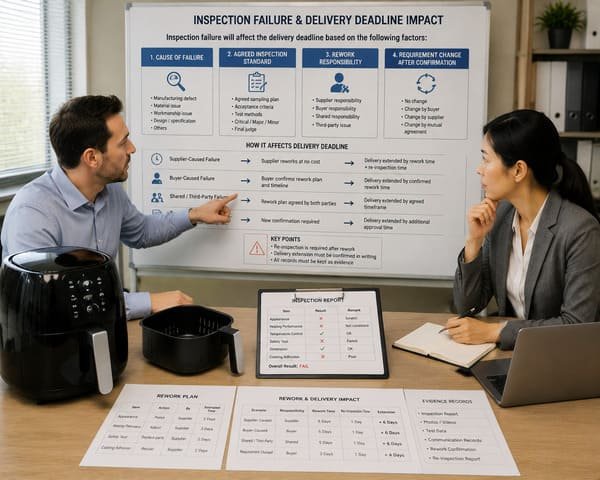
Contract and order documents
Important order documents include:
- Signed contract
- PI
- PO
- Approved quotation
- Product specification sheet
- Delivery milestone schedule
- Payment terms
- Inspection clause
- Delay remedy clause
- Dispute resolution clause
If the supplier is in China and the contract may need enforcement there, contract language, governing law, dispute resolution, and supplier legal entity should be reviewed carefully. For important transactions, legal counsel should review the structure.
Approval records
Approval records are especially important for air fryer orders with customization.
Keep records for:
- Golden sample approval
- Product specification approval
- Plug and voltage approval
- Packaging artwork approval
- Barcode approval
- Rating label approval
- Manual approval
- Carton mark approval
- Shipping mark approval
These records help determine whether delay came from buyer-side approval, supplier-side mistakes, or unclear requirements.
Inspection documents
Inspection evidence may include:
- Inspection booking record
- Inspection checklist
- Inspection report
- Defect photos
- Rework report
- Re-inspection report
- Approved corrective action plan
- Final pass confirmation
If inspection failure affects payment or delivery time, inspection documents become central evidence.
Shipment and payment documents
Shipment and payment documents may include:
- Deposit payment record
- Balance payment record
- Commercial invoice
- Packing list
- B/L draft
- Final B/L
- Loading photos
- Forwarder booking record
- Shipping advice
- Freight forwarder notice
- Warehouse receipt if relevant
The B/L shipped-on-board date can be important when shipment date is disputed.
Communication records
Keep written communication through email, official messaging tools, or exportable chat records. Useful records include:
- Supplier delivery promises
- Buyer approval messages
- Supplier delay explanations
- Recovery plan
- Cost change requests
- Inspection discussions
- Payment discussions
- Shipping updates
- Formal notices
Common mistake to avoid
Do not rely only on verbal promises or informal production photos. Delivery and breach responsibility should be supported by a complete evidence chain.
What should a formal late delivery notice and supplier recovery plan include?
A formal late delivery notice should record the agreed deadline, current delay status, evidence, contract reference, requested recovery plan, response deadline, and reserved rights.
When an air fryer supplier misses a milestone or final shipment date, a short message such as “please ship ASAP” is usually not enough. A formal notice helps create a clear record, reduce misunderstanding, and push the supplier to provide a practical recovery plan.
When to send a late delivery notice
A late delivery notice may be useful when:
- Production milestone is missed.
- Packaging approval schedule is missed.
- Inspection date is delayed without clear reason.
- Supplier cannot confirm production completion.
- Shipment booking is not arranged on time.
- Final delivery date is likely to be missed.
- Supplier asks for extra cost after delay.
- Supplier changes the delivery date without written agreement.
- Supplier gives only vague updates.
The notice should be professional and factual. It should not exaggerate, threaten unnecessarily, or make unsupported legal conclusions.
Late delivery notice should include
The notice should include:
- Contract or PI number
- Product model
- Order quantity
- Agreed delivery date or milestone
- Current status
- Description of delay
- Evidence already available
- Relevant contract clause if applicable
- Requested supplier explanation
- Requested recovery plan
- Deadline for supplier response
- Request for updated production or shipment evidence
- Any cost impact that needs discussion
- Reservation of contractual rights
Late delivery notice template
Subject: Notice of Late Delivery for Air Fryer Order [PI / Contract Number]
Dear [Supplier Name],
According to PI / Contract [number], the agreed delivery milestone for air fryer model [model number] was [agreed date or milestone]. As of [current date], the current order status is [current status], and the agreed milestone has not been completed.
Please provide a written update by [response deadline] covering:
- the current production status
- the reason for the delay
- the unfinished quantity or pending items
- the earliest production completion date
- the inspection schedule
- the shipment booking and loading plan
- any extra cost request with supporting evidence
- the corrective action or recovery plan
This notice is issued to clarify the delivery delay and preserve the buyer’s rights under the agreed contract terms. Please confirm the updated schedule and supporting evidence in writing.
Best regards,
[Buyer Name]
Supplier recovery plan should include
A useful supplier recovery plan should answer:
- What caused the delay?
- Which milestone was missed?
- Which quantity has been completed?
- Which quantity is still unfinished?
- Are components, packaging, labels, or manuals ready?
- Is the delay related to product defects, packaging, inspection, or shipping?
- What corrective action is being taken?
- What is the new production completion date?
- When can inspection be arranged?
- When can shipment be booked?
- Can partial shipment reduce business loss?
- Is air shipment needed?
- Who pays extra cost if expedited shipping is needed?
- What evidence supports the new schedule?
Common mistake to avoid
Do not rely only on informal chat messages after a delivery delay. A written notice, recovery plan, evidence request, and response deadline create a stronger record for negotiation and dispute handling.
How can buyers build an early-warning system for delivery risk?
Buyers can reduce delivery risk by tracking warning signs before the final shipment date is missed.
Most late shipments do not appear suddenly. They usually show early warning signs during sampling, artwork approval, material preparation, production updates, inspection scheduling, or shipment booking. A buyer who tracks these signs can act earlier and reduce failure cost.
Early warning signs before production
Before mass production, warning signs may include:
- Supplier cannot confirm component readiness.
- Supplier avoids giving a production schedule.
- Sample approval keeps moving.
- Packaging artwork proof is delayed.
- Supplier says “no problem” but gives no date.
- Plug, voltage, label, or manual details remain unclear.
- Supplier changes model or specification without written approval.
- Supplier does not confirm carton data.
- Supplier avoids written responsibility for delivery milestones.
These signs do not prove the supplier will fail, but they justify closer follow-up.
Early warning signs during production
During production, warning signs may include:
- No production photos or updates.
- Production status is always described vaguely.
- Finished quantity is not confirmed.
- Inspection date cannot be fixed.
- Supplier delays inspection access.
- Packaging is not ready while production is near completion.
- Supplier asks to ship without inspection.
- Supplier reports unexpected material shortage.
- Supplier changes delivery date without explaining cause.
When these signs appear, the buyer should request a written update and recovery plan.
Early warning signs before shipment
Before shipment, warning signs may include:
- Shipment booking is not arranged.
- Forwarder contact is unclear.
- Loading plan is missing.
- B/L draft cannot be provided.
- Supplier asks for extra freight cost suddenly.
- Carton quantity changes without explanation.
- Packing list data differs from prior carton data.
- Supplier delays sending commercial invoice or packing list.
- Supplier asks for final balance before agreed evidence is provided.
These issues may affect both delivery timing and payment risk.
What buyers should do when warning signs appear
The buyer should:
- Confirm the missed or risky milestone.
- Request written production status.
- Ask for evidence, not only promises.
- Review whether delay is supplier-caused, buyer-caused, or third-party-caused.
- Confirm whether inspection date is still realistic.
- Ask whether packaging, labels, and manuals are ready.
- Check whether shipment booking can be made.
- Request a recovery plan with dates.
- Preserve all communication records.
Common mistake to avoid
Do not wait until the final shipment date has already passed. Track milestones early and respond when the first delivery risk signals appear.
How should disputes over air fryer delivery delays be handled?
Delivery delay disputes should be handled through written notice, evidence review, recovery negotiation, contract remedies, and the agreed dispute resolution process.
Even with a clear contract, disputes can still happen. The response should be systematic. Angry messages rarely solve the issue. A better approach is to follow the contract structure and build a clean record.
Step 1: Confirm whether the delay is real
First confirm:
- What was the agreed milestone?
- What was the final shipment date?
- What event proves shipment?
- Has the supplier missed the milestone?
- Is there a grace period?
- Was the delay caused by buyer, supplier, third party, or shared causes?
Do not escalate before the facts are clear.
Step 2: Send formal notice
Send a written notice that refers to:
- PI or contract number
- Product model
- Agreed delivery date
- Current delay status
- Relevant contract clause
- Requested recovery plan
- Response deadline
This creates a record and gives the supplier a chance to explain and recover.
Step 3: Request evidence and recovery plan
Ask for production and shipment evidence, not only verbal updates. The supplier should provide:
- Current production status
- Finished quantity
- Remaining quantity
- Root cause of delay
- Rework plan if needed
- Inspection date
- Booking date
- Loading date
- Document timeline
Step 4: Apply agreed remedies carefully
If the contract includes delay penalties, discounts, air freight responsibility, cancellation rights, or payment adjustments, apply them according to the written terms.
Avoid unsupported claims such as “all losses must be paid by the supplier” unless the contract, evidence, and legal review support that position.
Step 5: Escalate according to the contract
If the supplier refuses to cooperate, the next step depends on the agreed dispute resolution clause. This may involve negotiation, mediation, arbitration, or court proceedings depending on the contract.
For cross-border transactions, dispute resolution should be selected according to contract value, supplier legal entity, asset location, governing law, enforcement path, contract language, and legal counsel advice.
Common mistake to avoid
Do not wait until the shipment is completely missed before taking action. Missed milestones, weak updates, failed inspection, and repeated vague promises should trigger early evidence collection and written follow-up.
What contract attachments help prevent air fryer delivery disputes?
Contract attachments help prevent delivery disputes by locking product specifications, packaging files, labels, inspection standards, carton data, and milestone schedules.
Many disputes happen because the contract is too short. It may mention the model name, price, and shipment date, but not enough operational detail. For air fryer orders, the attachments often matter as much as the main contract.
Recommended contract attachments
Useful attachments may include:
- Product specification sheet
- Approved quotation
- PI or PO
- Plug and voltage confirmation
- Heating component configuration if relevant
- Basket and coating requirement if relevant
- Control panel version
- Approved sample photos
- Golden sample record
- Color box artwork
- Barcode file
- Rating label file
- User manual version
- Warranty card if applicable
- Carton mark
- Carton size and weight
- Packing method
- Inspection checklist
- Delivery milestone schedule
- Payment schedule
- Approved supplier bank account record
- Shipping instruction
- Forwarder contact if nominated by buyer
These attachments help reduce arguments about what was agreed.
Version control matters
For private label and customized orders, version control should be clear. Packaging, manuals, labels, and carton marks may change during negotiation. The contract should identify the final approved version.
Version control may include:
- File name
- Approval date
- Responsible approver
- Final PDF or artwork proof
- Supplier confirmation
- Sample photo record
- Production version confirmation
Common mistake to avoid
Do not assume that a model number alone is enough. For air fryer procurement, packaging, label, manual, plug, voltage, inspection checklist, and shipment milestones should also be locked.
Can AI help review air fryer delivery clauses?
AI can help identify unclear delivery terms and generate clarification questions, but it should not replace supplier evidence, legal review, or contract execution control.
AI tools can be useful during contract preparation because they can help buyers notice vague wording. However, AI does not know the exact supplier, product model, legal jurisdiction, certification scope, production status, or enforceability conditions unless these are provided and verified.
Useful AI-assisted review tasks
AI can help procurement teams:
- Find unclear delivery start points
- Identify missing milestone dates
- Generate supplier clarification questions
- Compare payment and inspection conditions
- Draft late delivery notice templates
- Summarize supplier delay explanations
- Prepare recovery plan questions
- Check whether contract sections conflict
- Create an internal procurement checklist
Limits of AI review
AI should not be used as the final authority for:
- Legal enforceability
- Governing law selection
- Arbitration venue selection
- Penalty validity
- Product compliance
- Supplier reliability
- Exact certification requirements
- Exact tariff or customs responsibility
- Contract enforceability in a specific country
Important contracts should be reviewed by qualified legal counsel and procurement decision-makers.
Common mistake to avoid
Do not use AI-generated clauses as final contract language without checking product details, supplier identity, target market, governing law, and legal enforceability.
FAQ
What is the most important delivery term in an air fryer procurement contract?
The most important delivery term is the delivery start point. The contract should state whether delivery time starts after deposit, PI signing, sample approval, packaging approval, or all buyer-required files are confirmed.
Is “shipment within 30 days” enough?
“Shipment within 30 days” is usually not enough unless the contract clearly defines when the 30 days start, what event proves shipment, and what happens if sample approval, packaging approval, inspection, or payment is delayed.
Should air fryer contracts include delivery milestones?
Yes. Delivery milestones help track production progress before the final shipment date is missed. They also help identify whether delay was caused by the supplier, buyer, inspection failure, packaging approval, or logistics issues.
What date counts as delivery under FOB?
For FOB orders, the contract should define whether delivery is judged by booking date, container loading date, vessel loading date, or B/L shipped-on-board date. The B/L date is often useful evidence, but the contract should state the rule clearly.
Who is responsible if packaging approval is delayed?
Responsibility depends on cause. If the buyer approves artwork late, the delay may be buyer-caused. If the supplier prepares wrong artwork or prints without approval, the delay may be supplier-caused. Written approval records are important.
What happens if air fryer inspection fails before shipment?
The contract should state whether the supplier must rework, who pays re-inspection cost, whether balance payment is held, whether the original deadline still applies, and what happens after repeated failure.
Can the buyer deduct delay penalties from balance payment?
This depends on the contract wording, governing law, evidence, and commercial agreement. If deduction is intended, the contract should state how it works and whether a revised invoice or written adjustment is required.
Should final payment be made before inspection?
For higher-risk orders, final payment before inspection may reduce buyer control. Many buyers link balance payment to passed pre-shipment inspection, but the exact payment structure should match order value, supplier trust, and risk level.
Does platform protection replace a procurement contract?
No. Platform protection can support a dispute, but it should not replace clear PI terms, contracts, inspection reports, payment records, shipment documents, and evidence-based communication.
What evidence should be checked before final balance payment?
Buyers should check production completion, packaging version, label accuracy, inspection result, carton data, packing list, shipment booking, supplier bank account, and unresolved issue list before releasing final balance.
Can a supplier ask for extra freight cost after delay?
A supplier can request extra cost, but the buyer should check the cause of delay, original logistics agreement, written approval, contract terms, and freight evidence before accepting the request.
Should liquidated damages always be included?
Liquidated damages can be useful, but the clause should be commercially reasonable and reviewed under the governing law and dispute venue. It should not be treated as guaranteed recovery.
What should a late delivery notice include?
A late delivery notice should include the PI or contract number, product model, agreed milestone, current delay status, evidence, contract reference, requested recovery plan, response deadline, and reservation of rights.
How can buyers detect delivery risk early?
Buyers can detect delivery risk by tracking missed sample dates, vague production updates, delayed artwork proof, uncertain inspection dates, missing booking records, sudden freight cost requests, and inconsistent carton data.
What attachments should be added to the contract?
Useful attachments include product specifications, approved quotation, PI, sample photos, packaging artwork, barcode file, label file, manual version, carton mark, inspection checklist, delivery milestone schedule, and payment schedule.
Conclusion
Air fryer procurement contracts should not rely on vague delivery promises or general penalty wording. A stronger contract should define delivery start point, milestone schedule, final shipment proof, supplier-caused delay, buyer-caused delay, third-party delay, inspection failure, payment release, freight cost changes, documentation, and formal notice process.
The most useful contract is not only a document for punishment after failure. It is a control tool that helps both sides track production, identify delay early, preserve evidence, negotiate recovery, and reduce unnecessary disputes.
Before paying a deposit or approving mass production, the buyer should confirm what is known, what is still pending, what must be verified, and what happens if a milestone is missed.
CTA
If an air fryer procurement contract or supplier quotation is being reviewed, share the product model, target market, quantity stage, packaging requirements, delivery deadline, payment terms, inspection plan, trade term, and any supplier delay concerns through the inquiry form on the page.
The order details can be reviewed to identify unclear delivery terms, missing milestone controls, weak inspection clauses, payment risks, packaging approval gaps, freight cost responsibility issues, and supplier delay responsibility before PI confirmation, deposit payment, mass production, inspection, or shipment.
-
"Vague terms in contracts and accuracy – Weagree", https://weagree.com/clm/contracts/contract-drafting-principles/vague-terms-in-contracts/. This source explains the potential legal ambiguities and disputes that can arise from using vague terms in delivery clauses. Evidence role: expert_consensus; source type: education. Supports: Vague phrases in delivery clauses can lead to disputes due to their lack of specificity.. ↩
-
"[PDF] TIPS FOR ACHIEVING CLARITY IN CONTRACT DRAFTING", https://www.law.georgetown.edu/wp-content/uploads/2018/07/Tips-for-Achieving-Clarity-in-Contract-Drafting.pdf. This source outlines best practices for drafting delivery clauses, emphasizing the importance of specifying start times and conditions for shipment. Evidence role: expert_consensus; source type: education. Supports: Contracts should specify the start of the delivery period and preconditions for shipment to avoid ambiguity.. ↩
-
"Mail Order Food Safety", http://www.fsis.usda.gov/food-safety/safe-food-handling-and-preparation/food-safety-basics/mail-order-food-safety. This source supports the claim that standard delivery timelines for air fryer models often begin after deposit and PI confirmation. Evidence role: general_support; source type: institution. Supports: For a standard air fryer model with standard packaging, delivery time may start after deposit and PI confirmation.. Scope note: The source may not address all manufacturers or specific contractual terms. ↩
-
"Private Label Products Shipping Guide – Freightos", https://www.freightos.com/freight-resources/private-label-products/. This source provides evidence that customized or private-label products often require additional approvals and file submissions before delivery timelines commence. Evidence role: general_support; source type: institution. Supports: For private label, customized packaging, or market-specific configuration, delivery time may need to start only after sample approval, artwork approval, label confirmation, and all required files are complete.. Scope note: The source may not specifically address air fryers or all customization scenarios. ↩
-
"Manufacturing Month – International Trade Administration", https://www.trade.gov/manufacturing-month. This source explains the significance of factory release dates in international trade as a potential proof of shipment or delivery. Evidence role: definition; source type: education. Supports: Factory release date can serve as proof of shipment or delivery in certain trade agreements.. Scope note: The source may not address all trade terms or contract scenarios. ↩
-
"Bill of lading – Wikipedia", https://en.wikipedia.org/wiki/Bill_of_lading. This source discusses the role of the Bill of Lading (B/L) shipped-on-board date as a critical document in verifying shipment completion. Evidence role: definition; source type: education. Supports: The B/L shipped-on-board date is a recognized proof of shipment completion in international trade.. Scope note: The source may focus on specific trade terms like FOB or CIF. ↩
-
"Know Your Incoterms – International Trade Administration", https://www.trade.gov/know-your-incoterms. This source explains the role of Incoterms in defining cost, risk, and logistics responsibilities in international trade agreements. Evidence role: definition; source type: encyclopedia. Supports: Incoterms clarify cost, risk, and logistics responsibility in international trade.. ↩
-
"FOB (shipping) – Wikipedia", https://en.wikipedia.org/wiki/FOB_(shipping). This source provides an explanation of the FOB (Free on Board) Incoterm and its implications for cost and risk transfer at the port of shipment. Evidence role: definition; source type: encyclopedia. Supports: FOB terms clarify the point at which cost and risk transfer during shipping.. Scope note: The source may not specifically address the example of Shenzhen but will explain the general FOB term. ↩
-
"Project Schedule and Development of Milestones", https://kp.uky.edu/knowledge-portal/articles/project-schedule-and-development-of-milestones/. A milestone schedule is widely recognized as a project management tool that helps track progress and identify delays in various stages of a project. Evidence role: mechanism; source type: education. Supports: A milestone schedule helps both sides identify delay earlier.. ↩
-
"3 Reasons Why You Need a Golden Sample – SEACOMP", https://www.seacomp.com/resources/why-you-need-a-golden-sample. This source defines the concept of a golden sample and its role in ensuring product quality before mass production. Evidence role: definition; source type: encyclopedia. Supports: Golden sample approval date is a critical milestone in procurement contracts.. ↩
-
"Procurement Milestones Table | U.S. Department of the Interior", https://www.doi.gov/cloud/faq/process. This source explains the importance of clearly defined milestones in procurement contracts to ensure smooth production and delivery timelines. Evidence role: expert_consensus; source type: education. Supports: These milestones do not need to be complicated, but they should be visible and agreed before production begins.. ↩
-
"Artwork Management for Supply Chain | Specs, Data & Integration", https://www.manageartworks.com/solutions/supply-chain-packaging-artwork-coordination. Requiring packaging artwork approval before mass production is a common practice in supply chain management to ensure quality and compliance. Evidence role: expert_consensus; source type: education. Supports: if packaging artwork must be approved before mass production starts, then both sides can check whether a delay was caused by late buyer approval, supplier artwork mistakes, unclear packaging requirements, or factory production problems.. Scope note: The source may not address this specific example but will confirm the general practice. ↩
-
"Subpart 11.4 – Delivery or Performance Schedules – Acquisition.GOV", https://www.acquisition.gov/far/subpart-11.4. This source explains the importance of including a latest acceptable shipment date in contracts tied to time-sensitive promotions or campaigns. Evidence role: expert_consensus; source type: education. Supports: The contract should include a latest acceptable shipment date for orders linked to promotions, launches, or seasonal sales to ensure the commercial purpose is met.. ↩
-
"§ 2-504. Shipment by Seller. | Uniform Commercial Code | US Law", https://www.law.cornell.edu/ucc/2/2-504. This source discusses how remedies for missed shipment deadlines vary depending on the legal jurisdiction and specific contract terms. Evidence role: expert_consensus; source type: education. Supports: The exact remedy for missing the latest acceptable shipment date depends on the specific contract and legal environment.. Scope note: The source may not cover all possible legal environments or contract scenarios. ↩
-
"Selling on the Internet: Prompt Delivery Rules", https://www.ftc.gov/business-guidance/resources/selling-internet-prompt-delivery-rules. This source discusses scenarios where buyers may claim expedited shipping costs due to supplier delays. Evidence role: case_reference; source type: institution. Supports: Whether the buyer can claim expedited shipping cost.. Scope note: The source may provide examples specific to certain industries or regions, which might not universally apply. ↩
-
"Subpart 11.4 – Delivery or Performance Schedules – Acquisition.GOV", https://www.acquisition.gov/far/subpart-11.4. This source explains the importance of specifying a clear delivery date in procurement contracts to avoid disputes over delay responsibility. Evidence role: expert_consensus; source type: education. Supports: For air fryer procurement, the contract should state exactly which date will be used to judge delay responsibility.. ↩