Air fryer packaging options should be chosen by sales channel, brand stage, MOQ, cost, product protection, barcode needs, carton marks, plug and voltage version, mixed container plan, and repeat order logic.
Problem: Many importers ask about air fryer packaging only after discussing price, but packaging can affect cost, MOQ, freight, warehouse handling, retail presentation, product protection, and quotation accuracy.
Agitation: If packaging is confirmed too late, the order may face wrong box information, weak carton strength, barcode problems, retailer rejection, mixed-SKU confusion, reprinting delays, or higher landed cost.
Solution: A safer packaging decision should compare neutral packing, factory standard color box, OEM logo packing, custom color box, barcode, carton mark, manual language, export carton, and mixed container requirements before quotation or mass production.
Snippet: Air fryer packaging for wholesale orders should be selected by comparing channel needs, packing cost, MOQ, carton strength, barcode, carton mark, manual language, plug and voltage version, landed cost, and mixed container risk.
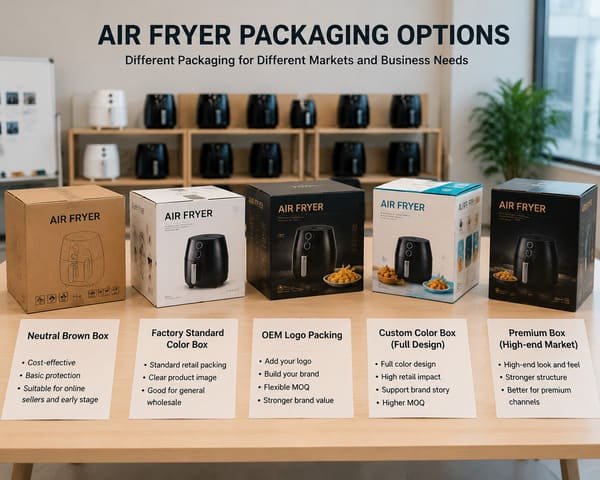
This guide is written for importers, distributors, appliance wholesalers, supermarket buyers, online bulk sellers, and OEM/private label customers who need to choose practical packaging before confirming an air fryer wholesale order.
What Packaging Options Are Available for Air Fryer Wholesale Orders?
Common air fryer wholesale packaging options include neutral packing, factory standard color box, OEM logo packing, custom color box, instruction manual, barcode, SKU label, carton mark, export master carton, and mixed container packing.
Packaging should not be treated as a decorative detail. It affects how the product is presented, protected, identified, stored, shipped, and sold through the buyer’s local channel.
| Packaging option | Buyer decision value |
|---|---|
| Neutral packing | May reduce complexity for early testing, wholesale circulation, or mixed container orders |
| Factory standard color box | May support faster quotation and retail-ready presentation when market fit is acceptable |
| OEM logo packing | May support brand recognition and distributor confidence when repeat orders are realistic |
| Custom color box | May fit supermarket, appliance shop, or private label channels that need stronger shelf presentation |
| Instruction manual | Should match language, model, plug, voltage, and user expectations |
| Barcode / SKU label | Supports retail identification, warehouse receiving, and stock control |
| Carton mark | Supports unloading, sorting, distributor handling, and mixed container identification |
| Export master carton | Protects product during handling, loading, and international shipment |
| Mixed container packing | Requires clearer SKU labels, carton sizes, and loading sequence |
In our daily communication with air fryer importers, packaging questions often start with “Can we add our logo?” or “Can we use a color box?” But from the supplier side, the more important question is whether the packaging matches the sales channel, carton strength, barcode, manual language, plug, voltage, and shipment plan.
Packaging Should Match the Order Stage
| Order stage | More practical packaging direction |
|---|---|
| First sample check | Confirm product, plug, voltage, and basic packing direction |
| First wholesale trial | Neutral packing or factory standard box may reduce complexity |
| Distributor order | Strong carton, clear carton mark, and repeatable SKU identification matter |
| Retail channel order | Barcode, product image, local language, and label accuracy become more important |
| Private label order | OEM logo, custom color box, manual, rating label, and artwork approval should be prepared |
| Repeat order | Packaging consistency helps reduce confusion and channel complaints |
Packaging is part of the order structure. It should be discussed before quotation becomes too detailed.
How Should Importers Choose Between Neutral Packing, Standard Color Box, and OEM Color Box?
Packaging should be selected by sales channel, market stage, MOQ, brand readiness, cost pressure, product protection, warehouse handling, and repeat order plan rather than by appearance alone.
There is no single best packaging option for every air fryer wholesale order. Neutral packing, factory standard color box, OEM logo packing, and custom color box each fit different buying stages.
| Packaging type | Best for | Risk to check |
|---|---|---|
| Neutral packing | Early testing, wholesale circulation, mixed container orders | Carton strength, label clarity, retailer acceptance |
| Factory standard color box | Faster wholesale or semi-retail orders | Box language, product image, plug/voltage information, market fit |
| OEM logo packing | Brand recognition and distributor confidence | Logo file, artwork approval, MOQ, repeat order plan |
| Custom color box | Supermarket, appliance shop, private label projects | Printing cost, claims accuracy, barcode, manual consistency |
| Export master carton | Shipment, warehouse handling, and distribution | Carton mark, gross/net weight, CBM, loading protection |
In many first-order discussions, we usually suggest that customers do not choose the most complex packaging too early. If the model, target market, order quantity, artwork, and repeat order plan are not clear yet, neutral packing or factory standard color box may reduce revision risk before moving into OEM color box.
Packaging Choice by Sales Channel
| Sales channel | Packaging priority |
|---|---|
| Wholesale market | Cost control, carton strength, simple identification |
| Distributor network | SKU clarity, carton mark, repeat order consistency |
| Supermarket | Barcode, shelf presentation, local language, label accuracy |
| Appliance shop | Product image, capacity, function explanation, manual clarity |
| Online bulk selling | Outer carton strength, barcode, return risk, fulfillment requirements |
| Private label | Brand consistency, artwork, box language, manual, rating label |
| Mixed container | SKU label, carton size, loading sequence, product protection |
The safer decision is not “Which box looks better?” The safer decision is “Which packaging option helps the product move through the buyer’s channel with fewer cost, handling, and communication problems?”
When Is OEM Packaging Worth Choosing for Air Fryer Wholesale Orders?
OEM packaging is more suitable when the model, market, quantity, logo, artwork, manual language, barcode, carton mark, and repeat order plan are clear enough to support brand packaging.
OEM packaging can help a buyer build brand recognition, distributor confidence, and retail presentation. But it also adds more details that must be checked before printing and production.
| OEM packaging readiness question | Why it matters |
|---|---|
| Is the final model confirmed? | The box image and claims should match the actual product |
| Is the target market clear? | Language, plug, voltage, and label details may depend on market |
| Is the order quantity suitable? | Packaging materials and printing may affect MOQ and quotation |
| Is the logo file ready? | Low-quality files can delay artwork preparation |
| Is the box language confirmed? | Wrong language may affect channel acceptance |
| Is the manual language confirmed? | User understanding and after-sales communication may be affected |
| Is the barcode prepared? | Retail and warehouse systems may need accurate identification |
| Is the carton mark confirmed? | Distribution and unloading may become difficult without clear marks |
| Is repeat order likely? | Complex packaging is easier to justify when future continuity exists |
When customers prepare OEM packaging, we often see that the packaging itself is not the only challenge. The real challenge is whether the product model, artwork, manual, barcode, plug, voltage, and carton mark are all ready at the same time. If one item changes late, the box may need revision.
When OEM Packaging May Be Too Early
| Situation | Safer path |
|---|---|
| Model is still uncertain | Confirm sample and standard model first |
| Market is not tested | Use simpler packaging before full private label investment |
| Artwork is not ready | Prepare logo, box text, product image, and layout first |
| Barcode is not confirmed | Check local channel or retailer requirement before printing |
| Manual language is uncertain | Confirm language and product version before final artwork |
| Quantity is small or irregular | Discuss whether standard packing is more practical |
| Repeat order plan is unclear | Avoid over-customizing before channel validation |
OEM packaging should support the buyer’s channel plan. It should not create unnecessary cost, delay, or revision risk.
How Does Air Fryer Packaging Affect Cost, MOQ, Shipping Risk, and Landed Cost?
Air fryer packaging can affect material cost, printing cost, packing labor, carton size, CBM, freight allocation, damage risk, warehouse handling, MOQ discussion, and landed cost logic.
Packaging cost is not only the price of a box. A stronger carton, different color box, barcode label, manual, inner protection, or custom printing can affect production preparation and shipment planning.
Inner protection
- neutral box / color box / OEM box
- manual and inserts
- barcode or SKU label
- rating label / warning label
- master carton
- carton mark printing
- artwork proofing
- packing labor
- CBM and freight impact
- damage / return allowance
= packaging-related landed cost logic
This formula is not a profit guarantee. It is a way to understand how packaging can affect total order cost, risk, and commercial feasibility.
| Cost or risk factor | Packaging connection |
|---|---|
| Inner protection | Affects product damage risk during shipment |
| Color box size | Affects carton size, CBM, and freight allocation |
| Printing | Affects artwork approval, cost, and production timing |
| Manual and inserts | Affect packing process and user communication |
| Barcode / SKU label | Affects retail and warehouse identification |
| Carton mark | Affects unloading, sorting, and mixed container handling |
| Master carton | Affects stacking, product protection, and shipping damage |
| Reprinting | Late changes may create delay and extra cost |
| Returns or complaints | Weak packaging or wrong information may increase after-sales pressure |
On the production and packing side, packaging cost is not only the price of a box. Inner protection, manual, barcode label, carton mark, printing, packing labor, carton size, and CBM can all affect the final landed cost logic. That is why we usually ask customers to confirm packaging requirements before preparing a serious quotation.
Low-Cost Packaging Is Not Always Lower-Risk
| Low-cost packaging decision | Risk to check |
|---|---|
| Thin carton | Higher damage risk during stacking or unloading |
| No clear carton mark | Warehouse sorting or distributor handling confusion |
| No barcode | Retail or inventory system problems |
| Generic manual | Poor user understanding in the target market |
| Wrong plug/voltage image | Market-version confusion or complaints |
| Weak inner protection | Product damage or return risk |
| Unconfirmed box claims | Retailer or customer complaint risk |
Packaging should reduce order risk. It should not only reduce visible packing cost.
Why Are Barcode, SKU Label, and Carton Mark Important for Wholesale Packaging?
Barcode, SKU label, and carton mark help retail systems, warehouses, distributors, and mixed-container handlers identify products, cartons, quantities, and market versions correctly.
For wholesale air fryer orders, barcode and carton mark are not small design details. They support stock control, warehouse receiving, container unloading, distributor sorting, and channel circulation.
| Packaging identification item | Why it matters |
|---|---|
| Barcode | Helps product identification in retail, inventory, or online systems |
| SKU label | Helps separate models, colors, capacities, or market versions |
| Carton mark | Helps identify cartons during unloading, storage, and distribution |
| Model number | Reduces confusion between similar products |
| Quantity per carton | Helps warehouse receiving and stock counting |
| Gross / net weight | Supports shipment and warehouse handling |
| Carton measurements | Helps loading, freight, and storage planning |
| Destination or customer mark | Supports distributor or channel-specific handling |
In mixed container orders, we often see that packaging risk is not only product damage. The bigger problem may be SKU confusion, unclear carton marks, different box sizes, or wrong loading sequence. Clear carton marks and SKU labels help buyers, warehouses, and distributors handle the goods more smoothly after arrival.
Barcode and Carton Mark Questions to Ask Early
| Question | Why it should be asked before printing |
|---|---|
| Does the sales channel require a barcode? | Retail or online systems may need scannable product identification |
| Is each model or variant using a separate SKU? | Different capacities, colors, or plug versions may need separation |
| What carton mark format is needed? | Warehouse or distributor handling may require specific marks |
| Should carton marks show model and quantity? | Helps reduce receiving and sorting confusion |
| Is mixed container involved? | SKU labels and carton marks become more important |
| Are local warehouse rules known? | Requirements may differ by buyer, channel, or market |
Barcode and carton mark requirements should be confirmed for the specific target market, sales channel, and warehouse process before final printing.
What Packaging Details Must Be Confirmed Before OEM Artwork or Mass Production?
Before OEM artwork or mass production, product model, capacity, plug, voltage, box claims, manual language, barcode, carton mark, SKU label, rating label, and artwork files should be confirmed.
Artwork approval is not only a design step. It is also a risk-control step. Once printing starts, even a small mistake may become expensive or delay the order.
| Detail to confirm | Risk if ignored |
|---|---|
| Product model | Box image or product description may not match the actual item |
| Capacity | Retail misunderstanding or customer complaint |
| Plug type | Wrong market version or wrong box image |
| Voltage | Label mismatch or product-version confusion |
| Box language | Poor channel acceptance or customer misunderstanding |
| Manual language | User confusion and after-sales pressure |
| Barcode | Retail or warehouse scanning issue |
| Carton mark | Receiving, sorting, or unloading confusion |
| SKU label | Mixed container or warehouse sorting risk |
| Rating label | Product and packaging information mismatch |
| Claims on box | Complaint or compliance concern if unsupported |
| Artwork version | Wrong printing file or delayed approval |
In our packing preparation work, small packaging mistakes can become expensive after printing starts. A wrong voltage mark, wrong plug image, wrong capacity claim, wrong barcode, or unclear carton mark may create warehouse confusion, retailer complaints, or reprinting delays. This is why artwork confirmation should not be treated as a simple design step.
Pre-Production Packaging Checklist
| Before production, confirm | Check point |
|---|---|
| Final model | Same as quotation, sample, and PI/PO |
| Box image | Same as actual product appearance |
| Capacity and functions | No unsupported or confusing claims |
| Plug and voltage | Same as target market version |
| Manual language | Matches sales channel and user needs |
| Barcode and SKU | Prepared before printing if required |
| Carton mark | Clear for warehouse and distributor handling |
| Carton strength | Suitable for shipment and loading plan |
| Packing method | Inner protection and product placement checked |
| Mixed container list | Each SKU and carton mark separated clearly |
| Artwork approval | Final version confirmed in writing |
| Sample or packaging proof | Checked before mass production when needed |
Packaging details should be locked in the written order documents before mass production.
What Packaging Mistakes Often Create Problems Before Production?
Packaging mistakes often happen when artwork is prepared before the final model, plug, voltage, manual language, barcode, carton mark, and box claims are confirmed.
In our daily packing discussions, the most common problem is not that the buyer chooses the wrong box type. The more common problem is that the box artwork is prepared too early. If the plug, voltage, model capacity, manual language, barcode, or carton mark changes later, the packaging file may need to be revised again before printing.
| Common packaging mistake | Possible order risk |
|---|---|
| Box image does not match final model | Retail confusion or complaint |
| Capacity claim is not confirmed | Customer misunderstanding |
| Plug image is wrong | Market-version confusion |
| Voltage information changes late | Label or box revision |
| Barcode is not ready | Retail or warehouse scanning issue |
| Carton mark is unclear | Receiving and sorting confusion |
| Manual language is decided too late | Printing delay or insert correction |
| Mixed container SKU labels are unclear | Warehouse handling confusion |
| Box claims are not verified | Complaint or compliance concern if unsupported |
| Artwork version is not controlled | Wrong printing file or approval delay |
During packaging confirmation, we usually try to separate design preference from order-critical information. Color, layout, and logo style are important, but model, plug, voltage, barcode, manual language, rating label, and carton mark should be treated as risk-control details.
What to Prepare Before Sending Artwork
| Before sending artwork | Why it matters |
|---|---|
| Final product photo | Prevents mismatch between box and product |
| Model number | Prevents similar model confusion |
| Capacity and function text | Avoids unsupported or confusing claims |
| Plug and voltage version | Matches target market version |
| Logo file | Supports cleaner artwork layout |
| Box language | Reduces reprint risk |
| Manual language | Improves user communication |
| Barcode file | Avoids late printing correction |
| Carton mark format | Supports warehouse and mixed container handling |
| Approval contact person | Prevents version confusion |
A packaging file should not be treated as final until the order-critical information is confirmed.
How Should Mixed Container Packaging Be Planned for Air Fryer Wholesale Orders?
Mixed container packaging should control SKU identification, carton strength, box size, loading sequence, language version, plug and voltage version, and product protection before shipment.
Mixed container orders can reduce single-SKU inventory pressure, but they can also increase packaging coordination risk. Different products, carton sizes, languages, marks, and plug versions must be organized clearly.
| Mixed container issue | Packaging risk |
|---|---|
| Different carton sizes | Loading inefficiency or higher damage risk |
| Different SKU labels | Warehouse sorting confusion |
| Different OEM artworks | File approval delay or wrong version |
| Different plug versions | Wrong market allocation |
| Different voltage versions | Label and manual mismatch |
| Different manual languages | Packing mix-up or user confusion |
| Different fragile levels | Higher damage risk during loading |
| Different carton marks | Unloading and distribution confusion |
From our daily order coordination experience, mixed container packaging needs more discipline than single-SKU packaging. If carton marks, SKU labels, packing lists, and loading sequence are not clear, the problem may only appear after the goods arrive at the buyer’s warehouse.
Mixed Container Packaging Questions
| Question | Why it matters |
|---|---|
| How many SKUs are included? | Each SKU may need separate label and carton mark |
| Are carton sizes different? | Loading and protection plan may change |
| Are all products using the same language? | Manuals and box text should not be mixed |
| Are plug and voltage versions different? | Wrong market version risk increases |
| Is OEM packaging used for all items? | Artwork approval may become more complex |
| Is the loading sequence planned? | Heavy or fragile cartons need proper arrangement |
| Is inspection required before loading? | Mixed products are easier to confuse without checking |
Mixed container packaging should be discussed early, not after all products are already packed.
How Should Importers Send Packaging Requirements Through WhatsApp Before Quotation?
Packaging requirements should be sent with target market, order quantity, sales channel, packing option, logo needs, box language, manual language, barcode, carton mark, plug, voltage, destination port, and mixed container plan.
WhatsApp should not be used only to ask “custom box price?” or “OEM packing?” A short structured message helps the supplier understand which packaging solution fits the order before quotation.
Hello, we are preparing an air fryer wholesale order.
Target market:
Order quantity:
Sales channel:
Packing option:
OEM logo: yes / no
Box language:
Manual language:
Barcode / SKU label:
Carton mark:
Plug and voltage:
Destination port:
Mixed container: yes / no
Could you help review which packaging option is more suitable before quotation?
When buyers only send “OEM packing?” or “custom box price?”, it is difficult to judge the real packaging solution. In our daily WhatsApp communication, a more useful message includes target market, quantity, sales channel, packing type, logo file, box language, manual language, barcode, carton mark, plug, voltage, and destination port.
Packaging Inquiry Checklist
| Information to send | Why it helps |
|---|---|
| Target market | Helps check language, plug, voltage, and channel expectations |
| Order quantity | Helps discuss packing preparation and MOQ logic |
| Sales channel | Wholesale, supermarket, online, or private label needs may differ |
| Packing option | Neutral, standard color box, OEM logo, or custom box |
| Logo file | Needed for OEM layout discussion |
| Box language | Helps avoid wrong printing direction |
| Manual language | Supports user communication and after-sales clarity |
| Barcode / SKU label | Supports retail, warehouse, and inventory handling |
| Carton mark | Supports receiving, sorting, and mixed container control |
| Plug and voltage | Helps avoid wrong market-version packaging |
| Destination port | Supports freight and landed cost discussion |
| Mixed container plan | Helps coordinate SKU labels, carton sizes, and loading sequence |
A clear packaging inquiry does not need to be long. It only needs enough information to turn a general price question into a useful packaging and quotation discussion.
FAQ
This FAQ answers common questions about air fryer wholesale packaging, neutral packing, OEM color box, barcode, carton mark, landed cost, mixed container packing, and WhatsApp quotation preparation.
What Is the Best Packaging Option for Air Fryer Wholesale Orders?
The best packaging option depends on sales channel, target market, order quantity, brand stage, carton strength, barcode needs, cost pressure, and repeat order plan.
Neutral packing may fit early wholesale testing, while OEM color box may fit private label or retail channels.
Is Neutral Packing Suitable for Air Fryer Wholesale Orders?
Neutral packing can be suitable for early testing, wholesale circulation, mixed container orders, or cost-sensitive channels.
Carton strength, label clarity, product protection, and retailer acceptance should still be checked.
When Should OEM Color Box Be Used?
OEM color box should be used when the model, market, quantity, logo, artwork, box language, manual, barcode, and repeat order plan are clear.
It may create unnecessary revision risk if these details are not ready.
Does Packaging Affect MOQ?
Packaging may affect MOQ when custom printing, color box materials, OEM logo, manual language, barcode labels, or carton marks require additional preparation.
The exact packaging MOQ should be confirmed by the specific model, packing type, artwork, and order quantity.
Does Packaging Affect Landed Cost?
Yes. Packaging can affect landed cost through carton size, CBM, freight allocation, packing labor, damage risk, warehouse handling, and return pressure.
The decision should compare total cost logic, not only box price.
Why Are Barcode and Carton Mark Important?
Barcode and carton mark help products move through retail, warehouse, distribution, unloading, and inventory systems.
They should be confirmed before printing, especially for retail channels and mixed container orders.
What Packaging Details Should Be Checked Before Production?
Product model, capacity, plug, voltage, box claims, manual language, barcode, carton mark, SKU label, rating label, carton strength, and artwork version should be checked before production.
These details help reduce printing mistakes, shipment confusion, and after-sales disputes.
Can Mixed Container Orders Use Different Packaging?
Mixed container orders can use different packaging, but SKU labels, carton marks, carton sizes, manual language, plug and voltage versions, and loading sequence must be controlled carefully.
Without clear identification, warehouse and distribution confusion may increase.
What Should Be Sent Before Asking for Packaging Price?
Target market, quantity, sales channel, packing type, OEM logo needs, box language, manual language, barcode, carton mark, plug, voltage, destination port, and mixed container plan should be sent before asking for packaging price.
This helps the supplier explain the packaging and quotation basis more clearly.
Conclusion
Air fryer packaging options should not be chosen only by appearance or box price. A better wholesale packaging decision should consider sales channel, market stage, MOQ, brand readiness, product protection, barcode, carton mark, manual language, plug and voltage version, carton size, CBM, landed cost, mixed container risk, and repeat order logic.
Neutral packing, factory standard color box, OEM logo packing, custom color box, and export master carton can all be useful when they match the order situation. Complex OEM packaging may support brand recognition, but it should be prepared only when the model, market, artwork, barcode, manual, and repeat plan are clear enough.
The safest packaging discussion starts before quotation and production. When the buyer shares target market, quantity, sales channel, packing type, logo needs, language requirements, barcode, carton mark, plug, voltage, destination port, and mixed container plan, the supplier can explain the packaging basis and risk points more clearly.
CTA
If the right air fryer packaging option is still unclear, feel free to send a short message through the page form, WhatsApp, or WeChat. Share your target market, order quantity, sales channel, packing idea, logo needs, barcode, carton mark, plug, voltage, or mixed container questions first. We can help review the key packaging details, explain possible cost and risk points, and make the next quotation discussion clearer.