The real minimum order quantity for custom air fryers depends on the customization depth. Simple logo printing requires 100 to 500 units. Standard OEM changes need 500 to 1,000 units. Deep customizations, such as new molds or smart functions, require 1,000 to 3,000 units.
Misunderstanding minimum order quantities can lead to blocked cash flow or excessive dead stock. Buyers who force high customization on small orders often face hidden mold fees, compliance failures, or supplier rejection.
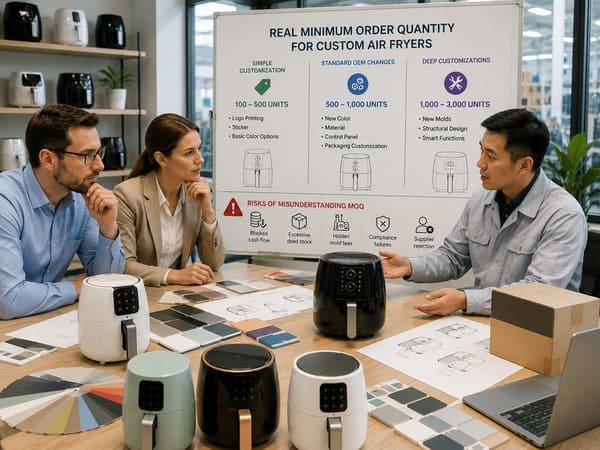
Evaluating air fryer order requirements goes beyond just picking a number. Minimum order quantities are essentially risk-sharing agreements between the buyer and the factory. This guide helps importers, wholesale distributors, and private label brands understand prototyping costs, packaging options, payment terms, and delivery schedules to ensure a safer purchasing process.
How much does a custom air fryer prototype/sample cost?
A standard air fryer sample costs between $50 and $150, excluding shipping. A fully customized working prototype with specific colors, modified UI panels, or unique heating elements usually costs $200 to $500, which suppliers often refund upon mass production.
Approving mass production without testing a physical prototype risks major functional defects. A generic sample does not guarantee the factory can execute your specific control panel language, plug type, or safety requirements.
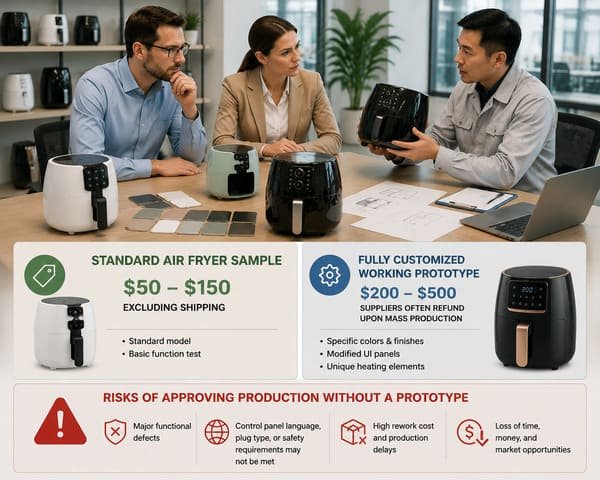
Understanding sample costs helps buyers plan their sourcing budget and verify supplier capabilities before placing bulk orders. Factories charge for samples because preparing a single customized unit disrupts mass production lines and requires specialized engineering time.1
If you need a standard off-the-shelf model to check basic material quality, the fee is minimal. However, creating a functional prototype that perfectly matches your OEM specifications takes more work. Engineers must modify the circuit board, adjust the housing color using trial injection molding, and source specific power cords compatible with your target market.
Before paying for a sample, buyers should clarify what the prototype represents. Ask the manufacturer if the sample is made using the exact materials and assembly methods intended for mass production.2 Also, confirm whether the sample fee will be deducted from your first commercial invoice.
When the sample arrives, conduct thorough functional testing. Check the heating consistency, the responsiveness of the digital touch panel, the fit of the fryer basket, and the durability of the non-stick coating. Never skip this physical verification phase, as fixing a misunderstood specification during bulk manufacturing is extremely expensive and time-consuming.
Can I customize air fryer the color box packaging with a low MOQ?
Yes, customizing an air fryer color box is possible with a low minimum order of 500 units. For smaller orders of 100 to 300 units, buyers can use standard brown cartons and add custom printed stickers to control printing costs.
Printing factories have strict minimum runs. Forcing full-color custom boxes on very small orders usually results in extreme unit price increases or forces the buyer to pay for unused packaging inventory upfront.
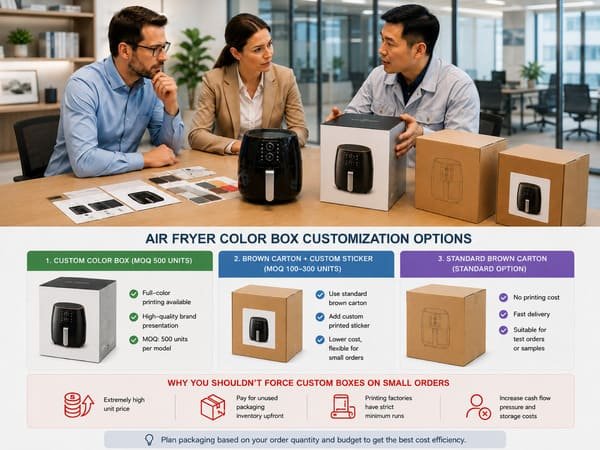
Packaging is a critical component of retail success, but it operates on different supply chain rules than the air fryers themselves. Air fryer manufacturers do not print boxes in-house; they outsource them to specialized printing factories. These printing facilities require a minimum print run, usually starting at 500 or 1,000 pieces3, to cover the setup costs of the printing plates.
If you are placing a small trial order, purchasing 1,000 custom boxes for only 300 machines means you must pay for the extra 700 boxes immediately. The factory will store the remaining boxes for your next order. While this secures your brand identity, it ties up cash.
A safer approach for new private label testing involves using a neutral gift box or standard corrugated carton and applying high-quality, custom-designed graphic decals. This keeps initial costs low while maintaining a professional appearance.
When planning packaging, buyers must also consider shipping durability. Retail packaging needs sufficient internal foam or pulp molding to pass drop tests4. A beautiful color box is useless if the air fryer arrives damaged. Always instruct your supplier to provide packaging that balances brand aesthetics with structural integrity for international container shipping.
| Packaging Type | Minimum Order Quantity | Setup Cost | Best For |
|---|---|---|---|
| Standard Box + Sticker | 100 – 300 pcs | Very Low | Market testing, budget constraints |
| Custom Color Box | 500 – 1,000 pcs | Medium | Established brands, retail shelves |
| Premium Rigid Box | 1,000+ pcs | High | High-end smart air fryer models |
What are the standard payment terms for OEM air fryers from China?
The standard payment term for OEM air fryer manufacturing is a 30% deposit via T/T before production begins, with the remaining 70% balance paid before shipment, usually after the buyer approves the pre-shipment quality inspection report.
Accepting 100% upfront payment leaves the buyer with zero leverage if quality issues arise. Conversely, expecting open credit terms on a first order usually causes the manufacturer to reject the business or quote artificially high prices.
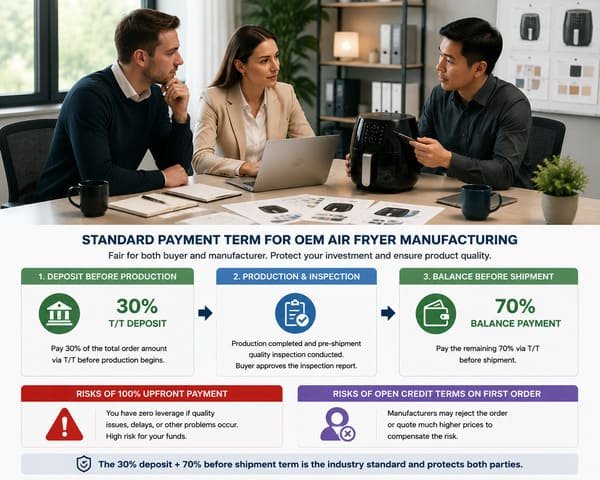
Navigating payment terms is a critical part of establishing a secure supply chain relationship. The 30/70 T/T (Telegraphic Transfer) structure is the industry standard for a practical reason: it balances risk.5 The 30% deposit gives the manufacturer the working capital needed to purchase raw materials, electronic components, and custom packaging for your specific order.
The 70% balance acts as the buyer’s security. This final payment should only be released after the goods are manufactured, packaged, and successfully pass a third-party quality inspection. This ensures the factory remains motivated to maintain quality standards throughout the entire production cycle.
For custom OEM projects requiring new molds, the mold fee is typically paid 100% upfront before any tooling work begins. This is separate from the product unit cost.
Letters of Credit (L/C) at sight are sometimes used for very large wholesale orders, typically exceeding $50,000.6 However, L/C processes involve high bank fees and strict documentation rules, making them impractical for standard trial orders or mid-sized imports. Buyers should build trust through the standard T/T process first. As order volumes grow and the relationship stabilizes over several shipments, buyers can negotiate better terms.
What is the average lead time for a 1,000 pcs air fryer order?
The average lead time for a standard 1,000-piece air fryer order is 30 to 45 days. This timeframe begins only after the buyer officially approves the final sample, confirms the packaging design, and transfers the initial deposit.
Failing to account for packaging design delays, certificate verification, or Chinese national holidays can push the actual delivery date weeks beyond the factory’s initial estimate, missing critical retail sales seasons.

Production lead time is a complex calculation, not a fixed guarantee. When a supplier quotes 35 days, that countdown does not start the day you send an inquiry. It starts when all technical specifications are locked, and the deposit clears the bank.
For a 1,000-unit batch, the actual assembly of the air fryers might only take three to five days. The bulk of the lead time is consumed by material preparation. The factory must order heating tubes, injection-molded plastics, circuit boards, and customized color boxes from their sub-suppliers. Procuring custom printed packaging often takes 15 to 20 days alone.7
Customization depth directly affects this schedule.8 If your order requires a specific plug type for the UK or Australia, or a non-standard plastic color, the factory must wait for those specific components to arrive. Furthermore, if you require new certification testing for a customized model, expect an additional four to six weeks of delay before mass production can even begin.
To manage lead time risks, buyers should build a buffer into their procurement schedule. Finalize all artwork and user manual translations early. Communicate clearly with the supplier about material readiness and establish specific milestones for packaging arrival and assembly line scheduling.
What is the standard AQL for air fryer pre-shipment inspection?
The standard Acceptable Quality Limit for air fryer inspections is AQL Level II. Buyers typically set critical defects at 0, major defects at 1.5, and minor defects at 4.0 to ensure electronic safety and functional reliability before shipping.
Skipping third-party inspection leaves buyers vulnerable to receiving containers full of defective appliances. Discovering scratched coatings, faulty heating elements, or missing certifications after the goods arrive in your country makes returns practically impossible.
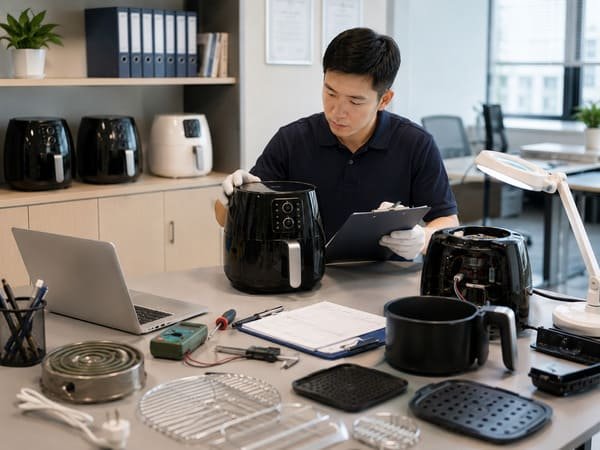
Quality control is the final defense line before taking ownership of the inventory. Because air fryers are high-wattage heating appliances, strict inspection is non-negotiable. Using the AQL (Acceptable Quality Limit) framework9 provides a mathematical standard for accepting or rejecting a batch.
Under AQL Level II, a critical defect (0 tolerance) includes anything that compromises safety, such as exposed wiring, incorrect grounding, or missing compliance labels. A major defect (1.5 tolerance) involves functional failures, like a broken timer, a fan that does not spin, or an inaccurate temperature sensor. Minor defects (4.0 tolerance) cover cosmetic issues that do not affect usage, such as a slight scratch on the plastic casing or a slightly misaligned logo.
A professional pre-shipment inspection goes beyond just turning the machine on. The inspector should verify the internal packaging strength, check the non-stick coating for peeling, and perform a high-voltage test to ensure electrical safety10. They should also compare the mass production units directly against your approved golden sample.
Always communicate your AQL standards to the manufacturer before placing the order. A reliable supplier will welcome third-party inspections. If a factory hesitates or refuses to allow an external inspector into their facility, buyers should treat that as a major red flag and reconsider the partnership.
How to negotiate a lower MOQ with Chinese air fryer manufacturers?
To negotiate a lower minimum order quantity, buyers should choose standard models, use existing factory colors, simplify custom packaging, and consolidate orders with the factory’s current production schedule to minimize assembly line disruption.
Pushing a factory into an unsustainably low volume on a highly customized product often results in compromised material quality, sudden price hikes, or indefinite production delays as the factory prioritizes larger, more profitable clients.
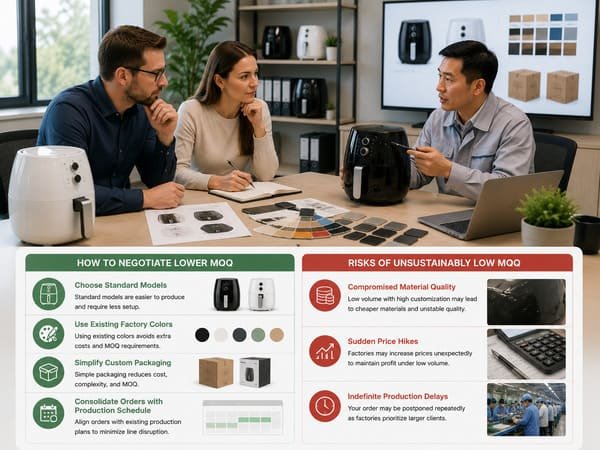
Minimum order quantities are essentially risk management tools for factories.11 Manufacturers set MOQs to ensure the cost of switching production lines, sourcing materials, and handling paperwork is covered by the profit of the run. Therefore, successful negotiation requires reducing the factory’s operational burden.
The most effective way to lower MOQ is to align your order with what the factory is already doing. If you select a popular air fryer model and accept the standard black or white injection molding, the factory does not need to purge their machines for a custom color. By reducing custom requests, you make a smaller run economically viable.
Another strategy is to accept a higher unit price for the initial trial order. Offering to pay a slightly elevated price on a 300-unit order compensates the manufacturer for their setup time, allowing you to test market demand without committing to 1,000 units.
Finally, consider simplifying your packaging. As discussed earlier, printing custom boxes is a major MOQ bottleneck.12 Agreeing to use standard cartons with high-quality stickers drastically lowers the barrier to entry. For new brands, the safest strategy is to start with an existing air fryer model, execute light private label customization, prove the retail concept, and move into deeper OEM customization once sales velocity is established.
FAQ About Air Fryer Manufacturer
What is the real MOQ for custom private label air fryers?
The minimum order quantity for private label air fryers ranges from 100 to 500 units for basic logo printing. Deep customizations require higher volumes. MOQ depends heavily on model choice, color, plug type, packaging method, and the specific production setup required.
Can Chinese air fryer manufacturers customize smart UI apps?
Yes, manufacturers can customize smart UI and app connections, but this requires an MOQ of 1,000 to 3,000 units. Modifying software and digital control panels requires additional engineering time and rigorous testing to ensure stable functionality and market compliance.
What certifications are required for importing air fryers?
Certification requirements depend entirely on the target market and the specific product model. Importers typically need CE and RoHS for Europe, UL or ETL for North America, and SAA for Australia to ensure electrical safety and legal customs clearance.
How long does OEM air fryer production usually take?
OEM air fryer production typically takes 30 to 45 days after the initial deposit is received. Lead time depends on sample approval, custom packaging confirmation, material readiness, order quantity, and the factory’s current manufacturing schedule.
What is the typical defect rate for wholesale air fryers?
A normal defect rate for wholesale air fryers is between 1% and 2% under standard mass production conditions. Buyers should establish clear AQL standards and conduct thorough pre-shipment inspections to control quality risks before the cargo leaves the factory.
How can buyers verify a real air fryer supplier in China?
Buyers can verify a supplier by checking their business license, factory address, production scope, and export experience. Requesting technical documents, supporting third-party inspections, and evaluating communication speed also help identify reliable manufacturing partners.
Conclusion
Understanding customization depth, true MOQs, and lead times helps buyers reduce supply chain risks. Prioritizing clear requirements over just chasing low prices ensures stable and compliant air fryer procurement.
Send Your Inquiry
Sourcing air fryers requires careful evaluation of product specifications and factory capabilities. To receive a clearer quotation and accurate sourcing advice, please provide us with your detailed requirements. Let us know your target market, expected order quantity, preferred product type, and required certifications. Including details about plug types, packaging needs, logo customization, and expected delivery schedules helps us recommend the best options. Contact AidKitchens today to build a more manageable and reliable supply chain.
-
"Mass production – Wikipedia", https://en.wikipedia.org/wiki/Mass_production. This source explains why factories charge for samples, emphasizing the disruption to mass production and the need for specialized engineering. Evidence role: mechanism; source type: education. Supports: Factories charge for samples because preparing a single customized unit disrupts mass production lines and requires specialized engineering time.. ↩
-
"Rights & Virtue Ethics in Prototype Testing & Validation", https://www.scu.edu/ethics/focus-areas/more-focus-areas/engineering-ethics/ethical-considerations-in-the-senior-design-project/rights–virtue-ethics-in-prototype-testing–validation/. This source discusses the importance of verifying whether samples match the materials and methods used in mass production. Evidence role: expert_consensus; source type: education. Supports: Ask the manufacturer if the sample is made using the exact materials and assembly methods intended for mass production.. ↩
-
"Minimum Order Quantities: What They Are and Why We Have Them", https://www.ecoenclose.com/blog/minimum-order-quantities-what-they-are-and-why-we-have-them/?srsltid=AfmBOopUmBI1VDle4bjIMrnJoYsGZ-yKD4S23zTzZsEPl4cceO6wrB2F. This source explains the typical minimum print run requirements for packaging factories, which are influenced by setup costs for printing plates. Evidence role: statistic; source type: education. Supports: Printing facilities require a minimum print run, usually starting at 500 or 1,000 pieces, to cover the setup costs of the printing plates.. Scope note: Minimum print runs may vary by region or factory specialization. ↩
-
"Dynamic Response of EPS Foam in Packaging – PMC – NIH", https://pmc.ncbi.nlm.nih.gov/articles/PMC12197106/. This source discusses the importance of internal foam or pulp molding in retail packaging to ensure products pass drop tests and arrive undamaged. Evidence role: mechanism; source type: research. Supports: Retail packaging needs sufficient internal foam or pulp molding to pass drop tests.. Scope note: The specific requirements for drop tests may vary depending on the product type and shipping conditions. ↩
-
"Methods of Payment – International Trade Administration", https://www.trade.gov/methods-payment. This source explains the widespread adoption of the 30/70 T/T payment structure in international trade and its role in balancing financial risk between buyers and manufacturers. Evidence role: expert_consensus; source type: education. Supports: The 30/70 T/T payment structure is widely recognized as an industry standard for balancing risk in supply chain relationships.. Scope note: The source may focus on specific industries or regions where this payment structure is prevalent. ↩
-
"Letter of Credit – International Trade Administration", https://www.trade.gov/letter-credit. This source provides an overview of Letters of Credit (L/C) usage in international trade, including their application for large wholesale orders and associated costs. Evidence role: mechanism; source type: institution. Supports: Letters of Credit (L/C) are commonly used for large wholesale orders in international trade, often exceeding $50,000.. Scope note: The source may not specify the $50,000 threshold universally but could provide general insights into L/C usage. ↩
-
"How Custom Printed Boxes Are Made: From Design to Delivery", https://www.ucanpack.com/blog/post/what-really-happens-when-you-order-a-custom-printed-box. This source provides typical lead times for custom printed packaging in manufacturing contexts. Evidence role: statistic; source type: institution. Supports: Procuring custom printed packaging often takes 15 to 20 days alone during production lead time.. Scope note: Lead times may vary depending on the region and supplier capabilities. ↩
-
"Why Focusing on Lead Time—Not Just Efficiency—Drives Success", https://interpro.wisc.edu/lead-time-drives-manufacturing-success/. This source explains how customization requirements, such as specific plug types or non-standard plastic colors, impact production timelines. Evidence role: mechanism; source type: education. Supports: Customization depth directly affects production lead time by requiring specific components to be procured before assembly can begin.. Scope note: The source may not cover all types of customization impacts. ↩
-
"Aql (عقل) – Global Critical Philosophy of Religion", https://globalcritical.barefield.ua.edu/self-and-persistence/aql-%D8%B9%D9%82%D9%84/. The source explains the AQL framework as a statistical method for determining acceptable defect levels in manufacturing batches. Evidence role: definition; source type: education. Supports: The AQL framework provides a mathematical standard for accepting or rejecting a batch.. ↩
-
"[PDF] High Voltage Safety Manual", https://lasers.colostate.edu/wp-content/uploads/2019/04/High-Voltage-Safety-Manual.pdf. The source outlines the importance and procedure of high-voltage testing in ensuring the electrical safety of appliances. Evidence role: mechanism; source type: research. Supports: High-voltage testing is a necessary step to ensure electrical safety in appliances.. Scope note: The source may focus on general electrical safety testing rather than air fryers specifically. ↩
-
"[PDF] Chapter 3 Inventory Management", https://www.bauer.uh.edu/egardner/3301H%20Operations%20Management/OM%20Text/3INVENTORY%20MANAGEMENT-1.pdf. This source explains how minimum order quantities function as risk management tools by covering operational costs such as production line changes and material sourcing. Evidence role: mechanism; source type: education. Supports: Minimum order quantities are essentially risk management tools for factories.. ↩
-
"Minimum Order Quantity: What Is It and Why Does It Matter", https://www.paramountglobal.com/knowledge/minimum-order-quantity/. This source discusses how custom packaging requirements, such as printed boxes, can increase minimum order quantities due to setup costs and production constraints. Evidence role: mechanism; source type: research. Supports: printing custom boxes is a major MOQ bottleneck.. ↩