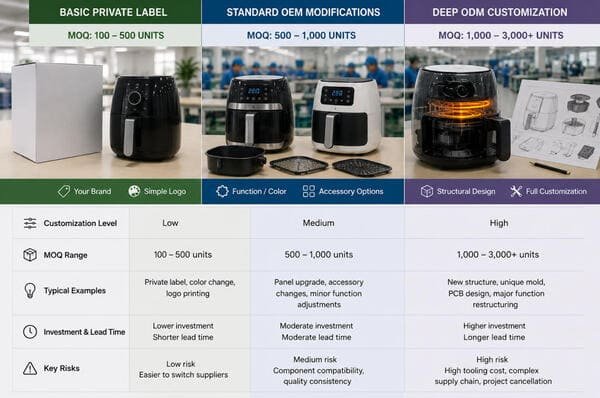
The real minimum order quantity for custom air fryers ranges from 100 to 500 units for basic private labeling, 500 to 1,000 units for standard OEM modifications, and 1,000 to 3,000+ units for deep ODM structural customizations.
Misunderstanding minimum order quantities often leads to severe cash flow strain or unexpected import non-compliance. Importers who force heavy customization on low volumes frequently face hidden supply chain risks, component quality compromises, or sudden project cancellations by the manufacturer.
Navigating minimum order quantities requires an understanding of how Chinese factories balance production efficiency against financial risk1. An air fryer MOQ is not a random number meant to turn away small businesses; it represents the threshold where bulk manufacturing becomes economically viable. This comprehensive guide breaks down the underlying factors that govern air fryer production volumes, hidden engineering costs2, and strategic procurement frameworks to help global appliance brands, wholesalers, and e-commerce sellers execute low-risk sourcing operations.
Which factors determine the real MOQ for custom air fryers in China?
The real MOQ for custom air fryers is determined by component supply limits, packaging print runs, and factory setup times. Upstream component suppliers dictate production minimums because parts like custom heating tubes, specific control boards, and specialized electrical plugs require fixed minimum material batches.
Ignoring these underlying supply chain constraints causes serious production friction and unexpected price hikes. Buyers who push for low volumes without understanding component dynamics often receive quotes with inflated unit prices or find their orders delayed indefinitely behind larger production runs.
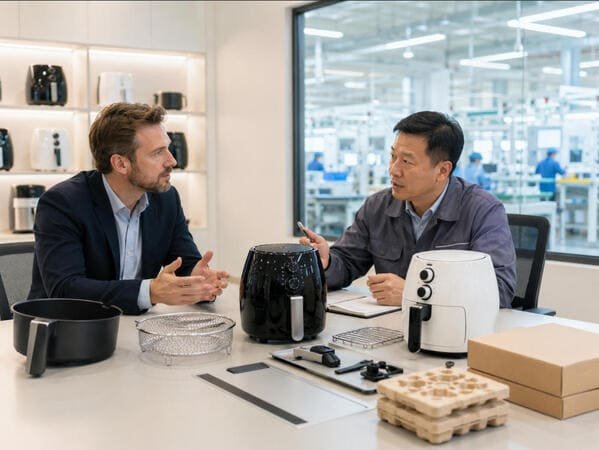
An air fryer manufacturer operates primarily as an assembly hub that relies on an extensive network of specialized sub-suppliers. When an importer requests a customized appliance, the minimum order quantity is rarely determined by the assembly line itself. Instead, it is constrained by the factories that produce the individual inputs.
For instance, injection molding facilities require a specific volume of plastic resin to clear out old colors and set up machinery3. Similarly, microchip and control panel manufacturers do not configure a production line for a handful of specialized circuit boards4. The standard electrical cord and plug assembly also carries its own sub-MOQ based on market safety certifications.
| Customization Tier | Average Real MOQ | Key Supply Chain Constraints |
|---|---|---|
| Light Private Label | 100 – 500 units | Standard components used; constrained only by basic printing packaging setups. |
| Standard OEM/ODM | 500 – 1,000 units | Constrained by custom plastic injection coloring and specialized market plug runs. |
| Deep ODM Customization | 1,000 – 3,000+ units | Constrained by brand-new mold investments, dedicated circuit boards, and safety testing. |
Furthermore, communication speed and clarity with the factory’s sales representatives play a decisive role. Transparent discussions early in the procurement process allow the factory to cross-check component availability with their sub-vendors, ensuring that the final agreed-upon production batch aligns perfectly with realistic material constraints.
How do new mold, color, and packaging customizations Air Fryer affect MOQ and costs?
New mold tooling requires an MOQ of 2,000 to 3,000+ units to amortize high engineering costs. Custom plastic shell colors require 500 to 1,000 units to justify injection molding setup waste, while customized color boxes demand at least 500 units due to professional printing press runs.
Failing to calculate these upfront customization investments can break an import budget before production even begins. Forcing complex modifications onto low-volume orders results in massive mold amortization surcharges or forces the buyer to pay for thousands of pieces of unused packaging stock.
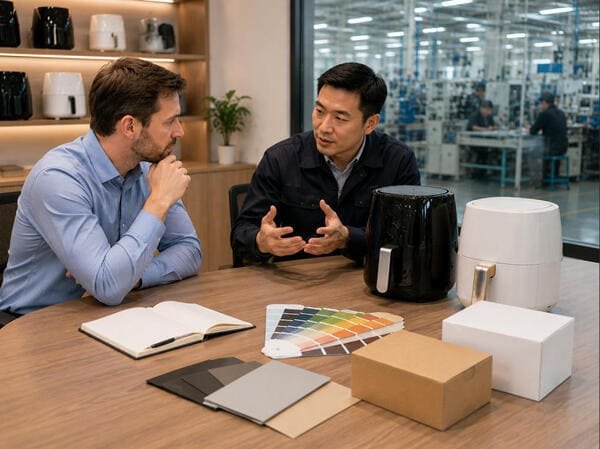
Customization depth directly dictates the financial and operational scale of an air fryer project. A simple private-label project utilizing laser engraving or silkscreen printing for a logo can be executed on a very small scale, as it utilizes standard off-the-shelf components already stocked by the factory.
However, when a buyer requests a proprietary shape, a dual-basket configuration, or a unique physical button layout, the manufacturer must build brand-new steel molds. Tooling a new air fryer mold is an expensive engineering process that typically costs between $15,000 and $40,000 depending on the complexity.5 To absorb this cost without charging the buyer an exorbitant premium per unit, factories require a guaranteed production volume over a specified timeframe.
Color changes present a different operational challenge. To produce a custom aesthetic—such as a specific matte green or pastel pink housing—the injection molding machines must be thoroughly purged of the previous plastic resin color.6 This setup process generates material waste, which must be financially covered by a minimum run of plastic parts, typically equating to 500 or 1,000 completed air fryers.
Buyers must account for hidden fees such as plate-making charges for custom boxes, tooling storage fees, laboratory certificate update premiums, and low-volume assembly surcharges when negotiating a lower air fryer minimum order quantity.
Neglecting these peripheral expenses can completely wipe out an importer’s expected profit margins upon final invoicing. A low initial FOB quote often masks substantial backend fees that manufacturers apply to offset the structural inefficiencies of small production runs.
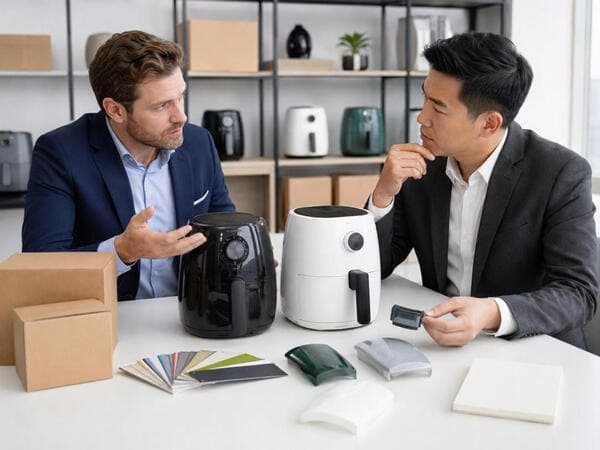
When negotiating down a minimum production volume, the factory must still cover its baseline operational expenses7. If a manufacturer agrees to lower their standard requirement from 1,000 units to 300 units, they will almost always restructure their pricing model to transfer the risk back to the buyer.
The most common hidden fee is the packaging plate-making surcharge. Printing sub-vendors charge fixed setup fees for the CMYK color plates used in custom boxes8. On an order of 1,000 units, this fee is negligible when spread across the batch, but on 200 units, it adds a substantial premium to each individual machine.
FAQ
1. What is the real minimum order quantity for custom air fryers?
The real MOQ for custom air fryers depends on the level of customization. Basic private labeling usually starts at 100 to 500 units, standard OEM modifications typically require 500 to 1,000 units, and deep ODM structural customization often requires 1,000 to 3,000+ units. The more complex the customization, the higher the MOQ because the factory must spread setup and engineering costs across a larger batch.
2. Which factors determine the real MOQ for custom air fryers in China?
The real MOQ is mainly determined by component supply limits, packaging print runs, and factory setup time. Custom heating tubes, circuit boards, plugs, plastic shells, and packaging materials all come from sub-suppliers that often have their own minimum batch requirements. In many cases, the assembly factory is not the real constraint—the upstream supply chain is.
3. How do mold, color, and packaging customizations affect MOQ and cost?
Customization depth has a direct impact on both MOQ and cost. New mold development usually requires 2,000 to 3,000+ units because tooling is expensive and must be amortized over volume. Custom shell colors often need 500 to 1,000 units due to resin changeover waste in injection molding. Customized color boxes generally need at least 500 units because printing vendors charge fixed setup costs for each design.
A lower MOQ often comes with additional charges that are not obvious in the first quotation. Common hidden fees include plate-making charges for custom boxes, tooling storage fees, certificate update or lab testing fees, and low-volume assembly surcharges. If buyers focus only on FOB unit price and ignore these extra costs, the final landed cost can rise significantly.
5. How can buyers reduce MOQ risk when sourcing custom air fryers?
Buyers can reduce risk by matching customization depth to order volume, using standard components whenever possible, and discussing requirements clearly with the factory early in the process. Transparent communication helps confirm whether component suppliers can support the requested order size. For low-volume projects, simpler private labeling is usually safer and more cost-effective than deep structural customization.
Conclusion
The real MOQ for custom air fryers is not a random policy set by the factory. It is driven by the economics of the supply chain, including component sourcing, packaging production, engineering investment, and line setup efficiency. Light private label projects can often be done at relatively low volumes, while OEM and ODM projects require higher commitments because of mold cost, material waste, and specialized production requirements.
For buyers, the biggest mistake is assuming that a lower MOQ automatically reduces risk. In reality, forcing heavy customization into small batches often creates hidden costs, quality instability, delayed production, or even project cancellation. A better sourcing strategy is to align customization scope with realistic order volume, understand all related costs in advance, and confirm supply chain feasibility before placing the order.
-
"What is a typical Minimum Order Quantity (MOQ) for low … – Orbit", https://orbit-kb.mit.edu/hc/en-us/articles/360039224292-What-is-a-typical-Minimum-Order-Quantity-MOQ-for-low-volume-manufacturing-in-China. This source explains how Chinese factories determine minimum order quantities by balancing production efficiency and financial risk. Evidence role: mechanism; source type: education. Supports: Chinese factories balance production efficiency against financial risk when setting minimum order quantities.. ↩
-
"Effect of air fryer frying temperature on the quality attributes of … – PMC", https://pmc.ncbi.nlm.nih.gov/articles/PMC8825730/. This source outlines the types of hidden engineering costs involved in manufacturing appliances like air fryers. Evidence role: definition; source type: research. Supports: Hidden engineering costs are a significant factor in air fryer production volumes.. Scope note: The source may focus on general engineering costs rather than those specific to air fryers. ↩
-
"Injection Molding Material Selection Guide – Protolabs", https://www.protolabs.com/resources/guides-and-trend-reports/thermoplastic-material-selection-for-injection-molding/. This source explains the operational requirements of injection molding facilities, including the need for specific resin volumes to transition between colors. Evidence role: mechanism; source type: education. Supports: Injection molding facilities require a specific volume of plastic resin to clear out old colors and set up machinery.. ↩
-
"Constraint programming models for serial batch scheduling with …", https://www.sciencedirect.com/science/article/pii/S2214716025000284. This source discusses the economic and logistical reasons why microchip and control panel manufacturers avoid small-batch production. Evidence role: expert_consensus; source type: research. Supports: Microchip and control panel manufacturers do not configure a production line for a handful of specialized circuit boards.. Scope note: The source may focus on general industry practices rather than specific examples of microchip and control panel production. ↩
-
"Plastic Mold Steel – No Minimum Order Value or Quantity", https://us.abrams-industries.com/buy/plastic-mold-steel. This source provides an estimate of the costs associated with tooling new molds for consumer appliances, including air fryers, and explains the factors influencing these costs. Evidence role: statistic; source type: education. Supports: Tooling a new air fryer mold is an expensive engineering process that typically costs between $15,000 and $40,000 depending on the complexity.. Scope note: The cost range may vary based on regional manufacturing practices and specific factory capabilities. ↩
-
"Purging Compounds For Injection Molding – Purgex", https://purgexonline.com/injection-molding/. This source explains the operational requirements for purging injection molding machines during color changes and the associated material waste. Evidence role: mechanism; source type: research. Supports: the injection molding machines must be thoroughly purged of the previous plastic resin color.. Scope note: The explanation may not cover all types of injection molding machines or resin materials. ↩
-
"[PDF] ESTIMATING MANUFACTURING COSTS FOR PRE-COMMERCIAL …", https://www.energy.gov/sites/default/files/2023-01/2022-11-29%20-%20Mfg%20Costs%20PDF%20%281%29_0.pdf. This source explains the financial constraints factories face in maintaining operational expenses, particularly when production volumes are reduced. Evidence role: mechanism; source type: education. Supports: Factories need to cover baseline operational expenses even when production volumes are reduced.. ↩
-
"16.306 Cost-plus-fixed-fee contracts. – Acquisition.GOV", https://www.acquisition.gov/far/16.306. This source provides an overview of CMYK printing processes and the associated setup fees charged by sub-vendors. Evidence role: mechanism; source type: encyclopedia. Supports: Printing sub-vendors charge fixed setup fees for CMYK color plates used in custom boxes.. Scope note: The source may not address specific fee structures for all printing sub-vendors. ↩