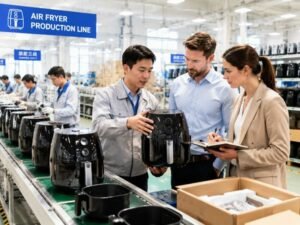
Ningbo and Guangdong both offer strong air fryer manufacturing capabilities, but the better choice depends on product requirements, supplier capability, order structure, and risk control needs.
Problem: Choosing the right manufacturing hub in China is often the first challenge for buyers sourcing air fryers. Many buyers compare regions before understanding what capabilities their specific product requires.
Agitation: Choosing the wrong sourcing ecosystem can create problems later, including supplier mismatch, unclear responsibilities, quality issues, unexpected costs, or production delays.
Solution: Buyers should compare Ningbo and Guangdong based on product complexity, supplier evidence, total sourcing cost, and verification requirements instead of assuming one region is always better.
Snippet: Buyers should choose between Ningbo and Guangdong by matching product requirements, supplier capability, total cost, and verification needs rather than relying only on regional reputation.
When overseas buyers search for air fryer manufacturers in China, Ningbo and Guangdong are two frequently considered manufacturing ecosystems.
However, the key question is not:
"Which region is the winner?"
The more useful question is:
"Which manufacturing ecosystem better matches your product, business model, and sourcing risk?"
Why are Ningbo and Guangdong important air fryer manufacturing hubs in China?
Ningbo and Guangdong are important because both regions have developed appliance supply chains, but their manufacturing advantages come from different ecosystems.
Buyers should treat regional reputation as an initial supplier search signal, not as proof of supplier capability.
A manufacturing region can provide access to resources, but the final sourcing decision depends on:
- Product capability;
- Engineering support;
- Quality management;
- Export experience;
- Communication efficiency;
- Responsibility ownership.
In our daily communication with air fryer buyers, we often see customers start with a location question:
"Should we buy from Ningbo or Guangdong?"
After discussing product details, the more important questions usually become:
- Does the supplier understand this product structure?
- Can they support the required customization?
- How do they control quality during mass production?
- Who manages engineering changes?
- How are problems handled after production starts?
The location helps narrow the search, but the supplier system determines execution quality.
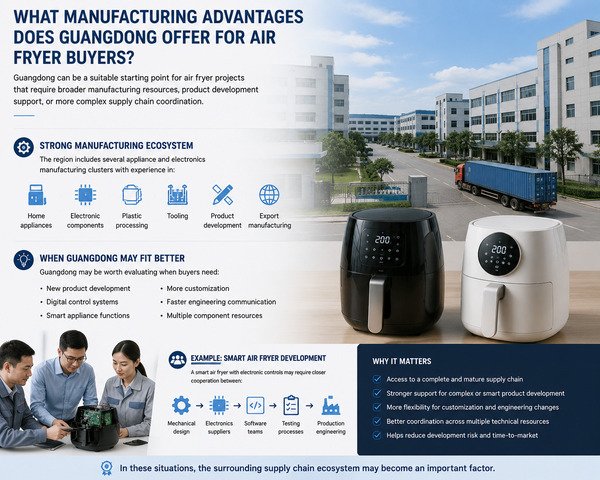
What manufacturing advantages does Guangdong offer for air fryer buyers?
Guangdong can be a suitable starting point for air fryer projects that require broader manufacturing resources, product development support, or more complex supply chain coordination.
The region includes several appliance and electronics manufacturing clusters with experience in:
- Home appliances;
- Electronic components;
- Plastic processing;
- Tooling;
- Product development;
- Export manufacturing.
When Guangdong may fit better
Guangdong may be worth evaluating when buyers need:
- New product development;
- Digital control systems;
- Smart appliance functions;
- More customization;
- Faster engineering communication;
- Multiple component resources.
For example, a smart air fryer with electronic controls may require closer cooperation between:
- Mechanical design;
- Electronics suppliers;
- Software teams;
- Testing processes;
- Production engineering.
In these situations, the surrounding supply chain ecosystem may become an important factor.
Manufacturing perspective
From a production cooperation perspective, we often remind buyers that a supplier location does not automatically represent product capability.
A supplier in a strong manufacturing region still needs to prove:
- Experience with similar products;
- Engineering capability;
- Quality control process;
- Production responsibility;
- Communication ability.
What manufacturing advantages does Ningbo offer for air fryer buyers?
Ningbo and surrounding areas are often considered suitable for mature OEM production and established small appliance manufacturing projects.
The region has developed experience in:
- Appliance manufacturing;
- Component supply;
- Export production;
- Standardized product manufacturing.
When Ningbo may fit better
Ningbo may be worth evaluating when buyers need:
- Mature air fryer platforms;
- Private label production;
- Standardized models;
- Stable manufacturing processes;
- Production-focused suppliers.
Many buyers do not need a completely new product.
They may need:
- Existing product platforms;
- Brand customization;
- Packaging changes;
- Market-specific adjustments;
- Reliable repeat production.
For these projects, manufacturing consistency may be more important than advanced product development.
Manufacturing perspective
In our experience working with sourcing projects, buyers sometimes focus heavily on finding a new design.
However, for many commercial products, a mature manufacturing process can reduce uncertainty.
A proven production process may help reduce:
- Development problems;
- Manufacturing changes;
- Communication issues;
- Quality variation.
However, buyers should still verify the individual supplier because regional advantages do not replace supplier evaluation.
Which air fryer product types fit Ningbo or Guangdong better?
The right manufacturing hub depends on the air fryer product architecture and the capabilities required to develop and produce it.
A common sourcing mistake is comparing regions before defining the product itself. Different air fryer designs require different supplier capabilities.

Standard air fryer models
Standard air fryer projects usually focus on:
- Production consistency;
- Cost control;
- Packaging flexibility;
- Stable supply;
- Repeat ordering capability.
For these products, a supplier with proven manufacturing experience may be more valuable than a supplier with advanced development resources that are not required.
Buyers should verify:
- Similar product experience;
- Production process stability;
- Quality control methods;
- Ability to maintain consistency.
Digital and smart air fryer models
Digital and smart air fryer projects usually require additional capabilities.
Buyers should evaluate:
- Electronic control experience;
- PCB management;
- Software or firmware coordination;
- Testing procedures;
- Engineering communication.
For smart products, supplier selection may depend more on technical coordination ability than manufacturing location.
Customized ODM air fryer projects
ODM projects require buyers to evaluate deeper supplier capabilities.
Important questions include:
- Who manages product development?
- Who controls tooling changes?
- How are prototypes improved?
- How are engineering problems handled before mass production?
The right supplier is not necessarily the supplier from the most famous manufacturing region.
The right supplier is the one whose capabilities match the project requirements.
How should buyers choose a manufacturing hub based on order structure?
Buyers should match their sourcing location with their business model, order requirements, and internal management capability.
Different buyers have different priorities.
| Buyer Type | Main Procurement Focus |
|---|---|
| New brand | Product flexibility, supplier communication, risk control |
| Private label importer | Existing models, customization, consistency |
| Retail buyer | Documentation, quality systems, repeat supply |
| Distributor | Product range, reliability, after-sales support |
| Experienced procurement team | Cost optimization and supplier management |
Small and medium buyers
Smaller buyers often need more support with:
- Supplier comparison;
- Product selection;
- Documentation review;
- Quality follow-up;
- Communication coordination.
For these buyers, a supplier or sourcing partner that reduces management complexity may create additional value.
The goal is not simply removing intermediaries.
The goal is reducing unnecessary risk and unclear responsibility.
Large-volume buyers
Large buyers usually focus more on:
- Production stability;
- Capacity planning;
- Quality consistency;
- Long-term cooperation.
However, larger orders do not eliminate sourcing risks.
Buyers should still verify:
- Production capability;
- Quality process;
- Supplier responsibility;
- Backup plans.
Should buyers compare Ningbo and Guangdong suppliers based only on price?
No. Buyers should compare total sourcing cost instead of only unit price.
A lower quotation does not always create lower procurement cost.
The real cost may include:
- Tooling expenses;
- Sample development;
- Quality inspection;
- Production corrections;
- Packaging adjustments;
- Communication time;
- Logistics coordination;
- Failure costs.

Why supplier quotations are often difficult to compare
During sourcing discussions, we often see buyers compare quotations from multiple suppliers.
However, different quotations may include different assumptions.
For example:
- Different product specifications;
- Different materials;
- Different packaging requirements;
- Different testing expectations;
- Different service responsibilities.
A fair comparison requires the same project definition.
Before comparing suppliers, buyers should confirm:
- Product specification;
- Quantity;
- Customization requirements;
- Packaging;
- Testing requirements;
- Delivery terms.
How can buyers verify whether an air fryer supplier is reliable?
Buyers should verify the individual supplier instead of relying only on the manufacturing region.
A supplier located in a strong manufacturing cluster still needs evidence of capability.

Check supplier identity before production discussions
Buyers should verify:
- Company information;
- Actual business entity;
- Factory location;
- Contract entity;
- Payment entity;
- Relationship between factory and trading company if applicable.
An online supplier profile or marketing statement is not proof of production capability.
Verify manufacturing capability
Important questions include:
- Does the supplier produce similar air fryer models?
- Which processes are controlled internally?
- Which processes are outsourced?
- Who manages quality control?
- How are production problems handled?
The goal is not requiring every supplier to own every process.
The goal is understanding responsibility and risk.
What documents should buyers check before ordering air fryers from China?
Buyers should review documents based on the product, target market, and sales channel.
A document should not only exist. Its scope and relevance should match the actual product.
Buyers should review:
- Company registration information;
- Factory information;
- Contract details;
- Production responsibility.
Buyers should confirm:
- Product specifications;
- Approved samples;
- Product drawings where applicable;
- Packaging requirements;
- Product configuration.
Buyers should understand:
- Inspection standards;
- Quality checkpoints;
- Problem handling process;
- Production consistency controls.
Buyers should verify:
- Whether documents match the specific model;
- Whether they apply to the target market;
- Whether product configuration is consistent.
A certificate or report should not automatically be considered applicable to every version of a product.
How do manufacturers evaluate air fryer order risks before production?
Manufacturers also evaluate order risks because unclear requirements can create problems during production.
From our experience communicating with buyers, many production problems begin before manufacturing starts.
The root cause is often unclear expectations.
Risk 1: Unclear product requirements
Before production, buyers and suppliers should align:
- Product specifications;
- Functional requirements;
- Appearance details;
- Packaging;
- Market requirements.
Small misunderstandings during early communication can become larger production issues later.
Risk 2: Sample approval does not guarantee mass production consistency
A successful sample is an important milestone, but buyers should also understand how consistency is maintained during mass production.
Useful verification points include:
- Approved reference sample;
- Production inspection points;
- Quality checkpoints;
- Final inspection process.
Risk 3: Unclear responsibility boundaries
Many sourcing problems happen because both sides assume the other party is responsible.
Before ordering, buyers should clarify:
- Who approves changes;
- Who handles defects;
- Who manages replacement parts;
- Who approves final shipment.
Should buyers work directly with factories or use sourcing partners for air fryer procurement?
The best sourcing structure depends on the buyer’s complexity, internal resources, and risk-control needs.
The decision should not be based on the simple idea that factories are always better or intermediaries are always unnecessary.
Modern supply chains often involve different roles creating different types of value.
Factories and manufacturers usually create value through:
- Product development;
- Manufacturing technology;
- Process control;
- Production efficiency;
- Product consistency.
Trading companies or sourcing partners may create value through:
- Supplier comparison;
- Cross-border communication;
- Quality follow-up;
- Logistics coordination;
- Documentation support;
- Multi-supplier management.
The correct question is:
Which sourcing structure reduces risk and improves execution for this specific buyer?
When direct factory cooperation may fit better
Direct factory cooperation may work well when buyers have the internal capability to manage:
- Technical communication;
- Quality control;
- Compliance coordination;
- Logistics;
- Supplier follow-up.
For experienced procurement teams with clear requirements, direct cooperation can be an effective approach.
When a sourcing partner may create additional value
A sourcing partner may be useful when buyers need support with:
- Finding suitable suppliers;
- Comparing different manufacturing options;
- Coordinating communication;
- Following production progress;
- Managing inspections;
- Reducing supplier management workload.
The buyer should evaluate:
- What service is provided;
- What responsibility is accepted;
- Whether fees are transparent;
- Whether the partner reduces real procurement risk.
The goal is not removing every intermediary.
The goal is removing unnecessary uncertainty.
How should buyers compare Ningbo and Guangdong suppliers before making a final decision?
The best comparison method is a structured supplier evaluation process using the same requirements.
Buyers should avoid comparing:
- One supplier’s standard model with another supplier’s customized product;
- Different specifications;
- Different packaging requirements;
- Different testing expectations.
A fair comparison requires the same RFQ information.
A practical supplier comparison checklist
| Evaluation Area | Buyer Question |
|---|---|
| Product capability | Has the supplier produced similar air fryer products? |
| Engineering support | Can they manage required customization? |
| Quality control | How is production consistency maintained? |
| Documentation | Are product documents suitable for the target market? |
| Cost structure | What is included in the quotation? |
| Communication | Who manages technical discussions? |
| Responsibility | Who handles issues after production? |
Manufacturing experience perspective
In our daily discussions with buyers, we often notice that supplier selection starts with price comparison.
However, many long-term sourcing problems are not caused by the highest quotation.
They are caused by:
- Unclear requirements;
- Poor communication;
- Missing verification;
- Undefined responsibility;
- Unexpected changes during production.
A supplier decision should balance cost, capability, and risk.
What sourcing process should buyers follow when purchasing air fryers from China?
A structured sourcing process can help reduce avoidable risks before bulk production.
Step 1: Define product requirements
Before contacting suppliers, buyers should clarify:
- Product type;
- Capacity requirements;
- Functions;
- Target market;
- Customization level;
- Packaging expectations.
Clear requirements improve supplier comparison.
Step 2: Identify suitable supplier candidates
Suppliers should be evaluated based on:
- Product experience;
- Manufacturing capability;
- Communication quality;
- Documentation readiness;
- Project suitability.
The largest supplier is not always the best match.
Step 3: Confirm samples and specifications
Before mass production, buyers should confirm:
- Product samples;
- Functional requirements;
- Appearance details;
- Packaging;
- Approved specifications.
A clear approval process reduces misunderstandings.
Step 4: Verify production readiness
Before bulk orders, buyers should confirm:
- Production plan;
- Quality checkpoints;
- Inspection process;
- Responsibility boundaries.
Step 5: Manage mass production and shipment
During production, buyers should maintain communication regarding:
- Quality;
- Changes;
- Inspection;
- Shipment approval.
Supplier selection is only the beginning. Execution management determines the final result.
FAQ
Is Ningbo better than Guangdong for air fryer manufacturing?
Neither region is universally better. Ningbo may fit mature OEM and production-focused projects, while Guangdong may fit projects requiring broader development resources or more complex coordination. Buyers should evaluate specific suppliers rather than regions alone.
Does Guangdong always provide higher-quality air fryer suppliers?
No. Guangdong has strong manufacturing resources, but supplier quality depends on the individual company’s capability, processes, experience, and verification evidence.
Is Ningbo always cheaper for air fryer production?
Not necessarily. Actual sourcing cost depends on product specifications, customization, quality requirements, logistics, and supplier responsibility.
Should buyers choose a factory instead of a trading company?
Not always. The better choice depends on the buyer’s needs. A factory may provide direct production control, while a sourcing partner may help reduce communication and coordination risks.
What should buyers verify before placing a large air fryer order?
Buyers should verify supplier identity, product specifications, sample consistency, document scope, quality controls, production responsibility, and commercial terms before moving into mass production.
Conclusion
Choosing between Ningbo and Guangdong for air fryer manufacturing is not a simple regional competition.
Both manufacturing ecosystems can support successful sourcing projects, but the right choice depends on:
- Product complexity;
- Order structure;
- Customization requirements;
- Supplier capability;
- Verification needs;
- Total sourcing risk.
Ningbo may be a strong option for mature OEM-focused projects, while Guangdong may provide advantages for more complex development and integrated supply chain needs.
However, the final decision should always be based on verified supplier capability rather than location reputation alone.
The most reliable sourcing approach is to define requirements clearly, compare suppliers fairly, verify evidence, and choose the manufacturing partner that best matches the buyer’s business objectives.
CTA
Choosing an air fryer manufacturing partner involves more than comparing Ningbo and Guangdong. The right decision depends on your product requirements, target market, customization plans, supplier evaluation process, and sourcing risks.
If you are reviewing air fryer suppliers or planning a new project, you can share your requirements, questions, or supplier concerns through our inquiry form, WhatsApp, or WeChat.
We can help you review key sourcing factors, identify information that should be verified, and discuss possible risks before moving forward with samples or production.