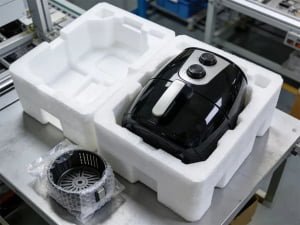
Reliable air fryer suppliers in China should be selected through staged verification, model-matched compliance checks, sample testing, safety review, cost comparison, PI/PO control, shipment document review, inspection, and stop/go decisions before first import payment.
Problem: First-time air fryer import sourcing often starts with supplier search, but the real challenge is deciding which China air fryer supplier is safe enough for samples, deposit payment, production, shipment, and repeat orders.
Agitation: A low quotation or professional-looking supplier profile can still hide certificate mismatch, sample-to-bulk inconsistency, safety risks, weak packaging, unclear shipping terms, document errors, delayed production, or after-sales responsibility gaps.
Solution: A safer first import should follow a sourcing decision system: define requirements, verify supplier evidence, review safety and compliance, test samples, compare real cost, lock order terms, prepare shipment documents, inspect before shipment, and review whether the supplier deserves the next order.
Snippet: A reliable air fryer supplier in China should be evaluated through supplier verification, compliance document review, product safety checks, sample testing, quotation comparison, PI/PO control, shipment document review, pre-shipment inspection, and stop/go decisions before the first import order.
Finding reliable air fryer suppliers in China is not only about searching Alibaba, attending exhibitions, or comparing factory prices. For a first air fryer import, the more useful question is whether the sourcing process can prevent expensive mistakes before money, time, inventory, and customer trust are committed.
Why is the first air fryer import from China a supplier validation project, not just a product purchase?
The first air fryer import should validate supplier execution, document consistency, safety control, production stability, packaging protection, inspection cooperation, and repeat-order potential.
A first order is not only a purchase of air fryer inventory. It is also a practical test of whether the selected China air fryer supplier can follow specifications, keep documents consistent, control safety-related parts, support inspection, protect packaging, and respond responsibly when problems appear.
The first import should answer several commercial questions before a larger order is considered:
- Does the supplier understand the required air fryer model, plug, voltage, packaging, and target market?
- Can the supplier provide documents that match the actual model being shipped?
- Does the sample reflect what can be produced in bulk?
- Are safety-related components controlled during production?
- Is the packaging strong enough for shipping, storage, and retail handling?
- Can the supplier accept clear PI/PO terms and pre-shipment inspection?
- Does the supplier respond constructively when defects, delays, safety concerns, or packaging problems are discussed?
In my sourcing experience, the first air fryer order should be treated as a supplier test, not only an inventory purchase. A supplier that performs well before payment but loses control during production is more dangerous than a supplier that asks careful questions at the beginning.
A first-time importer should avoid judging supplier reliability in one step. Reliable supplier selection is progressive verification. Communication, documents, samples, safety checks, inspection, delivery, and after-sales response all create evidence. A supplier becomes more trustworthy only when each stage supports the previous claim.
What type of air fryer supplier in China fits a first import: factory, trading company, or sourcing agent?
The right air fryer supplier type depends on order complexity, import experience, verification ability, communication cost, quality-control needs, and total sourcing risk.
Many first-time importers ask whether a China air fryer factory is always better than a trading company or sourcing agent. That question is too simple. The better question is which role reduces total risk for this specific first import.
A factory may be suitable when the air fryer model is standardized, the order volume is stable, product requirements are clear, and quality control, documentation, inspection, and logistics can be managed directly. Factories usually create value through production capability, engineering control, process management, capacity, and cost efficiency.
A service-based trading company may be suitable when the order involves mixed models, lower volume, export documentation, packaging coordination, supplier comparison, or communication support. A good trading company can reduce coordination cost and help manage supplier-side uncertainty.
A sourcing agent may be useful when supplier search, factory comparison, sample follow-up, inspection coordination, quotation checking, and shipment communication require local execution. The value is not simply “finding a supplier”; the value is reducing blind spots before payment and shipment.
A pure reseller that only hides supplier information without adding verification, quality control, documentation support, or responsibility may not create enough value. A service-based partner should be judged by transparency, responsibility boundary, verification ability, and total cost of ownership.
I usually do not ask whether a factory or trading company is “better” first. The better question is which role can reduce documentation errors, sample mismatch, inspection difficulty, communication cost, and shipment uncertainty for this specific first order.
For a first air fryer import, the safest supplier type is often the one that can provide clear evidence, stable communication, practical quality control, inspection cooperation, and cost transparency. Direct factory sourcing is not always the safest choice if the importer cannot manage the work that happens between quotation and shipment.
How can a reliable air fryer supplier in China be verified before deposit payment?
A reliable air fryer supplier in China can be verified through communication quality, company identity, document consistency, sample testing, safety review, inspection willingness, and PI/PO clarity.
Supplier verification should be staged. A supplier profile, fast reply, platform badge, or product catalog can support initial screening, but none of these should be treated as final proof of reliability.
A practical air fryer supplier verification ladder can include:
-
Initial communication
Check whether the supplier asks about model, capacity, plug, voltage, packaging, order quantity, target market, and sales channel. -
Company identity check
Review business license information, company name consistency, export experience, website, platform profile, and contact details. -
Product and model matching
Confirm whether the quoted air fryer model matches the required design, capacity, function, accessories, packaging, and market positioning. -
Certificate and test report review
Ask for documents connected to the actual model, not only general company-level claims. -
Safety-related component review
Check whether heating elements, wiring, thermostat, fuse, plastic housing, basket, handle, and glass parts are controlled consistently. -
Sample testing
Compare the received sample with the quotation, specification sheet, packaging promise, and compliance documents. -
Golden sample approval
Keep the approved sample as the reference for mass production. -
PI/PO confirmation
Move all important details into the order document before deposit payment. -
Pre-shipment inspection
Confirm mass production consistency before balance payment and shipment.
Fast replies can create a false sense of safety. In my experience, the real test starts when the same supplier must match model numbers, certificates, packaging details, safety questions, inspection requirements, and payment terms without contradiction.
A reliable air fryer supplier should not avoid questions about certificate scope, safety control, production process, inspection, packaging, defect handling, or delivery responsibility. Negotiation is normal. Avoidance is a warning signal.
What air fryer compliance documents should be checked before trusting supplier claims?
Air fryer compliance documents should be checked by model number, target market, plug, voltage, label, certificate holder, test report scope, and sales channel.
Air fryers are electrical appliances, so compliance claims require careful verification. A supplier saying “CE available,” “ETL available,” “UL available,” or “RoHS available” is not enough. The key issue is whether the document applies to the exact air fryer model, configuration, and target market.
Compliance checks should include:
- certificate name and holder
- test report number
- model number list
- plug type
- voltage and frequency
- rating label
- user manual
- warning label
- packaging label
- production factory name
- target country or region
- intended sales channel
- document validity and scope
No universal certification conclusion should be assumed without checking the specific product, model, configuration, market, and channel. Compliance requirements may change, and platform or retailer rules may add extra requirements beyond basic import documentation.
In my view, the most expensive compliance mistake is not missing a document at the beginning. It is discovering after production that the certificate belongs to a similar model, different plug, different voltage, or another certificate holder.
For a first air fryer import from China, compliance should be treated as a payment gate. If the document scope is unclear, the order should not move directly from quotation to deposit. The safer step is to request model-matched documents, check them against the sample, and confirm the target-market requirements before mass production.
How should air fryer importers check product safety and recall risk before choosing suppliers in China?
Air fryer supplier selection should include product safety risk, overheating risk, defect response, recall exposure, batch traceability, and after-sales responsibility before the first import order.
Air fryers are not simple kitchen accessories. They are electrical appliances that involve heating elements, wiring, plastic parts, coatings, glass doors in some models, handles, baskets, labels, user instructions, and consumer safety expectations.
A supplier that can provide a low quotation but cannot explain product safety controls may create risks beyond the first shipment. Public recall records show why this matters. CPSC recall notices for air fryers have included hazards such as overheating, fire and burn risk, product breakage during use, and related consumer injury concerns. These examples do not mean every air fryer supplier is unsafe, but they show why product safety should be treated as a supplier selection criterion, not only a paperwork issue.
Before choosing an air fryer supplier in China, the following questions should be checked:
- Does the supplier explain how overheating risk is controlled?
- Are heating elements, wiring, thermostat, fuse, plastic housing, basket, handle, and glass parts tested consistently?
- Can the supplier provide model-matched test reports and safety-related documentation?
- Is the rating label consistent with the sample, user manual, and certificate files?
- Are defect claims, spare parts, replacement, credit note, or recall cooperation responsibilities discussed before deposit payment?
- Does the PI/PO include defect-handling and no-unapproved-component-change terms?
- Can the supplier support traceability by batch, model, production date, and carton mark?
In my experience, the most dangerous supplier is not always the one with the highest visible defect rate at the sample stage. A more dangerous case is a supplier that cannot explain how safety-related components are controlled during mass production.
For a first air fryer import, product safety review should become a stop/go gate. If model safety documents are unclear, key components cannot be confirmed, or defect responsibility is avoided, the order should pause before deposit payment.
What air fryer sample, packaging, and after-sales details must be checked before confirming the first order?
Air fryer samples, packaging, labels, accessories, carton protection, loading risk, and after-sales responsibility should be checked before confirming the first import order.
Ordering a sample is not enough. A sample should be tested against the actual commercial use case: target market, sales channel, customer expectations, shipping method, packaging environment, and after-sales risk.
Air fryer sample checks should include:
- heating performance
- temperature stability
- basket coating appearance
- odor during heating
- basket fit and handle strength
- button or touch panel response
- timer and temperature control
- plug and voltage
- power cord and rating label
- user manual
- accessories
- retail box
- outer carton
- barcode and label consistency
Packaging deserves special attention. For air fryer imports, packaging is part of product quality, not only a shipping detail. A working unit can still become a commercial failure if the retail box collapses, the handle is damaged, the basket moves inside the box, or the product arrives looking returned before use.
Air fryer packaging checks should include:
- retail box strength
- inner inserts
- basket protection
- handle protection
- outer carton thickness
- carton sealing
- shipping marks
- label accuracy
- carton size
- volume weight impact
- pallet or loading plan when applicable
Why should carton loading and arrival condition be checked before shipping air fryers?
Carton loading and arrival condition should be checked because air fryer packaging, carton strength, container positioning, and moisture protection can directly affect sellable inventory.
Air fryers are bulky compared with many small consumer products. A weak carton, loose inner insert, poor loading method, or unclear shipping mark can turn acceptable factory goods into damaged retail inventory. This risk is especially important for retail, Amazon, supermarket, and distributor channels, where packaging condition affects customer trust.
Independent inspection companies also treat loading control as part of air fryer quality control. For example, air fryer container loading supervision may check whether goods are properly packed, securely loaded, and positioned to reduce shifting, impact, or moisture damage during transit.
Before shipment, the packaging and loading check should include:
- retail box condition
- outer carton strength
- inner insert protection
- handle and basket stability
- carton sealing
- shipping mark accuracy
- barcode and label visibility
- carton dimensions
- gross weight and net weight consistency
- container loading position
- moisture protection
- loading photos or video
- carton drop test result when required
I usually treat loading photos as part of the evidence chain. They cannot replace inspection, but they help confirm that finished goods were packed, marked, and loaded in a way that supports a later claim if cartons arrive damaged.
For first-time air fryer importers, shipment should not be approved only because the product passed a basic function check. Packaging, loading, and document consistency should also be confirmed before balance payment and shipping release.
After-sales responsibility should also be discussed before deposit payment. Electrical appliances can create higher return and complaint pressure than simple accessories. The supplier should clarify how dead-on-arrival units, production defects, spare parts, replacement, credit notes, or quality claims will be handled.
I usually treat after-sales terms as part of supplier reliability. A supplier that avoids defect-handling discussions before production may become difficult to manage when real problems appear after delivery.
How can air fryer quotations, shipping terms, landed cost, and failure cost be compared?
Air fryer quotations should be compared through unit price, shipping terms, landed cost, packaging cost, inspection cost, cash pressure, and sourcing failure cost.
A low air fryer unit price does not always mean a better sourcing decision. The quotation may exclude packaging upgrades, testing support, inspection cost, local handling, freight, destination charges, duty, taxes, after-sales cost, or defect handling.
A practical quotation comparison should use three layers:
1. Unit price
This is the visible product price. It may be quoted under EXW, FOB, CIF, or another trade term. The same air fryer price can mean very different responsibilities depending on what is included.
2. Landed cost
Landed cost includes the product cost plus the cost required to bring the air fryers to the destination warehouse or sales channel. This may involve packaging, inspection, freight, insurance, customs-related costs, taxes, local handling, and warehousing. Exact cost items depend on market, shipping method, trade terms, and product classification, so current verification is required.
3. Failure cost
Failure cost is often ignored by first-time importers. It can include rejected goods, wrong certificate scope, damaged packaging, delayed launch, rework, customer returns, after-sales claims, missed seasonal demand, and cash tied up in unsellable inventory.
I usually become cautious when one quotation looks much lower than the others. The question is not only why the price is low, but which cost has been moved outside the quotation: packaging, testing, inspection, freight, after-sales, or defect handling.
Shipping terms also matter. EXW may leave more origin-side cost and coordination work to the importer. CIF may look convenient but destination-side charges and control issues should be checked carefully. FOB can make comparison easier in many cases, but freight forwarder confirmation is still needed. No trade term should be selected without understanding cost responsibility and control points.
For air fryers, carton size and volume weight can strongly affect freight economics. A cheaper product with weak packaging or inefficient carton dimensions may become more expensive after shipping, storage, and damage risk are included.
What should be written into the air fryer PI or PO before deposit payment?
An air fryer PI or PO should lock model, specifications, packaging, compliance documents, inspection standards, payment terms, delivery schedule, and defect handling.
A clear PI or PO is one of the most important tools for controlling first-import risk. Chat messages are useful for discussion, but key order terms should be moved into formal order documents before deposit payment.
Important air fryer PI/PO details may include:
- supplier company name
- product model number
- capacity
- color
- function version
- plug type
- voltage and frequency
- accessories
- retail box requirements
- outer carton requirements
- label and manual requirements
- certificate and test report references
- safety-related component requirements when applicable
- approved golden sample
- order quantity
- unit price and trade term
- delivery date
- payment terms
- inspection standard
- pre-shipment inspection requirement
- defect handling method
- packaging approval
- no material or component change without approval
- batch traceability requirement when applicable
I prefer to move every important detail from chat into the PI or PO before deposit payment. If a detail is important enough to affect quality, compliance, safety, delivery, or payment, it is important enough to be written into the order document.
A practical evidence chain should also be kept. This can include quotation files, specification sheets, sample photos and videos, packaging confirmations, certificates, test reports, PI/PO, payment records, production photos, inspection reports, shipment documents, and confirmed supplier messages.
Platform protection, payment protection, or supplier promises should not replace order evidence. If a dispute happens, clear documents are more useful than vague conversations.
What import document package should be prepared for the first air fryer shipment from China?
A first air fryer shipment from China should prepare a complete document package covering order terms, product identity, packing details, shipment control, customs clearance, and inspection evidence.
A first import can fail even when the supplier and product look acceptable. Missing or inconsistent documents may delay customs clearance, create payment disputes, confuse freight forwarders, or make quality claims harder to prove after arrival.
Common international trade documents include items such as a commercial invoice, packing list, and bill of lading, while special documents may depend on the country of import, product type, standards, safety rules, inspection requirements, or tariff treatment. Exact requirements should be verified with the freight forwarder, customs broker, or relevant professional before shipment.
The document package should usually include:
- signed PI or PO
- commercial invoice
- packing list
- bill of lading or airway bill
- certificate or test report files, when applicable
- product specification sheet
- approved sample photos or videos
- packaging confirmation file
- inspection report
- shipping marks
- carton quantity and carton dimensions
- HS code or customs classification information to be verified with a broker
- insurance document, when used
- payment record
- supplier contact and company information
The key is not only whether each file exists. The important check is whether the information matches across documents. Product model, quantity, carton count, gross weight, net weight, plug, voltage, consignee, company name, and shipping marks should not contradict each other.
I usually check the document package before shipment, not after the goods arrive. Once goods are already in transit, correcting inconsistent documents becomes slower, more expensive, and more stressful.
For the first air fryer import, the supplier, freight forwarder, and customs broker should review the document package before shipment. Any market-specific requirement should be verified with the responsible customs broker or compliance professional before the goods leave China.
When should a first-time importer stop, switch air fryer suppliers, or continue?
A first-time importer should pause or switch suppliers when documents mismatch, inspection is refused, samples fail, payment pressure rises, safety concerns remain unclear, or key risks are avoided.
A strong sourcing system needs stop/go rules. Without stop/go rules, a first air fryer import can move forward simply because time has already been spent, samples have already been ordered, or the supplier keeps pushing for deposit payment.
Stop signals
Supplier cooperation should be reconsidered when:
- certificate model numbers do not match the quoted air fryer
- plug, voltage, or label details cannot be clearly explained
- safety-related component information is avoided
- third-party inspection is refused
- sample quality differs from the promised specification
- quotation changes without reasonable explanation
- deposit pressure becomes excessive
- company identity is unclear
- packaging plan is vague
- after-sales responsibility is avoided
- PI/PO terms are kept vague
- supplier refuses to write key details into order documents
- shipment documents contain contradictions that are not corrected
I take supplier hesitation seriously when inspection, certificate scope, safety control, or defect handling is discussed. A reliable partner may negotiate details, but should not avoid the topics that protect both sides before production starts.
Pause signals
A pause may be better than immediate rejection when:
- documents appear relevant but require scope verification
- sample issues are minor and correctable
- quotation is acceptable but freight terms remain unclear
- packaging needs improvement before mass production
- after-sales terms have not yet been added to the PI/PO
- target-market requirements still need confirmation
- shipment document details need broker review
Continue signals
A first order can move forward more safely when:
- supplier identity is consistent
- documents match the model and configuration
- sample quality is acceptable
- safety-related questions are answered clearly
- packaging is confirmed
- quotation terms are clear
- PI/PO protects key requirements
- inspection is accepted
- payment stages are reasonable
- defect handling is discussed before production
- shipment documents are consistent
- first-order review criteria are clear
The goal is not to eliminate every risk. The goal is to identify which risks are acceptable, which risks need verification, and which risks should stop the order before payment increases exposure.
How can the first air fryer order prepare a safer second import from China?
The first air fryer order should create evidence for reorder decisions, including quality results, safety signals, delivery performance, defect response, packaging condition, document consistency, and cost control.
A first import should not end when the goods arrive. The real value of the first order is the supplier evidence it creates. That evidence should decide whether the next air fryer order should be increased, repeated, modified, or moved to another supplier.
After the first air fryer import, the review should include:
- pre-shipment inspection result
- final product consistency
- safety-related defect signals
- packaging damage signals
- shipment condition
- document accuracy
- warehouse receiving feedback
- customer complaints
- defect categories
- supplier response speed
- supplier responsibility attitude
- replacement or credit handling
- reorder price stability
- lead time consistency
- communication quality during problems
I usually judge a supplier more clearly after the first problem than after the first quotation. The response to defects, delays, packaging issues, or document mistakes often shows whether a second order is worth placing.
Before the second order, the importer should update the golden sample, packaging standard, inspection checklist, defect agreement, document checklist, and supplier scorecard. A safer second import depends on improving the control system based on real first-order evidence.
This is where first-time sourcing becomes supply chain building. A supplier that performs consistently across documents, samples, production, safety control, packaging, delivery, and problem solving becomes more valuable than a supplier that only offers the lowest first quotation.
FAQ
These answers clarify the remaining air fryer sourcing questions that often affect first import decisions.
Is Alibaba enough to find reliable air fryer suppliers in China?
Alibaba can be a supplier search channel, but it cannot replace supplier verification, document review, sample testing, inspection, PI/PO control, and shipment document checking.
Platform profiles, badges, response speed, and transaction history may help with initial screening. They should not be treated as full proof of supplier reliability. A first air fryer import still requires model-matched documents, sample checks, safety review, quotation review, payment control, and pre-shipment inspection.
Is a China air fryer factory always better than a trading company?
A China air fryer factory is not always better; the better option depends on order complexity, import experience, communication needs, quality control, documentation, and total cost.
A direct factory may be suitable for stable models and larger repeat orders. A service-based trading company or sourcing agent may reduce risk when the first import requires supplier comparison, document coordination, inspection follow-up, or logistics communication. The decision should be based on value creation and verification ability, not only supplier identity.
Should the lowest MOQ air fryer supplier be chosen for a first import?
Low MOQ can reduce inventory pressure, but it does not automatically reduce compliance, quality, packaging, safety, delivery, or after-sales risk.
A low MOQ order can still become expensive if the certificate scope is wrong, the sample does not match production, packaging fails, safety issues appear, or shipment cost is underestimated. MOQ should be evaluated together with total landed cost, supplier control, and failure cost.
Can an air fryer sample prove that mass production will be safe?
An air fryer sample can show initial feasibility, but it cannot fully prove mass production consistency.
A sample should become the golden sample reference. Mass production still requires written specifications, approved packaging, confirmed materials, production follow-up, safety-related component control, and pre-shipment inspection before balance payment.
What documents are needed for the first air fryer shipment from China?
A first air fryer shipment usually needs order, invoice, packing, shipment, inspection, and product document files, but exact import requirements should be verified with the freight forwarder or customs broker.
The document package may include PI/PO, commercial invoice, packing list, bill of lading or airway bill, inspection report, certificates or test reports when applicable, packaging confirmation, shipping marks, carton details, and payment records.
What is the safest payment approach for a first air fryer import?
A safer payment approach connects payment stages with document review, sample approval, PI/PO confirmation, production evidence, pre-shipment inspection, and shipment document consistency.
Exact payment terms depend on supplier, order size, platform rules, relationship history, and risk tolerance. No payment structure should be treated as universally safe. The important principle is to avoid paying too much before key evidence is verified.
Should private label or ODM air fryers be used for a first import?
A first air fryer import is usually safer with mature standard models or light private-label customization, while deeper ODM development increases cost, sample, certification, MOQ, and production risk.
ODM may be suitable when product development budget, testing capacity, certification planning, and market validation are available. For a first import, excessive customization can create risk before the supplier relationship is proven.
What air fryer sourcing mistakes are most costly for first-time importers?
The most costly air fryer sourcing mistakes often involve certificate mismatch, weak packaging, unclear shipping terms, sample-to-production inconsistency, vague PI/PO terms, skipped inspection, document inconsistency, safety blind spots, and undefined after-sales responsibility.
These mistakes are expensive because they usually appear after deposit payment, production, shipment, or customer delivery. Earlier verification is usually cheaper than later correction.
Conclusion
Finding reliable air fryer suppliers in China for a first import should not be handled as a simple supplier search. The safer approach is a staged sourcing decision system that verifies supplier identity, checks compliance documents, reviews product safety, tests samples, compares true cost, controls PI/PO terms, prepares shipment documents, inspects production, and reviews whether the supplier deserves a second order.
The strongest sourcing decision is not based on the lowest unit price or the most confident supplier promise. It is based on evidence: matching documents, approved samples, safety-related answers, clear packaging, transparent quotation terms, inspection cooperation, written responsibility, consistent shipment documents, and real first-order performance.
For electrical appliances such as air fryers, the first import should also create safety, document, loading, and after-sales evidence, not only supplier and price evidence.
A first air fryer import should create inventory and supplier evidence at the same time. When both are controlled, the next import decision becomes easier, safer, and more commercially reasonable.
CTA
Safer air fryer sourcing starts with clear product requirements, target market, quotation details, compliance concerns, safety questions, packaging needs, shipment documents, and inspection plans before deposit payment.
If supplier documents, sample quality, certification scope, safety concerns, quotation terms, shipping costs, carton loading, or first-order risks are still unclear, share the current air fryer sourcing requirements through the inquiry form, WhatsApp, or WeChat. A practical discussion can help identify which details should be verified before moving forward with the first order.