Many buyers ask one simple question first. Then they get five different answers, five different prices, and no clear idea what the real air fryer MOQ means.
The MOQ for air fryers from China usually falls between 100 and 1,000 units, depending on how much you customize. In my experience, 100–300 units often works for market testing, 300–500 units fits basic private label, and 500–1,000+ units is more common for full OEM or ODM air fryer projects.
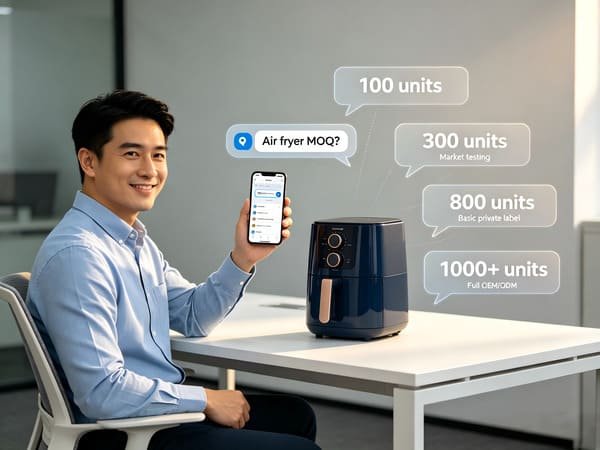
When I discuss new air fryer projects with buyers, I often find that MOQ is not really one question. It is several questions mixed together. Buyers want to know the minimum order. They also want to know the safest order size, the lowest-risk launch quantity, and the point where customization starts to make sense. On our production side, these are related, but they are not the same. That is why one supplier may quote 100 units and another may quote 1,000 units for what looks like the same product category.
What MOQ Range Is Typical for Stock, Private Label, and OEM Air Fryers from China?
A buyer may hear “low MOQ available” and think any air fryer can be ordered in very small quantities. That is where confusion starts.
For air fryers from China, the most common MOQ range is 100 to 1,000 units. Stock or sample orders can start at 1 to 10 units. Basic private label orders often start around 100 to 500 units. Full OEM or ODM air fryer projects usually start around 500 to 1,000 units or more, especially when the product structure, mold, packaging, plug, or certification setup changes.
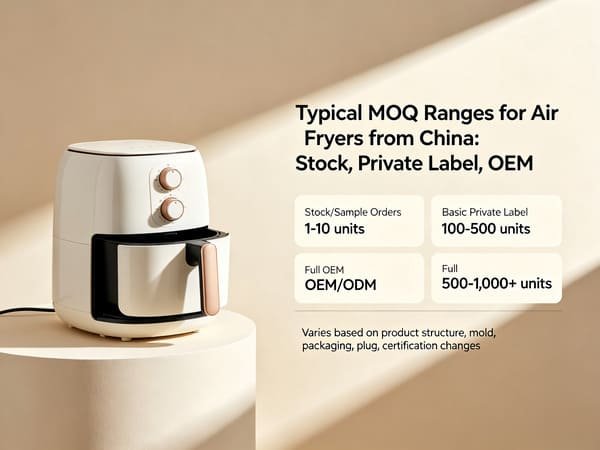
In our daily work, I split air fryer MOQ into three simple levels. The first level is stock or sample quantity. This is useful when a buyer wants to inspect quality, test cooking results, or send samples to the sales team. This quantity is small, but it is not a real production MOQ. The second level is light customization. This usually means a standard existing model with logo printing, color box adjustment, or a simple manual update. At this stage, many projects can start from 100, 200, 300, or 500 units. The third level is true OEM or ODM. This is where the buyer wants a different look, different control panel, special plug, custom accessories, or a version aimed at a specific market. Then the MOQ rises because more materials, more setup work, and more risk sit behind the order.
I usually tell buyers to think about MOQ by project type, not by category name alone. “Air fryer” is too broad. The real MOQ depends on whether the product is off-the-shelf, lightly branded, or deeply customized.
| Order type | Typical MOQ range | What it usually includes |
|---|---|---|
| Sample or stock order | 1–10 units | Testing, inspection, trial purchase |
| Market test order | 100–300 units | Standard model, low customization |
| Basic private label | 300–500 units | Logo, packaging, manual changes |
| OEM / ODM order | 500–1,000+ units | Deeper product, market, or compliance changes |
Why Do Air Fryer Suppliers in China Quote Different MOQs for the Same Product Category?
Many buyers assume one product category should have one normal MOQ. In reality, suppliers may be pricing very different projects under the same product name.
Air fryer suppliers in China quote different MOQs because they do not all start from the same base model, stock level, tooling situation, packaging method, supplier chain, or risk tolerance. One supplier may have ready parts and printed cartons in stock. Another may need to buy materials from zero. That alone can change the MOQ a lot.
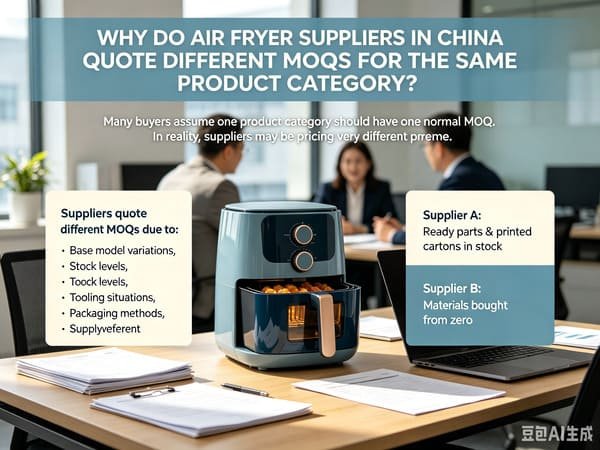
I see this all the time. A buyer sends one inquiry to five factories and gets very different MOQ replies. Then the buyer thinks some suppliers are not serious. Sometimes that is true. But many times the reason is more basic. Each factory starts from a different real condition.
One factory may already run a 5-liter air fryer on the line every month. That means the plastic housing, inner pot, heating parts, carton size, and supplier chain are already in place. For that factory, 200 units with a logo sticker may be workable. Another factory may produce mostly kettles and only handle air fryers through a partner line. That factory may quote 1,000 units because it has less control over flexible production. A third factory may accept 100 units, but then quietly raise the unit price, use plain packaging, or remove some accessory options.
The same thing happens with compliance and market versions. A supplier may have an EU version ready, but the U.S. plug version may require a different sourcing plan. So the MOQ is not just about “air fryer.” It is about the exact version of the air fryer you want to import.
| Reason for MOQ difference | How it affects the quote |
|---|---|
| Existing stock of parts | Can lower MOQ |
| Production line schedule | Can raise or lower MOQ |
| Packaging method | Custom cartons often raise MOQ |
| Market version | Plug, voltage, and labeling affect MOQ |
| Supplier risk policy | Conservative factories often quote higher MOQ |
How Packaging, Logo Printing, and Certifications Change the MOQ for Air Fryers
A buyer may think only the product matters. In fact, small changes outside the appliance itself often move the MOQ first.
Packaging, logo printing, manuals, labels, plug versions, and certification arrangements can all increase the MOQ for air fryers. A plain box with a sticker usually needs less quantity than a full custom color box. A simple logo print may add little. A new certification version or destination-market setup usually pushes the MOQ higher because it creates more cost and more production planning work.
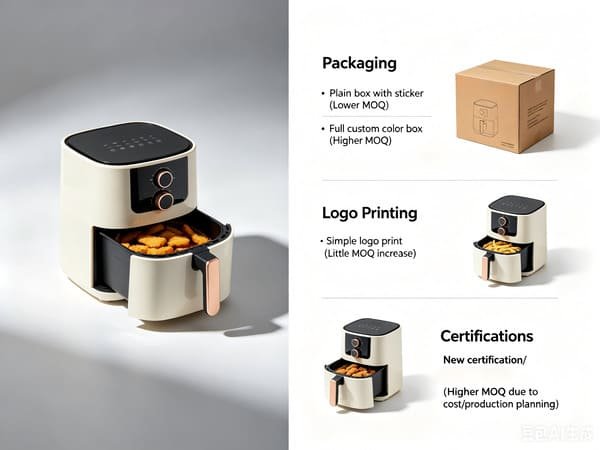
On our side, I often explain that the product body is only one part of the order. Many buyers say they want “just a simple private label air fryer,” but then the actual request includes a custom gift box, a new instruction booklet, a barcode label, a special plug, an insert card, and retail-ready packaging photos. None of these changes looks large by itself. Together, they move the project away from stock supply and toward organized custom production.
Packaging is often the first MOQ trigger. A custom carton supplier may not want to run only 100 boxes. Manual printing can create the same issue, especially if the manual has multiple languages or legal pages for a specific market. Logo printing can also change the MOQ if it requires a new printing method, metal badge, or mold insert instead of a simple silk print. Certifications can push the MOQ even further because the buyer may need a market-specific version with matching label details, voltage, plug, and technical file support.
So when I review MOQ with a buyer, I always ask what level of customization they really need for the first order. This helps us keep the project practical.
| Custom item | MOQ impact |
|---|---|
| Sticker logo | Low |
| Printed logo on housing | Low to medium |
| Custom color box | Medium |
| New manual and labels | Medium |
| New plug or market version | Medium to high |
| New certification setup | High |
When Does an Air Fryer MOQ Shift from Piece-Based to Container-Based Ordering?
At the beginning, buyers think in pieces. Later, serious import projects start to move in shipping terms.
An air fryer MOQ shifts from piece-based to container-based ordering when the buyer moves from trial quantities into repeat purchasing, mixed model planning, or freight optimization. At that stage, the key question is often not “What is the minimum number of pieces?” but “How can I fill space efficiently and keep landed cost under control?”
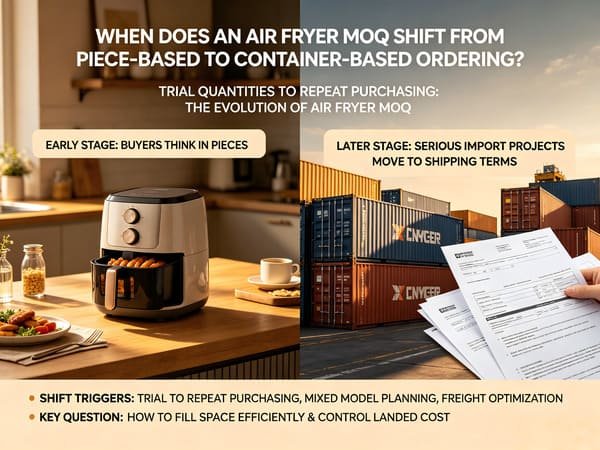
I usually see this shift after the first or second successful order. In the early stage, the buyer wants to test the market. A quantity like 200 or 300 units feels natural. It is easy to understand and easy to budget. But once the buyer starts thinking about reorder cycles, warehouse flow, and freight cost, the discussion changes. Then we start asking how many units fit in a 20-foot or 40-foot container, whether two models can be mixed, and whether the carton size can be optimized.
This is important because a low MOQ is not always the lowest-risk choice. A small order shipped inefficiently may have a high landed cost. That can hurt the margin more than a slightly bigger order. On the other hand, a bigger order only works if the buyer can sell through it in a healthy time frame. So I do not treat container thinking as something only large importers use. I think even mid-size buyers should understand the point where unit MOQ stops being the most useful number.
| Ordering stage | Main buying logic |
|---|---|
| First test order | Piece-based MOQ |
| Early repeat order | Piece-based with freight review |
| Stable reorder stage | Container planning starts |
| Mature import program | Container-based cost control |
How Importers Can Negotiate a Lower MOQ Without Increasing Unit Cost Risk
Many buyers ask for a lower MOQ first. That is normal. The better question is how to lower MOQ without making the deal worse in hidden ways.
Importers can negotiate a lower air fryer MOQ by reducing early customization, using existing molds, accepting standard packaging, combining models or colors, placing a trial order with reorder terms, or sharing setup costs in a clear way. The goal is not only to lower the quantity. The goal is to lower quantity without pushing unit cost, quality risk, or delivery risk too high.
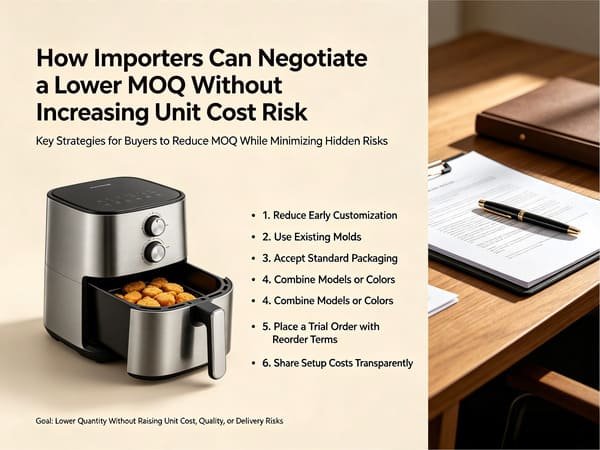
When I help buyers reduce MOQ, I start with the parts of the project that create the least value in the first order. For example, a buyer may not need a fully custom carton for the first market test. A standard box with a branded label may be enough. Or the buyer may launch one color first instead of three. Or we may use an existing heating system and focus only on branding and positioning. These choices can cut risk without making the final product weak.
I also think clear reorder planning helps a lot. If a buyer can explain the first-order test plan and likely reorder timing, a supplier is often more open to a flexible MOQ. That is because the factory sees a path to repeat business instead of a one-time small order. Mixed ordering can help too. Sometimes a buyer can combine two products or two models to reach a material threshold more efficiently.
Good MOQ negotiation is practical. It is not about forcing the lowest number. It is about building a first order that both sides can execute well.
| Negotiation method | Why it works |
|---|---|
| Use existing model | Cuts development risk |
| Reduce packaging complexity | Lowers print and material limits |
| Start with one color | Simplifies production |
| Share setup charges clearly | Keeps MOQ lower without hidden confusion |
| Present reorder plan | Gives factory more confidence |
What Hidden Cost Trade-Offs Buyers Should Check Before Accepting a Low Air Fryer MOQ
A very low MOQ can look attractive in the quote sheet. Then the buyer finds the real cost later in other places.
Before accepting a low air fryer MOQ, buyers should check for hidden trade-offs such as higher unit price, plain packaging, weaker accessory sets, higher sample charges, split shipment cost, slower lead time priority, or reduced flexibility on after-sales support. A low MOQ is only good if the full landed cost and project quality still make sense.
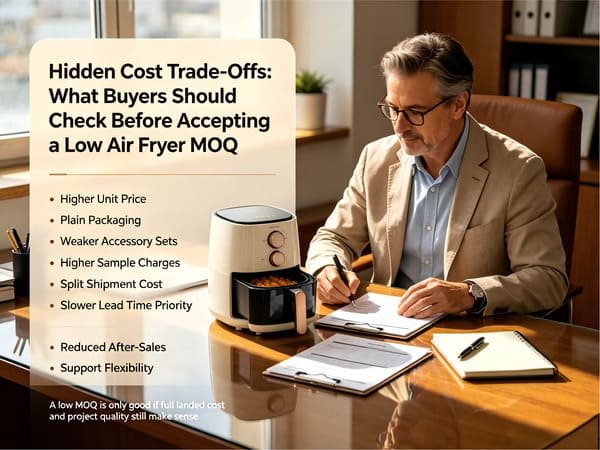
I have seen buyers celebrate a 100-unit MOQ and then lose the benefit through higher unit pricing or extra handling charges. This happens because the factory still needs to recover setup cost, labor planning, and material waste. If it cannot recover that through volume, it may recover it somewhere else. That is not always wrong. But the buyer should see it clearly before deciding.
I always tell buyers to review MOQ together with five other points: unit price, packaging level, lead time, defect handling, and freight plan. A low MOQ with weak carton protection can create claim costs later. A low MOQ with a delayed line slot can cause stock problems. A low MOQ with high freight cost can kill margin. So the real question is not “Can I buy fewer air fryers?” The real question is “Can I still make a healthy business case at that lower volume?”
This is why I prefer simple first orders with clear cost structure. A realistic MOQ usually performs better than an artificially low MOQ with hidden compromises.
| Hidden trade-off | Risk to the buyer |
|---|---|
| Higher unit price | Lower margin |
| Basic packaging only | More damage risk |
| Longer lead time | Slower launch |
| Limited accessory options | Lower market appeal |
| Higher freight per unit | Higher landed cost |
| Less service flexibility | More after-sales pressure |
Conclusion
The MOQ for air fryers from China is not one fixed number. In real sourcing, it depends on how far you move from stock supply into true private label and OEM work.
FAQ
What is the normal MOQ for private label air fryers from China?
For private label air fryers, I usually see a practical MOQ around 300 to 500 units. Some standard air fryer models can start lower, but that depends on logo method, packaging, and whether the factory already produces that air fryer version.
Can I buy only 100 air fryers from China for a first order?
Yes, sometimes. A 100-unit air fryer order is possible for market testing if you choose a standard model and keep customization light. For a deeper air fryer OEM project, 100 units is usually too low for efficient production.
Why is the MOQ for one air fryer supplier 200 units and another 1,000 units?
Air fryer MOQ changes based on stock parts, production planning, customization level, and packaging setup. One factory may already run that air fryer model. Another may need to build the air fryer project from zero, so the MOQ goes up.
Do custom packaging and logo printing increase air fryer MOQ?
Yes. Custom packaging, printed housing logos, manuals, and labels can all increase air fryer MOQ because they create separate print runs, material planning, and setup work. The more custom your air fryer project becomes, the higher the MOQ usually goes.
Is a lower air fryer MOQ always better for importers?
Not always. A lower air fryer MOQ can come with higher unit cost, weaker packaging, and less efficient freight. I always review the full landed cost before I treat a low air fryer MOQ as a real advantage.
What MOQ should I expect for a custom OEM air fryer from China?
For a custom OEM air fryer, I think 500 to 1,000+ units is a realistic starting point in many cases. If the air fryer includes custom housing, packaging, plug version, or market-specific compliance setup, the MOQ can move even higher.