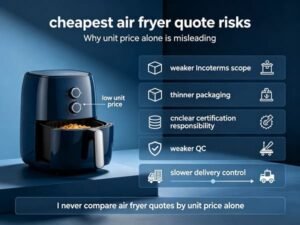
Many new brands rush into customization too early. Then they lose time, spend too much, and find out the real problem was never product creativity. It was getting a stable launch system working first.
For most new brands, launching an air fryer brand from China works best when I start with a mature ODM model instead of jumping straight into full OEM development. That path usually gives faster launch speed, lower upfront cost, lower risk, and a better chance to get a compliant, market-ready product selling before I invest in deeper customization.
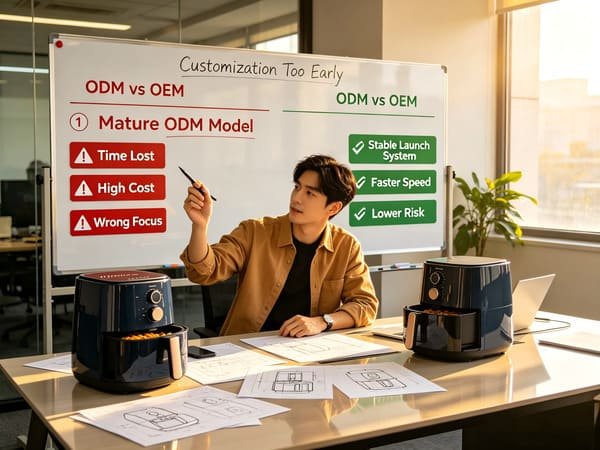
When I look at a new air fryer brand launch, I do not start with the question, “How custom can this product become?” I start with a simpler question: “How fast can I get a product that can sell steadily without creating avoidable supply-chain problems?” That change in thinking matters a lot. A brand launch is not only a product project. It is a system project. The first shipment tests the product, the supplier, the packaging, the compliance documents, the QC process, and the shipping flow at the same time. That is why my most practical rule is simple: first make the chain work well enough to sell steadily, then make the product more unique later.
Should You Start Your Air Fryer Brand with ODM, OEM, or Simple Private Labeling from China?
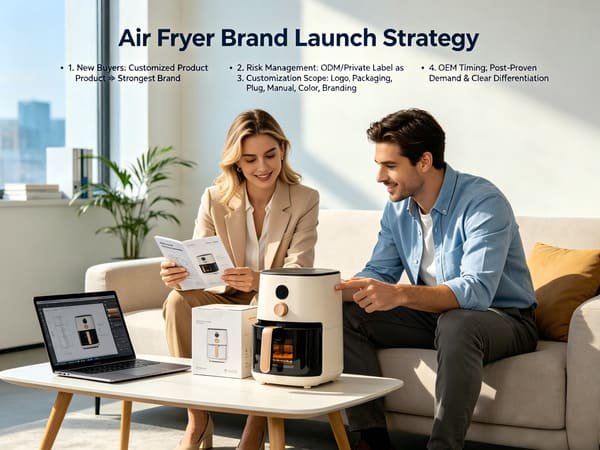
Many new buyers assume the strongest brand starts with the most customized product. In practice, that often creates too much risk too early.
For most new air fryer brands, ODM or simple private labeling is the better starting point. I usually choose an existing mature model, then customize the logo, packaging, plug type, manual, color, and branding details. Full OEM usually fits later, after demand is proven and the brand has a clearer reason to invest in deeper product differentiation.
I think this choice becomes much easier when I match it to business stage. If I am launching a new brand, I usually need speed, manageable cost, and a lower-risk learning cycle. ODM helps with that because the factory already has the product platform, the tooling, and usually a more mature production process.1 I can focus on getting the commercial basics right. That means the right model, the right target channel, the right packaging, and the right compliance path.
OEM is more powerful in one way, but also heavier in every other way.2 It usually asks for more budget, more development time, more sample rounds, and more project management. That makes sense only when I already know enough about my customers and my sales path to justify the extra burden. So if my real challenge is getting to market, ODM usually fits better. If my real challenge is becoming harder to copy after I already have traction, then OEM starts to make more sense.
| Launch path | Best fit for | Main benefit |
|---|---|---|
| Simple private label | Fast test launch | Lowest complexity |
| ODM | New brands and first launches | Faster and safer market entry |
| OEM | More mature brands | Stronger differentiation later |
How to Shortlist a China Air Fryer Manufacturer for Your Brand Launch
A beautiful product photo and a low quote do not tell me whether a supplier can actually support a smooth launch.
To shortlist a China air fryer manufacturer, I first standardize my RFQ, then compare factories on existing model maturity, customization scope, quoting clarity, production credibility, payment identity, willingness to support inspection, and certification readiness for my target market. I do not shortlist based on price alone.
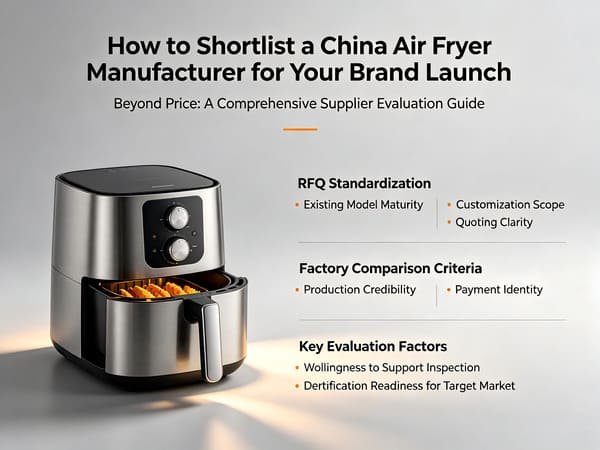
When I shortlist suppliers, I want the process to stay controlled. I do not ask different factories to quote different versions of the product. I use one RFQ template so each supplier is pricing the same capacity, voltage, plug, wattage, controls, basket type, coating, packaging level, certification target, MOQ, and Incoterm. This is where many launch mistakes start. If the product and quote basis are not normalized, the supplier comparison becomes noise.3
Then I look beyond the unit price. Does the factory have mature air fryer models already in production? Can it show clear packaging options and manual control? Does it understand how to support North American compliance?4 Is the legal seller identity and payment identity clear? A supplier that answers these points well often gives me more confidence than a supplier that only sends a very low number.
| Shortlist check | What I want to see |
|---|---|
| Existing air fryer platform | Proven, stable models |
| RFQ response quality | Clear and comparable answers |
| Customization scope | Realistic, not vague promises |
| Factory credibility | Production proof and organized communication |
| Payment identity | Clear legal seller and bank path |
| Compliance readiness | Match to target market |
What MOQ, Sample Cost, and Customization Scope Should You Confirm Before Launching a Private Label Air Fryer?
A supplier may sound flexible in early messages. Real flexibility only becomes useful when the project boundaries are clear.
Before I launch a private label air fryer, I confirm the MOQ for the exact customization level, the sample fee and whether it is credited later, the sample lead time, and the exact scope of changes that fit the supplier’s existing platform. I want to know where simple private label ends and deeper OEM work begins.
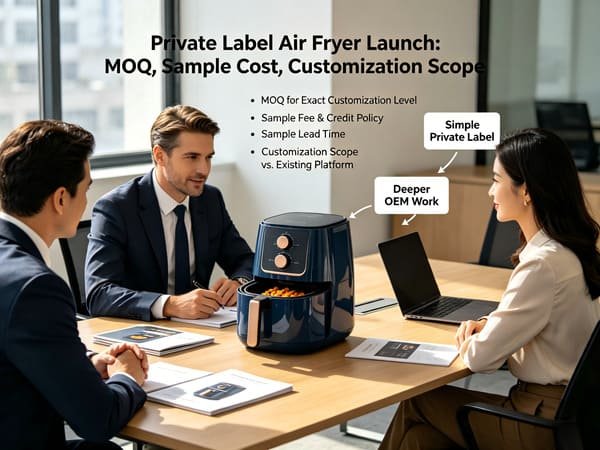
This step matters because MOQ is not only a quantity number5. It is a project-definition number. One MOQ may apply to a stock model. Another may apply to logo and carton changes. A much higher one may apply to structural changes, custom controls, or a market-specific version. I always want those layers separated.
Sample terms matter for the same reason. A sample can look expensive compared with the bulk price6, but that is normal if it requires special handling, special packaging, or custom plug preparation. What matters more is whether the supplier explains the sample logic clearly and whether the sample fee is credited back after the first production order.
Customization scope is where I want suppliers to be honest. The best suppliers usually say, “These are the changes we can do inside our current platform, and these are the changes that would move the project into a different cost and timing model.” That honesty protects the launch far more than a broad promise.
| Point to confirm | Why it matters |
|---|---|
| MOQ by project type | Shows the real launch threshold |
| Sample fee | Reveals the entry cost |
| Sample credit rule | Changes first-order economics |
| Sample timing | Affects launch schedule |
| Allowed customization | Prevents later disputes |
| OEM boundary | Stops scope confusion |
Which Certifications and Compliance Requirements Must Your Air Fryer Brand Meet in the Target Market?
A good air fryer sample does not help much if it cannot enter the target market cleanly.
The certifications and compliance requirements depend on where I plan to sell, but for North America I need a credible path to recognized product certification, correct labeling, and model-level market scope. I do not ask only whether the supplier has a mark. I ask whether the exact model, label, and market version can be verified and supported for the destination market.
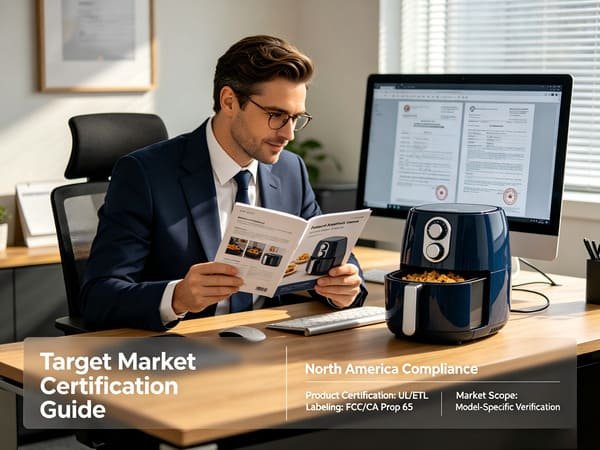
For North America, this is one of the most important supplier checks in the whole launch process. A certification mark is useful only if it belongs to the right certifier, the right model, and the right market scope. I want the supplier to support that path with clear records, not casual statements. I also want the factory to understand that compliance is not just about testing once7. It is also about label control, model consistency, and keeping production aligned with the approved version.
That is why I treat certification capability as part of manufacturing capability8. A supplier that can explain the compliance path clearly is usually safer to launch with than a supplier that only says the product is “ready” for the market.
| Compliance point | What I verify |
|---|---|
| Target market | U.S., Canada, EU, or other |
| Exact model coverage | Must match the product I launch |
| Label control | Must fit the approved market version |
| Certification path | Must be clear and verifiable |
| Ongoing consistency | Must survive mass production |
How to Develop Air Fryer Packaging, Logo, Manual, and Branding Without Slowing Down Production
Branding can help the launch. Poorly managed branding can also become the main reason the launch slows down.
To develop air fryer packaging and branding without slowing production, I freeze the branding scope early, use one approved artwork workflow, and tie every brand element to the same production file set. That means the logo method, gift box artwork, manual, rating label, barcode, plug version, and warning language must all be approved before mass production starts.
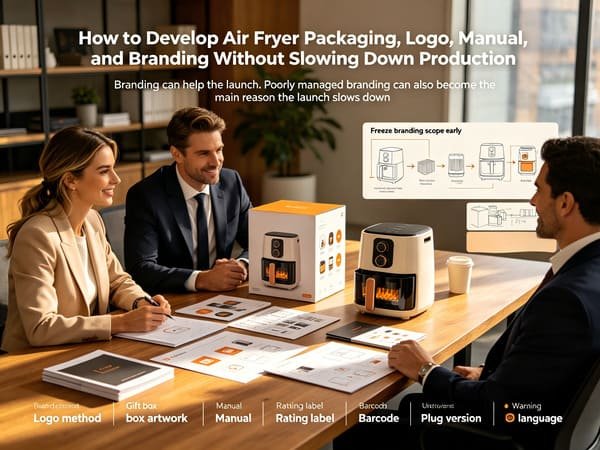
I think the best branding process is a controlled one, not a creative one that stays open too long. The earlier I decide which logo method I want, which packaging level I need, and which manual version fits the market, the less likely I am to create production delay later.9 This is why I prefer to use one approval flow for all artwork. It keeps the factory, the buyer, and the packaging supplier aligned.
I also like to keep the first launch practical. A simple but clean private-label package usually works better than trying to redesign everything in the first order.10 The goal of the first run is to get a branded, compliant, sellable product out smoothly. Once that system is stable, I can make the next version more ambitious.
| Branding item | Why I lock it early |
|---|---|
| Logo method | Prevents appearance surprises |
| Gift box artwork | Prevents carton delay |
| Manual version | Prevents market mismatch |
| Rating label | Prevents compliance issues |
| Barcode and stickers | Prevents warehouse and channel problems |
| Plug version | Prevents wrong-market production |
How to Move from Sample Approval to Mass Production, QC, and Shipment for Your Air Fryer Brand
A passed sample is not the end of launch work. It is the point where I turn a promising idea into a controlled production order.
After the sample passes, I convert every approved detail into production documents, then lock the contract, deposit terms, inspection criteria, shipment deadline, and balance-payment conditions before mass production starts. I treat the first shipment as a system test, not just a product delivery.
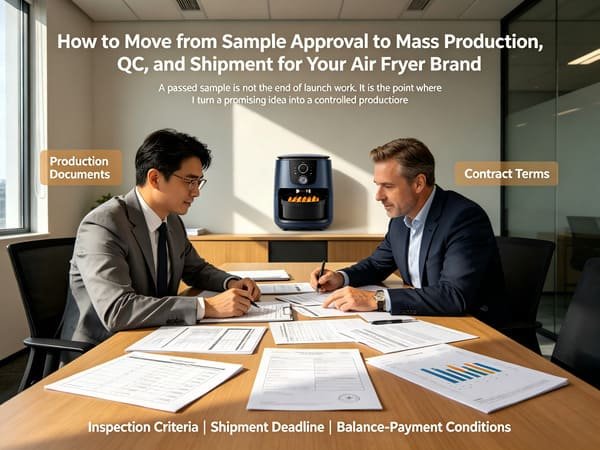
This is one of the most important parts of the launch. I do not want the factory producing from memory or from chat history. I want a written production package. That means the specification sheet, golden sample, packaging files, label files, manual, plug version, inspection standard, and shipping terms should all be frozen in the order documents.
Then I move to control. I confirm the lead time basis, the inspection stage, the shipping deadline, and the balance-payment trigger. I also make sure the supplier supports inspection and does not resist product verification before shipment11. The first order is not only about selling product. It is also about testing whether this supplier can become a long-term part of the brand’s supply chain.
| Launch step | What I lock down |
|---|---|
| Sample approval | Golden sample and spec confirmation |
| Contract stage | Product, packaging, Incoterm, timing |
| Production stage | Lead time, QC checkpoints, labeling control |
| Pre-shipment stage | Inspection standard and shipment release terms |
| First shipment | Real test of supplier reliability |
Conclusion
The strongest air fryer brand launch is usually not the most customized one. It is the one that gets a compliant, stable, sellable product into the market first, then builds deeper differentiation on top of a working supply chain.
FAQ
Should I launch my air fryer brand with ODM or OEM from China?
For most new brands, I would start with ODM. An ODM air fryer launch from China is usually faster, lower risk, and easier to manage than a full OEM air fryer project. OEM makes more sense after the brand already has proven demand and a clearer product strategy.
What should I confirm before choosing a China air fryer manufacturer for my brand?
I confirm the air fryer manufacturer’s existing models, MOQ, sample terms, customization scope, payment identity, inspection support, and certification path for my target market. A low quote matters less than a factory that can launch the air fryer brand cleanly and reliably.
Why is sample approval not enough before mass production of a private label air fryer?
Because the private label air fryer sample must be converted into production records. I want the golden sample, specification sheet, packaging artwork, label, manual, plug version, and inspection standard all written into the production file before the bulk air fryer order starts.
Which certification issue matters most when launching an air fryer brand in North America?
The most important point is that the air fryer certification must match the exact model and market scope. I do not rely on a logo alone. I verify that the air fryer certification path is real, current, and tied to the correct U.S., Canada, or dual-market version.
How can I avoid slowing down my air fryer launch with too much customization?
I keep the first air fryer launch practical. I lock the logo, packaging, manual, label, and plug version early, and I avoid deep OEM changes until the supply chain is already working well. That keeps the air fryer branding process from delaying production.
What is the best mindset for a first air fryer brand launch from China?
My best rule is simple: first make the air fryer supply chain stable enough to sell steadily, then make the product more unique later. A working air fryer launch system creates more value than early customization that slows everything down.
-
"OEM vs ODM: What’s the Difference in Hardware Manufacturing?", https://www.seacomp.com/resources/oem-vs-odm-manufacturing. This source explains how ODM manufacturers typically provide pre-existing product platforms, tooling, and established production processes, which can reduce time-to-market and initial costs. Evidence role: mechanism; source type: education. Supports: ODM manufacturers already have product platforms, tooling, and mature production processes, which facilitate faster and safer market entry.. ↩
-
"Why Is Project Management Important? – Purdue University", https://www.purdue.edu/projectmanagementcertification/news/why-is-project-management-important/. This source discusses the trade-offs of OEM manufacturing, including its higher costs, longer development times, and greater project management requirements, which align with the claim. Evidence role: general_support; source type: research. Supports: OEM manufacturing involves higher costs, longer development times, and more intensive project management compared to ODM.. Scope note: The source may not address all industries or product types, so the claim’s applicability could vary. ↩
-
"RFQ Process Explained: Steps, Examples, and Best Practices", https://simfoni.com/rfq-process/. Normalizing product specifications in RFQs ensures comparability across suppliers, as supported by procurement best practices. Evidence role: expert_consensus; source type: education. Supports: Normalizing product and quote basis is essential for meaningful supplier comparison.. ↩
-
"[PDF] Administrative Interpretation 17-8, Portable Cooking Appliances – ORS", https://ors.od.nih.gov/ser/dfm/Documents/Interp%2017-8%20Portable%20Cooking%20Appliances.pdf. North American compliance for consumer electronics often involves meeting standards like UL certification and FCC regulations. Evidence role: definition; source type: government. Supports: Suppliers need to understand North American compliance requirements for consumer electronics.. Scope note: The source may focus on specific compliance standards rather than general supplier readiness. ↩
-
"Minimum Order Quantity (MOQ): Formula, Tips, & Benefits | NetSuite", https://www.netsuite.com/portal/resource/articles/inventory-management/minimum-order-quantity-moq.shtml. This source explains how MOQ can vary based on project requirements, such as stock models, customizations, and market-specific versions. Evidence role: definition; source type: education. Supports: MOQ is not only a quantity number but also a project-definition number, varying by factors like stock models, logo changes, and structural customizations.. ↩
-
"Why Are Clothing Samples So Much More Expensive Than Bulk …", https://mmsclothing.com/why-are-clothing-samples-so-much-more-expensive-than-bulk-orders-%F0%9F%A7%90%F0%9F%91%97/. This source discusses why sample costs are often higher than bulk prices due to factors like special handling and custom preparation. Evidence role: mechanism; source type: education. Supports: A sample can appear expensive compared to bulk pricing because of special handling, packaging, or custom preparation requirements.. ↩
-
"Corporate Compliance and Its Impact on Businesses", https://online.law.pitt.edu/blog/impacts-of-corporate-compliance-programs. This source discusses the importance of ongoing compliance measures, including label control and production consistency, in maintaining certification standards. Evidence role: expert_consensus; source type: research. Supports: Compliance involves ongoing measures beyond initial testing, such as label control and production consistency.. ↩
-
"Smart Manufacturing & Digital Integration – Ivy Tech Community …", https://www.ivytech.edu/programs/all-academic-programs/school-of-advanced-manufacturing-engineering-applied-science/smart-manufacturing-digital-integration/. This source explains how certification capability is integrated into manufacturing processes, emphasizing its role in ensuring product compliance and market readiness. Evidence role: mechanism; source type: education. Supports: Certification capability is an integral part of manufacturing capability, ensuring compliance and market readiness.. ↩
-
"Impact of Perceived Product Value on Customer-Based Brand Equity", https://pmc.ncbi.nlm.nih.gov/articles/PMC9280421/. This source supports the claim that early decisions in branding elements like logo, packaging, and manuals can reduce production delays by ensuring alignment across stakeholders. Evidence role: mechanism; source type: research. Supports: The earlier decisions are made about branding elements, the less likely production delays will occur.. Scope note: The source may not address all branding elements or industries. ↩
-
"When Less Is More: The Power of Simple Packaging for …", https://www.ama.org/2023/09/26/when-less-is-more-the-power-of-simple-packaging-for-consumable-products/. This source supports the claim that simple and clean private-label packaging is often more effective for initial product launches, based on industry practices and consumer behavior. Evidence role: expert_consensus; source type: education. Supports: Simple private-label packaging is generally more effective for initial product launches than complex redesigns.. Scope note: The effectiveness of simple packaging may vary depending on the product category and target market. ↩
-
"Risk factors in the assessment of suppliers – PMC – NIH", https://pmc.ncbi.nlm.nih.gov/articles/PMC9342744/. This source confirms the importance of supplier cooperation in pre-shipment inspections to ensure product quality and compliance. Evidence role: expert_consensus; source type: education. Supports: The supplier should support inspection and not resist product verification before shipment to ensure quality control.. ↩