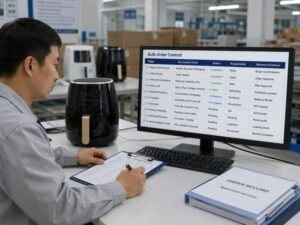
A safer OEM appliance brand in an emerging market starts with product-market fit, controlled customization, realistic cash-flow planning, local packaging, verified market configuration, consistent production, after-sales readiness, and repeat-order discipline before deeper OEM or ODM investment.
Problem: Appliance importers in emerging markets often see OEM branding as a way to improve margin, build channel loyalty, and reduce dependence on generic products.
Agitation: If branding starts too early or goes too deep, the project can create hidden pressure: slow-moving inventory, unsuitable SKUs, packaging mistakes, unclear warranty promises, weak after-sales support, certificate-scope issues, and unstable repeat orders.
Solution: Treat OEM brand building as a staged procurement and risk-control system. A private label appliance brand should begin with a stable product, clear market fit, light customization, local trust materials, verified configuration, controlled pilot orders, and repeat-order feedback before deeper OEM or ODM development.
Snippet: OEM appliance brand building in emerging markets should be evaluated through product-market fit, pilot SKU strategy, local packaging, cash-flow risk, certificate-scope verification, production consistency, after-sales readiness, and repeat-order scaling before deeper customization.
Building an OEM appliance brand in an emerging market is not only a marketing decision. It is also a sourcing, production, cash-flow, channel, and after-sales decision. A brand name on the box can create value only when the product, packaging, service promise, and supply chain can support that promise repeatedly.
In our daily work with appliance importers, many early conversations begin with logo, color, or packaging ideas. Those details matter, but the strongest projects usually begin one step earlier: Which product can the local channel actually sell? Which price band can the market accept? Which appliance can be serviced after shipment? Which SKU deserves repeat orders?
This guide looks at OEM brand building from a factory and supplier-side perspective. It does not promise sales, profit, compliance, delivery, or brand success. Instead, it explains how appliance importers can reduce avoidable risk before moving from generic sourcing into private label, OEM, or ODM brand development.
Why is OEM brand building different in emerging appliance markets?
Emerging appliance markets often require stronger value-for-money, channel trust, simple functions, local-language support, spare parts planning, stable supply, and practical after-sales before deeper brand investment can work.
In many emerging markets, appliance buyers are careful with household spending. Retailers and distributors may also be cautious when recommending a new brand. A product must often prove that it is affordable, useful, easy to explain, reasonably durable, and serviceable after purchase.
A private label brand in this context should not copy every strategy from mature markets. Premium design, complex smart features, and heavy advertising may work later, but early-stage brand trust often comes from simpler things: stable quality, clear packaging, easy manuals, visible warranty terms, and reliable supply.
Emerging market brand reality
| Mature market focus | Emerging market priority |
|---|---|
| Premium design | Reliable basic performance |
| Smart ecosystem | Easy-to-understand functions |
| Lifestyle branding | Clear product benefit |
| High-end packaging | Trustworthy retail presentation |
| Rapid product innovation | Stable SKU and repeat supply |
| Large advertising budget | Distributor and retailer confidence |
| Feature complexity | Simple use and easier after-sales |
| Brand story | Product consistency and warranty clarity |
From what we see in customer communication, a new appliance brand often wins the first channel opportunity through price and appearance, but it earns the second order through fewer complaints, stable packaging, and reliable after-sales handling.
Is OEM appliance brand building more than logo and packaging?
OEM appliance brand building includes product fit, price positioning, local configuration, packaging, manuals, warranty cards, spare parts, batch consistency, complaint feedback, and repeat-order planning, not only logo printing.
Logo and packaging help a product look branded, but they do not automatically create a brand. In appliances, the brand promise is tested after the sale: during product use, when problems appear, when spare parts are needed, and when a retailer decides whether to reorder.
In our production and order follow-up work, logo printing is rarely the most difficult part. More risk often appears in product selection, plug and voltage confirmation, packaging file control, manual language, warranty expectations, spare parts preparation, and batch consistency.
OEM brand building layers
| Brand layer | What it controls |
|---|---|
| Product selection | Whether the appliance fits local use and channel needs |
| Price positioning | Whether the brand can compete without destroying margin |
| Local configuration | Plug, voltage, frequency, rating label, and market fit |
| Visual identity | Logo, color, packaging style, and product appearance |
| Local trust materials | Manual, warranty card, icons, labels, after-sales contact |
| Quality consistency | Sample-to-bulk match and repeat-batch stability |
| After-sales planning | Spare parts, repair logic, complaint feedback |
| Repeat SKU strategy | Whether the same model can support future orders |
A stronger OEM brand discussion should move from “Can this logo be printed?” to “Can this product, package, service promise, and supply chain support a real brand in the target market?”
Should an appliance importer build a brand now or stay with wholesale trading first?
Brand building becomes safer when channel access, price band, product category, cash flow, after-sales support, and supplier coordination are already clear; otherwise, wholesale trading or light private label may reduce early risk.
Not every importer needs to create a full private label brand immediately. Standard wholesale or light private label can be a better first step when the target market is still being tested.
A brand increases responsibility. It may improve long-term value, but it also brings inventory commitment, packaging version control, warranty expectations, and channel trust pressure. If the sales channel is not yet clear, too much branding can lock money into the wrong SKU.
OEM brand readiness scorecard
| Readiness area | Ready signal | Risk signal |
|---|---|---|
| Channel access | Existing distributors, retailers, or online channels | Only a general market idea |
| Product category | Clear appliance type and price band | Searching only for “hot products” |
| Price positioning | Target retail price and margin logic are known | FOB price is the only focus |
| Cash flow | Trial order and inventory cycle are manageable | Budget only supports lowest unit price |
| Brand role | Brand purpose is clear | Logo is the only brand plan |
| After-sales ability | Spare parts and complaint process are planned | No warranty or repair thinking |
| Supplier support | Samples, packaging, documents, and repeat orders can be supported | Only catalog and quotation are offered |
| Repeat logic | Reorder criteria are defined | First order is treated as a one-time test |
During communication with customers, a practical question often helps: Is the first goal to test demand, build channel trust, or create a long-term brand line? Each goal needs a different order structure.
How can importers check product-market fit before choosing OEM appliances?
Product-market fit can be checked through local purchasing power, retail price band, channel type, plug and voltage match, function simplicity, repairability, packaging appeal, spare parts access, and repeat-order potential.
A product should not be selected only because it looks modern or has a good factory price. The first branded appliance should fit local use habits, local power conditions, retail expectations, and after-sales capacity.
For example, a complex digital appliance may look attractive in a catalog, but it may create more complaints if local customers prefer simple controls or if repair support is limited. A simpler model with stable quality may sometimes build trust faster than a more advanced model with higher service risk.
Product-market fit checklist
| Product question | Why it matters |
|---|---|
| Does the product fit local purchasing power? | Price band affects sell-through and inventory risk |
| Does the channel understand the product? | Retailers and distributors need clear selling points |
| Is the function easy to explain? | Complex functions can increase return and complaint risk |
| Does the appliance match local plug and voltage? | Wrong configuration can block sales or use |
| Is the product easy to service? | Repairability affects after-sales cost |
| Are spare parts available? | Spare parts reduce full-unit replacement pressure |
| Is packaging suitable for the channel? | Retail shelf and e-commerce needs may differ |
| Can the same SKU be repeated? | A brand needs continuity, not random one-time products |
In real OEM appliance projects, product-market fit should be discussed before packaging design. A good logo cannot rescue a product that is too expensive, too fragile, too hard to explain, or too difficult to service in the target market.
Which path fits better: standard model, private label, OEM, or ODM?
The best path depends on launch speed, customization depth, budget pressure, technical complexity, sample time, market proof, differentiation need, and ability to control production risk.
Standard models, private label, OEM, and ODM are not levels of quality. They are different project paths. The right choice depends on how much market proof already exists and how much customization risk the importer can manage.
From the supplier side, many projects described as “OEM” are actually private label projects: an existing model, logo, gift box, manual, rating label, and carton mark. This is often a practical starting point for emerging markets because it reduces development risk.
Project path comparison
| Path | Best for | Main risk to verify |
|---|---|---|
| Standard model | Market testing and fast launch | Weak differentiation and price competition |
| Private label | Brand launch with existing product structure | Packaging, logo, label, manual, MOQ, and channel fit |
| OEM | Deeper configuration or brand-specific changes | Sample lock, cost change, certificate scope, production control |
| ODM | New design or stronger differentiation | Tooling, engineering, testing, longer timeline, higher risk |
Practical path logic
| Situation | Safer direction |
|---|---|
| Market is not yet proven | Standard model or light private label |
| Channel wants brand identity | Private label with controlled customization |
| Product needs specific local configuration | OEM discussion with clear technical files |
| Strong differentiation is already justified | ODM may be considered after market proof |
| Cash flow is tight | Avoid deep customization at the first stage |
A new brand does not need the deepest customization on the first order. In many cases, the safer path is to prove one product, repeat it, improve it, and then increase customization gradually.
How should the first pilot SKU be selected for an emerging market?
A first pilot SKU should be stable, easy to explain, serviceable, locally configured, price-fit for the channel, packaging-ready, and suitable for repeat orders before broader customization.
The first branded SKU should not carry too many experiments at once. Too many colors, too many models, too many packaging versions, or too much structural customization can make the first order harder to control.
In our daily work, first-order problems often come from overloading the project. A customer may want several models, multiple colors, custom packaging, new features, and a tight budget at the same time. Each item may be reasonable alone, but together they increase sampling, production, inspection, inventory, and after-sales pressure.
Pilot SKU strategy
| Stage | Recommended logic |
|---|---|
| First trial | Select a stable model with light private label customization |
| First feedback | Track channel response, complaints, and price acceptance |
| Repeat SKU | Keep models that sell steadily and create fewer problems |
| Controlled upgrade | Add color, packaging improvement, feature change, or new SKU gradually |
| Brand line building | Form a product family only after repeat demand appears |
| Deeper OEM / ODM | Consider stronger customization after real market proof |
First pilot SKU filter
| Filter | Safer signal |
|---|---|
| Product stability | Existing model with production history |
| Local fit | Correct plug, voltage, frequency, language, and label plan |
| Price band | Matches target retail and distributor margin logic |
| Serviceability | Spare parts and repair logic are realistic |
| Packaging | Gift box and carton can support the channel |
| Repeat potential | SKU can become a stable reorder item |
| Customization depth | Light enough to control first-order risk |
The first pilot SKU should answer one main question: Can this product support the beginning of a brand without creating too much operational risk?
What cost and cash-flow risks appear when building an OEM appliance brand?
OEM brand cost includes more than unit price: packaging, samples, testing, spare parts, inventory, slow-moving stock, warranty replacement, channel credit, and repeat-order timing can affect cash flow.
A private label brand often requires more upfront decisions than generic sourcing. Packaging files, logo application, manuals, rating labels, warranty cards, and spare parts all add coordination work. Some items may not look expensive alone, but together they affect cash flow and order flexibility.
From what we see in order planning, the most dangerous cost is not always the visible OEM charge. Slow-moving branded inventory can be harder to resell than generic inventory. A wrong SKU under a private label may lock capital longer and reduce room for the next order.
Brand cost and cash-flow risk map
| Cost item | Hidden risk |
|---|---|
| OEM packaging | Printing MOQ and version-change cost |
| Custom color | Material preparation and minimum order pressure |
| Samples | Multiple rounds may be needed before approval |
| Certificate-scope checking | Documents may need review by model and market |
| Spare parts | Ties up cash but supports after-sales |
| Slow-moving inventory | Branded goods may be harder to redirect |
| Warranty replacement | Reduces real margin after shipment |
| Channel credit terms | Extends cash recovery cycle |
| Reorder delay | Weakens channel confidence |
| Packaging mistakes | Rework, delay, or discount risk |
Unit price is not enough
A low unit price can look attractive during quotation, but brand building should be judged by total cost of risk. That includes product quality, packaging strength, complaint handling, replacement cost, and ability to reorder the same SKU.
A healthier first order should protect both margin and learning speed. It should generate useful market feedback without placing too much capital into unproven customization.
How should packaging, manuals, warranty cards, and local language be prepared?
Local trust materials should make product use, safety, warranty, service contact, model information, and sales messages clear for the target market before packaging printing and mass production.
Packaging is not only a visual design task. For an emerging market appliance brand, packaging, manuals, labels, warranty cards, and service information help the retailer explain the product and help the consumer trust it.
In our experience, packaging problems often appear late because the design looks finished, but technical and local details are not locked. A box may miss the correct model, barcode, rating information, local language, warranty statement, or product image. These details can affect retail acceptance and customer trust.
Local trust package
| Trust element | What to prepare |
|---|---|
| Local language manual | Clear use, care, and safety instructions |
| Warranty card | Practical warranty terms and service contact |
| Rating label | Model, electrical information, and traceability |
| Packaging icons | Easy-to-understand product benefits |
| Product photos | Consistent online and retail presentation |
| Barcode | Retail and warehouse system support |
| Carton mark | Logistics and inventory control |
| After-sales contact | Clear route for service questions |
| Distributor training sheet | Simple points for channel sales teams |
Packaging approval flow
| Step | What to check |
|---|---|
| Logo and brand name | Correct file, size, color, and position |
| Gift box layout | Product image, feature claims, language, icons |
| Manual | Correct model, safe use, cleaning, warranty logic |
| Rating label | Electrical details and model consistency |
| Barcode | Number, size, placement, scannability |
| Warranty card | Service rules and contact method |
| Carton mark | Model, quantity, handling, warehouse details |
| Final artwork lock | Approved version before mass printing |
A strong brand package should reduce confusion. It should help the distributor sell, help the consumer use the product correctly, and help the after-sales team handle questions.
How should compliance, plug, voltage, and certificate scope be verified?
Market configuration should be checked by exact model, plug, voltage, frequency, rating label, sales channel, target country, test report scope, certificate holder, and current document status.
Compliance and configuration cannot be confirmed by a certificate name alone. Appliance requirements may depend on product type, model, voltage, plug, market, channel, and current document status. These details should be verified before payment and mass production.
From a supplier perspective, certificate questions should be specific. “Do you have certification?” is less useful than asking whether the document scope matches the exact model, target country, plug, voltage, rating label, and ordered configuration.
Market configuration checklist
| Item | Why it matters |
|---|---|
| Exact model | Prevents using documents for another product |
| Plug type | Affects local usability and channel acceptance |
| Voltage / frequency | Affects safe and practical product use |
| Rating label | Must align with product and documents |
| Target country | Market rules and expectations may differ |
| Sales channel | Retailers or platforms may request extra documents |
| Test report scope | Shows what was actually tested |
| Certificate holder | Clarifies document ownership and control |
| Factory information | Checks production-site relevance |
| Current status | Reduces outdated-document risk |
Safer verification language
Instead of treating “certificate available” as enough, the project should ask:
Can the document scope be checked against the exact model, ordered configuration, target market, plug, voltage, rating label, and sales channel before mass production?
This protects the brand from moving forward based on incomplete assumptions.
How can factory-side production consistency protect a new appliance brand?
Production consistency protects a new brand by keeping samples, components, color, labels, packaging, QC checks, inspection standards, and repeat-order versions aligned across batches.
Brand trust depends on repeatability. If the first batch and second batch feel different, look different, or fail in different ways, channel confidence becomes weaker. Production consistency is therefore a brand asset, not only a factory operation.
From what we see on the production line, many consistency issues are preventable when project files are complete. Model code, BOM, color sample, logo position, packaging version, label file, manual version, and golden sample should be controlled before mass production.
Factory-side consistency checklist
| Control item | Brand value |
|---|---|
| Model code | Keeps ordered product clear |
| BOM | Controls key components and version |
| Golden sample | Creates physical reference |
| Color sample | Reduces visual variation |
| Packaging version | Prevents mixed artwork |
| Manual version | Keeps instructions consistent |
| Rating label | Supports traceability and document checking |
| QC checklist | Aligns inspection expectations |
| Production record | Helps review batch issues |
| Repeat-order file | Keeps future orders consistent |
Common consistency risks
| Risk | Possible impact |
|---|---|
| Sample not sealed | Bulk goods may differ from approval |
| Packaging version changes | Channel confusion and rework |
| Different component substitution | Performance or complaint variation |
| Unclear color standard | Brand appearance inconsistency |
| Missing inspection standard | Disputes before shipment |
| No repeat-order file | Next batch may restart from zero |
A new appliance brand should not rely only on memory or chat records. Production files, approved samples, and inspection standards help turn a first order into a repeatable brand product.
Why is after-sales planning critical for appliance brands in emerging markets?
After-sales planning is critical because appliance complaints, repairs, spare parts, warranty handling, packaging damage, and repeated defects can quickly affect channel confidence and brand trust.
Appliances are not simple disposable goods. When problems appear, the brand name on the product becomes responsible in the eyes of distributors, retailers, and consumers. A weak after-sales plan can turn a good first shipment into a difficult long-term relationship.
In our daily communication with customers, after-sales is often discussed too late. It may appear only after the first complaints arrive. A better approach is to plan spare parts, defect feedback, warranty logic, and complaint recording before the first branded order ships.
After-sales readiness table
| After-sales item | Why it matters |
|---|---|
| Spare parts list | Reduces full-unit replacement pressure |
| Warranty terms | Prevents channel and consumer misunderstanding |
| Complaint feedback form | Helps identify repeated defects |
| Repairability | Affects service cost and response speed |
| Manual clarity | Reduces misuse-related complaints |
| Packaging protection | Reduces transport damage claims |
| Local service contact | Increases brand responsibility and trust |
| Batch tracking | Helps connect problems to production versions |
| Replacement logic | Protects margin and customer satisfaction |
| Supplier feedback loop | Helps improve the next order |
Brand trust after shipment
A new brand may win attention with packaging, but it keeps trust through service. For emerging markets, a simple and clear after-sales plan can be more valuable than adding one more advanced feature.
After-sales preparation also helps the supplier. When defect information is organized by model, batch, symptom, photo, and usage condition, the factory can respond more effectively and improve future production.
How can importers compare factory claims with real proof before scaling?
Factory claims should be compared with business documents, sample records, production files, QC checklists, inspection reports, certificate-scope documents, packaging samples, and repeat-order feedback.
A supplier claim is useful as a starting signal, but it should not be treated as proof. Phrases such as “OEM supported,” “strict quality control,” “certificates available,” or “stable production” should be connected to documents, samples, files, and inspection evidence.
During communication with customers, serious brand projects usually ask better questions after the first sample. They ask how the sample will be locked, how packaging versions are controlled, how defects are recorded, and how the same SKU can be repeated.
Factory claim vs proof table
| Factory claim | Proof to request |
|---|---|
| OEM experience | Past project files, sample records, packaging examples |
| Strict QC | QC checklist, inspection records, testing process |
| Certificate support | Model-matched documents and test report scope |
| Stable production | Production records, batch tracking, repeat-order files |
| Good packaging | Packaging sample, carton spec, transport-protection logic |
| After-sales support | Spare parts list and complaint feedback process |
| Same as sample | Golden sample and signed specification |
| Fast communication | Clear answers, complete files, consistent follow-up |
| Brand support | Local packaging, manual, label, and warranty discussion |
Supplier role should match sourcing complexity
The best supply chain role depends on order complexity and risk-control needs. A direct factory may fit stable, larger-volume, single-model orders. A professional trading company or sourcing agent may add value when multiple SKUs, supplier comparison, inspection coordination, documentation follow-up, or logistics communication are needed.
The goal is not to remove every intermediary. The goal is to remove unclear responsibility, weak verification, and unnecessary risk.
When is an OEM appliance brand ready to move from pilot order to repeat order?
A pilot brand is ready for repeat orders when sell-through, complaints, packaging performance, supplier response, cash-flow cycle, SKU stability, and defect feedback show controlled risk.
Repeat orders should not be based only on the hope that the brand will grow. They should be based on evidence from the first order. The pilot order should answer whether the product, packaging, channel, service process, and supplier cooperation can be repeated.
From a factory-side view, repeat orders become smoother when the first order creates usable feedback. If complaints, packaging damage, spare-part needs, and channel reactions are recorded clearly, the second order can improve instead of repeating the same problems.
OEM brand scaling gate
| Scaling question | Scale signal | Pause signal |
|---|---|---|
| Sell-through | Channel movement is stable | Sales depend mainly on heavy discounting |
| Complaint pattern | Problems are limited and explainable | Same problems repeat often |
| Packaging | Damage and confusion are low | Packaging errors continue |
| Supplier response | Feedback enters next-batch improvement | Issues remain unresolved |
| Cash flow | Inventory and payment cycle are manageable | Stock and credit pressure increase |
| SKU stability | Clear reorder models exist | Product mix changes every batch |
| After-sales | Spare parts and complaint logic work | Service pressure is unclear |
| Brand trust | Channel wants repeat supply | Channel treats product as one-time low-price goods |
Repeat-order review checklist
| Review point | Why it matters |
|---|---|
| Sales feedback | Shows whether the product fits the channel |
| Complaint records | Shows quality or usage problems |
| Spare-part demand | Shows after-sales pressure |
| Packaging damage | Shows transport and carton improvement needs |
| Return reasons | Shows product, manual, or service gaps |
| Inspection result | Shows shipment control quality |
| Cash-flow cycle | Shows whether scaling is financially safe |
| Supplier cooperation | Shows whether long-term work is practical |
| Reorder SKU | Shows whether brand continuity exists |
A brand is ready to scale only when the first order creates confidence, not just sales activity.
How can importers avoid over-customization before the market is proven?
Over-customization can be avoided by starting with proven models, light branding, limited colors, controlled packaging versions, clear sample approval, and market feedback before deeper OEM or ODM changes.
Over-customization is one of the easiest ways to increase first-order risk. New molds, special colors, unique functions, many SKUs, or complex packaging can all create higher MOQ, longer preparation, more sample rounds, and more cash-flow pressure.
In our experience, the safest early brand projects often look modest at the beginning. They use a stable existing model, adjust branding carefully, test one or two channels, collect feedback, and upgrade only after repeat demand appears.
Over-customization risk map
| Customization decision | Risk before market proof |
|---|---|
| Too many models | Inventory and management pressure |
| Too many colors | Material MOQ and version confusion |
| New mold too early | Tooling cost and longer development |
| Complex function change | Testing and after-sales risk |
| Premium packaging too early | Higher cost before demand is proven |
| Multiple manual versions | File-control mistakes |
| Deep OEM without repeat data | Cash-flow and quality-control pressure |
| ODM too early | Engineering risk without confirmed demand |
Safer customization sequence
| Stage | Customization depth |
|---|---|
| Market test | Existing model with basic branding |
| First private label | Logo, gift box, manual, warranty card |
| Repeat order | Packaging improvement and stable SKU file |
| Controlled OEM | Color, control panel, accessories, local configuration |
| Deeper OEM / ODM | New design or structure after proven demand |
A brand can still look professional without excessive customization. Clear packaging, stable quality, local language support, and reliable service can create stronger trust than risky early overdesign.
A useful OEM brand discussion needs target country, category, channel, price band, quantity plan, project path, customization scope, packaging needs, configuration, certificate questions, sample plan, and after-sales concerns.
A clear project brief helps the supplier understand whether the goal is market testing, private label launch, repeat-order improvement, or deeper OEM development. It also helps identify which risks should be checked before quotation.
From the supplier side, a message with only “send catalog and best price” usually cannot support a serious brand discussion. A better message gives enough context to recommend the right product path and avoid unnecessary customization.
OEM brand cooperation brief
| Information | What to share |
|---|---|
| Target country | Market, plug, voltage, language, channel questions |
| Product category | Appliance type and preferred functions |
| Sales channel | Wholesale, retail, online, distributor, project supply |
| Price band | Target retail level or market position |
| Quantity plan | Trial order, first batch, repeat expectation |
| Project path | Standard model, private label, OEM, or ODM |
| Brand idea | Logo, color, packaging style, positioning |
| Packaging needs | Gift box, manual, warranty card, barcode, carton mark |
| Configuration | Plug, voltage, frequency, label, accessories |
| Certificate questions | Target market and document-scope concerns |
| Sample plan | Functional sample, packaging sample, golden sample |
| After-sales concerns | Spare parts, warranty, repair, complaint feedback |
The clearer the project brief, the easier it becomes to review product fit, cost risk, sample plan, packaging preparation, and repeat-order potential.
FAQ
Is OEM brand building suitable for every appliance importer?
No. OEM brand building is more suitable when product category, channel access, target price band, cash-flow capacity, supplier support, and after-sales planning are clear enough to support repeat orders.
Should a new appliance brand start with OEM or private label?
Private label is often safer for early market testing because it uses an existing product structure with controlled branding. Deeper OEM or ODM may be considered after market feedback, repeat demand, and after-sales risk become clearer.
Is logo printing enough to build an appliance brand?
No. Logo printing is only one visible part. A real appliance brand also needs product consistency, local configuration, packaging, manuals, warranty cards, spare parts, complaint handling, and repeat-order planning.
What is the biggest risk for emerging market appliance brands?
The biggest risk is often scaling too early before product-market fit, after-sales support, cash flow, and supply consistency are proven. This can create slow inventory, complaints, and weak channel trust.
How many SKUs should a first OEM brand order include?
The first order should usually focus on a small number of stable SKUs. Exact quantity and SKU count should depend on product category, channel capacity, MOQ, cash flow, and after-sales readiness.
How can packaging help build trust in emerging markets?
Packaging can build trust by using local language, clear product benefits, accurate model information, warranty details, readable icons, barcode, rating label, and visible service contact information.
Why is after-sales more important for appliances than many other products?
Appliances may need repair, spare parts, warranty handling, and technical explanation after sale. Poor after-sales planning can quickly damage channel confidence and brand reputation.
Can one certificate cover every OEM appliance version?
No. Certificate scope should be checked by exact model, configuration, plug, voltage, rating label, target country, factory information, and current document status before mass production.
Should appliance importers work only with direct factories?
No. The best role depends on order complexity, volume, communication needs, inspection requirements, and risk-control ability. Direct factories, trading companies, and sourcing agents can all create value when responsibility and proof are clear.
When should deeper OEM or ODM development begin?
Deeper OEM or ODM development becomes safer after stable sales feedback, repeat orders, manageable complaints, clear cash-flow capacity, and a strong reason for differentiation have been confirmed.
Conclusion
OEM appliance brand building in emerging markets should not begin with logo design alone. It should begin with a practical question: Can the product, channel, price band, cash flow, packaging, market configuration, production consistency, and after-sales plan support a repeatable brand?
The safer path is usually staged. Start with product-market fit, choose a stable pilot SKU, use controlled private label customization, prepare local trust materials, verify plug and certificate scope, lock samples and production files, plan spare parts, and review the first order before scaling.
From our daily work with appliance importers, the strongest brand projects are not always the most customized at the beginning. They are the projects with clear market logic, practical packaging, realistic cost planning, careful sample approval, organized complaint feedback, and disciplined repeat-order decisions.
A brand becomes stronger when each shipment creates usable evidence. The first order should test the market. The repeat order should improve consistency. Deeper OEM or ODM should come only when the brand has enough proof to support more investment.
CTA
If an OEM appliance brand is being planned for an emerging market, feel free to share the target country, product category, sales channel, expected quantity, branding ideas, packaging needs, plug and voltage requirements, certificate questions, or after-sales concerns through the page form, WhatsApp, or WeChat.
With these details, we can help review the brand-building path, product selection, customization risk, packaging points, sample plan, and repeat-order questions before the project moves forward.