
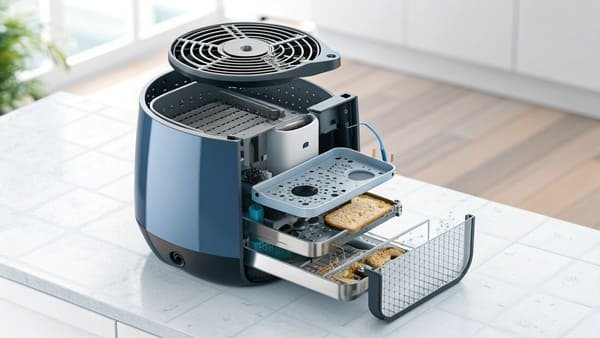
Are you struggling to make sense of air fryer quotes from China? The prices are all over the place, leaving you to wonder if you’re getting a great deal or being set up for quality issues. On our production lines, we know a few dollars can mean the difference between a reliable product and a customer-return nightmare.
To effectively compare air fryer prices from different suppliers, you must request a detailed breakdown of key components like the motor material, plastic grade, power, and included certifications. Standardize these specifications in a comparison sheet to expose hidden costs and ensure an apples-to-apples evaluation.
Let’s break down exactly how to do this so you can source with confidence.
What components make up the total price of air fryers from various suppliers?
Ever receive a quote that seems too good to be true? It probably is. A low price often hides inferior components that can lead to product failure, bad reviews, and costly returns. When we cost a new air fryer model, we carefully balance these components to ensure performance and longevity.
The total price of an air fryer is mainly composed of the housing and plastic (25%), electronics (20%), heating element and fan (15%), labor (15%), and packaging (10%), with the supplier’s profit margin typically sitting around 15%.
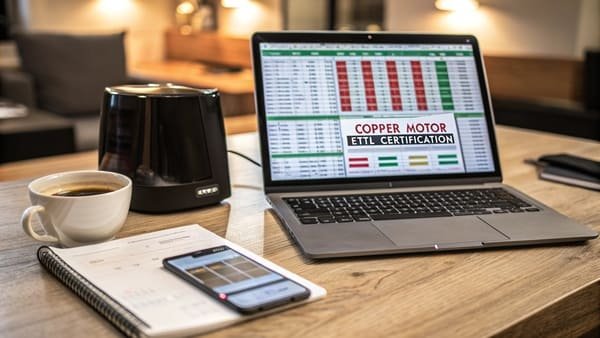
Understanding the Bill of Materials (BOM) is crucial for spotting where a supplier might be cutting corners. A typical digital air fryer with an FOB price of $20.00 will have a cost structure that looks something like this. If a supplier’s price is more than 15% below the average, they are likely making compromises on critical components.
Key Cost Drivers in an Air Fryer
The biggest variables are in the materials. For example, the housing is a major cost factor. We always recommend using new, virgin plastic1. Some factories use "regrind" or recycled plastic to lower costs. While it looks fine initially, it can become brittle and emit a distinct "burnt plastic" smell when heated, which is an immediate red flag for customers. A simple way to check this is to run a sample unit at its maximum temperature for 15 minutes and smell it.
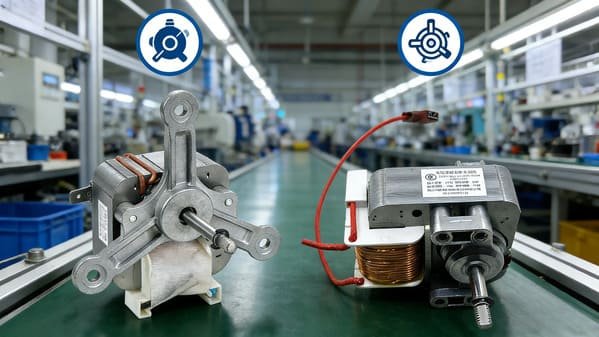
The motor is another area. A motor with 100% copper windings2 will last for years, while a cheaper aluminum or copper-clad aluminum (CCA) motor can fail within months of regular use. This single component choice has a huge impact on the product’s lifespan and your brand’s reputation.
Here is a typical cost breakdown for a mid-range air fryer:
| Component | Approximate Cost Percentage | Why It Matters |
|---|---|---|
| Housing & Plastic Parts | 25% | Determines durability and potential for bad odors. |
| Electronics (PCB, Display) | 20% | Affects user interface reliability and lifespan. |
| Heating Element & Fan Motor | 15% | The core of performance; determines cooking speed and evenness. |
| Labor & Assembly | 15% | Reflects the factory’s quality control and assembly standards. |
| Packaging & Accessories | 10% | Protects the unit during transit and includes manuals. |
| Supplier Profit | 15% | The negotiable margin for the factory. |
How can I request and analyze detailed quotations?
Getting vague quotations with just a model number and a price is a common frustration. This forces you into endless back-and-forth emails just to understand what you’re actually buying. From our experience, we find that clients who provide detailed requests get the fastest and most accurate quotes.
Request detailed quotes using a specific template that requires suppliers to list key cost drivers like motor material, plastic grade, certifications, and power cord length. Analyze these responses in a comparison matrix to easily spot discrepancies and incomplete information.
The best way to force transparency is to make the supplier fill in your blanks. Don’t let them send you their standard, often vague, proforma invoice. Instead, send them a clear request for quotation (RFQ) that asks for the specific details that determine quality and cost. This levels the playing field and makes comparison straightforward.
The "Apples-to-Apples" Comparison Matrix
Create a simple spreadsheet to track the responses. This visual tool immediately highlights which supplier is offering better value versus which one is simply cheaper. If a supplier leaves a field blank, you can immediately identify their quote as incomplete.
| Metric | Supplier A (Low Price) | Supplier B (Mid Price) | Why It Matters |
|---|---|---|---|
| Incoterm3 | EXW (Ex Works) | FOB (Free on Board) | EXW seems cheaper but adds local shipping and customs fees. |
| Power | 1300W | 1500W | Higher wattage means faster cooking and higher copper cost. |
| Motor Type4 | Aluminum Winding | 100% Copper | Copper motors last years; aluminum can fail in months. |
| Plastic Grade | Recycled PP | New ABS/PP | Recycled plastic can smell and become brittle when heated. |
| Certifications5 | None / CE only | ETL / FDA | ETL/UL is mandatory for US retail; CE is for the EU. |
| Cable Length6 | 0.8 meters | 1.2 meters | Shortening the cord is a common, sneaky cost-cutting trick. |
Your RFQ Template
You can copy and paste this template to send to potential suppliers. It requires them to address the most common areas where costs are cut.
"Hello [Supplier Name],
Please provide a quotation for [Quantity] units of [Model Name] based on FOB [Port, e.g., Shenzhen] terms.
Please confirm the following specifications in your quote:
- Motor Material: Is it 100% Copper, or CCA (Copper Clad Aluminum)?
- Housing Material: Is it 100% Virgin PP/ABS or does it contain Recycled material?
- Certifications5: Does the price include valid ETL and FDA reports? Please attach the first page of the reports.
- Power Cord: What is the exact length (in meters) and wire gauge (e.g., 3x16AWG)?
- Spare Parts: What percentage of free spare parts (e.g., PCBs, heating elements) is included with the order?
Note: We will perform a drop test and a ‘burn-in’ smell test on the sample before approving mass production."
This approach saves time and demonstrates that you are a serious, detail-oriented buyer.
What factors should I consider beyond the unit price?
Focusing only on the FOB price is a classic sourcing mistake. In our work with brand owners, we’ve seen how "hidden" costs related to compliance, shipping terms, and quality control can quickly erase the savings from a low unit price. These factors are just as important as the product itself.
Beyond unit price, critically evaluate the Incoterms (EXW vs. FOB), the validity of certifications (ETL/UL for the US), packaging quality, and the supplier’s willingness to provide spare parts. These factors directly impact your total landed cost and long-term risk.
A cheap air fryer that can’t be legally sold or arrives damaged is worthless. You must dig deeper to understand the total cost of getting the product into your customers’ hands.
The True Cost of Compliance
Certifications are non-negotiable for most major markets, especially the US.
- ETL vs. UL7: For the US market, an air fryer must have a nationally recognized safety certification. UL (Underwriters Laboratories) is the most famous, but ETL (Intertek) is a fully equivalent and more cost-effective alternative accepted by major retailers like Amazon and Walmart. If a supplier only has "CE," that certification is for the European market and is not valid in the US.
- FDA: Any surface that touches food, such as the air fryer basket and tray, must be made from FDA-compliant materials8. The supplier should provide a current test report for the specific coating they use. This is not expensive for a factory to obtain, so a lack of it is a major red flag.
Normalizing EXW vs. FOB Prices
Many suppliers quote EXW (Ex Works) to appear cheaper. This price only covers the product at the factory gate. You are responsible for paying for trucking to the port, customs clearance in China, and all subsequent shipping fees. FOB (Free on Board) includes these local costs.
To compare an EXW price to an FOB price, use this simple formula:
Comparable FOB Price = EXW Price + (Local China Costs ÷ Total Units)
For example:
- Supplier A offers $18.00 (EXW).
- Supplier B offers $19.00 (FOB).
- Local costs (trucking, customs) are around $400 for your order of 500 units.
- The per-unit add-on for Supplier A is $400 / 500 = $0.80.
- Supplier A’s real comparable price is $18.00 + $0.80 = $18.80.
Now the comparison is clear. Supplier B is only slightly more expensive but handles all the local logistics, saving you significant time and hassle.
How do I ensure a fair and transparent price comparison?
Ensuring a fair comparison comes down to standardizing information and verifying claims. Don’t take a supplier’s word for it—ask for proof. In our factory, we are accustomed to providing documentation because we know serious buyers require it. A reliable partner will be transparent.
To ensure a fair comparison, create a standardized comparison matrix with non-negotiable specs. Verify claims by requesting documentation like certification reports and material data sheets. Finally, always order a physical sample to test performance and material quality before committing to a bulk order.

A transparent process protects you from unpleasant surprises down the line. It’s about building a partnership based on clear, verified information, not just optimistic promises.
The Power of Verification
Your RFQ and comparison matrix are your primary tools. But the final step is verification.
- Ask for Documents: When a supplier claims to have ETL certification9, ask for the report number or a copy of the certificate. You can verify this on the Intertek online directory. The same goes for FDA food-grade reports.
- Order a Sample: This is the most important step. No amount of documentation can replace a physical evaluation. Once you receive the sample, test it thoroughly:
- Does it cook evenly?
- Does the plastic smell when hot?
- Is the build quality solid?
- Does the cord length match the quote?
Building a Supplier Scorecard10
For long-term partnerships, consider creating a simple scorecard. This helps you move beyond price and evaluate suppliers on factors that truly matter for your business.
| Evaluation Criteria | Supplier A | Supplier B | Supplier C |
|---|---|---|---|
| Price Competitiveness | 8/10 | 7/10 | 6/10 |
| Component Quality (Verified) | 5/10 | 9/10 | 9/10 |
| Communication & Transparency | 6/10 | 8/10 | 9/10 |
| Certification & Compliance | 4/10 | 9/10 | 9/10 |
| Total Score | 23/40 | 33/40 | 33/40 |
This method makes it clear that while Supplier A might have the best price, Suppliers B and C are much stronger partners overall due to their superior quality and transparency.
Conclusion
Comparing air fryer prices is about looking past the sticker price. By using a detailed RFQ, an analysis matrix, and verifying claims, you can uncover the true value and make an informed choice.
-
Explore the advantages of virgin plastic, including durability and safety, to understand its importance in product quality. ↩
-
Learn about the significance of copper windings in motors for longevity and performance, crucial for product reliability. ↩
-
Understanding shipping terms like EXW and FOB can save you money and avoid hidden costs. ↩
-
Learn why copper motors are more reliable and cost-effective in the long run. ↩
-
Discover the significance of ETL and FDA certifications for product safety and compliance. ↩ ↩
-
Explore how cable length impacts safety and convenience in appliance design. ↩
-
Understanding the differences between ETL and UL certifications can help you make informed decisions for product safety and compliance. ↩
-
Exploring FDA-compliant materials ensures that your products meet safety standards, protecting consumer health and enhancing marketability. ↩
-
Understanding ETL certification is crucial for ensuring product safety and compliance. Explore this link to learn more. ↩
-
A supplier scorecard can enhance your evaluation process. Discover best practices to build one effectively. ↩