Finding a reliable air fryer manufacturer in China requires verifying factory capabilities, checking export experience, and confirming product certifications for target markets. Buyers must evaluate production capacity, sample quality, minimum order quantities, and support for third-party quality inspections before ordering.
Choosing a supplier based only on low prices often leads to delayed shipments, uncertified products, or mass production that fails to match the original sample. This risks customs holds and high return rates.
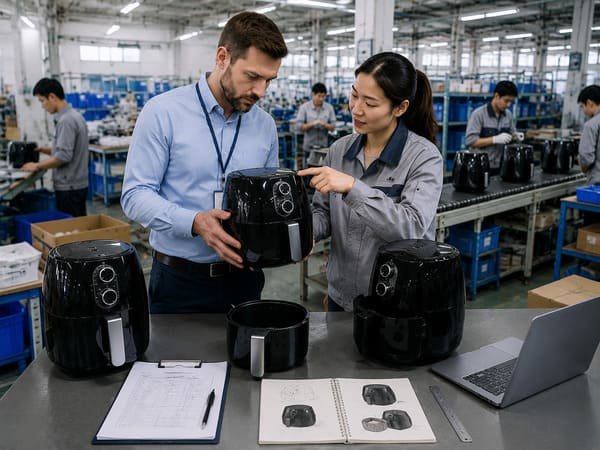
To build a stable supply chain, buyers need a systematic approach to supplier evaluation. This guide explains how to verify real factories, understand certification requirements, compare quotations effectively, and control quality risks before loading the shipping container.
What should buyers check before choosing an air fryer manufacturer?
Buyers should check the manufacturer’s business license, core product catalog, and main export markets. It is essential to verify their production lines, experience with required plug types, packaging customization abilities, and willingness to accept third-party pre-shipment inspections.
Partnering with a trading company pretending to be a factory can cause communication delays and unexpected cost increases. Lack of specific export experience may lead to compliance failures in your target market.
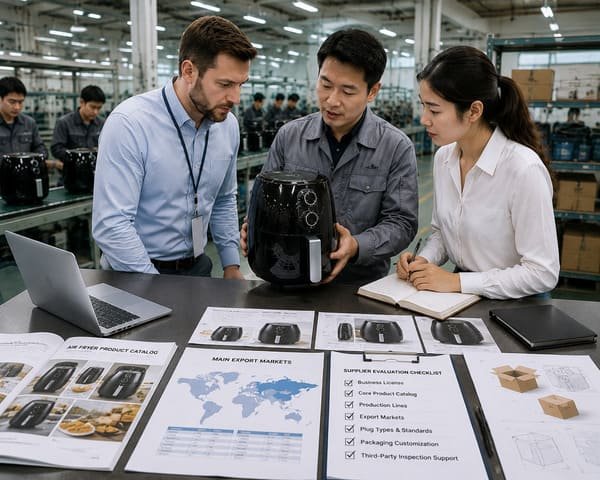
Evaluating an air fryer supplier goes beyond looking at product pictures on a B2B platform. The first step is to confirm their core competency1. A factory that produces air fryers, blenders, and vacuum cleaners might not have the same engineering depth as a factory dedicated specifically to heating appliances like air fryers and toaster ovens.
Ask the supplier about their main export markets. If you are importing to Europe, a supplier who only exports to Southeast Asia might not fully understand CE or RoHS compliance2, or they might struggle with European plug and voltage standards.
Another critical point is production capacity and supply chain stability. Ask about their assembly lines, injection molding capabilities, and how they source core components like heating elements and motors. A reliable supplier usually has stable relationships with component vendors.
Furthermore, evaluate their communication efficiency. Professional B2B suppliers should provide clear answers regarding minimum order quantities (MOQ). MOQ changes by model, color, plug, packaging, and logo method. If a supplier promises an extremely low MOQ with full customization without asking for details, it is a red flag. Always confirm their policy on private label packaging and instruction manual printing before moving forward.
How can buyers verify if an air fryer supplier is a real factory?
Buyers can verify a real air fryer factory by reviewing their business license, checking the registered address, and requesting a live video tour of the production lines. Checking ISO9001 certificates and asking detailed engineering questions also helps identify real manufacturers.
Sourcing from intermediaries without knowing it removes your control over quality and production schedules. If a problem occurs during mass production, intermediaries often lack the technical ability to solve it quickly.
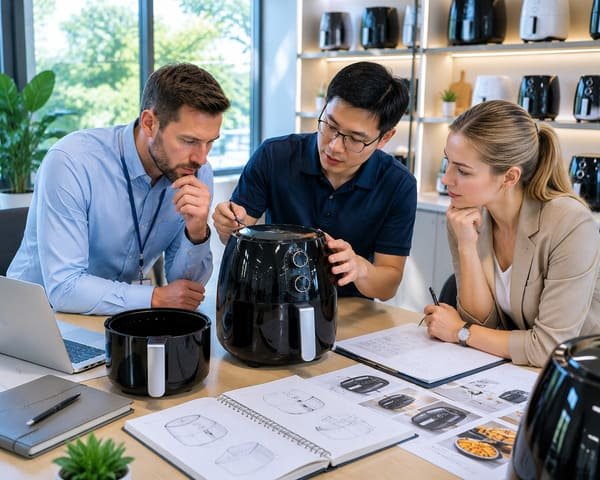
Distinguishing a real factory from a trading company is a common challenge for overseas buyers. While trading companies have their place, large volume importers and private label brands usually prefer direct factory relationships to better control costs, technical modifications, and quality.
Start by examining the supplier’s business license. The registered address should be in an industrial zone, not a downtown office building. The business scope should explicitly mention manufacturing or production, not just sales or trade.
A highly effective verification method is requesting a live video call3. Ask the sales representative to walk through the assembly lines, injection molding workshop, and testing lab. Real factories are usually happy to show their facilities. If a supplier constantly makes excuses to avoid a video tour, proceed with caution.
You can also check their ISO9001 quality management system certificate4 to see if the certified scope covers air fryer manufacturing. Additionally, technical communication reveals a lot. Real factories have engineers who can quickly answer questions about PCB board modifications, heating element wattage, or mold changes.
| Factor | Lower-Risk Supplier (Real Factory) | Higher-Risk Supplier (Trading Company) |
|---|---|---|
| Business Scope | Manufacturing, Production explicitly stated | Sales, Trade, Export focus |
| Address | Located in an established Industrial Zone | Located in a Commercial Office Building |
| Live Video Tour | Enthusiastically supports factory walk-throughs | Avoids or delays video tour requests |
| Technical Support | Provides fast, direct engineering answers | Slow responses, constantly needs to check with others |
What certifications are required for importing air fryers?
Required certifications depend on the target market. Importers need CE, RoHS, and LFGB for Europe, and UL or ETL plus FDA for North America. Buyers must ensure the certificates specifically match the exact air fryer model being purchased.
Importing air fryers with fake, expired, or mismatched certificates can result in goods being seized by customs. It also exposes retail buyers to massive legal and safety liabilities if the product causes electrical fires.

Certification is non-negotiable when importing electrical kitchen appliances. Because air fryers use high-wattage heating elements, market regulators strictly enforce electrical safety and food-contact material standards.
Certification requirements depend entirely on the target market. For the United States, you typically need UL or ETL for electrical safety, FCC for electromagnetic interference, and FDA compliance for the non-stick coating on the basket and crisper plate. For the European Union, CE (including LVD and EMC directives), RoHS, and LFGB (food contact) are mandatory.
A major mistake buyers make is accepting a general certificate. One certificate does not cover every product a factory makes. You must verify that the test report matches the exact product model, voltage, and components you are ordering. Available certification depends on the product model.
Ask the supplier to provide clear copies of the certificates and test reports. You can verify these documents directly with the issuing testing laboratories, such as SGS, TUV, or Intertek. If you require a custom plug type or an upgraded control panel, discuss this early, as technical changes might require updating the existing certification. We can support certification discussion before order confirmation to ensure your importing process goes smoothly.
How should buyers compare air fryer quotations?
Buyers should compare quotations by looking beyond the base price to check the required order quantity, packaging specifications, plug types, and included accessories. Quotations must also clarify the trade terms, warranty policies, and materials used for the heating elements.
Focusing only on the lowest FOB price often hides hidden downgrades in product quality. Suppliers might use thinner plastics, cheaper non-stick coatings, or weaker carton boxes, leading to high damage rates during transit.

Comparing B2B quotations is about evaluating the total cost of ownership, not just the unit price. When you receive prices from different air fryer suppliers, you must ensure you are comparing apples to apples.
First, check the specifications. Does the quoted price include a mechanical dial or a digital touch screen? What is the wattage? Does it use an iron basket with a basic coating, or a higher-quality Teflon or ceramic coating? Small material changes significantly affect the price and product lifespan.5
Second, review the packaging details. A cheap quotation might only include a basic brown box. If you need a full-color retail box, molded pulp inserts for drop protection, and custom user manuals, the price will increase. Make sure the quotation explicitly states the packaging method.
Third, confirm the minimum order quantity (MOQ) tied to the price. A lower price might require an order of 5,000 units, while an order of 1,000 units might cost more. MOQ changes by model, color, plug, packaging, logo method, order quantity, and production setup.
Finally, clarify the trade terms (e.g., FOB Shenzhen or EXW) and the validity period of the quotation. Material costs and exchange rates fluctuate, so a quote from three months ago might no longer be valid.6
How can buyers reduce quality risks before shipment?
Buyers can reduce quality risks by approving a final pre-production sample, defining clear inspection standards, and hiring a third-party agency to conduct a pre-shipment inspection. Checking packaging strength and testing basic functions are essential before container loading.
Skipping pre-shipment inspections can result in receiving an entire container of defective products. Once the goods leave China, returning them is financially impossible, leaving the buyer to absorb the total loss and deal with angry retail customers.
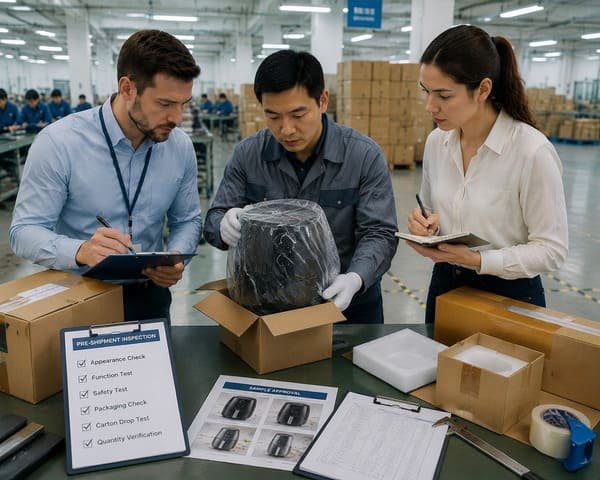
Quality control must be proactive, not reactive. The process starts long before mass production begins. Buyers must approve a final golden sample7 that represents exactly what the mass production should look like. This sample should confirm the color, plug, logo printing, packaging, and non-stick coating quality.
Once mass production finishes, never skip the pre-shipment inspection. You can hire independent inspection agencies to visit the factory. They will use the AQL (Acceptable Quality Limit) standard8 to check a random batch of the finished air fryers before approving the container loading process.
Practical inspection points should include visual checks for scratches or poor plastic injection, function tests to ensure the heating element reaches the correct temperature, and safety tests like the high-voltage test.
Packaging checks are equally critical. Air fryers are heavy and bulky. Ensure the carton drop concern is addressed as part of the inspection to verify that the internal packaging protects the product during ocean freight and local courier delivery. A reliable supplier will always support third-party inspections and clearly agree on quality standards before accepting the order deposit.
FAQ About Air Fryer Manufacturer
What is the MOQ for private label air fryers?
Minimum order quantities for private label air fryers generally range between one thousand and two thousand units per model, although this specific number fluctuates depending on your custom color requirements, logo printing methods, plug types, and retail packaging specifications. Factories require these volumes to cover the setup costs of production lines and customized materials. Discussing your exact needs helps suppliers offer the most accurate volume requirements.
How can buyers verify a real air fryer manufacturer in China?
Buyers can verify a real air fryer manufacturer in China by closely examining their official business license, requesting a live video tour of the production lines, and confirming that their registered address is located within an established industrial manufacturing zone. Asking detailed engineering questions about product modifications also helps identify true manufacturing capabilities. Trading companies often struggle to answer technical questions without contacting a factory first.
What certifications are required for importing air fryers?
Required certifications for importing air fryers depend entirely on the target market, with the European Union requiring CE, RoHS, and LFGB, while the North American market strictly demands UL or ETL for electrical safety and FDA compliance for food-contact materials. Never assume one certificate covers all regions. Always verify that the testing documents match the exact model, voltage, and components you intend to purchase.
Can one air fryer certificate be used for different models?
One general air fryer certificate cannot automatically be applied to different models because safety testing laboratories must evaluate the specific electrical components, heating elements, non-stick coatings, and internal structural designs that are uniquely associated with each individual product variation. If you request a different control panel or plug type, the existing certification might need an update. Always request matching test reports before confirming orders.
How long does private label air fryer production usually take?
Private label air fryer production usually takes between thirty and forty-five days after the buyer approves the final pre-production sample and confirms all customized packaging designs, but this timeline can shift based on material readiness and the factory production schedule. Peak manufacturing seasons and complex mold modifications will extend this lead time. Clear communication regarding order quantity and delivery expectations is necessary to prevent delays.
What packaging options are available for OEM air fryer orders?
Available packaging options for OEM air fryer orders typically include standard brown corrugated cartons for e-commerce drop-shipping, full-color printed retail boxes for supermarket shelves, and internal molded pulp or EPS foam inserts to ensure protection during international ocean freight. High-quality packaging prevents transit damage and reduces product return rates. Always specify your sales channel so the supplier can recommend the most suitable packaging strength.
Conclusion
Finding a reliable air fryer manufacturer requires careful verification of certifications, factory capabilities, and quality control processes. Thorough evaluation helps build a stable, compliant, and profitable long-term supply chain.
Send Your Inquiry
If you are looking for a reliable air fryer supply partner, we are here to help. To provide you with an accurate quotation and practical sourcing advice, please send us an inquiry detailing your target market, required certifications, expected order quantity, and preferred product type. Let us know your specific plug type, custom packaging needs, and logo or private label requirements. Sharing your expected delivery schedule and inspection requirements helps us recommend the best options for your business and ensures a smoother procurement process.
-
"Manufacturing engineering – Wikipedia", https://en.wikipedia.org/wiki/Manufacturing_engineering. This source explains the importance of assessing a supplier’s specialization in specific product categories to ensure engineering depth. Evidence role: expert_consensus; source type: education. Supports: A factory producing multiple product types might lack the engineering depth of a specialized factory.. ↩
-
"EU Legislation and CE Marking – International Trade Administration", https://www.trade.gov/country-commercial-guides/eu-eu-legislation-and-ce-marking. This source provides an overview of CE and RoHS compliance requirements for products exported to Europe. Evidence role: definition; source type: government. Supports: Suppliers exporting to Europe need to understand CE and RoHS compliance standards.. ↩
-
"Live Video ID Verification – Northwestern University", https://services.northwestern.edu/TDClient/30/Portal/KB/Article/2887/Live-Video-ID-Verification. Live video calls are widely recognized as a practical method for verifying factory authenticity, as they allow buyers to observe production facilities directly. Evidence role: mechanism; source type: education. Supports: A live video call is an effective way to verify whether a supplier is a real factory.. ↩
-
"Program Requirements for Commercial Fryers Partner …", https://www.energystar.gov/sites/default/files/specs/private/Commercial_Fryers_Program_Requirements.pdf. The ISO9001 certificate is a globally recognized standard for quality management systems, often used to assess manufacturing capabilities. Evidence role: definition; source type: institution. Supports: Checking the ISO9001 certificate can help determine if the supplier is a real factory.. Scope note: The certificate alone does not guarantee the supplier is a factory; it only indicates adherence to quality management standards. ↩
-
"The Internet’s Favorite Non-Toxic Air Fryers Have One …", https://www.youtube.com/watch?v=Lu0QwWk3vio. This source explains how material choices, such as coatings and basket types, influence both the cost and durability of air fryers. Evidence role: mechanism; source type: research. Supports: Small material changes significantly affect the price and product lifespan.. ↩
-
"[PDF] How Do Exchange Rates Affect Import Prices? Recent Economic …", https://www.usitc.gov/publications/332/ID-21.pdf. This source discusses how fluctuations in material costs and exchange rates can affect the validity of supplier quotations over time. Evidence role: mechanism; source type: institution. Supports: Material costs and exchange rates fluctuate, so a quote from three months ago might no longer be valid.. Scope note: The source may not specifically address air fryer quotations but provides general insights into trade and pricing dynamics. ↩
-
"What is a Golden Sample in Manufacturing? An Essential Tool", https://insight-quality.com/what-is-a-golden-sample/. This source explains the importance of golden samples in quality control, detailing how they serve as benchmarks for mass production. Evidence role: mechanism; source type: education. Supports: Buyers must approve a final golden sample that represents exactly what the mass production should look like.. ↩
-
"Acceptable quality limit – Wikipedia", https://en.wikipedia.org/wiki/Acceptable_quality_limit. This source provides an overview of the AQL standard, explaining its role in determining acceptable defect levels in quality inspections. Evidence role: definition; source type: encyclopedia. Supports: They will use the AQL (Acceptable Quality Limit) standard to check a random batch of the finished air fryers before approving the container loading process.. ↩