
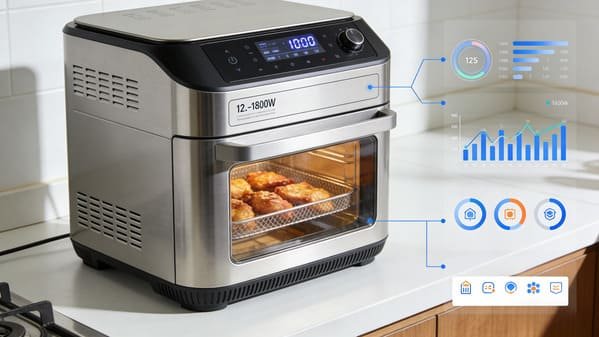
Worried that the air fryers you source are driving up your customers’ electricity bills? An inefficient appliance can quickly erase its convenience benefits, leading to market complaints and returns.
Focus on wattage (1200-1800W), cooking cycle consumption (kWh), and design features like insulation and precise digital controls. These indicators directly impact operational costs and performance, making them crucial for evaluating models from Chinese suppliers for your market.
Understanding these key metrics is the first step. Let’s explore each one so you can make smarter purchasing decisions.
What energy efficiency ratings are relevant for my market?
Importing products without the right certifications can block your sales. Wondering which energy labels matter for air fryers? It’s a common point of confusion we help our partners navigate daily.
While universal air fryer ratings are still emerging, focus on market-specific labels. Key certifications include the EU Energy Label for Europe and ENERGY STAR for the US. Also, verify CE compliance, which includes energy-related directives for EU market access.
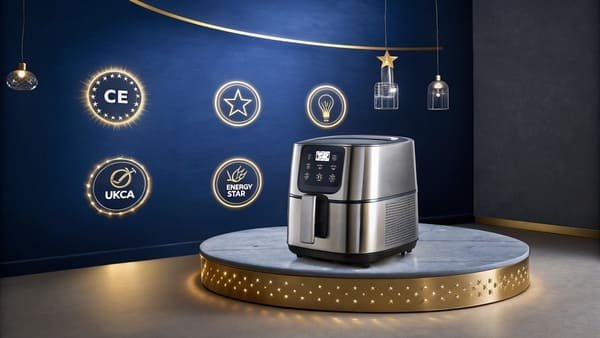
When we prepare shipments for different global partners, navigating regional energy regulations is a top priority. While air fryers are not yet part of mandatory labeling programs in all regions, compliance with broader electrical and energy standards is non-negotiable. For instance, any product destined for the European Union must bear the CE mark, which certifies that it meets EU safety, health, and environmental protection requirements. This implicitly covers energy efficiency to some extent under directives like the Ecodesign Directive.
Key Regional Certifications
In the US market, the ENERGY STAR1 label is the gold standard for energy efficiency. Although it’s not yet widely applied to air fryers, models that do carry this certification have a significant marketing advantage. For China’s domestic market, the China Energy Label (CEL)2 is prominent, but it doesn’t currently cover air fryers. However, seeing a supplier reference CEL standards can indicate their awareness and capability in energy-efficient design.
Practical Compliance Table
To simplify, here’s a breakdown of the most common certifications you’ll encounter and what they mean for your business.
| Certification/Label | Primary Market | Relevance for Air Fryers | Action for Buyers |
|---|---|---|---|
| CE Mark | European Union | Mandatory. Confirms compliance with EU health, safety, and energy use standards. | Always demand a valid CE Certificate of Conformity from your supplier. |
| EU Energy Label | European Union | Emerging. Not mandatory for air fryers yet, but suppliers may provide data. | Ask for efficiency data formatted similarly to the EU label for comparison. |
| ENERGY STAR1 | United States | Voluntary. A strong selling point indicating superior efficiency. | Prioritize models with this label if targeting the US market. |
| UKCA Mark | Great Britain | Mandatory. The post-Brexit equivalent of the CE mark for England, Scotland, and Wales. | Ensure products for the UK market have this specific marking. |
Understanding these regulations ensures your products aren’t stopped at customs and meet the expectations of retailers and consumers in your target market.
How can I compare the energy consumption of different air fryer models?
Choosing between two similar-looking models can be tough. If one consumes more power, it could hurt your brand’s reputation. On our assembly lines, we test every unit to ensure performance matches specifications.
To compare models effectively, calculate the energy consumption in kilowatt-hours (kWh) per cooking cycle. Use the formula: (Wattage ÷ 1,000) × (Cooking Time in Minutes ÷ 60). This provides a standardized metric for an apples-to-apples comparison of operational cost.
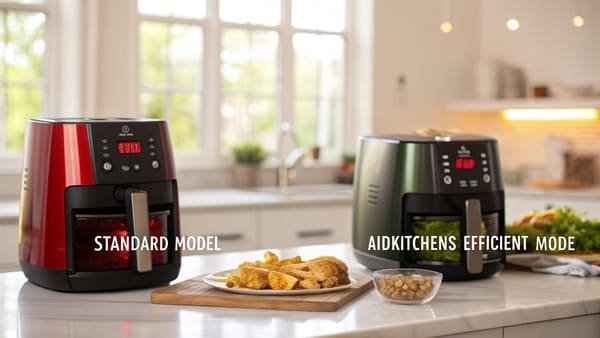
A simple wattage rating can be misleading. A higher-wattage (e.g., 1800W) air fryer might seem less efficient than a lower-wattage (e.g., 1400W) one. However, the higher-powered unit may heat up faster and complete a cooking cycle in less time, potentially using the same amount of energy or even less. That’s why calculating the consumption per cycle is essential. For example, a 1800W model that cooks fries in 15 minutes uses 0.45 kWh. A 1400W model that takes 20 minutes uses approximately 0.47 kWh. In this scenario, the higher-wattage model is slightly more efficient.
Standardized Testing Protocol
To get a reliable comparison, you need a consistent test. We recommend using a standard food item, like 500g of frozen french fries, and cooking it to a desired level of crispiness. Record the total time, including any preheating. This real-world test provides a much clearer picture than just relying on the numbers printed on the box.
Key Metrics for Comparison
Here is a table outlining the key metrics you should request from a supplier or measure yourself to compare different air fryer models accurately.
| Metric | Unit | How to Calculate/Find It | Why It Matters |
|---|---|---|---|
| Power Rating3 | Watts (W) | Listed on the product’s rating label. | Indicates maximum power draw. |
| Cooking Time | Minutes | Time a standard recipe from start to finish. | Shorter times generally mean lower energy use. |
| Energy Per Cycle4 | kWh | (Watts ÷ 1000) × (Time in hours) | The most accurate metric for direct comparison. |
| Annual Cost | $, €, £ | Energy Per Cycle4 × Uses Per Year × Cost per kWh | Translates technical data into a tangible cost for the end-user. |
By using this structured approach, you move beyond simple wattage figures and can confidently identify the truly energy-efficient models for your product line.
What questions should I ask suppliers about energy-saving features?
You see "energy-saving" in every product description, but what does it actually mean? To avoid marketing fluff, you need to ask specific questions. We often discuss these very features with clients during the ODM process.
Ask suppliers to detail the unit’s insulation, the precision of its digital thermostat (e.g., ±5°C), its preheat time, and whether it has an auto-shutoff function. These specific features directly contribute to reducing energy waste during operation.

General claims of efficiency are not enough. You need to dig into the design and engineering specifics that make a product genuinely energy-saving. When we develop a new air fryer, these features are central to our design process because they impact both performance and long-term operating cost. A well-insulated unit, for example, retains heat better. This means the heating element doesn’t have to cycle on as frequently to maintain the set temperature, directly cutting down on electricity usage. A cool-touch exterior is often a good indicator of quality insulation.
Essential Questions for Your Supplier
Your goal is to get concrete data, not vague assurances. A professional supplier will have ready answers to these questions. If they hesitate or provide unclear responses, it could be a red flag about their technical expertise or the product’s quality.
Supplier Inquiry Checklist
Use this checklist to structure your inquiries and evaluate a supplier’s commitment to energy efficiency5.
| Feature Category | Key Questions to Ask | What a Good Answer Looks Like |
|---|---|---|
| Insulation | "What materials are used for insulation? Is the exterior cool-touch?" | "We use a double-wall construction with an air gap, ensuring the exterior remains below 60°C." |
| Temperature Control | "What is the accuracy of the digital thermostat?" | "Our NTC sensor maintains the temperature within a ±5°C variance of the set point." |
| Heating Speed | "How long does the unit take to preheat to 200°C?" | "Preheating to 200°C is completed in under 3 minutes, which minimizes idle energy consumption." |
| Smart Features | "Does the model include an auto-shutoff or a preheat-ready notification?" | "Yes, it has an auto-shutoff timer and an audible alert signals when preheating is complete." |
| Air Circulation | "How is the airflow optimized for even cooking?" | "Our patented cyclone fan technology ensures uniform heat distribution, reducing cooking time by 15%." |
Asking these targeted questions helps you differentiate between suppliers who simply assemble parts and those who engineer efficient, high-performance appliances.
How do I ensure compliance with energy efficiency regulations?
Sourcing a great product is only half the battle; ensuring it can be legally sold in your market is critical. Getting a container of goods rejected at customs due to non-compliance is a costly mistake.
Ensure compliance by requesting up-to-date documentation for all relevant certifications, such as CE for Europe or UKCA for Great Britain. Verify these documents with the issuing authority and conduct third-party lab testing for confirmation if necessary.
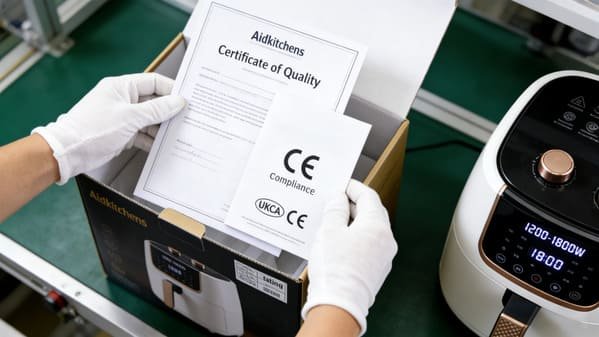
Compliance is a non-negotiable part of our manufacturing process. For every batch we produce for export, we prepare a full set of compliance documents. This isn’t just about having a piece of paper; it’s about proving the product has been designed, built, and tested to meet specific legal standards. A reliable manufacturer should be able to provide a Declaration of Conformity (DoC), which is a formal statement that the product meets all applicable requirements. This document is often supported by detailed test reports from accredited laboratories. Never take a supplier’s word for it—always ask for the paperwork.
Verification is Key
Unfortunately, fraudulent certificates6 exist. It’s wise to perform due diligence. You can often check the validity of a certificate number on the website of the issuing body (e.g., TÜV, Intertek, SGS). For large orders or new supplier relationships, investing in your own third-party testing provides peace of mind and legal protection. This independent verification confirms that the product you are buying is the same one that was originally certified.
Final Pre-Shipment Checks
Before a shipment leaves our factory, it undergoes a final inspection that includes a documentation check. This ensures that the products are correctly marked (e.g., with the CE logo), the rating labels are accurate, and the user manual contains the required safety and compliance information. This final step prevents simple errors that could cause major problems at the port of entry. As a buyer, you can and should request a copy of this final inspection report7 for your records.
Conclusion
Focusing on wattage, cycle consumption, design features, and verified compliance is key. This ensures you source air fryers that are efficient, marketable, and legally compliant in your region.
-
Explore the importance of the ENERGY STAR label to understand its impact on energy efficiency and marketability. ↩ ↩
-
Learn about the China Energy Label (CEL) to gauge its relevance in energy-efficient design and supplier credibility. ↩
-
Exploring Power Rating will give insights into energy consumption and cooking efficiency of air fryers. ↩
-
Understanding Energy Per Cycle helps you evaluate the efficiency and cost-effectiveness of air fryers. ↩ ↩
-
Exploring this link will provide insights into energy-efficient practices that can enhance your supplier evaluation. ↩
-
Understanding the risks of fraudulent certificates can help you protect your business and ensure compliance. ↩
-
Knowing how to obtain a final inspection report is crucial for ensuring product compliance and safety. ↩