
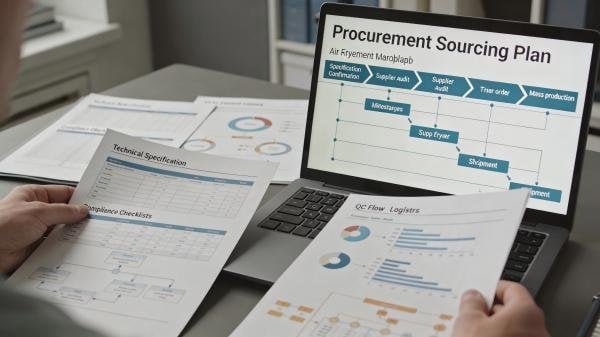
Are you struggling to create a reliable air fryer procurement plan? A vague strategy can lead to quality issues and lost profits, a common frustration we see with new importers.
A robust air fryer procurement plan from China requires defining technical specifications like wattage and capacity, ensuring regulatory compliance (UL/CE), establishing strict QC protocols, verifying supplier capabilities beyond surface-level claims, and clarifying logistics and commercial terms like MOQ and Incoterms.
Let’s break down these critical parameters step-by-step to help you build a plan that protects your investment and secures your supply chain.
What technical specifications are most important for my air fryer procurement plan?
Selecting the right technical specs feels overwhelming. Choose wrong, and your product might underperform or fail to meet market expectations, a costly mistake our clients aim to avoid with our help.
The most important technical specifications are wattage, capacity, and control interface. These elements directly impact cooking performance, user experience, and your product’s target market segment, from personal-sized budget models to premium family-sized units.
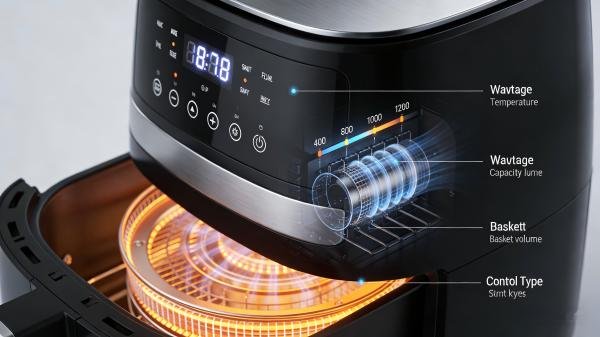
When we develop new air fryer models, technical specifications are the foundation of the entire project. They determine the cost, performance, and target audience. A clear definition of these parameters is the first step in communicating your needs to a manufacturer. You must decide which product tier you are targeting. Chinese factories can produce a wide spectrum of quality, and your specs will guide you to the right partner.
Heating Element and Wattage
The engine of the air fryer is its heating element1. Wattage is not just a number; it is a direct indicator of performance. For smaller units, typically under 4 liters, a 1200–1500W element is sufficient. However, for the popular family-sized models of 5 liters or more, we recommend 1700W or higher. This ensures the air fryer can reach and maintain high temperatures quickly, delivering the "crispy" results customers expect without long preheating or cooking times. A lower-wattage unit in a large basket will simply bake the food slowly, leading to poor reviews.
Control Interface
The user interface defines the customer’s daily interaction with your product. You have two primary choices:
| Control Type | Pros | Cons | Best For |
|---|---|---|---|
| Mechanical Dials | Lower cost, higher durability, fewer failure points. | Lower perceived value, less precise. | Budget-conscious or commercial models. |
| Digital/Touch Panel | Higher perceived value, presets for ease of use. | Higher cost, requires quality PCB control. | Mid-range to premium consumer markets. |
While a digital screen with presets offers a modern feel, it also introduces a potential point of failure: the Printed Circuit Board (PCB). When we build digital models, we implement rigorous testing on the PCBs to ensure they can withstand heat and power fluctuations.
Capacity and Configuration
Capacity is a key selling point. Personal-sized (2–4 Liters) units are in a highly competitive price bracket with lower margins. Family-sized models (5–8 Liters) represent the bulk of the market. A rapidly growing premium segment is the dual-zone air fryer, which features two independent baskets. These designs are more complex and require sophisticated power management systems to run both zones effectively, but they command a higher retail price.
How can I determine the ideal order quantity and delivery schedule?
Miscalculating your order quantity can be disastrous. Ordering too little leads to stockouts and lost sales during peak season, while ordering too much ties up capital in unsold inventory.
To determine your ideal order quantity and delivery schedule, start with a conservative sales forecast. Negotiate a smaller trial order (300-500 units) to test the market, then scale up based on sell-through data, factoring in the manufacturer’s lead times.
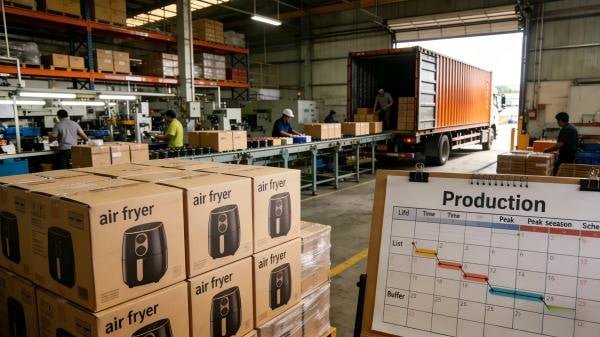
Determining the right order volume and timing is a balancing act between your market demand and the factory’s production realities. From our experience on the factory floor, lead times are not static; they fluctuate based on raw material availability and seasonal demand. A solid procurement plan accounts for these variables.
MOQ and Trial Orders
Most established factories have a Minimum Order Quantity (MOQ) of 500–1000 units per model. This is because setting up a production line for a specific product involves fixed costs. However, for a new business relationship, asking for a smaller trial order is a reasonable strategy. Many manufacturers, including us, are open to a "test order" of 300–500 units. This allows you to validate the product in your market before committing to a full container load. Be prepared for a potential surcharge of 5-10% on these smaller orders, as it helps cover our setup costs.
Understanding Lead Times
Never assume a fixed delivery schedule. You must differentiate between standard and peak season lead times. Ask potential suppliers for both.
| Period | Typical Lead Time | Reason |
|---|---|---|
| Standard (Off-Season) | 30-45 days | Factory has available capacity. |
| Peak Season (Aug-Nov) | 45-75 days | High order volume before major holidays. |
| Post-Chinese New Year | 45-60 days | Production ramps up after a long holiday. |
Peak season for kitchen appliance manufacturing typically runs from August to November, ahead of Black Friday and Christmas. During this time, production lines are fully booked, and raw material suppliers are stretched. If you need stock for the fourth quarter, you should be placing your order no later than August. Always build a buffer of 2-3 weeks into your schedule to account for potential delays in production or shipping.
Logistics and Incoterms
Your delivery schedule is also tied to your chosen shipping terms (Incoterms). The most common term is FOB (Free on Board), which means the factory is responsible for transporting the goods to the designated Chinese port. From that point on, you or your freight forwarder take over responsibility for shipping, insurance, and customs clearance. Your procurement plan should clearly state the Incoterm and the port of departure (e.g., FOB Zhongshan).
What market factors should influence my procurement parameters?
Ignoring market-specific regulations is a fast track to failure. Importing non-compliant air fryers can lead to customs seizures, forced product recalls, and even devastating liability lawsuits from your customers.
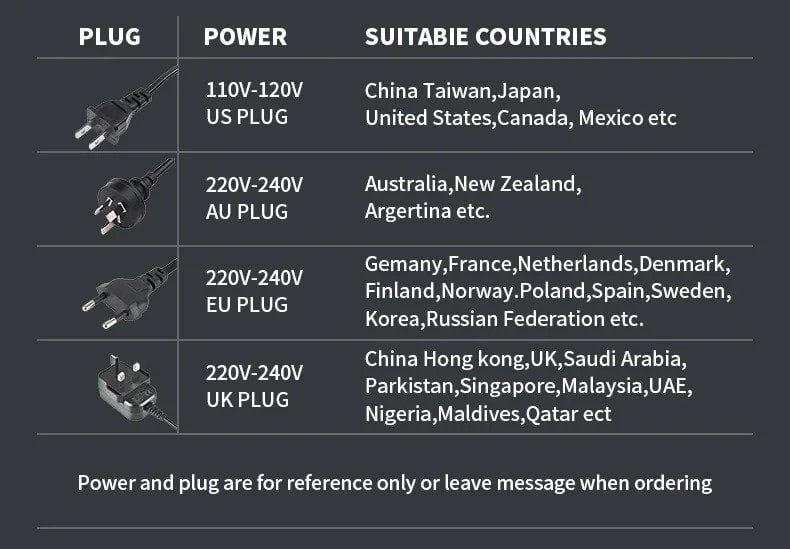
The most critical market factors are regulatory compliance and safety certifications. Your procurement plan must specify the exact certifications required for your target market (e.g., UL for the USA, CE for the EU) and the correct plug and voltage.
As a manufacturer that exports globally, ensuring compliance is a non-negotiable part of our process. Air fryers are high-wattage heating appliances with inherent fire risks. Each market has its own set of rules designed to protect consumers, and your product must meet them.
Mandatory Safety Certifications
Your target market dictates the required certifications. Do not assume a "CE" mark is sufficient for the US market, or that a supplier’s internal test report is a substitute for a certificate from an accredited lab.
- USA: UL (Underwriters Laboratories) or ETL (Intertek) certification is the gold standard and practically mandatory for any major retailer. Additionally, any materials that come into contact with food, like the non-stick coating on the basket, must be FDA-compliant.
- EU: A CE mark is required, which declares conformity with several directives. For air fryers, the most important are the Low Voltage Directive (LVD) for electrical safety and the Electromagnetic Compatibility (EMC) directive. Furthermore, RoHS (Restriction of Hazardous Substances) and REACH regulations restrict the use of certain chemicals.
Plug and Voltage Specifications
This may seem basic, but it’s a common and costly mistake. Our production lines are equipped to handle various international standards, but you must specify what you need. A product built for the EU market (220-240V, Type C/F plug) will not work in the US (110-120V, Type A/B plug) and can be a safety hazard. Clearly state the required voltage, hertz, and plug type in your purchase order.
Packaging for Your Sales Channel
Market factors also include how your product will be sold. Packaging designed for palletized retail shipments is often insufficient for e-commerce. If you sell online and ship individual units, you must specify "mail-order packaging" (MOP). This typically involves stronger, double-walled cardboard and additional internal padding to withstand the rigors of the courier network. Requesting that your supplier performs drop tests based on ISTA standards is a wise investment to reduce shipping damage and returns.
How do I align my procurement plan with my business goals?
A procurement plan that isn’t tied to your business goals is just a shopping list. To build a profitable brand, you need a strategic approach that balances cost, quality, and supplier relationships.
Align your procurement plan with business goals by defining your brand’s position (e.g., value vs. premium), selecting a supplier whose capabilities match that vision, and building a QC protocol that protects your brand’s reputation for quality and safety.
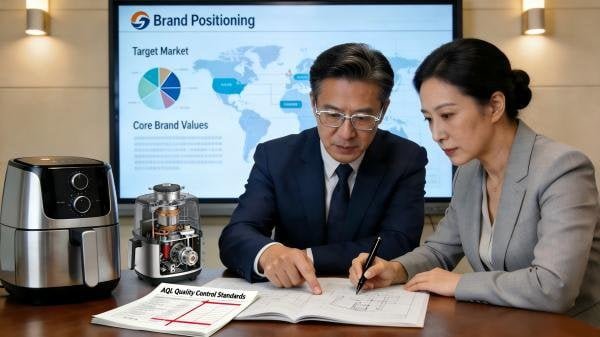
Your procurement plan is an extension of your business strategy. It dictates your product quality, your cost of goods sold, and ultimately, your brand’s reputation in the market. When we work with clients on an ODM basis, our first question is always about their brand’s long-term goals. Are you competing on price, or are you building a premium brand known for reliability? The answer changes everything.
Supplier Capability vs. Business Model
Don’t just look for the lowest price; look for the right partner. A supplier’s capabilities must align with your goals.
| Business Goal | Required Supplier Capability |
|---|---|
| Compete on Price | High-volume production, focus on cost efficiency, standard models. |
| Build a Premium Brand | Strong R&D, willingness to co-develop (ODM), excellent quality control, vertically integrated. |
| Fast Market Entry | Offers existing certified models (OEM), flexible MOQ, fast lead times. |
Ask potential suppliers about their level of vertical integration. Do they make their own injection molds, heating elements, and motors? A factory that controls its core components has far more control over quality and lead times than one that simply assembles outsourced parts. This is critical for building a reliable, high-quality product line.
Quality Control as a Brand Asset
Your QC protocol is not just about catching defects; it’s about protecting your brand. Your procurement plan must detail your inspection requirements. We work with clients to define standards based on Acceptance Quality Limit (AQL).
- Critical Defects (AQL 0): Zero tolerance for safety issues like faulty wiring, overheating plugs, or exposed live components.
- Major Defects (AQL 1.5): Functional failures like a non-working timer, a heating element that doesn’t reach temperature, or excessive motor noise.
- Minor Defects (AQL 2.5): Cosmetic issues like small scratches or blemishes that don’t affect function.
In your plan, specify key tests you want performed, such as a 4-hour continuous run test to check for component failure, a cross-hatch adhesion test on the basket’s non-stick coating, and packaging drop tests.
Building Long-Term Value
Finally, think beyond the first order. A good procurement plan includes provisions for the entire product lifecycle. Negotiate a spare parts policy with your supplier. Requesting 1-2% of your order value in free spare parts (like PCBs or heating elements) allows you to handle warranty claims locally. This is far more cost-effective than shipping defective units back to China and shows you are planning for long-term customer satisfaction.
Conclusion
Building a successful air fryer business requires a detailed procurement plan. Focus on technical specs, compliance, QC, and logistics to create a strong foundation for a profitable, long-term partnership.
-
Understanding the heating element’s role can help you choose the best air fryer for crispy results. ↩