
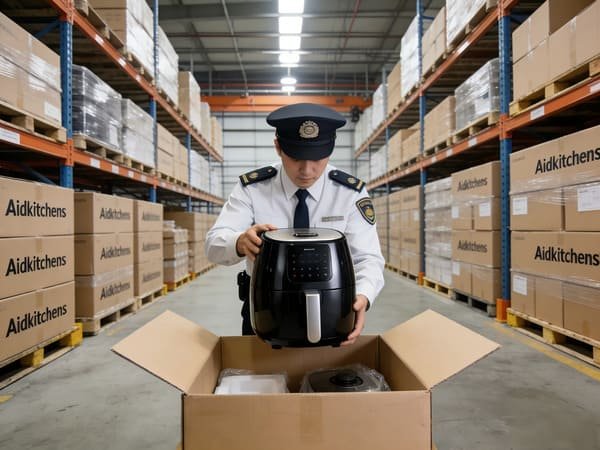
Is your air fryer shipment stuck at customs? These delays cost money and damage your reputation. Ensuring your products are compliant before they even leave our factory is the solution.
To ensure smooth customs clearance for air fryers from China, you must focus on three core areas: correct HS code classification, valid safety and compliance certifications, and perfectly consistent documentation. Getting these right prevents delays, unexpected taxes, and potential seizure of your goods.
Navigating customs can be complex, but it doesn’t have to be. Let’s break down the essential steps to make sure your air fryers arrive without any issues.
What documents are required for smooth customs clearance?
Missing just one document can bring your entire shipment to a halt. This creates a paperwork nightmare and costly port storage fees. We help prevent this by preparing these key documents.
For smooth customs clearance, you need a Commercial Invoice, Packing List, and Bill of Lading (or Airway Bill). A Certificate of Origin is also often required. All documents must have consistent information, including product descriptions, quantities, and declared values to avoid issues.
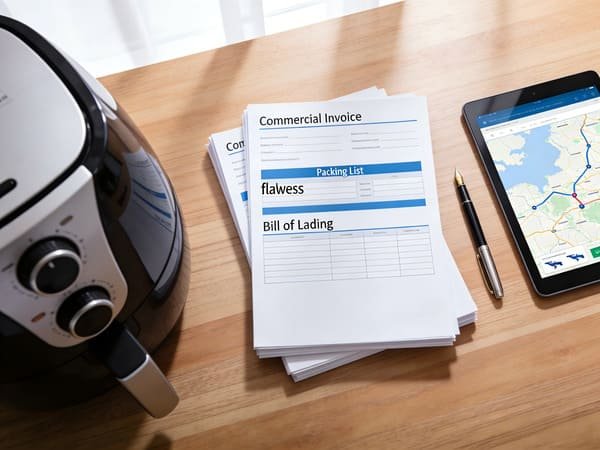
To ensure a seamless customs process, your documentation must be flawless. Each document serves a specific purpose, and any inconsistency between them can raise red flags for customs authorities, leading to inspections and delays. From our experience shipping globally, we know that accuracy here is non-negotiable.
Key Document Details
The commercial invoice is the primary document used by customs to determine duties. It must contain a clear and detailed description of the goods. For air fryers, this means specifying the model number, capacity in liters, power rating in watts, and key features. Vague descriptions like "kitchen appliance" are not sufficient and can lead to re-evaluation and penalties. The packing list complements the invoice by detailing the contents of each carton, including weights and dimensions, which helps customs verify the shipment’s contents without having to unpack everything.
Essential Documentation Checklist
Having a complete and accurate set of documents prepared before the shipment leaves the port is crucial. Here is a breakdown of the essential paperwork:
| Document | Purpose | Critical Information for Air Fryers |
|---|---|---|
| Commercial Invoice1 | Declares the value of the goods for duty and tax assessment. | Model, capacity, power, unit price, total value, HS code. |
| Packing List2 | Details the contents, weight, and dimensions of each package. | Quantity per carton, net/gross weight, CBM, model numbers. |
| Bill of Lading3 (B/L) | A contract between the shipper and carrier; acts as a receipt of goods. | Shipper/consignee details, port of loading/discharge, vessel name. |
| Certificate of Origin4 | Certifies the country where the goods were manufactured. | Required for preferential tariffs under certain trade agreements. |
Finally, the Bill of Lading3 (or Airway Bill for air freight) is your title to the goods. Ensure the consignee information is 100% correct to avoid issues with releasing the cargo at the destination. For certain markets, a Certificate of Origin4 is also vital for claiming preferential tariff rates, so confirming this requirement with your customs broker is a wise step.
How can I avoid delays or penalties at customs?
Customs penalties and unexpected storage fees can quickly erase your profit margins. These risks are real, but they are also avoidable. Taking proactive steps before shipping is your best defense.
To avoid delays or penalties, verify the correct HS code with a customs broker before shipping. Also, ensure all required safety certifications are valid and match the product. Finally, conduct pre-shipment inspections to guarantee product quality and compliance with all declared specifications.

Avoiding customs issues starts long before your container is loaded. It’s about proactive management and clear communication with your supplier. In our manufacturing process, we integrate these checks to minimize risks for our clients. The goal is to present customs with a shipment that is transparent, compliant, and easy to process.
Pre-Shipment Verification
The single most effective way to prevent delays is to get everything right from the start. This involves a three-pronged approach: classification, certification, and inspection.
First, never guess the HS code5. This code determines the duty rate. Work with a customs broker in your destination country to confirm the correct classification for your specific air fryer model. A multi-function air fryer-grill combo might have a different code than a basic model.
Second, verify all compliance certificates6. If you are importing to the EU, you need CE and RoHS. For the US, you need FCC and a safety mark like UL or ETL. We always provide our clients with verifiable copies of these documents. It is your responsibility to ensure they are valid for your market.
Third, insist on a pre-shipment inspection7 (PSI). An inspection confirms that the goods match the documentation, meet quality standards, and are labeled correctly. This simple step can catch potential problems before they become costly customs issues.
Common Triggers for Customs Inspections
Customs authorities are trained to look for red flags. Understanding these can help you avoid scrutiny.
| Red Flag | How to Avoid It |
|---|---|
| Document Inconsistencies | Cross-check all documents (invoice, packing list, B/L) for matching quantities, values, and descriptions. |
| Under-valuation of Goods | Declare the true transaction value. Unusually low prices for air fryers will trigger an audit. |
| Vague Product Descriptions | Use specific descriptions like "5.5L Digital Air Fryer, 1700W" instead of "Kitchenware." |
| Missing Compliance Marks/Labels | Ensure the product, packaging, and manual have all required certification marks (CE, UL, FCC, etc.) printed. |
By addressing these areas proactively, you transform customs clearance from a source of stress into a predictable part of your supply chain.
What regulations and duties apply to importing air fryers?
Unsure about the specific rules for your country? This uncertainty can lead to surprise taxes or even blocked entry. We help our clients navigate these regulations during the development phase.
Regulations for air fryers primarily concern electrical safety (UL/ETL, CE), food-contact materials (FDA, LFGB), and electromagnetic compatibility (FCC, EMC). Duties are determined by the HS code (typically 8516.60 or 8516.79), with rates varying significantly by country and trade agreements.
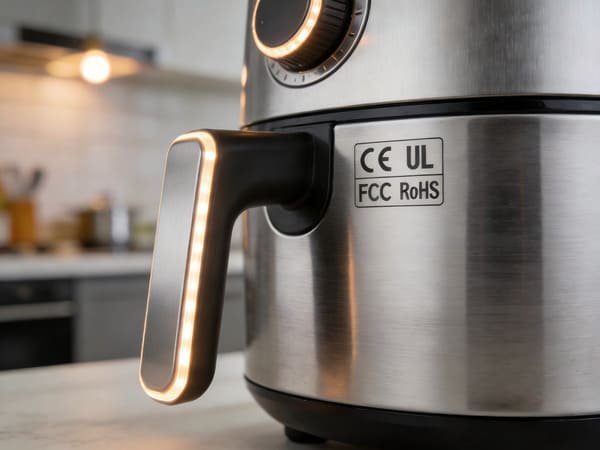
Understanding the specific regulations and duties for your target market is critical for accurate cost calculation and market entry. These rules are not just suggestions; they are legal requirements. Air fryers are electrical appliances that heat to high temperatures, so safety is a top priority for regulators worldwide.
Every market has its own set of rules. For example, shipments to the United States must comply with FCC regulations8 for electromagnetic interference and typically require a Nationally Recognized Testing Laboratory (NRTL) mark like UL or ETL to prove electrical safety. Any parts that touch food, such as the basket and pan, must also meet Food and Drug Administration (FDA) standards.
In the European Union, the requirements are different. Air fryers must bear the CE mark, which signifies conformity with health, safety, and environmental protection standards. This involves compliance with the Low Voltage Directive (LVD) and the Electromagnetic Compatibility (EMC) Directive. Additionally, RoHS regulations restrict the use of certain hazardous substances. We design and build our air fryers to meet these diverse international standards, ensuring the necessary testing and certification are in place.
Understanding Duties and Tariffs
The Harmonized System (HS) code9 is the key to determining your import duty rate. Air fryers usually fall under heading 8516, "Electric instantaneous or storage water heaters and immersion heaters; electric space heating apparatus…". The most common subheadings are 8516.60 (for ovens, cookers, cooking plates, etc.) or 8516.79 (for other electro-thermic appliances). The exact classification can depend on features like capacity or multi-functionality. Misclassification is a common and costly mistake. An incorrect HS code can lead to back-payments, fines, and future shipments being flagged for inspection. Always confirm the HS code with a licensed customs broker in your country. They will provide the most accurate and up-to-date information on duty rates, including any additional tariffs that may apply to goods from China.
How do I resolve customs issues if they arise?
A customs hold notice can be alarming. Your first instinct might be to panic, but a fast and structured response is required. Every day your shipment sits, your costs increase.
If a customs issue arises, immediately contact your customs broker to understand the exact problem. Then, provide the requested documentation or clarification to customs authorities promptly. Maintaining open communication between your supplier and your broker is crucial for a quick resolution.

Even with the best preparation, issues can sometimes occur. The key is not to panic but to act swiftly and methodically. When we get a call from a client about a customs hold, our first step is always to help them gather the precise information needed. The resolution process depends entirely on the reason for the hold.
Steps for Resolving Common Customs Holds
Most customs issues fall into a few common categories: documentation errors10, valuation questions, or compliance checks. Your response should be tailored to the specific problem.
- Contact Your Broker Immediately: Your customs broker11 is your representative on the ground. They can speak directly with customs officials to get clear details on why the shipment is being held. Is it a missing document? A question about the declared value? A request for proof of certification? Don’t guess—get the facts.
- Gather and Submit Information: Once you know the problem, work with your supplier to provide the necessary information. If customs questions the value, you may need to provide proof of payment. If they need to verify a safety certificate, we can provide the original test report from our files. Respond as quickly as possible.
- Pay Any Required Fees or Duties: If the issue is due to a miscalculation of duties or a penalty for a minor error, it is often fastest to pay the amount owed to get the cargo released. You can dispute the charge later if you believe it was incorrect, but leaving the cargo at the port will incur far greater storage costs.
Preventing Future Issues
Once the immediate problem is resolved, analyze what went wrong to prevent it from happening again. This is where a strong supplier relationship becomes invaluable.
| Issue | Long-Term Solution |
|---|---|
| Documentation Error | Create a standardized document checklist for every shipment and have it reviewed by both your team and your supplier. |
| HS Code Dispute12 | Obtain a binding ruling from customs for your product to have an official classification on record. |
| Certification Questions | Keep a digital and physical file of all test reports and certificates. Verify their validity before each new order. |
Resolving a customs issue reinforces the importance of diligence. Use it as a learning experience to strengthen your import process.
Conclusion
Smooth customs clearance is about preparation, not luck. By focusing on correct documentation, valid certifications, and accurate classification, you can turn a complex process into a predictable part of your business.
-
Understanding the Commercial Invoice is crucial for ensuring accurate duty assessments and avoiding penalties. ↩
-
A detailed Packing List helps streamline customs verification and prevents shipment delays. ↩
-
Learn about the Bill of Lading to understand its role as a contract and receipt in the shipping process. ↩ ↩
-
Explore the importance of the Certificate of Origin for claiming preferential tariffs and ensuring compliance. ↩ ↩
-
Understanding HS codes is crucial for accurate duty rates and avoiding customs delays. ↩
-
Learn about essential compliance certificates to ensure your products meet legal requirements. ↩
-
Discover how pre-shipment inspections can prevent costly customs issues and ensure quality. ↩
-
Understanding FCC regulations is crucial for compliance in the U.S. market, ensuring your products meet safety standards. ↩
-
Exploring HS codes helps avoid costly misclassifications and ensures accurate duty rates for importing air fryers. ↩
-
Preventing documentation errors is crucial for smooth customs clearance and avoiding delays. ↩
-
Understanding the role of a customs broker can help you navigate customs issues more effectively. ↩
-
Learn about HS Code disputes to ensure proper classification and avoid costly mistakes. ↩