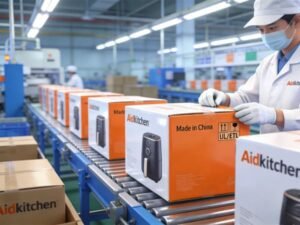

Drowning in a sea of technical jargon from air fryer suppliers? It’s a common issue for buyers. We often see clients focus on the wrong numbers, leading to underperforming products.
The main technical specifications to know are wattage (1400W+), basket capacity and surface area, temperature range (up to 400°F/200°C), fan speed (2500-3600 RPM), and safety certifications like CE or UL. These core specs directly determine an air fryer’s performance, safety, and market suitability.
Understanding these key metrics is the first step to differentiating a high-performance appliance from a low-quality one. Let’s dive into the details of what each specification actually means for you and your customers.
What are the essential technical parameters for air fryers I should focus on?
It’s easy to get distracted by flashy features and marketing claims. The real story of an air fryer’s quality is told in its core technical data, but many buyers aren’t sure which numbers matter most.
Focus on five essential parameters: wattage for heating power, basket surface area for cooking evenness, maximum temperature for crisping ability, fan speed for air circulation, and the specific safety certifications required for your market. These five pillars define the appliance’s core performance and compliance.

When our engineers design a new air fryer, we balance these five elements to create a reliable, high-performance machine. A powerful heater is useless if the fan can’t circulate air effectively, and a large basket is pointless if it can’t reach a high enough temperature. Think of them as an interconnected system. Focusing on these core specs will help you cut through the noise and evaluate a product’s true potential.
Power and Heating Performance
Wattage1 is a primary indicator of an air fryer’s power. It determines how quickly the unit heats up and recovers temperature after you add food. In our R&D, we’ve found that models below 1400 watts often struggle to produce a truly crispy texture.
| Parameter | Recommended Specification | Why It’s Essential |
|---|---|---|
| Wattage1 | 1400W – 2000W | Higher wattage provides faster pre-heating and better heat recovery for crispier food. |
| Voltage | 110-120V or 220-240V | Must match your target market’s electrical grid to avoid product failure or safety hazards. |
| Temperature Range | Up to 400°F / 200°C | High temperatures are necessary for the Maillard reaction, which creates browning and crispiness. |
Cooking Chamber and Airflow2
While many focus on basket capacity in quarts or liters, the actual cooking surface area is more critical. A wide, flat basket allows food to be spread in a single layer, ensuring every piece is hit by the hot, circulating air. A cramped, deep basket leads to steaming instead of frying. Furthermore, fan speed, measured in RPM (revolutions per minute), must be optimized for the chamber size. A powerful fan in a well-designed chamber is the secret to even cooking.
How can I compare technical specs across different air fryer models?
You have spec sheets from three different suppliers, and they all look similar. How do you decide which one offers the best value and performance when the numbers seem almost identical?
To effectively compare specs, create a standardized comparison chart. List your essential parameters—wattage, basket area, temperature range, and certifications—for each model side-by-side. Don’t just compare numbers; evaluate them in context. A 1700W model with a small basket is less efficient than a 1500W model with a large one.
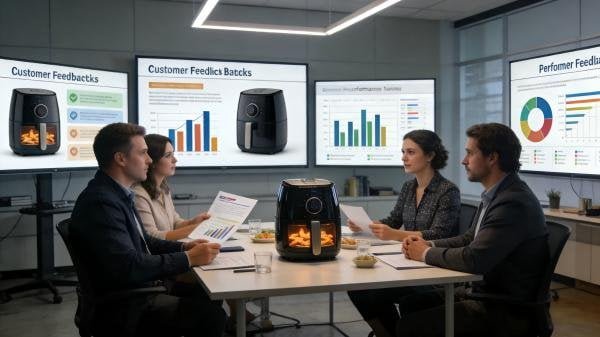
We often provide clients with comparison sheets to illustrate these differences. It’s not about finding the highest number for every spec; it’s about finding the right balance. For example, a square basket offers more usable surface area than a round one of the same quoted capacity. You have to look past the headline number and understand how the specifications work together to create a better cooking experience.
Create a Comparison Checklist
Use a simple table to organize the data from each potential supplier. This will help you visualize the differences and identify the superior product.
| Specification | Model A (Supplier 1) | Model B (Supplier 2) | Model C (Supplier 3) |
|---|---|---|---|
| Wattage | 1500W | 1700W | 1500W |
| Capacity (Quarts) | 5.5 qt | 5.8 qt | 5.5 qt |
| Basket Shape | Round | Square | Square |
| Max Temperature | 400°F / 200°C | 380°F / 190°C | 400°F / 200°C |
| Key Certifications3 | CE, RoHS | UL listed | CE, UL, RoHS |
| Basket Coating | PFOA-Free Non-stick | Standard Non-stick | Ceramic Coated |
In this example, Model C stands out. While its wattage is the same as Model A’s, its square basket offers more usable space, and it has more comprehensive certifications and a premium basket coating. Model B has higher wattage but falls short on temperature and certifications.
Look for a Balanced System
The best air fryer isn’t the one with the highest wattage or the biggest basket. It’s the one where the heating element, fan, and cooking chamber are engineered to work together as a balanced system. A powerful 1800W heater paired with a slow, inefficient fan will create hot spots and uneven cooking. Conversely, a great fan can’t compensate for an underpowered heating element. Ask suppliers how these components are matched in their design.
What questions should I ask suppliers about air fryer performance and safety?
A spec sheet only tells part of the story. To truly understand a product’s quality and the supplier’s capability, you need to ask targeted questions that go beyond the basic numbers.
Ask suppliers specific questions about their quality control on key components. Inquire about the heating element’s expected lifespan, the brand and PFOA-free status of the non-stick coating, and their in-production testing for temperature accuracy and overheat protection functions. These questions reveal their attention to detail.
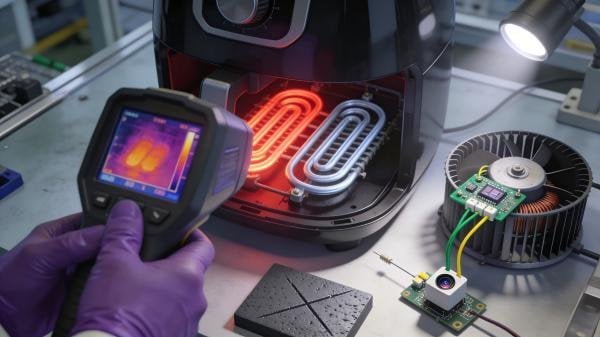
When a potential partner asks us these types of questions, we know they are serious about quality. On our production lines, every single unit undergoes a functional test where we check temperature calibration and safety shut-offs. We are always prepared to share details about our component suppliers and QC processes. A supplier who gives vague answers to these questions is a major red flag.
Key Questions for Your Supplier
Be direct and specific. A professional manufacturer will have ready answers.
- Heating Element: "What is the material and expected service life of your heating element? What are your QC tests for it?" A good answer will specify the material (e.g., nichrome) and an expected lifespan in hours, plus mention tests like resistance and power checks.
- Basket Coating: "Is the non-stick coating PFOA and BPA-free? Can you provide the certification for the coating material?" They should immediately confirm its safety compliance and be able to produce the documentation.
- Temperature Accuracy: "What is the temperature tolerance for your air fryers? How do you test this during production?" A quality manufacturer will specify a tight tolerance (e.g., +/- 5°C) and describe a calibration check during assembly.
- Safety Features: "Can you detail the over-temperature protection mechanism? At what temperature does it activate?" They should explain that a thermal fuse or sensor automatically cuts power if the unit exceeds a safe temperature (usually around 250°C).
A supplier’s ability to answer these questions confidently demonstrates their technical expertise and commitment to quality.
How do I ensure the specifications meet my market’s requirements?
Choosing a product with great specs is useless if it doesn’t comply with your country’s legal and electrical standards. This is a common and costly mistake when sourcing from China.
To ensure compliance, first identify your market’s mandatory electrical standards (voltage and plug type) and required safety certifications (e.g., UL for the US, CE for the EU). Then, demand copies of these specific, valid certificates from the supplier and verify their authenticity on the issuing body’s website.
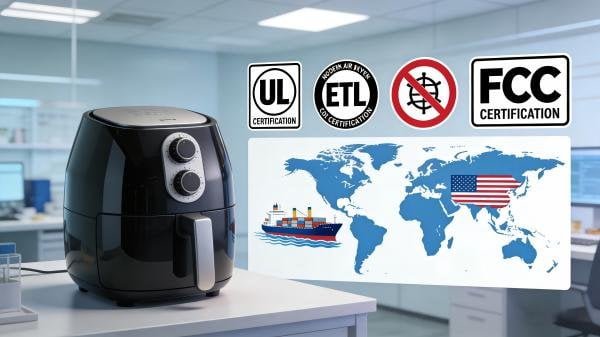
We manufacture for clients all over the world, and the first step in any new project is confirming the target market’s requirements. We maintain a database of these standards to ensure every shipment is 100% compliant. Never assume a supplier knows your market’s rules. It is your responsibility to specify what you need, and their responsibility to prove they can deliver it.
Electrical and Plug Standards
This is the most basic requirement. An air fryer designed for China’s 220V grid will be underpowered or not work at all on the 120V grid in North America. Make sure the product is built for your specific voltage and comes with the correct plug type.
Mandatory Safety Certifications
Certifications are non-negotiable proof of safety and quality. They are a legal requirement for market access.
| Region | Voltage | Key Certifications | What They Cover |
|---|---|---|---|
| North America | 120V / 60Hz | UL / ETL | Electrical safety, fire and shock risk. |
| European Union | 220-240V / 50Hz | CE (LVD, EMC, RoHS) | Electrical safety, electromagnetic compatibility, hazardous substances. |
| LFGB | Food-contact material safety (especially for Germany). | ||
| Australia/NZ | 230V / 50Hz | RCM | Electrical safety and EMC. |
Always request the actual certificate and test report. Look for the certificate number and verify it in the online database of the issuing organization (e.g., UL’s Product iQ database). A supplier claiming a product "meets CE standards" without providing a valid certificate is not compliant.
Conclusion
Understanding an air fryer’s technical specifications is crucial for sourcing a quality product. Focus on the balanced system of wattage, basket design, temperature, and fan speed, and always verify the safety certifications for your specific market.
-
Understanding wattage helps you choose an air fryer that cooks food evenly and quickly, ensuring delicious results. ↩ ↩
-
Exploring this topic reveals how design impacts cooking efficiency and food quality, enhancing your air frying experience. ↩
-
Understanding air fryer certifications ensures safety and quality, helping you choose a reliable product. ↩