

Finding your next best-selling air fryer is exciting. But a poorly planned budget can erase your profits before you even start. We’ve seen it happen, and it’s completely avoidable.
To set an air fryer budget, you must look beyond the factory price. A successful budget includes the unit cost, shipping, import duties, taxes, and a reserve for unexpected expenses. This total figure is known as the "landed cost," which reflects your true investment per unit.
Understanding every cost component is key to ensuring your product launch is profitable. Let’s break down exactly what you need to account for.
What costs should I include when budgeting for air fryer procurement from China?
When we develop a new air fryer model, we consider every component, from the heating element to the plastic housing. You should apply this same detailed approach to your procurement budget.
Your budget must include the Ex-Works (EXW) or Free on Board (FOB) unit price, ocean or air freight, customs duties, local taxes (like VAT/GST), port fees, and inland transportation. These components together form the total cost of goods.
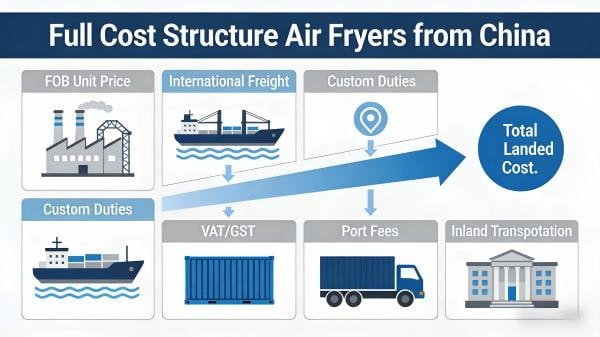
When you budget for air fryer procurement, it’s crucial to think past the price tag you see on a supplier’s quote. The initial unit price is just the beginning of the story. A comprehensive budget provides a clear picture of your total investment and helps you set a competitive retail price while protecting your profit margins.
H3: Core Cost Components
The first and most obvious cost is the price of the air fryer itself. This is often quoted as either EXW (Ex-Works) or FOB (Free on Board)1. EXW means you are responsible for all costs from our factory door. FOB means we handle the costs of getting the goods to the designated port in China. For most international buyers, FOB is a more convenient starting point. This unit price is influenced by factors like materials, capacity, digital vs. manual controls, and certifications (e.g., CE, ETL).
H3: Logistics and Import Fees
Next are the logistics costs. This includes international freight (sea or air), insurance, and destination port charges. Sea freight is more economical for bulk orders but takes longer. Air freight is faster but significantly more expensive, usually reserved for urgent stock or high-value samples. Once the goods arrive in your country, you must pay customs duties and taxes. These rates vary dramatically by country and product classification. A freight forwarder can provide accurate estimates for these costs.
Here is a table breaking down the essential budget items:
| Cost Category | Description | How to Estimate |
|---|---|---|
| Unit Cost (FOB) | The price per air fryer from the factory, including transport to the Chinese port. | Get quotes from suppliers. |
| International Freight | The cost to ship goods from the port in China to your country’s port. | Contact a freight forwarder. |
| Customs Duties2 | A tax imposed on imported goods by your government. | Check your country’s tariff schedule. |
| Taxes (VAT/GST) | Sales tax applied at the time of import. | Consult your accountant or customs broker. |
| Inland Transport | The cost to move goods from the destination port to your warehouse. | Get quotes from local trucking companies. |
How can I estimate the total landed cost of air fryers?
We often have clients who are surprised by the final cost per unit. Estimating your total landed cost accurately is the only way to avoid this. It’s your true cost per item.
To estimate the total landed cost, sum the product cost (FOB price), international shipping, insurance, customs duties, and local delivery fees. Then, divide this total by the number of units ordered. This gives you the true cost per air fryer.
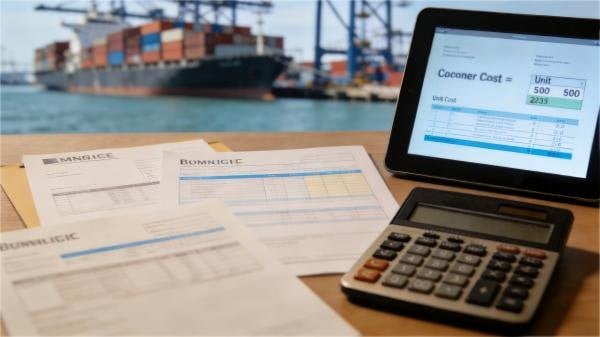
The landed cost is the most critical number for your business. It determines your pricing strategy, gross margin, and ultimately, your profitability. Failing to calculate it correctly can lead to selling products at a loss. Let’s walk through a practical example to make it clear.
H3: The Landed Cost Formula
The basic formula is simple:
Landed Cost per Unit3 = (Total Product Cost + Total Shipping & Logistics Costs + Total Duties & Taxes) / Number of Units
Let’s break this down with a hypothetical order. Imagine you are purchasing 500 mid-range air fryers from us.
H3: Sample Calculation
Here is a step-by-step calculation to illustrate the process. These figures are examples; your actual costs will vary. Always get firm quotes from your supplier and freight forwarder.
| Cost Element | Calculation | Amount |
|---|---|---|
| FOB Product Cost | 500 units x $40/unit | $20,000 |
| Ocean Freight & Insurance | (From China to USA West Coast) | $2,500 |
| Customs Duties | 2.7% of Product Cost ($20,000) | $540 |
| Port & Brokerage Fees | (Destination port handling) | $400 |
| Inland Trucking | (Port to your warehouse) | $600 |
| Total Investment4 | Sum of all costs | $24,040 |
| Landed Cost Per Unit | $24,040 / 500 units | $48.08 |
As you can see, the initial $40 unit price becomes a $48.08 landed cost. This 20% increase is your true cost of acquisition. Basing your pricing on the $40 FOB price would have severely damaged your profit margin.
What strategies can I use to optimize my procurement budget?
During our product development cycles, we constantly look for ways to optimize costs without sacrificing quality. You can apply the same mindset to your procurement process to maximize your budget’s effectiveness.
Optimize your budget by increasing order volume for lower unit prices, choosing sea freight over air, and consolidating shipments. Partnering with a manufacturer who offers flexible ODM services can also reduce long-term development costs.
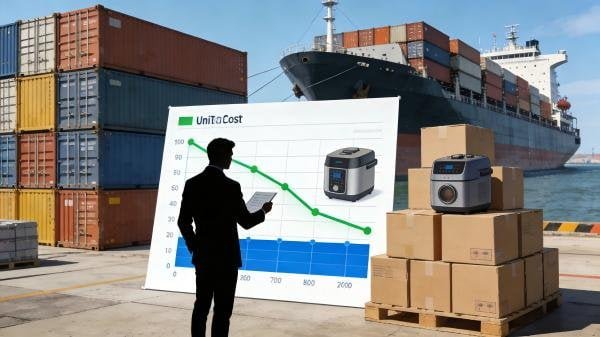
Optimizing your budget is a continuous effort, not a one-time task. It involves making strategic decisions at every stage of the procurement process. Small adjustments can lead to significant savings, especially when ordering in large volumes.
H3: Leverage Economies of Scale
The most straightforward way to reduce your per-unit cost is to order more. Manufacturing involves fixed setup costs for tooling and production line calibration. When you place a larger order, these fixed costs are spread across more units, lowering the price of each one. When discussing orders with us, always ask for a tiered pricing structure (e.g., prices for 500, 1000, and 2000 units). The savings can be substantial.
H3: Plan Your Logistics
Logistics is a major cost center. Rushing orders with air freight is a budget killer. Instead, plan your inventory needs well in advance to take advantage of slower, cheaper sea freight. If you are importing multiple products from China, consider using a consolidation service. A third-party logistics provider can group your smaller shipments into one full container, significantly reducing your per-cubic-meter shipping cost.
H3: Smart Product Customization (ODM)
While it may seem counterintuitive, investing in ODM (Original Design Manufacturing) can save money long-term. Instead of buying a generic, off-the-shelf product, you can work with us to modify an existing design. You might choose a slightly more cost-effective material for the housing or remove a feature your target market doesn’t value. This "value engineering" process creates a unique product at an optimal price point, giving you a competitive edge.
We’ve seen promising partnerships sour because of unexpected costs. A good manufacturer is transparent, but you must also be vigilant. Hidden expenses often appear after you’ve committed to an order.
Account for hidden expenses by adding a 5-10% contingency fund to your budget. Proactively ask suppliers about costs for samples, custom packaging, third-party quality inspections, and potential currency fluctuation risks before finalizing your order.
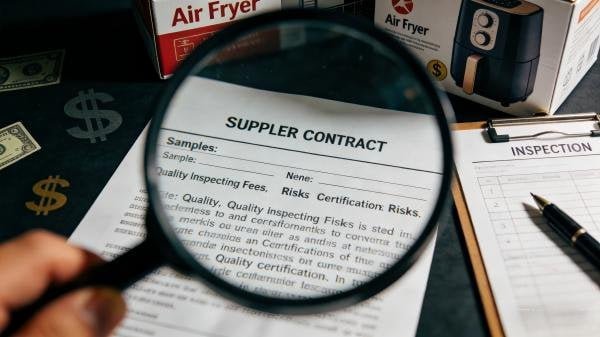
Hidden costs are dangerous because they are not on the initial quote. They can pop up at various stages, from pre-production to final delivery. The key to managing them is awareness and proactive questioning. Don’t assume anything is included unless it is explicitly stated in your purchase agreement.
H3: Pre-Production and Quality Control Costs
Before mass production begins, you’ll likely need samples. While some suppliers offer free samples, you almost always have to pay for expensive international courier fees. If you require custom packaging with your own branding, there will be design fees and printing plate costs. Furthermore, we always recommend hiring a third-party Quality Control (QC) agent to inspect your goods before they leave our factory. While our internal QC is rigorous, an independent inspection provides peace of mind and is a crucial business expense.
H3: Financial and Post-Shipment Risks
Currency fluctuations can also be a hidden cost. If your payment is in USD but the supplier’s costs are in RMB, a shift in the exchange rate between placing the order and making the final payment can increase your price. Discuss payment terms and currency with your supplier. Finally, consider potential costs for product returns or warranty claims. Even with the best quality control, defects can happen. Having a small fund set aside for managing post-sale issues is a prudent financial strategy.
Here is a checklist of common hidden costs to discuss with your supplier:
| Hidden Cost Category | Questions to Ask Your Supplier |
|---|---|
| Samples | "Is the sample unit free? What is the estimated courier cost to my location?" |
| Custom Packaging | "Are there one-time setup fees for custom boxes? What is the MOQ for branded packaging?" |
| Third-Party QC | "Do you permit third-party inspections at your facility? Is there a fee for this?" |
| Payment Fees | "What are the fees for a wire transfer (T/T)? Do you accept other payment methods?" |
| Certifications | "Does the quoted price include the cost of ETL/CE certification for my market?" |
| Spare Parts | "Is an initial stock of spare parts for warranty purposes included in the price?" |
Conclusion
Setting a proper budget is more than just finding the cheapest price. It involves a detailed analysis of all costs to determine your true landed cost and ensure long-term profitability.
-
Understanding FOB is crucial for international shipping, as it defines cost responsibilities and can save you money. ↩
-
Learn about customs duties to avoid unexpected costs and ensure compliance with import regulations. ↩
-
Understanding Landed Cost per Unit is crucial for accurate pricing and profit margin calculations in international trade. ↩
-
Calculating Total Investment helps businesses assess their overall costs and make informed financial decisions. ↩