
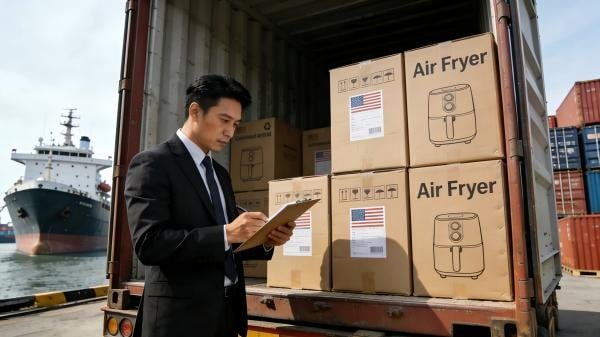
Choosing a supplier without US export experience can lead to costly customs delays and compliance failures. We’ve seen buyers get stuck with unsellable inventory. You need a reliable method to verify their claims.
To verify a supplier’s US export experience, check third-party trade databases like Panjiva for shipment history. Also, request redacted documents like a Bill of Lading (B/L) from a past US shipment and test their knowledge of mandatory US certifications like UL/ETL and FCC.
Let’s break down the exact steps you can take to confidently vet any potential supplier.
What questions should I ask to confirm a supplier’s US export experience?
You’re on a call with a potential supplier, but asking generic questions yields vague, unhelpful answers. You need to cut through the sales pitch and ask things that only a true, experienced exporter can answer confidently.
Ask about their primary US ports, freight forwarders, and typical shipment volumes to the US. Crucially, inquire about their familiarity with UL/ETL safety standards and FCC regulations for air fryers, and ask if they can provide redacted Bills of Lading as proof.
The quality of your questions determines the quality of your supplier. An experienced partner will have ready answers for specific operational, logistical, and compliance-related inquiries. In our experience, vague responses are a major red flag. When we onboard new clients, we proactively provide this information because we know it builds trust. An inexperienced supplier, on the other hand, will often stumble or give generic replies.
H3: Key Question Categories
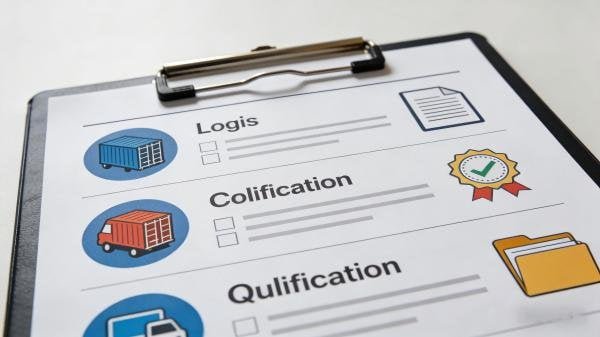
You should structure your questions around three core areas: logistics, compliance, and customer history. This approach gives you a complete picture of their capabilities.
- Logistical Questions1: These questions test their practical knowledge of the shipping process. A factory that ships to the US regularly will know the ins and outs of ports, transit times, and documentation.
- Compliance Questions2: These are non-negotiable. An air fryer that isn’t compliant with US standards is a liability. Their knowledge here is critical.
- Historical Questions: These questions verify their track record. While they may be hesitant to share customer details, their ability to produce other forms of evidence speaks volumes.
Use the table below to guide your conversation.
| Category | Key Question | What to Look For in the Answer |
|---|---|---|
| Logistics | "Which US ports do you ship to most frequently?" | Specific ports (e.g., Los Angeles/Long Beach, New York/New Jersey, Savannah). Vague answers like "all major ports" are a warning sign. |
| Logistics | "Which freight forwarders do you partner with for US shipments?" | Naming established freight forwarders (e.g., Kuehne + Nagel, Flexport). This shows they have existing relationships. |
| Compliance | "What US certifications, like UL or ETL, do your air fryers have?" | Confident, immediate confirmation and readiness to provide certification numbers or documents. They should understand these are mandatory. |
| History | "Can you provide a redacted Bill of Lading from a recent US shipment?" | Willingness to provide the document with sensitive customer info blacked out. This is direct proof of export activity. |
How can I check if the supplier understands US compliance and logistics requirements?
A supplier might claim they ship to the US, but do they truly understand the dense web of regulations? A simple mistake in compliance or logistics can get your entire shipment detained by US Customs, wiping out your profits.
Verify compliance by discussing specific certifications like UL or ETL for electrical safety and FCC for electronic interference. A knowledgeable supplier will have test reports ready. For logistics, ask which Incoterms they prefer for US shipments and how they handle customs clearance.
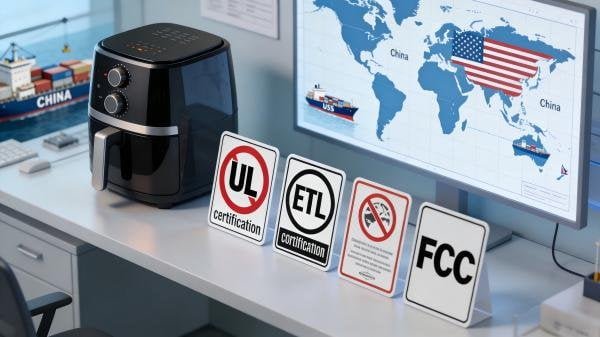
From our production lines, every component and design choice is made with global compliance in mind. For the US market, this isn’t just a suggestion—it’s a requirement. A supplier who treats UL/ETL certification as an optional add-on does not have real US export experience. They must understand that these standards are fundamental to product safety and market access. Similarly, their grasp of logistics should go beyond just getting the product on a boat.
H3: Verifying Compliance Knowledge
The US has some of the strictest product safety and electronics standards in the world. Your supplier must be an expert in them.
- Electrical Safety (UL/ETL)3: Air fryers are heating appliances that pose a fire risk if not properly manufactured. UL (Underwriters Laboratories) and ETL (Intertek) are the primary certifications that verify a product’s safety for US consumers. Your supplier must be able to provide a valid certificate number for the specific model you are interested in.
- Electronics Emissions (FCC)4: Modern air fryers contain digital controllers and displays that can emit radio frequencies. The Federal Communications Commission (FCC) requires these devices to be tested to ensure they don’t interfere with other electronic devices. Ask for the FCC declaration of conformity.
- Food-Contact Materials (FDA): The basket and any surfaces that touch food must be made from materials that are compliant with Food and Drug Administration (FDA) regulations. The supplier should be able to provide material safety data sheets (MSDS) or test reports proving this.
H3: Assessing Logistical Expertise
Experienced suppliers have a streamlined process for getting goods from their factory in China to your warehouse in the US.
- Incoterms: Ask them what Incoterms they typically use. Most experienced suppliers work with FOB (Free On Board) or EXW (Ex Works), but their ability to discuss the pros and cons of others like DDP (Delivered Duty Paid) shows a deeper understanding.
- Customs & Tariffs: A seasoned exporter will be familiar with the Harmonized System (HS) codes for air fryers and can advise on current US tariffs and duties. They should also have a relationship with a reliable customs broker.
What documentation should I request to verify their export history?
Talk is cheap, and a slick sales presentation doesn’t prove anything. Without concrete evidence, you are basing a massive business decision on trust alone—a risky move when sourcing from overseas.
To get undeniable proof, request redacted copies of three key documents from a previous US shipment: a Bill of Lading (B/L), a Commercial Invoice, and a Packing List. These documents form a paper trail that is difficult to fake and proves real-world experience.
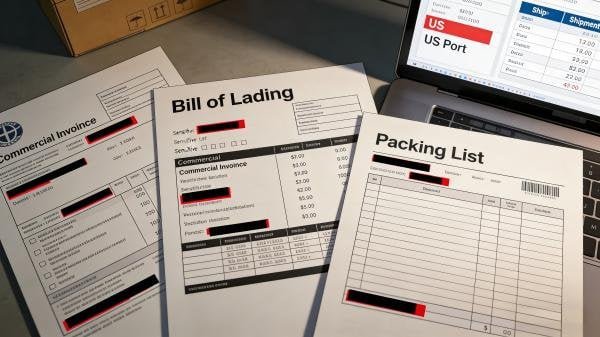
When a new B2B client asks us for proof of our export capabilities, we understand the need for verification. While we must protect our existing clients’ confidentiality, we have a standard procedure to provide redacted shipping documents. This transparency builds confidence. A supplier that refuses to provide any documentation, citing "confidentiality" for every detail, is often hiding a lack of experience. Be persistent but reasonable in your request; you don’t need their customer’s name, just proof that the shipment happened.
H3: The Trio of Essential Documents
Each of these documents serves a unique purpose in the shipping process, and together they create a verifiable record of a past export.
- Bill of Lading (B/L): This is the single most important document. It is a legal contract between the shipper and the carrier, detailing the type, quantity, and destination of the goods. Ask for a B/L from a shipment within the last 12 months. The shipper’s name should match the supplier’s, and the destination port should be in the US.
- Commercial Invoice: This is the bill for the goods sent from the seller to the buyer. It includes a detailed description of the products, their value, and the HS codes. It confirms they have experience correctly valuing and classifying air fryers for US customs.
- Packing List: This document provides the details of the shipment’s contents, including the weight, dimensions, and number of cartons. It shows they are capable of preparing goods for international transit and providing the necessary information for customs and logistics handlers.
| Document | What It Proves | Key Details to Check |
|---|---|---|
| Bill of Lading (B/L) | That a shipment actually occurred. | Shipper Name, Consignee (can be redacted), US Port of Discharge, Vessel Name, Date of Shipment. |
| Commercial Invoice | Knowledge of product classification and valuation for customs. | Product Description ("Air Fryer"), HS Code, Unit Value, Shipper/Seller Name. |
| Packing List | Experience in preparing goods for international shipping. | Carton quantities, Net/Gross Weight, Dimensions. This confirms they can manage physical logistics. |
How do I assess their familiarity with US market standards?
Your supplier might be able to ship a compliant product, but do they understand the US consumer? A product that is technically safe but fails to meet market expectations for performance, features, or usability will lead to poor reviews and high return rates.
Assess their US market familiarity by discussing common consumer pain points, like uneven cooking or peeling non-stick coatings. Ask them how their product design and quality control processes specifically address these known issues for the American market.

During our own R&D for new air fryer models, we don’t just focus on engineering a product that works. We study US market trends, analyze top-selling models on Amazon, and read thousands of customer reviews. This informs our design choices, from the user interface on the digital display to the durability of the non-stick coating on the basket. A supplier who is truly invested in the US market will be able to have this kind of detailed conversation with you. They won’t just be a factory; they will be a partner who understands your end customer.
H3: Beyond Technical Specifications
Familiarity with the US market goes deeper than just hitting a certain wattage or temperature range.
- User Experience (UX): Ask them about the intuitiveness of their controls. Are the presets based on popular American foods? Is the manual easy to understand for a native English speaker? Suppliers who only sell in their domestic market often overlook these subtle but critical details.
- Performance Expectations: US consumers expect fast pre-heating, even cooking, and crispy results. Discuss how their fan and heating element technology achieves this. Ask for performance test data comparing their models to popular US brands.
- Durability and After-Sales Support: High return rates can kill your business. Ask about their quality control process for common failure points, such as basket coatings, drawer mechanisms, and electronic controls. What is their warranty policy and how do they handle spare parts for US-based customers?
H3: Using Trade Data to Verify Claims
While you ask these qualitative questions, you can use quantitative data to back them up. Services like Panjiva or ImportKey allow you to search for a supplier’s name and see their actual shipment history into the US. This is objective, third-party data pulled from US Customs records.
| Data Platform | What to Look For | How It Helps |
|---|---|---|
| Panjiva | Consistent shipment history over several years. | Shows they are not a one-time exporter but have an established business shipping to the US. |
| ImportKey | Volume and frequency of shipments. | A supplier shipping hundreds of containers a year is more experienced than one shipping a few. |
| Volza | List of buyers (sometimes available). | If they ship to known US brands or retailers, it’s a strong sign of their quality and reliability. |
By combining direct questions with objective data, you can build a comprehensive and reliable assessment of a supplier’s true experience with the US market.
Conclusion
Verifying a supplier’s US export experience requires more than taking their word for it. By asking targeted questions, requesting specific documents, and using trade data, you can confirm their capabilities and protect your investment.
-
Logistics play a vital role in shipping efficiency. Discover key logistical questions to ask for better shipping outcomes. ↩
-
Understanding compliance is crucial for ensuring product safety and legality. Explore this link to learn more about essential compliance inquiries. ↩
-
Understanding UL/ETL certification is crucial for ensuring product safety and compliance in the US market. ↩
-
Exploring FCC requirements helps ensure your products meet necessary standards and avoid interference issues. ↩