

Are you finding it hard to get a fair price on air fryers without risking quality? From our production lines, we see buyers struggle with this balance, hurting their margins or products.
You can get better prices on air fryers from China by preparing thoroughly, demonstrating long-term partnership potential, and negotiating on factors beyond just the unit cost. The goal is a fair agreement that protects quality and strengthens the supplier relationship for future business.
This process might seem complex, but it’s straightforward if you break it down. Let’s explore the key strategies to help you secure a great deal.
What strategies are effective for negotiating air fryer prices?
Many buyers focus solely on getting the lowest unit price. In our experience, this is a limited approach that often misses opportunities for better overall value and can strain the partnership.
Effective strategies include leveraging order volume, bundling different products, and negotiating on payment terms, packaging, or included spare parts. Showing a clear plan for future business makes suppliers more flexible, creating value beyond a simple price cut.
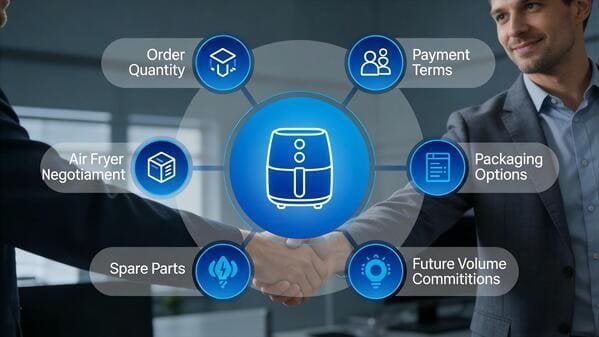
To secure the best deal, you need to think like a partner, not just a customer. Suppliers are more willing to make concessions for buyers who offer long-term, stable business. Pushing for an unsustainably low price only encourages factories to cut corners, which is especially risky with electrical appliances like air fryers. Instead, focus on creating a larger pie for everyone to share.
Leverage Quantity and Future Business
One of the most direct ways to get a better price is by increasing your order quantity1. Our pricing, like that of most manufacturers, is structured in tiers. An order for 5,000 units will naturally have a lower per-unit cost than an order for 500. Before you start, ask for the supplier’s price tiers.
If you can’t commit to a large initial order, frame the discussion around your annual purchasing volume. A clear forecast (e.g., "we plan to order 2,000 units over the next 12 months") shows the supplier the long-term value of your business. You can also bundle different models—perhaps two types of air fryers and one blender—to increase the total order value and unlock better pricing.
Negotiate Beyond the Unit Price
If a supplier is firm on their unit price, explore other areas where they can add value. This approach shows you respect their costing but are still looking for a commercially viable deal. Consider negotiating on the following points:
- Payment Terms2: The standard is often a 30% deposit and 70% before shipment. You could offer a 50% deposit for a 1-2% discount or, if you have an established relationship, ask for terms like 30% deposit, 40% before shipment, and 30% after delivery.
- Packaging: A custom-designed color box can be a significant cost. Ask if they can include it for free or at a reduced price.
- Free Spare Parts: Request a higher percentage of free spare parts (e.g., 2% instead of the standard 1%), which can lower your long-term service costs.
- Incoterms3: Ask if they can cover inland transportation to the port (FOB) at no extra cost.
| Negotiation Point | Standard Offer | Potential Negotiation Goal |
|---|---|---|
| Unit Price | Standard quote based on MOQ | 5-10% discount for higher volume or better terms |
| Payment Terms2 | 30% deposit, 70% before shipment | 50% deposit for a discount, or partial payment post-delivery |
| Packaging | Standard brown export carton | Included custom-designed color box at no extra cost |
| Spare Parts | 1% of order value (FOC) | 2% of order value (FOC) to reduce after-sales costs |
How can I prepare for price negotiations with Chinese suppliers?
We often receive inquiries from buyers who start negotiating without any preparation. This immediately puts them at a disadvantage, as they have no baseline to judge whether an offer is fair, good, or poor.
To prepare, thoroughly research realistic factory prices on platforms like Alibaba and 1688. Define your target price and walk-away point, and identify at least five alternative suppliers. This groundwork gives you the confidence and leverage needed for a successful negotiation.
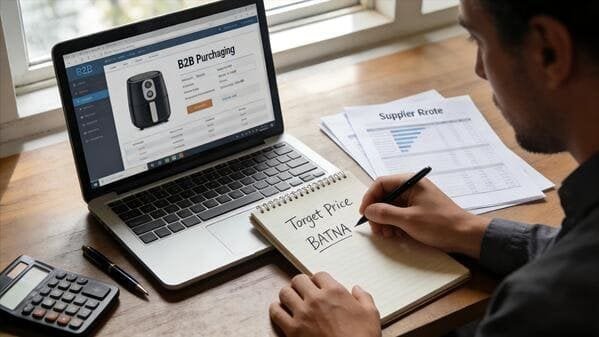
Preparation is 90% of a successful negotiation. When a potential partner comes to us with a clear understanding of the market, their requirements, and their budget, the conversation becomes much more productive. It shifts from a simple price haggle to a collaborative discussion about building a product that meets their market needs at a feasible cost.
Research Realistic Market Prices
Before contacting any supplier, you need a solid understanding of the price range for the air fryer4 you want. Use platforms like Alibaba, Made-in-China, and even 1688 (Alibaba’s domestic B2B site) to see what similar models cost. Remember that listed prices are often just a starting point.
Request quotes from at least 5-10 different suppliers for the same product specifications. This will give you a realistic average and help you identify outliers—both those who are too expensive and those who are suspiciously cheap. A price that seems too good to be true often indicates compromises in materials, components, or certifications.
Define Your Negotiation Parameters
Don’t go into a negotiation without clear goals. You must define three key numbers:
- Target Price: The ideal price you want to achieve.
- Best Alternative to a Negotiated Agreement (BATNA): Your backup plan. This is usually the best offer from another qualified supplier.
- Walk-Away Point: The absolute maximum price you are willing to pay. If the supplier can’t meet this, you must be prepared to walk away.
Having these defined gives you a clear framework. It prevents you from making emotional decisions and allows you to stay in control of the conversation.
| Preparation Step | Description | Key Action |
|---|---|---|
| Market Research | Understand the typical price range for your desired air fryer4. | Get quotes from 5-10 suppliers; check B2B platforms5. |
| Supplier Vetting | Focus on real manufacturers, not just trading companies. | Check business licenses, factory audits, and product range. |
| Define Price Points | Set your target, BATNA, and walk-away price. | Write these numbers down and stick to them. |
| Identify Trade-offs | Know what you can concede (e.g., higher MOQ for lower price). | List potential non-price concessions like packaging or terms. |
What factors influence the final price agreement?
Buyers sometimes assume price is only about materials and labor. While those are major factors, from our factory’s perspective, the final price is also shaped by risk, relationship potential, and overall order complexity.
Key factors influencing the price include order quantity, product specifications, material costs, payment terms, and the supplier’s perception of you as a long-term partner. A stable, predictable client often receives better pricing than a one-time, high-maintenance buyer.
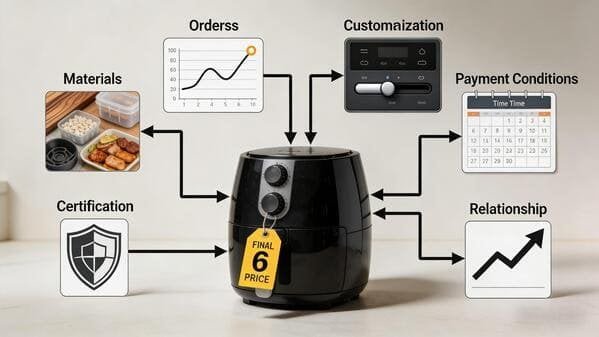
The final price is a reflection of the total value proposition. A buyer who communicates clearly, provides detailed specifications, and shows potential for repeat business is less "costly" for us to work with. This efficiency is often reflected in the price. On the other hand, frequent changes, unclear requirements, and unrealistic demands increase our operational costs and risks, which can lead to a higher quote.
Tangible vs. Intangible Factors
The final price is a mix of hard costs and softer, relationship-based elements.
Tangible Factors:
- Bill of Materials (BOM)6: The cost of raw materials (plastic, steel) and key components (heating element, motor, PCB) is the biggest driver. Volatile commodity markets can impact quotes.
- Order Quantity (MOQ): As discussed, higher volumes allow for better economies of scale in both material purchasing and production efficiency.
- Customization: Complex or unique design changes require new molds or engineering work, which adds to the cost. A standard model will always be cheaper.
- Certifications: Requirements like ETL for North America or CE for Europe add testing and compliance costs.
Intangible Factors:
- Relationship Potential7: If a supplier believes you will become a key account with steady, recurring orders, they are more likely to offer a competitive price on the first order to win your business.
- Ease of Doing Business: Clear communication, prompt feedback, and organized purchase orders make you an attractive client. This "low friction" partnership is valuable and can result in more favorable terms.
- Brand Reputation: A well-known brand or a buyer with a proven track record may get better pricing, as the supplier sees it as a lower-risk partnership.
Understanding both sides of this equation helps you position yourself as the ideal client that suppliers want to keep.
How do I ensure a win-win outcome in price discussions?
A negotiation should not be a battle where one side wins and the other loses. When we are forced into a price that is too low, quality inevitably suffers. The goal is a sustainable partnership.
Ensure a win-win outcome by focusing on a fair price that allows the supplier to maintain quality standards. Be respectful, communicate your long-term vision, and confirm all details in a legally binding Purchase Order (PO) to protect both parties.
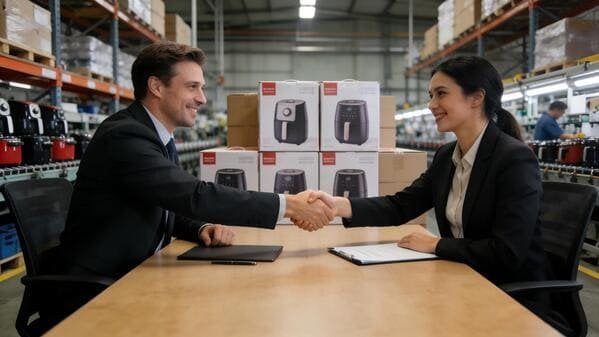
The best business relationships we have are with partners who understand that our success is tied to theirs. They don’t push for the lowest possible price; they push for the best possible value. This means getting a quality product that performs reliably, delivered on time, at a price that allows both of us to profit.
Protect Quality and the Relationship
The most dangerous thing a buyer can do is push a supplier’s price below their break-even point. When this happens, the factory has two choices: refuse the order or accept it and find ways to cut costs. For an air fryer, this could mean using a cheaper plastic that doesn’t withstand heat well, a lower-grade heating element that fails prematurely, or skipping critical quality control8 steps. This is a lose-lose situation.
Always frame the negotiation around partnership. Use language like, "How can we work together to reach our target price of $X?" instead of "Your price is too high." Acknowledge their expertise and ask for suggestions on how to reduce costs without compromising the product’s integrity. For example, "Is there a different material or component we could use to make this more cost-effective?"
Formalize the Agreement
Once you’ve agreed on all terms, formalize everything in a detailed Purchase Contract9 and Purchase Order. This document is your ultimate protection. It should include:
- Detailed product specifications
- Agreed-upon unit price and total value
- Packaging requirements
- Payment and Incoterms
- Production lead time and delivery date
- Quality standards and inspection criteria
- Penalties for delays or quality failures
A clear, comprehensive PO prevents misunderstandings and ensures both parties are aligned. It transforms a verbal agreement into a binding commitment, which is the foundation of a professional and lasting business relationship.
Conclusion
Negotiating air fryer prices is about more than just numbers. It requires preparation, strategic thinking, and a focus on building a long-term, win-win partnership with your Chinese supplier.
-
Understanding how order quantity affects pricing can help you negotiate better deals with suppliers. ↩
-
Exploring common payment terms can provide insights into negotiating favorable conditions with your suppliers. ↩ ↩
-
Understanding Incoterms is crucial for negotiating shipping costs and ensuring better terms with suppliers. ↩
-
Explore this link to understand the price range and features of various air fryers available in the market. ↩ ↩
-
This resource will guide you through the top B2B platforms, helping you find reliable suppliers. ↩
-
Exploring this link will deepen your understanding of BOM’s role in cost management and production efficiency. ↩
-
This resource will provide insights into how building strong supplier relationships can lead to better pricing and terms. ↩
-
Exploring quality control best practices can help you maintain product integrity and avoid costly mistakes in production. ↩
-
Understanding Purchase Contracts is crucial for protecting your interests in business deals and ensuring clarity in agreements. ↩