

Sourcing air fryers from China feels like a huge opportunity, but what if a bad shipment ruins your brand? From our production lines, we see how a solid plan prevents this.
Developing a risk response plan involves identifying key procurement risks like quality, safety, and supply chain disruptions. You then create mitigation strategies, such as supplier vetting, quality inspections, and clear contract terms, to protect your investment and ensure product compliance and safety.
Let’s break down how to build a robust plan that secures your supply chain and protects your business.
What risks should I consider when importing air fryers from China?
Worried about hidden defects in your shipment? A faulty wire or a toxic coating can lead to costly recalls and damage your reputation. Understanding the specific risks is the first step to protection.
Key risks include electrical faults, unsafe materials like PFOA in coatings, and performance failures that can create health concerns like acrylamide. Also, consider supply chain disruptions, intellectual property theft, and non-compliance with mandatory safety standards like UL or CCC.
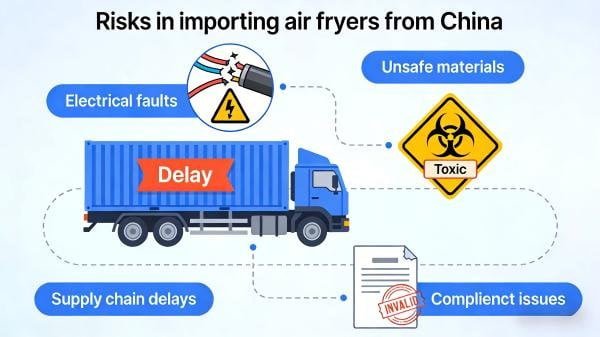
When we manufacture air fryers for our clients, we focus heavily on mitigating risks before they become problems. You should be aware of several categories of risk.
Electrical and Fire Hazards
Electrical safety is non-negotiable. Poorly assembled units can lead to significant fire hazards. Common issues include inadequate wiring insulation, faulty thermostats that fail to prevent overheating, and the use of uncertified or counterfeit electrical components. For instance, a power cord that doesn’t meet the standards of your target market (like UL for the US) can be a major liability. During our own quality control, we perform high-voltage tests and earth continuity checks on every batch to ensure these risks are eliminated.
Material and Food Safety Concerns
The materials that come into contact with food are under intense scrutiny. The non-stick coatings on air fryer baskets are a primary concern. If not sourced correctly, they can contain harmful substances like PFOA, which are banned in many regions. Beyond coatings, the plastics used for the housing must be heat-resistant and free from harmful chemicals. We always demand material safety data sheets (MSDS) from our suppliers to verify compliance and ensure food-grade safety for our clients.
Supply Chain and Compliance Risks
Your risks don’t end at the factory gate. Supply chain disruptions can cause significant delays, leading to stockouts and lost sales. Other risks include intellectual property (IP) theft, where a supplier might replicate your unique design for other customers. Furthermore, navigating customs requires strict adherence to regulations. A failure to provide correct certification, like a CCC mark for China or CE for Europe, can result in your entire shipment being seized.
| Risk Category | Specific Example | Potential Impact |
|---|---|---|
| Electrical Safety | Use of non-certified power cords | Product recall, fire hazard, legal liability |
| Material Safety | Non-stick coating contains PFOA | Health risks for consumers, ban on sales |
| Performance | Uneven heating element | Poor cooking results, customer complaints, acrylamide risk |
| Supply Chain | Production delays due to raw material shortage | Stockouts, missed sales seasons, damaged retailer relationships |
| Compliance | Missing required safety certifications1 (e.g., UL, CE) | Shipment seized by customs, fines, market access denied |
| Intellectual Property | Supplier sells your custom design to a competitor | Loss of market exclusivity and competitive advantage |
How can I create a proactive risk management plan?
Are you tired of reacting to problems only after they appear? Waiting for quality issues to surface in customer reviews costs far more than preventing them. A proactive plan puts you in control.
Create a proactive plan by first identifying potential risks through comprehensive supplier audits and factory visits. Then, develop response strategies for each risk, such as mitigation, avoidance, or transfer. Document these in a clear plan with specific actions and responsibilities.

A proactive plan shifts your focus from firefighting to prevention. From our experience, the clients who succeed are those who work with us to build this plan from day one. It doesn’t have to be complicated.
Step 1: Thorough Supplier Vetting
This is your first line of defense. Before placing an order, vet potential suppliers rigorously. Don’t just rely on their website or sales pitch. Ask for business licenses, quality management certifications (like ISO 9001), and previous test reports for similar products. We welcome factory audits because it allows serious buyers to see our production lines, quality control processes, and engineering capabilities firsthand. A supplier who is hesitant to provide documentation or allow a visit is a major red flag. Avoid them.
Step 2: Define Your Quality and Safety Standards
You cannot leave quality to chance. Create a detailed specification sheet that outlines every critical requirement for your air fryer. This should include:
- Key Components: Specify the brand or standard for critical parts like the motor, heating element, and controller.
- Material Requirements: Mandate food-grade, PFOA-free coatings and specific types of heat-resistant plastic.
- Performance Criteria: Define the expected temperature accuracy, heating time, and cooking uniformity.
- Safety Certifications: List the required certifications for your target market (e.g., UL, ETL, CE, RoHS).
This document becomes the foundation for your contract and quality inspections.
Step 3: Map Risks to Response Strategies
For each risk you identified, assign a clear response strategy. The four common strategies are:
- Avoid: Eliminate the risk by making a different choice. For example, avoid suppliers who cannot provide a valid ISO 9001 certificate.
- Mitigate: Reduce the likelihood or impact of the risk. For instance, mitigate quality issues by implementing a multi-stage inspection plan.
- Transfer: Shift the financial impact of the risk to a third party. A classic example is purchasing product liability insurance.
- Accept: If a risk is minor and the cost of mitigation is too high, you may choose to accept it. For example, accepting a small percentage of cosmetic defects.
| Risk Identification Method | Purpose | Best for Detecting |
|---|---|---|
| Factory Audit | Assess supplier’s overall capability and quality systems. | Systemic issues, poor management, lack of traceability. |
| Pre-Production Inspection | Check raw materials and components before mass production. | Use of substandard materials, incorrect components. |
| During Production Inspection (DUPRO) | Monitor processes and check initial products off the line. | Assembly errors, deviations from specifications. |
| Pre-Shipment Inspection (PSI) | Final check of finished goods for quality, quantity, and packing. | Functional defects, cosmetic flaws, packaging errors. |
What contract terms help mitigate procurement risks?
Do you feel your contracts leave you exposed if something goes wrong? A weak agreement can mean you bear all the costs of a supplier’s mistake. It’s time to add clauses that protect you.
Your contract should include specific clauses on quality standards, inspection rights, penalties for delays, and clear terms for intellectual property ownership. Also, define liability for non-compliance with safety regulations and establish a clear process for handling defective products.

The purchase agreement is your most powerful tool for risk mitigation. When we onboard a new client, we work together to create a contract that provides clarity and security for both sides. Your contract should be more than just a price and quantity agreement. It needs to be a detailed playbook for your production.
Quality and Inspection Clauses
Your contract must explicitly reference your detailed specification sheet. Use an Acceptance Quality Limit (AQL)2 to define the maximum number of defects you will tolerate. For example, you might set an AQL of 0 for critical defects, 1.5 for major defects, and 4.0 for minor defects. The contract should also grant you or your designated third-party inspector the right to conduct inspections at various stages, including pre-production, during production (DUPRO), and pre-shipment. Crucially, add a clause stating that final payment is conditional upon the goods passing the pre-shipment inspection.
Penalties for Delays and Non-Compliance
Late delivery can be devastating, especially during peak sales seasons. Your contract should include a penalty clause for shipment delays. A typical clause might specify a penalty of 0.5% to 1% of the order value for each week of delay, up to a maximum cap (e.g., 10%). Similarly, include penalties for failing to meet the agreed-upon quality standards. This could involve the supplier bearing the cost of rework, replacement, or even air freight for urgent replacement parts.
Protecting Your Intellectual Property (IP)
If you’ve invested in a unique design, you must protect it. Your contract should include a clear IP ownership clause stating that all custom molds, designs, and tooling developed for your product belong exclusively to you. An NNN (Non-Disclosure, Non-Use, Non-Circumvention) agreement, drafted by a lawyer specializing in Chinese law, provides stronger protection than a standard NDA. It prevents the supplier from using your IP, selling your product to others, or bypassing you to contact your customers.
How do I monitor and update my risk response strategies?
Feeling confident with your initial plan? Markets change, new regulations appear, and suppliers’ performance can fluctuate. A plan that is not updated is a plan that is destined to fail.
Regularly monitor key performance indicators like defect rates, on-time delivery percentages, and customer feedback. Conduct quarterly reviews of your supplier’s performance and update your risk plan annually or whenever a significant incident occurs to ensure it remains effective.

A risk plan is a living document, not a file-and-forget exercise. In our factory, we have weekly production meetings to review any issues that arose. You should adopt a similar mindset of continuous improvement for your procurement process.
Tracking Key Performance Indicators (KPIs)
Data is your best tool for monitoring. Track metrics that give you a clear view of your supply chain’s health. Key KPIs include:
- Defect Rate3: Track the percentage of defective units found during inspections and reported by customers. A rising trend is an early warning sign.
- On-Time Delivery Rate: Measure how consistently your supplier meets shipping deadlines.
- Supplier Communication4: Rate the supplier’s responsiveness and transparency.
- Customer Feedback: Monitor returns and reviews for recurring product issues.
Use a simple supplier scorecard to track these KPIs quarterly. This provides objective data for performance reviews.
Regular Reviews and Audits
Schedule regular check-ins with your supplier to discuss performance. A quarterly business review is a good cadence. In addition to communication, plan for periodic on-site audits, perhaps annually. An audit allows you to see if the supplier is maintaining the standards you observed during your initial visit. It’s an opportunity to spot potential issues, like worn-out machinery or high staff turnover in the quality department, before they impact your product.
Staying Informed and Adapting
The regulatory landscape is constantly evolving. New safety standards or chemical restrictions can be introduced with little warning. Subscribe to industry newsletters and government agency updates (like the CPSC in the US) to stay informed. When a new risk emerges—for example, a news report about fires caused by a certain type of air fryer—evaluate how it applies to your product. Update your risk plan, specification sheets, and inspection checklists accordingly to adapt to the changing environment.
| Monitoring Activity | Frequency | Purpose |
|---|---|---|
| Track KPIs | Weekly/Monthly | Identify performance trends and early warning signs. |
| Supplier Scorecard | Quarterly | Objectively evaluate and compare supplier performance over time. |
| On-Site Audit | Annually | Verify ongoing compliance, process stability, and management changes. |
| Risk Plan Review | Annually or post-incident | Adapt the plan to new risks, regulations, and business goals. |
| Regulatory Monitoring5 | Continuously | Ensure ongoing compliance with evolving legal and safety standards. |
Conclusion
Developing a risk plan for air fryer procurement isn’t about avoiding China; it’s about engaging smartly. A proactive plan protects your brand, ensures product quality, and builds strong supplier partnerships.
-
Understanding safety certifications is crucial for compliance and market access; this link offers valuable information. ↩
-
Understanding AQL is crucial for setting quality standards in contracts, ensuring you maintain product integrity. ↩
-
Understanding how to calculate Defect Rate can help you identify quality issues early and improve your supply chain. ↩
-
Effective Supplier Communication can lead to better collaboration and performance; discover techniques to enhance your interactions. ↩
-
Staying compliant with regulations is vital for business success; learn best practices for effective Regulatory Monitoring. ↩