

We often see buyers overwhelmed by the sheer number of air fryer options. Choosing the wrong model means wasted investment, excess inventory, and missed opportunities in a competitive market.
To find the right air fryer, you must match its technical specifications—capacity, wattage, structure, and functions—to your target customer, sales channel, and price point. Then, confirm your supplier can reliably and compliantly mass-produce that specific model for your market.
This process seems complex, but it’s straightforward when broken down. Let’s walk through the key factors you need to consider to make a profitable choice.
What factors should I consider to match air fryer models to my market requirements?
Choosing an air fryer without deeply understanding your market is a huge gamble. On our production lines, we’ve seen how even a small mismatch in specifications can lead to poor sales for our clients.
To match an air fryer to your market, first define your end-user (family size, cooking habits) and sales channel (online, retail). Then, decide your price positioning—budget, mid-range, or premium—as this dictates the necessary size, finish, and feature set.
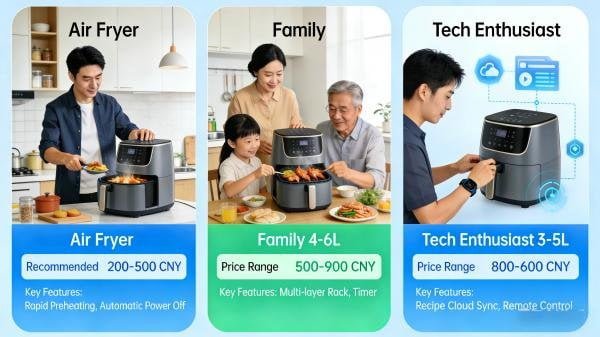
To ensure your product resonates with buyers, you must start with a clear picture of who they are and where they shop. This foundational analysis informs every subsequent decision, from features to pricing. If you get this step right, you build a product that the market is already waiting for.
Know Your End-User and Sales Channel
The first step is always to define your customer. Are you selling to a young couple in a small apartment or a large family in a suburban home? Their needs are vastly different. For households, consider typical family size, cooking habits, and available kitchen counter space. For commercial clients like restaurants or cafes, the focus shifts to daily output volume and menu requirements.
Your sales channel1 also matters. Products sold online often benefit from more features that can be highlighted in listings, while retail products may need to prioritize a striking visual design and compact packaging to stand out on the shelf. In our experience, clients selling on platforms like Amazon need detailed specs and lifestyle photos, whereas those supplying large retail chains focus more on packaging dimensions and in-store appeal.
Define Your Market Positioning
Your brand’s position in the market—budget, mid-range, or premium—is the next critical factor. This decision will directly influence the product’s materials, finish, and functions. A budget-friendly model2 might use basic plastic housing and simple knob controls, while a premium model3 would feature a stainless steel finish, a digital touchscreen, and smart connectivity. Trying to sell a premium-feature product at a budget price will destroy your margins, and a basic product won’t attract premium buyers.
Here’s a simple breakdown:
| Market Position | Target Customer | Key Product Attributes | Typical Materials & Finish |
|---|---|---|---|
| Budget | Price-sensitive individuals, students | Basic functionality, compact size, ease of use | Standard plastics, manual controls, simple design |
| Mid-Range | Families, general consumers | Good capacity, multiple pre-set programs, durability | High-grade plastics, digital display, some metal accents |
| Premium | Tech-savvy users, home chefs | Large capacity, smart features (Wi-Fi), advanced functions (dehydrate, roast) | Stainless steel, glass windows, premium touchscreens |
How can I evaluate the features and specifications that best fit my target customers?
Are you paying for features your customers don’t actually need? In our R&D process, we focus on integrating specs that deliver real value, because over-engineering a product can easily price you out of the market.
Evaluate features by focusing on capacity and wattage. Match the capacity (in liters) to the user’s household size and the wattage to local electrical standards. This ensures the appliance is practical and safe for your target customer’s daily use without being excessive.
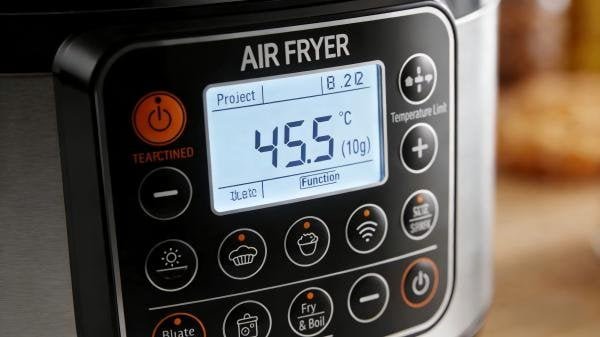
Once you understand your market, you can dive into the technical details. The right specifications are not about having the "most" of everything; they are about having the "right" combination for your specific audience. This is where you translate market needs into a tangible product blueprint.
Choosing the Right Capacity and Wattage
Capacity (measured in liters or quarts) and power (measured in watts) are the two most fundamental specifications. They must align with your user’s needs and the electrical infrastructure of your target country. For example, a high-wattage appliance designed for the US (120V) will not work in Europe (230V) without modification. When we develop products for different regions, we always start by calibrating power systems4.
A small unit is perfect for a single person but useless for a family of five. Conversely, a large-capacity air fryer5 might be overkill for a small household and take up too much precious counter space.
| Household Size | Recommended Capacity | Typical Wattage Range | Best For |
|---|---|---|---|
| 1-2 People | 1.2 L – 2.5 L | 800 W – 1400 W | Singles, couples, small apartments |
| 3-4 People | 3.0 L – 5.0 L | 1400 W – 1800 W | Average families, versatile use |
| 5+ People | 5.0 L – 10.0 L+ | 1700 W – 2000 W+ | Large families, entertaining guests |
| Commercial | 10.0 L+ | 1800 W+ (often 220V+) | Restaurants, cafes, food service |
Basket vs. Oven vs. Dual-Chamber Structures
The physical structure of the air fryer5 is another key differentiator. Each type serves different cooking styles and price points.
- Basket-Style: This is the most common and recognizable type. It’s simple, compact, and generally more affordable. It’s perfect for quickly cooking items like fries, wings, and vegetables.
- Oven-Style: These look like miniature convection ovens. They offer more versatility with multiple racks, allowing you to cook different foods at once or use functions like rotisserie and dehydration. They are ideal for "all-in-one" home users but are larger and more expensive.
- Dual-Chamber: A growing trend, these units feature two separate baskets. This allows users to cook two different dishes simultaneously at different temperatures and times—a powerful marketing feature. However, they command a higher price and require more counter space.
| Air Fryer Type | Main Advantage | Ideal Use Case | Price Point |
|---|---|---|---|
| Single Basket | Simple, affordable, compact | Everyday cooking for smaller households | $ |
| Oven-Style | Versatile, multi-rack capacity | "All-in-one" cooking, baking, roasting | $$ |
| Dual-Chamber | Cook two dishes at once | Families, multitaskers, efficiency lovers | $$$ |
What questions should I ask suppliers to clarify the differences between air fryer types?
Receiving vague or incomplete answers from suppliers is a common frustration for buyers. We believe clear communication is essential, so we always prepare detailed specification sheets to avoid any confusion about product capabilities.
Ask suppliers for detailed data on energy consumption, insulation quality, and airflow design to gauge efficiency. Inquire about their mass production experience with specific models and request test reports and certifications (like ETL, CE) relevant to your target market to verify their claims.

Once you have a target product profile, your job is to find a supplier who can actually build it to your standards. The questions you ask are crucial for vetting their technical competence and reliability. Don’t just ask for a price; dig into the details that determine long-term quality and performance.
Inquiring About Performance and Efficiency
Go beyond the basic features list. Ask questions that reveal the true performance of the unit. For example, an energy-efficient model can be a strong selling point in markets where electricity costs are high.
Key performance questions include:
- What is the energy consumption (kWh) per standard cooking cycle6?
- Can you provide data on heat-up time to 200°C (400°F)?
- What materials are used for insulation, and how does it affect the exterior temperature during operation?
- Describe the airflow design. Is it vortex, cyclonic, or a standard fan? How does this ensure even cooking?
- What type of heating element is used (e.g., halogen, coiled), and what is its expected lifespan?
A knowledgeable supplier will have this data readily available from their internal testing and R&D. Hesitation or an inability to answer these questions is a red flag.
Verifying Production Capability and Compliance
A supplier might claim they can make any product, but you need to verify their experience. It is far less risky to partner with a factory that already specializes in the type of air fryer you need.
Key verification questions include:
- Can you share references or case studies for similar models you have produced?
- What is your monthly production capacity for dual-basket (or oven-style, etc.) air fryers?
- Do you hold existing certifications for this product category for my target market (e.g., ETL for North America, CE/RoHS for Europe)?
- Can you provide a copy of your ISO 9001 certificate7 and your latest BSCI audit report?
- What is your quality control process for incoming materials, in-process assembly, and final inspection?
Asking for this documentation forces the supplier to prove their capabilities and their commitment to compliance, protecting your business from legal issues and quality failures down the line.
How do I balance cost and functionality when choosing air fryer models?
We constantly work with clients to find that perfect balance. Adding every possible feature drives up cost, while cutting too many corners can result in a product that disappoints customers and hurts your brand.
To balance cost and functionality, focus on a "Minimum Viable Product" for your target price point. Prioritize core functions your customer values most and eliminate nice-to-have features that add significant cost. Obtain transparent, component-level cost breakdowns from your supplier.
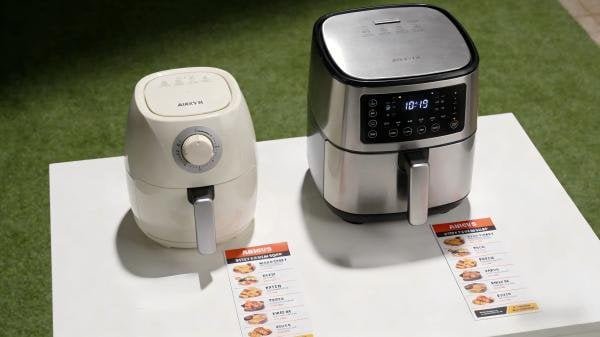
Ultimately, every procurement decision comes down to balancing the cost of goods with the potential retail price and sales volume. Making a profitable decision requires a strategic approach, where every dollar spent on a feature is justified by a clear customer benefit.
Adopt a "Minimum Viable Product8" (MVP) Mindset
Start by defining the absolute essential features for your target market segment. For a budget model, this might be just a reliable timer, accurate temperature control up to 200°C, and a 3-liter capacity. Anything else—like a digital screen or preset programs—is an extra. For a premium model, the MVP might include a digital interface, a 5-liter capacity, and at least five presets.
By identifying this core MVP, you create a baseline product. From there, you can strategically add one or two extra features that provide a competitive edge without inflating the cost too much. This prevents "feature creep," where the product becomes overly complex and expensive.
Request Component-Level Costing
To make informed trade-offs, you need to understand where the money is going. Ask potential suppliers for a transparent cost breakdown. This doesn’t mean they have to reveal their profit margins, but they should be able to tell you the cost implications of different choices.
For example, ask:
- What is the cost difference between using a mechanical knob and a digital touchscreen?
- How much does upgrading from a standard plastic housing to a stainless steel finish add to the unit price?
- What is the cost to add a dehydration function or a "keep warm" feature?
This level of transparency allows you to see if a feature’s cost is justified by the value it adds. A $2 increase for a digital screen might be a great investment for a mid-range product, but a $5 increase for a Wi-Fi module might not be, depending on your target customer. This data empowers you to build the most cost-effective product for your market.
Conclusion
Choosing the right air fryer from China is a strategic process, not a guess. By matching specs to your market, verifying supplier capabilities, and balancing cost with function, you can procure a winning product.
If you have your target market in mind and need a reliable partner to bring your vision to life, feel free to contact us. We’re here to help you navigate the details.
-
Understanding various sales channels can help you optimize your product strategy and reach your target audience effectively. ↩
-
Discovering the traits of budget-friendly models can help you cater to price-sensitive consumers effectively. ↩
-
Learning about premium models can guide you in developing high-quality products that attract discerning customers. ↩
-
Understanding power systems is crucial for ensuring appliances work efficiently in different regions. ↩
-
Explore the advantages of air fryers, including health benefits and cooking versatility, to enhance your culinary experience. ↩ ↩
-
Understanding energy consumption helps you choose an efficient model, saving on electricity costs in the long run. ↩
-
Exploring ISO 9001 certification can reveal how quality management systems ensure product reliability and safety. ↩
-
Understanding MVP can help you streamline product development and focus on essential features that meet market needs. ↩