
It is easy to get excited by a good quote and a nice sample. It is much harder to fix the damage after I place an order with a supplier whose documents do not even match.
I should request a basic company document package that confirms the air fryer supplier’s legal identity, payment identity, and product responsibility. The minimum set includes the business license, legal company name, registration details, bank account information, quotation or pro forma invoice, draft contract, company chop or signing proof, audit report, air fryer test reports, and food-contact material documents.
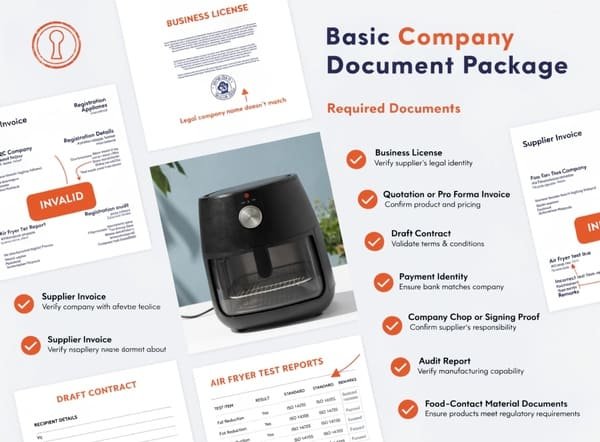
When I start talking with a new air fryer supplier, I do not begin by trusting the website, the showroom, or the sales presentation. I begin by asking a simple question: who is this company on paper, and how do I know the same company will receive my payment, control the product, and take responsibility if something goes wrong? In our daily work with small kitchen appliance projects, I have learned that many sourcing problems begin long before production starts. They begin at the document stage. A supplier may look professional, yet the quotation comes from one company, the bank account belongs to another, and the test reports belong to a third. At that point, the buyer is not dealing with one clear business entity. The buyer is dealing with confusion. For a first order, I want a basic package of documents before I even discuss a deposit seriously. I do not collect these papers for formality. I collect them because they show whether the supplier has a clean legal chain, a real operating structure, and a believable connection to the air fryer product itself. That is the foundation of safe sourcing.
Which Basic Company Documents Should an Air Fryer Supplier Provide First?
The first document package should prove three things. It should prove the company exists, show who will receive payment, and connect that company to the air fryer product being offered.
When I ask an air fryer supplier for documents, I do not start with a long and complicated list. I start with the basic set that tells me whether the company is worth taking seriously. These are the documents that should come first because they establish identity, payment clarity, and product responsibility. If a supplier cannot provide these basic files in a clear way, I usually assume the later process will not become easier.
The first document I request is the business license. That is the base identity record. Then I ask for the full legal company name, registration number, registered address, and legal representative. In many cases, those details appear on the business license already, but I still want them stated clearly in the supplier’s communication. After that, I request the quotation or pro forma invoice. This shows which company is making the commercial offer. Then I ask for bank account details with the beneficiary name. I want to know exactly who would receive my money if I moved forward.
Next, I request the draft contract or purchase agreement. This matters because it shows which company expects to take legal responsibility for the deal. I also ask for a sample of the company chop or some form of signing authorization. In many export transactions, this is one of the easiest ways to see whether the document chain is formal and organized. Then I request a recent factory audit or supplier assessment report. That gives me a first look at whether the company has real operational capability. Finally, I request product-related documents, especially an air fryer test report and food-contact material declarations for baskets, trays, coatings, and plastics that touch food.
This is the first package I usually want:
| Document | What It Confirms | Why I Ask Early |
|---|---|---|
| Business license | Legal existence of the company | Base proof that the supplier exists |
| Full legal company name and registration number | Exact legal identity | Needed for all later document matching |
| Registered address and legal representative | Formal company details | Helps verify location and responsibility |
| Pro forma invoice or official quotation | Commercial offering entity | Shows who is quoting the order |
| Bank account details and beneficiary name | Payment destination | Confirms who would receive funds |
| Draft contract or purchase agreement | Contracting entity | Shows who will carry legal responsibility |
| Company chop sample or signing authorization | Formal document authority | Helps verify the legitimacy of signed files |
| Recent factory audit or supplier assessment report | Operating capability | Gives early evidence of real management or production strength |
| Relevant air fryer test report | Product connection | Shows the supplier is tied to a real appliance product |
| Food-contact material declaration | Food-contact safety support | Important for baskets, trays, coatings, and plastics |
I also pay attention to how the supplier sends these documents. If the files are organized, named clearly, and sent without confusion, that already tells me something good about their internal discipline. If the supplier sends screenshots, partial files, old scans, or unrelated records from different companies, I take that as an early sign of risk.
In our own business, we know buyers want clarity, not paperwork for its own sake. The right supplier should understand why these documents matter. A serious company should be ready with them. It should not act surprised that a buyer wants to know who is selling, who is signing, and who is collecting payment. For a first order, these are not extra requests. They are the minimum.
Why the Air Fryer Supplier’s Business License Is the First Document to Verify?
The business license is the starting point because it tells me the supplier’s legal identity before I look at any commercial or technical claims.
Out of all the files I request, the business license is the one I check first. I do that because every other document should connect back to it. If I do not know the exact legal identity of the supplier, then I cannot properly judge the quotation, the bank account, the contract, or even the test reports. The business license is where the legal story begins.
When I review the business license, I look for the full legal company name first. I want the exact name, not only the brand name shown on the website or catalog. Many suppliers market themselves under one brand but operate under a different legal entity. That can be normal. But I need to know it clearly. I also check the registration number, registered address, legal representative, and business scope. These details help me understand whether the supplier’s commercial story fits the legal record.
The business scope is especially useful. If the supplier says it makes air fryers, I want to see wording related to manufacturing, production, processing, assembly, or appliance development. If the scope only shows trade, import-export, or general sales, I do not reject the supplier immediately, but I stop assuming it is a direct factory. That difference matters because it changes how I judge control over quality, schedule, and problem solving.
I also compare the registered address with the address the supplier gives me in email, quotation, and factory introduction. If those locations do not line up, I ask why. One difference may have a normal explanation, but repeated mismatches usually mean I need to dig deeper. The legal representative is also useful because it helps me see whether later contract and stamp records are consistent.
This is how I usually review the license:
| License Detail | What I Check | Why It Matters |
|---|---|---|
| Full legal company name | Exact registered name | All later documents should connect to this |
| Registration number | Unique company identity | Helps avoid confusion with similar names |
| Registered address | Official company location | Tests whether the supplier’s story is consistent |
| Legal representative | Named responsible person | Supports contract and authority review |
| Business scope | Manufacturing or trading language | Reveals whether production claims are believable |
| Company status | Active and valid registration | Reduces risk of dealing with an abnormal entity |
In our own export work, I know that once the base identity is unclear, every later discussion becomes weaker. The buyer may think they are negotiating with one company, while the actual legal entity behind the order is different. That creates risk in payment, dispute handling, and compliance ownership. This is why I never skip the business license or treat it as routine admin work. It is the anchor. If the anchor is weak, the whole transaction is weak.
A clean business license does not prove the supplier is perfect. But without a clean business license, I have no reason to trust the rest of the file set.
How to Check Whether the Air Fryer Supplier’s Bank Account Matches the Legal Company Name?
The safest payment chain is a clear one. The company on the business license, quotation, contract, and bank beneficiary should all fit together in a way I can understand and verify.
One of the most common sourcing risks appears when buyers focus on price and ignore payment identity. I never separate payment identity from company identity. When I ask for bank details, I am not just asking where to send money. I am asking who will legally receive the deposit and whether that company is the same one I have been evaluating all along.
I start by placing the business license next to the quotation or pro forma invoice, then I compare those against the bank account details. The beneficiary name is the key item. If the beneficiary matches the legal company name, that is the cleanest and safest structure. If it does not match, I need a clear written explanation. Sometimes the supplier uses an affiliated export company, a parent company, or a platform-controlled payment path. That can be legitimate. But I do not accept it on trust alone. I want the relationship explained in writing, and I want it to make sense across the full document chain.
I also check whether the bank account details change late in the process. A last-minute change to another bank account is one of the clearest warning signs for me. It does not automatically mean fraud, but it does mean I pause. I verify again before anything moves. The same applies if the supplier asks me to pay a personal account or an unexplained third-party company. That is not a small issue. That is a major identity risk.
This is the match logic I use:
| Item | What Should Match | Why It Matters |
|---|---|---|
| Business license | Legal company name | Base identity reference |
| Pro forma invoice or quotation | Quoting entity name | Shows who is selling the order |
| Draft contract | Contracting party name | Defines legal responsibility |
| Bank beneficiary | Payment receiving entity | Confirms where funds actually go |
| Company chop or signing proof | Same business chain | Supports formal authorization |
I also like to check the payment instructions against the supplier’s email behavior. If official documents all show one company, but the payment request comes from a different email signature or another unrelated name, I slow down and ask questions. In our daily B2B projects, payment clarity is not optional. Buyers need to know who gets the money and who is responsible after that.
For platform orders, I only follow the payment route inside the protected order system. I do not move funds outside the platform just because the supplier asks. Protected payment routes are not perfect, but they are much safer than off-record account changes.
If the bank beneficiary does not match the legal company name, I do not look for reasons to excuse it. I look for proof to explain it. Until that proof is clear, I do not pay.
Which Air Fryer Certificates and Test Reports Should You Request for Market Compliance?
Air fryer sourcing is not only about company identity. It is also about whether the supplier can connect itself to a real, compliant appliance product that fits the target market.
Once I am satisfied that the company identity documents are coming together, I turn to product-related documents. For air fryers, this matters a lot because the product touches three risk areas at once. It involves electrical safety, heating performance, and food-contact materials. If the supplier has no clear compliance file for the product, I treat that as a serious weakness.
The first product file I request is a relevant air fryer test report. I want to see that the supplier has supporting evidence tied to an actual appliance product, not just a general catalog claim. I check the product description, model number, rating details, and any other information that helps connect the report to the air fryer being discussed. A report from an unrelated product does not help me much. A report from a loosely similar model may be useful as background, but I do not treat it as final proof.
I also ask for any market-facing compliance documents that matter for the destination market. The exact set depends on where the product will be sold, but the main point is simple: the supplier should be able to show that it understands compliance, not just sales language. In air fryer projects, I also request food-contact material declarations or supporting documents for the basket, tray, coating, and plastic parts that may touch food. These parts matter because they affect user safety and brand risk directly.
The basic product-related package I want usually looks like this:
| Product Document | What It Shows | Why It Matters |
|---|---|---|
| Relevant air fryer test report | The supplier is linked to a real appliance product | Supports product credibility |
| Product certification documents | Target-market readiness | Helps reduce compliance risk |
| Food-contact material declaration | Safety support for food-contact parts | Important for basket, tray, coating, plastics |
| Supporting material records | Traceability of key materials | Helps judge consistency and control |
| Recent product audit or assessment reference | Connection between product and process control | Adds confidence in mass production readiness |
I also pay attention to document freshness and relevance. If the supplier sends very old reports, reports under another company name, or reports that do not clearly fit the air fryer under discussion, I do not ignore that. In our own product development work, even small design changes can affect testing scope, labeling, or material declarations. That is why I want documents that are as close as possible to the actual product and actual business chain.
A supplier does not need to solve every compliance issue before the first email. But it should be able to show that it has real product evidence and understands what is needed for the target market. If it cannot do that, I assume the risk later will be higher, not lower.
How to Confirm All Air Fryer Supplier Documents Belong to the Same Business Entity?
The real goal is not collecting separate papers. The real goal is proving that one consistent business entity stands behind the quote, the product, the bank account, and the responsibility.
This is where many buyers make mistakes. They collect documents one by one and feel satisfied because each file looks acceptable on its own. I do not stop at that point. I compare the documents against each other. That comparison is where the truth usually appears.
I begin with the business license as the base. Then I place the quotation, contract, bank account details, company chop sample, audit report, and product test reports beside it. I compare the legal company name first. Then I compare the address. Then I compare any company registration details that appear on the documents. If the supplier uses an affiliated company, I want that relationship explained clearly. If the supplier uses different entities for quoting, contracting, and payment, I want to know exactly why and how those entities connect.
I also check whether the audit report or supplier assessment report points to the same legal chain. If the audit was done on another company or another site with no clear link, it does not give me much comfort. The same is true for product reports. If the test reports belong to another company, I need to understand whether that company is part of the same business structure or whether the supplier is simply borrowing product evidence from elsewhere.
This is the comparison table I use:
| Document Type | What I Compare | What I Want to See |
|---|---|---|
| Business license | Name, address, registration details | Base legal identity |
| Quotation or pro forma invoice | Company name and address | Same commercial entity or clearly explained affiliate |
| Draft contract | Contracting party name | Same legal party that will take responsibility |
| Bank details | Beneficiary name | Same entity or documented payment structure |
| Company chop or signing proof | Name and authorization | Formal document authority within the same chain |
| Audit report | Legal entity and site details | Operational proof linked to the same company |
| Test reports and certificates | Applicant or company name | Product evidence tied to the same business entity |
In our own B2B work, I know that buyers want one clear answer to a simple question: who exactly am I dealing with? If the supplier cannot answer that with matching documents, I do not move forward casually. A mismatch may be explainable. A pattern of mismatch is dangerous. The more gaps I see, the more likely it is that accountability will become weak if something goes wrong later.
I also like to ask the supplier a direct question: which exact company will quote, sign, receive payment, and stand behind the air fryer quality? A good supplier should answer this clearly and without delay. A weak supplier often answers in general words and hopes the buyer will not push further.
All the documents should point to one business story. If they do not, I assume I do not yet know the real business structure well enough to place an order safely.
Which Missing or Inconsistent Documents Signal Risk Before You Place an Air Fryer Order?
The biggest warning signs often come from simple gaps. Missing documents, mismatched names, and vague payment instructions usually tell me more than a polished catalog ever can.
Before I place an air fryer order, I look not only at what the supplier sends but also at what is missing. Missing or inconsistent documents are often the earliest signs that the supplier may not be able to carry a clean and accountable transaction. In my experience, these warning signs should never be brushed aside as small paperwork issues. They often point to deeper problems in identity, product ownership, or process control.
The first red flag is a missing business license or a business license that is unclear, incomplete, or difficult to read. The second is inconsistency in the legal company name across the quotation, contract, bank details, and test reports. The third is a bank beneficiary that does not match the contracting entity, especially when the supplier cannot explain the difference clearly. The fourth is a missing audit report or assessment record when the supplier claims strong factory capability. The fifth is missing product test reports or no food-contact supporting documents for the basket, tray, coating, or plastics.
I also pay attention to how the supplier reacts when I ask for these files. A serious supplier may need a little time to organize them, but it usually understands why they matter. A risky supplier often becomes vague, impatient, or defensive. That reaction is part of the evaluation too.
Here are the red flags I watch closely:
| Missing or Inconsistent Item | Why It Signals Risk |
|---|---|
| No business license provided | Legal identity is not properly supported |
| Legal company name differs across documents | Accountability chain is unclear |
| Bank beneficiary does not match contract entity | Payment risk is high |
| No draft contract or weak contract party details | Legal responsibility is not defined clearly |
| No company chop sample or signing proof | Document authority may be weak |
| No audit report or supplier assessment | Real operating capability is harder to verify |
| No relevant air fryer test report | Product connection is weak |
| No food-contact material declaration | Food-contact safety support is unclear |
| Last-minute account change | High identity or payment risk |
| Supplier avoids explaining mismatches | Transparency is weak |
In our product and supplier work, I have learned that documents do not need to be perfect to be useful, but they do need to be coherent. A supplier can have an affiliate structure. A supplier can have a sales company and a factory company. A supplier can also update bank details for a real reason. What matters is whether the structure is transparent and supported by evidence. If the structure is not transparent, I do not treat the order as ready.
For a first order, these basic company documents are the minimum I want before I discuss a deposit seriously. I would rather spend more time checking paperwork at the start than spend much more time later dealing with delayed shipments, compliance gaps, or payment disputes.
Conclusion
Before I place an air fryer order, I want one clear document chain that proves the supplier exists, can receive payment properly, and is truly connected to the product and its compliance responsibility.
FAQ
What is the minimum document package I should request from an air fryer supplier?
I would request the business license, full legal company name, registration number, registered address, official quotation or pro forma invoice, bank account details with beneficiary name, draft contract, company chop sample or signing authorization, recent factory audit report, relevant air fryer test report, and food-contact material declaration for key food-contact parts.
Why is the business license more important than the quotation at the start?
The business license gives me the supplier’s official legal identity. The quotation only shows what the supplier wants to sell. I need the legal company name, registration number, and address first, because I use that information to verify the quotation, contract, and bank details later.
Is it always a problem if the bank account name is different from the supplier name?
It is not always a problem, but it is always a point that needs explanation. The supplier may use an affiliated export company or group company. I still need written proof that explains the relationship clearly. I do not send a deposit until the payment entity and contract entity make sense together.
What product documents matter most for an air fryer?
I focus on relevant product test reports, safety and compliance support for the target market, and food-contact documents for the basket, tray, coatings, and plastics that touch food. These documents help show the supplier is linked to a real air fryer product and has at least basic compliance support behind it.
Why should I ask for a factory audit or supplier assessment report?
The audit report helps me judge whether the supplier has real operating capability. It can show factory conditions, quality systems, production process control, and management structure. It does not replace my own audit, but it gives me an early view of whether the supplier looks like a real operating partner.
How do I confirm that all supplier documents belong to the same business entity?
I compare the legal company name, registration number, address, chop name, authorized signer, and beneficiary name across all files. I want the documents to tell one consistent story. If names or addresses differ, I ask for a written explanation and supporting proof.
What are the clearest warning signs before I place the first order?
The biggest warning signs are a missing business license, mismatched company names across documents, a bank beneficiary that does not match the contract entity, missing food-contact support, unrelated test reports, and pressure to pay a deposit before verification is complete.
Should I pay the deposit if only some of the documents are ready?
For a first order, I would not. I want the core document package checked before deposit talks move forward. The first order is when I have the least protection from past experience. That is exactly when document discipline matters most.