Selecting an air fryer supplier in China requires structured evaluation of certification validity, manufacturing capability, pricing logic, communication efficiency, quality systems, energy efficiency design, and after-sales support. Buyers who focus only on surface-level factors often face compliance issues, unstable quality, delayed delivery, and higher total landed cost during mass production and import stages.
The main risk is choosing suppliers without verifying production consistency, certification-model matching, or real export capability. This often leads to failed inspections, shipment delays, or unexpected redesign costs after order confirmation and tooling.
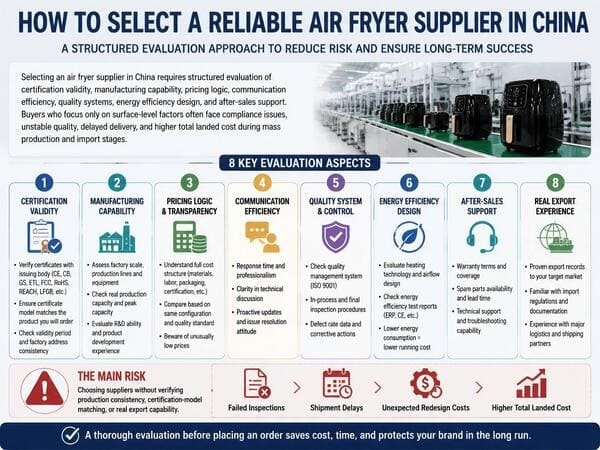
This article explains seven common procurement mistakes and provides practical evaluation methods to help buyers reduce sourcing risk and improve supplier selection accuracy in OEM and wholesale air fryer projects.
Are air fryer safety certifications being overlooked when selecting a supplier?
Safety certifications must be verified against the exact air fryer model before sourcing decisions are finalized. Many buyers only check document availability without confirming model matching, testing scope, or market-specific compliance requirements, which increases import rejection and customs clearance risk.
Ignoring certification validation may result in shipment holds, failed audits, or forced product redesign after production begins.
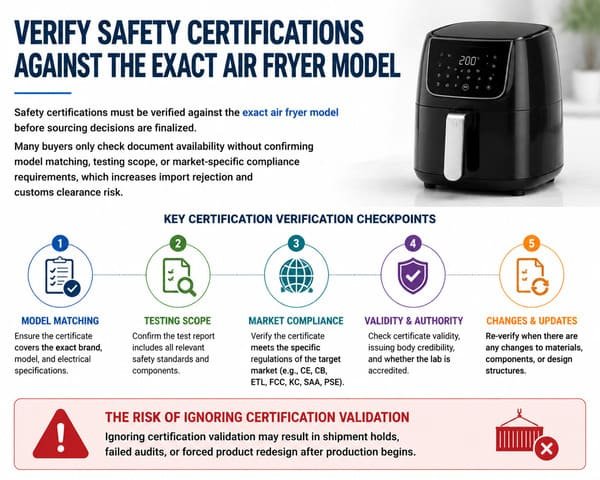
Air fryer safety certifications play a critical role in market access, especially for EU and North American distribution channels. CE, RoHS, REACH, UL-related requirements, FCC, and food-contact material compliance may apply depending on product structure and destination market.
A common sourcing mistake is assuming one certificate covers all product variants. In reality, certification scope is tied to specific voltage, heating system, PCB design, and material configuration1. Even small design changes may invalidate existing reports.
Buyers should request:
- Full test reports, not only certificates
- Model number matching documentation
- Test scope details (voltage, wattage, components)
- Validity period and issuing lab information
Verification steps should include cross-checking sample units against certified specifications. A mismatch between production units and certified samples is one of the most frequent causes of customs delays in air fryer imports2.
Do communication gaps with air fryer suppliers slow down sourcing projects?
Communication gaps often extend development cycles and increase misunderstanding risks during RFQ confirmation, sample approval, and production planning. Clear, structured communication is essential to ensure accurate specification alignment and reduce iteration delays in air fryer sourcing projects.
Delayed or unclear communication can lead to wrong specifications, re-sampling costs, and missed seasonal sales windows.
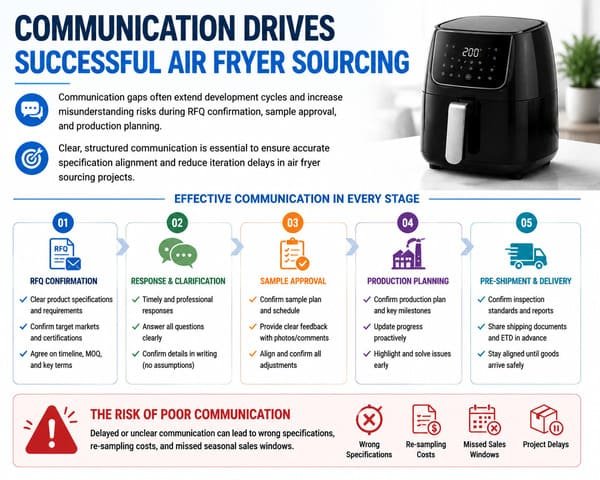
Efficient communication is a key factor in supplier performance evaluation. Many sourcing delays occur not due to manufacturing capacity, but due to unclear requirement transmission between buyer and supplier.3
Digital communication tools such as WhatsApp and WeChat are widely used in B2B sourcing because they improve response speed and reduce misunderstanding compared to email-only communication.4 However, communication speed alone is not sufficient. Structured RFQ documents are still required to avoid interpretation differences.
Common communication risks include:
- Unclear product specifications
- Missing packaging requirements
- Unconfirmed plug or voltage standards
- Delayed feedback during sampling stage
To reduce these risks, buyers should:
- Use structured RFQ templates
- Confirm specifications in written format
- Request visual confirmations (photos/videos)
- Set clear response timelines
Communication efficiency should be evaluated alongside technical capability, not treated as a secondary factor.
Is selecting an air fryer supplier based only on the lowest price increasing procurement risk?
Focusing only on the lowest unit price often increases hidden costs, including quality instability, weak packaging, delayed delivery, and limited after-sales support. Total landed cost should be evaluated instead of unit price alone in B2B air fryer sourcing decisions.
Low pricing without structural cost transparency can result in quality failures or unexpected rework expenses.
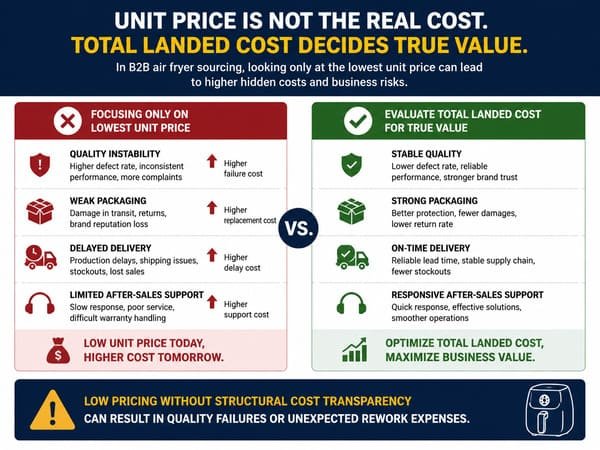
Price-focused sourcing often ignores hidden cost components5 such as:
- Packaging strength for export logistics
- Component quality differences
- Certification support inclusion
- Inspection and testing costs
- After-sales responsibility allocation
In many cases, suppliers offering extremely low FOB prices[^6] reduce costs by using lower-grade heating elements, simplified PCBs, or thinner coatings. These differences may not be visible in initial samples but appear during mass production.
A more reliable evaluation method is total cost breakdown comparison:
| Factor | Lower-Risk Evaluation | Higher-Risk Signal |
|---|---|---|
| Unit Price | Slightly higher but stable | Extremely low, unclear breakdown |
| Materials | Specified components | Vague descriptions |
| Packaging | Export-grade carton | Minimal protection |
| QC Support | Inspection allowed | Inspection discouraged |
Buyers should evaluate price together with consistency, not as an isolated decision factor.
Is air fryer manufacturing capability being properly audited before placing orders?
Manufacturing capability should be verified through production scope, equipment capability, export experience, and sample consistency. Without proper auditing, buyers risk selecting trading companies or mismatched factories that cannot support stable OEM production.
Poor capability evaluation often leads to inconsistent batches and delayed shipments.
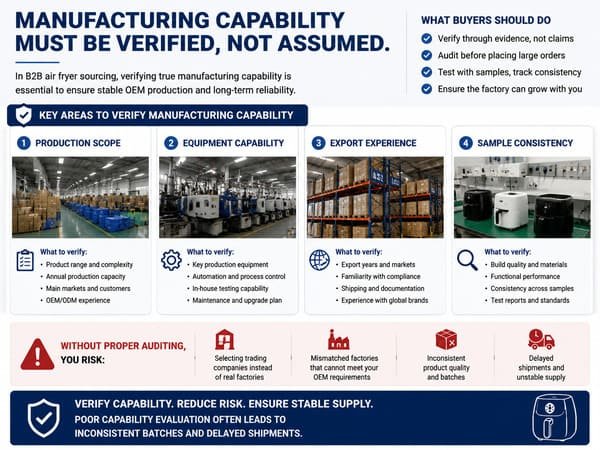
Supplier capability evaluation should go beyond basic introductions. Real manufacturing capacity is reflected in production stability and repeat order consistency rather than marketing claims.6
Key audit points include:
- Production line structure and specialization
- Ability to handle multiple voltage models
- Control over component sourcing
- Export history to target markets
- Sample consistency across batches
Many sourcing issues occur when buyers rely only on product catalogs or sales communication. Without factory-level verification, it is difficult to confirm whether the supplier controls actual production or outsources assembly.7
Recommended audit steps:
- Request factory videos showing production lines
- Confirm core component sourcing channels
- Compare multiple sample batches
- Verify export documentation experience
Capability evaluation should be multi-layered rather than based on single indicators.
Are air fryer quality management systems being ignored during supplier evaluation?
Quality management systems determine whether production consistency can be maintained across large-scale air fryer orders. Ignoring QC structure increases defect rates, inspection failures, and after-sales disputes.
Weak quality systems often result in inconsistent heating performance and assembly defects.
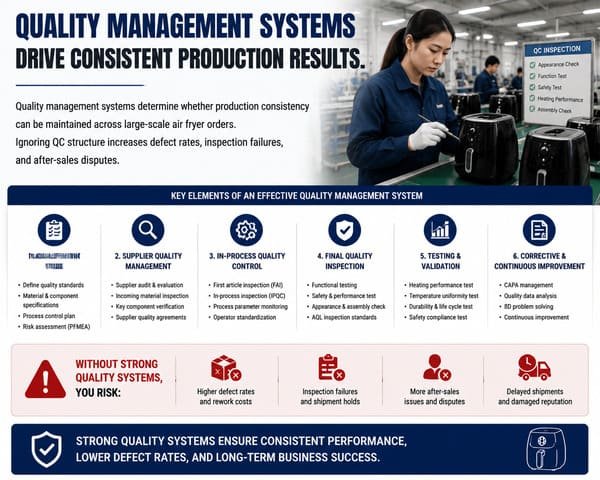
A structured quality system ensures that every production stage is monitored, including incoming materials, assembly processes, functional testing, and packaging inspection. Without this system, production quality may vary between batches.
Key QC components include:
- Incoming material inspection
- In-line production checks
- Functional heating tests
- Final packaging inspection
- AQL sampling standards8
Suppliers with strong QC systems usually provide documented inspection reports and support third-party inspection before shipment. This reduces dispute risk and improves consistency for repeat orders.
Buyers should also verify whether QC covers:
- Heating uniformity testing9
- Safety cut-off performance
- Coating durability checks
- Packaging drop tests
A well-structured QC system reduces dependency on final inspection only and ensures earlier detection of issues in production.
Is energy efficiency being overlooked in air fryer product design and sourcing decisions?
Energy efficiency impacts long-term product competitiveness, especially in regulated markets with strict appliance energy standards. Ignoring efficiency design can lead to market rejection or poor consumer acceptance in retail channels.
Low efficiency design may also increase operational cost concerns in commercial distribution.
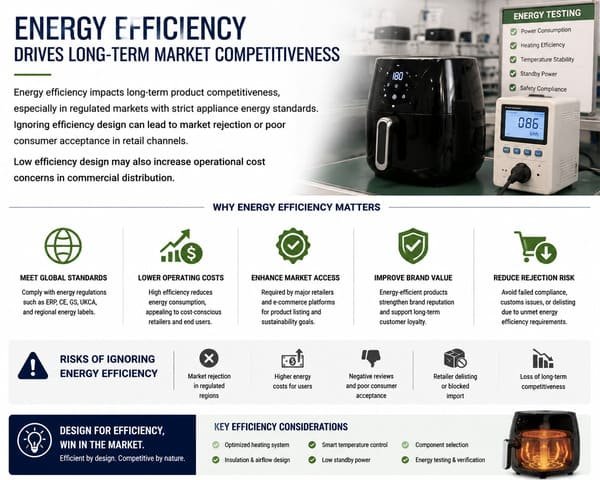
Energy efficiency in air fryer design depends on heating element type, insulation structure, airflow design, and control system precision.10 These factors influence cooking speed, power consumption, and thermal stability.
Buyers often overlook energy performance during sourcing because it is not always visible in early samples. However, it becomes critical during certification testing and retail distribution evaluation.
Key evaluation points include:
- Heating element efficiency
- Temperature control accuracy
- Chamber insulation design
- Air circulation system design
Energy efficiency should be discussed early in OEM development stages, especially when targeting EU or high-end retail markets.11 Late-stage adjustments may require redesign and increase lead time.
Is after-sales service and warranty support unclear when working with air fryer suppliers?
After-sales service structure determines how product defects, replacements, and warranty claims are handled after shipment. Unclear warranty terms often lead to cost disputes and customer dissatisfaction in distribution channels.
Weak after-sales systems increase long-term operational risk for importers.
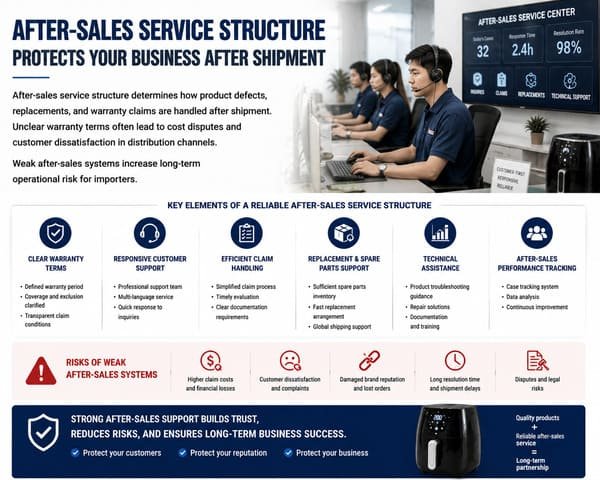
After-sales support is often underestimated during supplier selection. However, it becomes critical once products enter retail or e-commerce channels where return rates and warranty claims12 must be managed.
Key after-sales considerations include:
- Warranty duration and scope
- Spare parts availability
- Replacement policy for defective units
- Response time for service requests
Suppliers should clearly define whether warranty covers components, labor, or replacement units. Without clear structure, buyers may face inconsistent claim handling.
It is also important to confirm:
- Spare parts stock availability
- Long-term model support
- Communication channel for claims
After-sales capability reflects supplier maturity and long-term cooperation reliability13, not just product quality at shipment stage.
FAQ About Air Fryer Supplier Evaluation
What is the most important factor when selecting an air fryer supplier in China?
A structured evaluation combining certification validity, manufacturing capability, quality control systems, communication efficiency, and after-sales support determines supplier reliability in B2B air fryer sourcing. Focusing on only one factor increases procurement risk and may result in unstable product performance or shipment delays.
How can air fryer certification compliance be verified before ordering?
Certification compliance should be verified through model-matched test reports, specification alignment, and valid laboratory documentation. Cross-checking voltage, components, and design details ensures that certificates accurately represent the actual production unit before mass production begins.
Why does low air fryer pricing often increase sourcing risk?
Low pricing can indicate reduced material quality, limited quality control processes, or missing certification support. Total landed cost evaluation, including packaging, inspection, and after-sales structure, provides a more accurate assessment of procurement risk than unit price alone.
How should buyers evaluate air fryer supplier manufacturing capability?
Manufacturing capability should be assessed through factory verification, production line structure, export experience, and sample consistency. Multiple validation points reduce the risk of working with trading intermediaries or unstable production sources.
What role does communication play in air fryer supplier selection?
Communication efficiency directly impacts project timelines, specification accuracy, and sample approval speed. Structured RFQ documents combined with fast response channels like WhatsApp or WeChat help reduce misunderstanding and improve sourcing efficiency.
Why is quality management important in air fryer sourcing?
Quality management ensures stable production performance across batches through material inspection, functional testing, and packaging checks. Without structured QC systems, defect rates and inconsistency risks increase significantly in mass production.
Conclusion
Reliable air fryer sourcing depends on certification verification, capability audit, structured pricing evaluation, and strong quality systems rather than single-factor decisions.
Send Your Inquiry
A clear inquiry improves quotation accuracy and reduces sourcing uncertainty in air fryer procurement. Provide target market, estimated order quantity, product model, certification requirements, plug type, packaging expectations, logo or private label needs, delivery timeline, and inspection requirements. Structured information helps suppliers evaluate feasibility, compliance scope, and production scheduling more effectively for OEM and wholesale projects. AidKitchens can support these discussions with model selection and export-oriented sourcing guidance for global buyers.
-
"Certification – UL Solutions", https://www.ul.com/services/certification. This source explains how certification scope is determined by technical specifications such as voltage, heating systems, and material configurations. Evidence role: mechanism; source type: education. Supports: Certification scope is tied to specific technical specifications, and changes in these can invalidate existing reports.. ↩
-
"Air Fryers and Food Safety", http://www.fsis.usda.gov/food-safety/safe-food-handling-and-preparation/food-safety-basics/air-fryers-and-food-safety. This source provides data or case studies on customs delays caused by mismatches between certified samples and production units. Evidence role: case_reference; source type: government. Supports: Customs delays in air fryer imports are frequently caused by mismatches between certified samples and production units.. Scope note: The support may focus on specific regions or industries, not universally applicable. ↩
-
"Examining collaborative buyer–supplier relationships and social …", https://pmc.ncbi.nlm.nih.gov/articles/PMC9434505/. This source provides evidence that communication issues, rather than manufacturing limitations, are a primary cause of sourcing delays. Evidence role: mechanism; source type: research. Supports: Sourcing delays are often caused by unclear communication rather than manufacturing capacity.. Scope note: The study may focus on specific industries or regions, limiting generalizability. ↩
-
"Emerging Technologies in Supply Chain Management: What to Watch", https://www.ucumberlands.edu/blog/the-role-of-technology-in-supply-chain-management. This source supports the claim that WhatsApp and WeChat are commonly used in B2B sourcing to enhance communication efficiency. Evidence role: general_support; source type: research. Supports: WhatsApp and WeChat are widely used in B2B sourcing to improve communication efficiency.. Scope note: The evidence may focus on specific industries or geographic regions where these tools are prevalent. ↩
-
"Adopting a Price-quality Scale within Fair Trade to Broaden Its …", https://www.forbes5.pitt.edu/article/adopting-price-quality-scale-within-fair-trade-broaden-its-consumer-base. This source discusses how suppliers may reduce costs by compromising on material quality, such as using lower-grade components or simplified designs. Evidence role: mechanism; source type: research. Supports: Suppliers offering extremely low FOB prices reduce costs by using lower-grade heating elements, simplified PCBs, or thinner coatings.. Scope note: The source may focus on specific industries, limiting generalizability to all sourcing contexts. ↩
-
"Economic Indicators: Manufacturing & Production – Research Guides", https://libguides.rutgers.edu/c.php?g=336288&p=2265467. This source explains how production stability and repeat order consistency are key indicators of manufacturing capacity, contrasting them with marketing claims. Evidence role: expert_consensus; source type: education. Supports: Real manufacturing capacity is reflected in production stability and repeat order consistency rather than marketing claims.. ↩
-
"5.3 Product Verification", https://www.nasa.gov/reference/5-3-product-verification/. This source discusses the challenges of verifying supplier control over production versus outsourcing, emphasizing the need for factory-level audits. Evidence role: mechanism; source type: research. Supports: Without factory-level verification, it is difficult to confirm whether the supplier controls actual production or outsources assembly.. ↩
-
"Acceptable quality limit – Wikipedia", https://en.wikipedia.org/wiki/Acceptable_quality_limit. The source explains the role of AQL sampling standards in quality control, including their application in production monitoring. Evidence role: definition; source type: education. Supports: AQL sampling standards are a key component of quality control systems.. ↩
-
"The Importance of Heating Unit Operations in the Food Industry to …", https://pmc.ncbi.nlm.nih.gov/articles/PMC9094675/. The source provides an overview of heating uniformity testing methods and their importance in product safety and performance. Evidence role: mechanism; source type: research. Supports: Heating uniformity testing is an essential aspect of quality control for products involving heat application.. ↩
-
"Electric Resistance Heating | Department of Energy", https://www.energy.gov/energysaver/electric-resistance-heating. This source explains the technical factors influencing energy efficiency in air fryer design, including heating elements, insulation, airflow, and control systems. Evidence role: mechanism; source type: education. Supports: Energy efficiency in air fryer design depends on heating element type, insulation structure, airflow design, and control system precision.. ↩
-
"Industrial Efficiency Technologies | Department of Energy", https://www.energy.gov/cmei/ito/industrial-efficiency-technologies. This source discusses the importance of addressing energy efficiency in OEM development stages, particularly for EU and high-end retail markets. Evidence role: expert_consensus; source type: institution. Supports: Energy efficiency should be discussed early in OEM development stages, especially when targeting EU or high-end retail markets.. Scope note: The source may focus on general OEM practices rather than air fryers specifically. ↩
-
"WARRANTY CLAIMS MODELLING – Cornell eCommons", https://ecommons.cornell.edu/server/api/core/bitstreams/cf035cc5-d345-4bbf-9bc3-bca014a09927/content. This source provides statistical data on return rates and warranty claims in retail and e-commerce channels, highlighting their impact on after-sales support. Evidence role: statistic; source type: research. Supports: Return rates and warranty claims become critical once products enter retail or e-commerce channels.. Scope note: The data may vary by industry and region. ↩
-
"After-Sales Service: 4 Ways to Turn Support Into Profit – Iter Consulting", https://www.iterconsulting.com/supply-chain-cost-efficiency/after-sales-service-4-ways-turn-support-into-profit/. This source discusses how after-sales capability is an indicator of supplier maturity and reliability in long-term partnerships. Evidence role: expert_consensus; source type: education. Supports: After-sales capability reflects supplier maturity and long-term cooperation reliability.. Scope note: The interpretation may depend on specific supplier industries. ↩