A private label air fryer project can look simple at first. Then the wrong factory turns it into slow samples, unclear compliance, rising MOQ, and a launch that keeps slipping.
For most importers, the best private label air fryer path starts with ODM, not full OEM. I usually suggest choosing a mature existing model first, then customizing the logo, packaging, plug type, manual, color, and branding details. This route usually gives lower startup cost, faster launch speed, and a more manageable MOQ than building a completely new air fryer from zero.
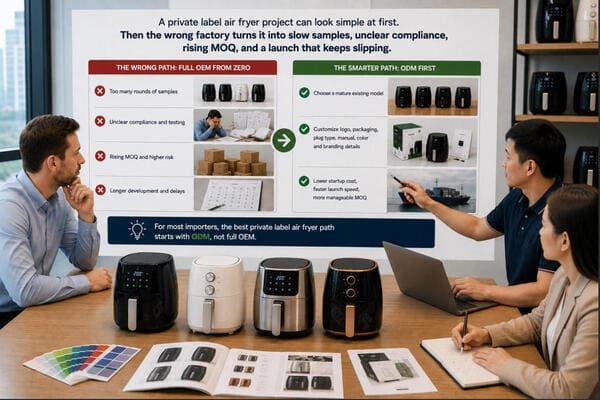
When I discuss private label air fryer projects with buyers, I usually start with one practical point: most brands do not need a new product platform on day one. They need a market-ready product they can launch with low execution risk. That is why I often prefer a strong ODM base model over an ambitious full OEM plan. A mature model already has known production logic, known materials, known packaging dimensions, and often a clearer compliance path. That saves time. It also reduces the number of things that can go wrong at the same time. In real sourcing, the best private label factory is usually not the one promising the most dramatic customization. It is the one that can deliver a stable, branded, compliant air fryer with the least surprise.
How Can I Verify a Private Label Air Fryer Manufacturer’s Engineering Capabilities Before Ordering?
Many buyers ask for price first. I think that is too early. I want to know what the factory can actually do before I care what number it sends.
Before I request a quote from a private label air fryer manufacturer, I check whether the supplier has mature existing models, real customization options, packaging support, export experience, certification readiness, and stable production control. If those basics are weak, the quote may look attractive but still lead to a poor project result.

When we review factory fit, I care most about capability in layers. First, I want product maturity—such as proven 1500W-1800W high-efficiency heating platforms1 and NTC precision temperature controls (40°C – 200°C). Does the supplier already produce air fryers that are stable and commercially proven? Second, I want customization control. Can the supplier handle logo work, manual updates, carton changes, plug versions, and color changes without confusion? Third, I want document discipline. A factory that cannot organize labels, manuals, and approval files usually creates problems later in production.
I also pay attention to whether the supplier is realistic. A good private label manufacturer usually knows where customization should stop. If a supplier says yes to everything too quickly, I become more cautious, not less. The right partner should be able to explain which requests fit light ODM, which requests need deeper project work, and which requests may push the order into true OEM territory.
| Capability area | What I want to verify |
|---|---|
| Existing product platform | Mature, stable air fryer models (4L-8L capacity, double baskets) |
| Customization ability | Logo, color, plug, carton, user manual localization |
| Export experience | Familiarity with target market needs (North America & Europe) |
| Packaging support | Retail-ready and transport-safe options (ISTA 1A drop test standard2) |
| Compliance readiness | Clear path for market certification (ETL, cETL, FDA) |
| Production control | Organized sampling and mass production with tracing |
What is the Real MOQ and Customization Scope for Private Label Air Fryers?
A supplier may sound flexible in the first message, but real flexibility only shows up when MOQ, sample policy, and customization limits are clear.
To check a private label air fryer supplier properly, I ask for the real MOQ by project type, the sample fee and whether it is refundable, the sample lead time, and the exact scope of customization that fits within the base product platform. This helps me separate stock supply, light private label, and deeper OEM work before the quote becomes confusing.
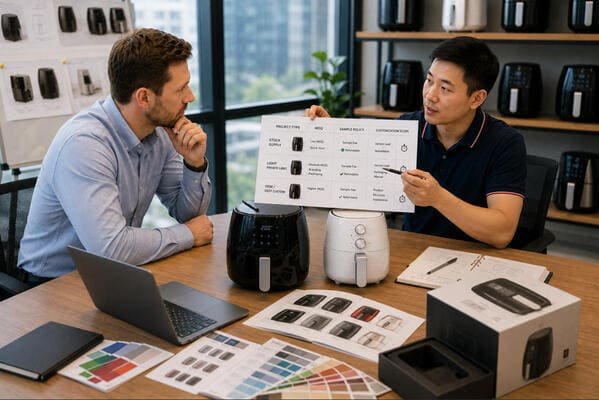
In practical sourcing, MOQ is not only a quantity issue. It is a project-definition issue. A standard private label factory typically requires an MOQ of 1,000 units for stock colors with custom logos3, but this scale shifts dynamically. A supplier may accept one MOQ for a stock model, another for logo and carton customization, and a much higher one (often 2,000+ units) for bespoke housing structures or market-specific hardware versions. I always ask for these levels separately. That gives me a cleaner picture of what the supplier is actually offering.
Sample terms matter just as much. I want to know whether the functional sample is built from stock components, whether custom packaging is included, and whether the sample fee can be credited back after the first bulk order. I also want to know how many sample rounds the supplier expects. A factory that manages samples well—delivering a working sample within 7–10 days—usually manages bulk projects better too4.
Customization scope is where many misunderstandings start. I prefer factories that clearly say, “These are the changes we can do inside our existing air fryer platform, and these are the changes that would require a different cost model.” That kind of clarity reduces risk much more than an aggressive promise.
| Item to check | Why it matters |
|---|---|
| MOQ by customization level | Shows real project threshold (e.g., 1000pcs vs 2000pcs) |
| Sample fee | Reveals entry cost (engineering and courier fees) |
| Sample credit policy | Helps estimate first-order economics upon contract signing |
| Sample lead time | Affects launch speed (standard vs custom cosmetic sample) |
| Allowed branding scope | Prevents later disputes over laser printing vs molded logo limits |
| What counts as OEM | Prevents false expectations on tooling investments |
Which Compliance Certifications Matter Most for North American and European Air Fryer Markets?
A good-looking air fryer is not enough. If the product cannot enter your target market smoothly, the project is weak from the start.
The certifications that matter depend on the destination market, but for North American private label air fryers, buyers should focus on whether the supplier has a credible path for recognized product certification and label control for the exact model and market version. I do not ask only whether the product has a logo such as ETL. I ask whether the listing, model scope, and market coverage are correct and verifiable.
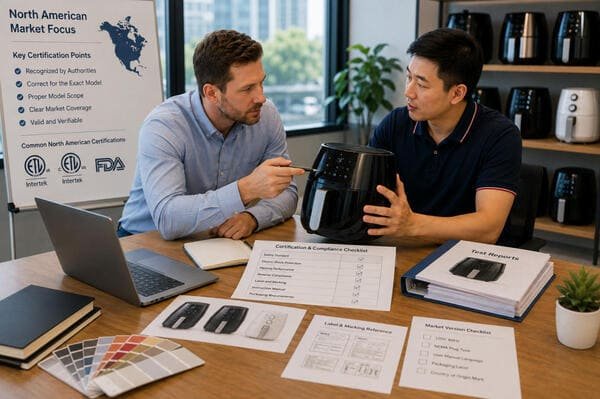
For many buyers, this is the point where supplier comparison becomes serious. A factory may have a decent price and a nice sample, but if the compliance path is unclear, the project is still risky. For North America, I want the supplier to understand the difference between a general compliance claim and a real product certification path involving ETL, cETL, FCC, and FDA-compliant food-contact material reporting5 (like Teflon-free or Ceramic non-stick coatings). For Europe, CE, RoHS, and LFGB6 are the hard metrics. I also want them to understand market scope, label artwork control, and ongoing consistency.
In our own export logic, I do not treat certification as a side document. I treat it as part of manufacturing capability. A supplier that can manage testing support, label alignment, and ongoing production consistency is much more valuable than a supplier that only says, “We can do ETL.” Compliance strength is not only about passing one test. It is about keeping the product and the paperwork aligned through production.
| Certification question | Why I ask it |
|---|---|
| Which market is covered? | U.S., Canada, or both (ETL vs cETL) |
| Is the exact model covered? | Prevents model mismatch or component unauthorized substitution |
| Who controls label artwork? | Prevents compliance errors on rating labels and warnings |
| Can the listing be verified? | Confirms certification is real via active Intertek/UL databases |
| Can the factory support ongoing consistency? | Protects repeat orders during quarterly factory audits |
How Do I Evaluate Air Fryer Packaging, Logo, and Branding Customization Options?
Many private label projects look similar in product photos. The real difference often appears in the branding details and how well the factory controls them.
To evaluate private label air fryer customization, I check the logo method, carton quality, manual format, warning-label accuracy, barcode handling, and artwork approval process. Good customization is not only about making the product look branded. It is about making the product market-ready, consistent, and easy to launch.
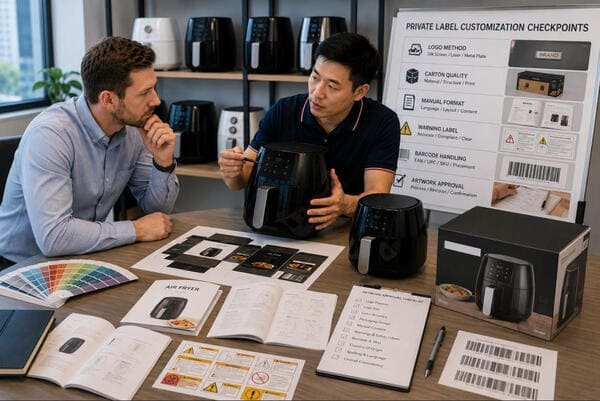
I usually start with the simplest question: what is the buyer really trying to customize? Some buyers need only a logo and color box. Others need full retail packaging, insert cards, California Proposition 65 warning language7, and marketplace-ready FNSKU/UPC labels. These are very different scopes, and I want the supplier to show examples of each.
Logo method matters because not all branding methods create the same commercial effect. A laser engraving, a silk-screen housing print, a metal badge, and a mold-embedded logo all sit at different cost and quality levels. The same is true for packaging. A standard export carton is not the same as a 5-layer corrugated, retail-ready gift box. Manuals also deserve more attention than many buyers give them. For North America or multilingual markets, manual formatting and warning language can affect both customer experience and compliance readiness.
The strongest private label factories are usually not the ones that promise endless packaging choices. They are the ones that can manage branding details without creating artwork confusion or production mistakes.
| Customization area | What I review |
|---|---|
| Logo method | Laser engraving, silk-screen print, metal badge, molded detail |
| Gift box design | Retail value, 5-layer corrugated strength, and high-res print control |
| Export carton strength | Shipping protection (double-wall corrugated passing drop tests8) |
| User manual | Multilingual layout (English/Spanish/French), FDA/Prop 65 warnings |
| Labels and barcode | Accuracy, positioning, and Amazon FNSKU execution control |
| Artwork approval flow | Prevents mass-production errors via signed PDF blueprints |
What Factory QC Controls and Defect Rates Should My Air Fryer Supplier Maintain?
A factory can have a good sample and still fail on the most important part: repeatable production.
Importers should verify whether the private label air fryer manufacturer has real line capacity, stable lead-time planning, in-process QC, final inspection control, and a workable spare-parts or defect-handling policy. I do not want only a production promise. I want evidence that the factory can repeat the same quality level across bulk orders.
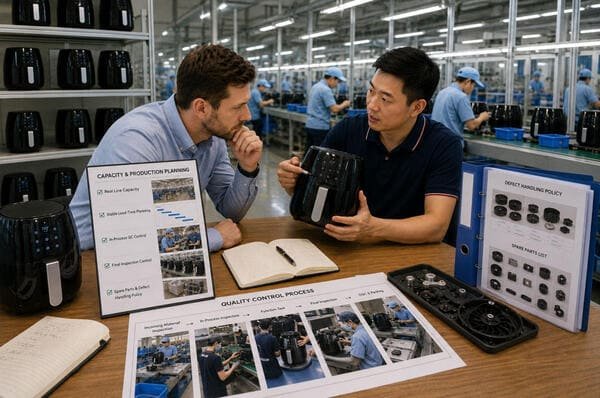
On our side, I always look at capacity together with control. Large capacity alone does not help if production scheduling is weak. A short lead time (typically 35–45 days for mass production) alone does not help if the factory cannot hold consistency. That is why I ask how lead time is counted, what happens if packaging approval is late, and what in-line checks are used during production.
QC is not only about the final inspection report. I want to know whether the factory checks key points during assembly—like the 100% High-Voltage Safety Insulation Check9, the heating element ground test, and the coating scratch-resistance test. They must handle appearance standards clearly and have a process for label and packaging verification before shipment. This matters even more for private label products because branding errors are often just as damaging as functional defects.
A good private label partner should also be realistic about capacity and defect rates (aiming for a critical defect rate of 0% and major defect rate under 1.5% AQL standard10). I trust factories more when they explain what they can ship well, not only what they hope to win.
| Area to verify | What I want to know |
|---|---|
| Production line capability | Can the factory support repeat orders well? (Daily output metrics) |
| Lead time basis | What event starts the clock? (Deposit payment vs artwork sign-off) |
| In-process QC | Are key checks done during production? (High-voltage safety & NTC calibration) |
| Final inspection | How is shipment quality confirmed? (AQL 2.5/4.0 standard reporting) |
| Label and carton control | Are branding details checked before shipment to avoid customs hold? |
| Defect response | Are spare parts (1% FOC components) or claim rules clear? |
Beyond Price: How Do I Compare Multiple Air Fryer Factories Effectively?
The lowest quote can be useful. It can also be the least complete and the most risky. That is why I never stop at the price column.
To compare private label air fryer manufacturers well, I normalize the product specification, customization scope, MOQ, Incoterm, compliance path, lead time, and QC support first. Then I compare total sourcing risk, not only unit price. The best factory is usually the one with the lowest normalized cost and the lowest execution risk, not the one with the cheapest visible quote.
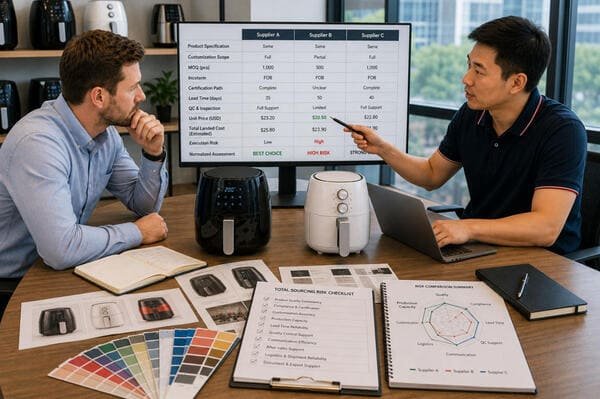
My practical method is simple. First, I make every supplier quote the same air fryer version. Same plug. Same packaging level. Same manual scope. Same MOQ basis. Same trade term (FOB Shenzhen or FOB Ningbo). Second, I score the supplier on commercial clarity. Are tooling, sample terms, and packaging charges explained well? Third, I score the supplier on execution confidence. Are the compliance answers clear? Are the lead times realistic? Are the customization limits honest?
This method usually changes the ranking quickly. The “best price” supplier often falls behind once the real comparison becomes fair. A stronger factory may not always send the lowest number, but it often offers the best private label result because it reduces launch risk, rework risk, and compliance risk11 at the same time.
FAQ
Should a new brand choose ODM or OEM for a private label air fryer?
For most new brands, I would start with ODM. A private label air fryer based on an existing mature model usually gives faster launch, lower startup cost, and a more manageable MOQ than a fully new OEM air fryer project.
What is the most important thing to check before requesting a private label air fryer quote?
I first check whether the private label air fryer manufacturer already has stable existing models and a clear customization process. A low quote means less if the factory cannot manage packaging, manuals, compliance, and repeat production well.
How do I know if a private label air fryer manufacturer is really ready for North America?
I check the private label air fryer factory’s certification path, label control, plug and voltage handling, and whether the exact model can support the right U.S. or Canada market version. Compliance readiness matters as much as production capability.
What customization options matter most in a private label air fryer project?
The most important private label air fryer customization points are usually logo method, gift box design, manual content, warning labels, plug type, and overall packaging control. These are the details that make the air fryer market-ready, not just visually branded.
How should I compare two private label air fryer manufacturers correctly?
I compare private label air fryer manufacturers only after I normalize the same product spec, MOQ, Incoterm, packaging, and certification scope. Then I compare not only the price, but also lead time, QC control, and compliance clarity.
What kind of private label air fryer factory is usually the safest choice?
The safest private label air fryer factory is usually the one with proven existing models, realistic customization options, transparent quoting, and a credible certification and production-control process. It is not always the cheapest factory, but it is often the one with the lowest execution risk.
Conclusion
For most buyers, the best private label air fryer strategy starts with a strong ODM model, clear branding scope, realistic MOQ, and a supplier that can deliver a compliant product with low execution risk.
-
"Acrylamide formation in air-fried versus deep and oven-fried potatoes", https://pmc.ncbi.nlm.nih.gov/articles/PMC10808661/. This source confirms the existence and commercial use of 1500W-1800W high-efficiency heating platforms in air fryer technology. Evidence role: mechanism; source type: research. Supports: Proven 1500W-1800W high-efficiency heating platforms are a sign of product maturity in air fryer manufacturing.. ↩
-
"Test Procedures – International Safe Transit Association", https://ista.org/test_procedures.php. This source explains the ISTA 1A drop test standard and its application in ensuring transport-safe packaging. Evidence role: definition; source type: institution. Supports: The ISTA 1A drop test standard is a recognized method for ensuring transport-safe packaging in manufacturing.. ↩
-
"MOQ for Private Label : r/shopify – Reddit", https://www.reddit.com/r/shopify/comments/11xmmhh/moq_for_private_label/. This source provides industry-standard MOQ requirements for private label factories, including variations based on customization levels. Evidence role: statistic; source type: research. Supports: Private label factories generally require a minimum order quantity of 1,000 units for stock colors with custom logos.. Scope note: The data may vary by region or specific industry segment. ↩
-
"Lead time – Wikipedia", https://en.wikipedia.org/wiki/Lead_time. This source discusses the correlation between sample lead times and bulk project management efficiency in manufacturing. Evidence role: mechanism; source type: paper. Supports: Factories that deliver samples within 7–10 days tend to manage bulk projects more efficiently.. Scope note: The correlation may not apply universally across all manufacturing sectors. ↩
-
"Food Packaging & Other Substances that Come in Contact with Food", https://www.fda.gov/food/food-ingredients-packaging/food-packaging-other-substances-come-contact-food-information-consumers. This source explains the certification requirements for products entering the North American market, including ETL, cETL, FCC, and FDA compliance. Evidence role: definition; source type: government. Supports: North American product certification paths involve ETL, cETL, FCC, and FDA-compliant food-contact material reporting.. ↩
-
"Support – CE Certification and RoHS – Hope Industrial Systems", https://www.hopeindustrial.com/support/ce-rohs/?srsltid=AfmBOooOhZWgidF1NJAo96-msM9GOdo6vIQb2_viP2XmUr9M5ziq-M_B. This source outlines the CE, RoHS, and LFGB certification requirements for products entering the European market. Evidence role: definition; source type: government. Supports: European product certification paths involve CE, RoHS, and LFGB compliance.. ↩
-
"Frequently Asked Questions for Businesses – P65Warnings.ca.gov", https://www.p65warnings.ca.gov/business-resources/frequently-asked-questions-businesses. California Proposition 65 requires businesses to provide warnings about significant exposures to chemicals that cause cancer, birth defects, or other reproductive harm. Evidence role: definition; source type: government. Supports: California Proposition 65 warning language is a necessary compliance element for certain products sold in the state.. ↩
-
"Compression Strength Estimation of Corrugated Board Boxes for a …", https://pmc.ncbi.nlm.nih.gov/articles/PMC9864211/. Double-wall corrugated cartons are designed to provide enhanced durability and are often tested for their ability to withstand drops and impacts during shipping. Evidence role: mechanism; source type: research. Supports: Double-wall corrugated cartons are tested for durability and shipping protection, making them suitable for export packaging.. Scope note: Specific drop test standards may vary by industry or shipping requirements. ↩
-
"Stay Safe: The Importance of High-Voltage Testing", https://ncetest.com/stay-safe-the-importance-of-high-voltage-testing/. This source describes the High-Voltage Safety Insulation Check and its role in ensuring electrical safety during manufacturing. Evidence role: mechanism; source type: research. Supports: The 100% High-Voltage Safety Insulation Check is a key quality control measure during assembly to ensure product safety.. ↩
-
"Explaining Acceptance Quality Limit (AQL) for product inspection", https://www.eurofins.com/assurance/resources/articles/explaining-acceptance-quality-limit-aql/. This source explains the Acceptable Quality Limit (AQL) standards and provides benchmarks for critical and major defect rates in manufacturing quality control. Evidence role: definition; source type: education. Supports: A critical defect rate of 0% and major defect rate under 1.5% are realistic targets for private label manufacturing quality control.. ↩
-
"Risk factors in the assessment of suppliers – PMC – NIH", https://pmc.ncbi.nlm.nih.gov/articles/PMC9342744/. This source explains how supplier selection impacts risks such as product launch delays, rework costs, and compliance failures. Evidence role: mechanism; source type: research. Supports: A stronger factory often offers the best private label result because it reduces launch risk, rework risk, and compliance risk at the same time.. Scope note: The source may focus on specific industries or product categories, which could limit general applicability. ↩