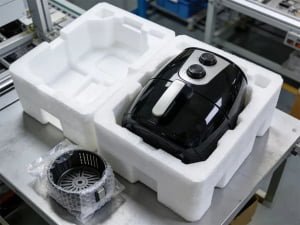
A suitable OEM air fryer manufacturer should be verified through project type, customization scope, market configuration, sample approval, packaging control, certificate-scope checking, production locking, inspection readiness, after-sales planning, and repeat-order stability before private label production.
Problem: Importers and private label brands often search for an OEM air fryer manufacturer, but many projects begin with only a logo request, a target price, or a catalog comparison.
Agitation: If OEM details are not confirmed before sampling and production, small mistakes in plug, voltage, color, control panel, packaging artwork, manual, rating label, certificate scope, or inspection standard can become shipment delay, retail rejection, customer complaints, or brand damage.
Solution: Treat OEM air fryer sourcing as a project-readiness decision. Before deposit or mass production, the project should be checked through product fit, customization depth, supplier proof, sample-to-production locking, packaging approval, document verification, inspection planning, and after-sales preparation.
Snippet: An OEM air fryer manufacturer should be evaluated by checking project type, customization scope, sample approval, packaging artwork, certificate scope, production version control, inspection readiness, after-sales planning, and repeat-order stability before private label production.
Quick answer
| Quick question | Practical answer |
|---|---|
| Is OEM air fryer manufacturing only logo printing? | No. Logo is only one part of OEM. Product configuration, packaging, labels, plug, voltage, manuals, inspection, and after-sales planning also matter. |
| What should be prepared before quotation? | Target country, sales channel, quantity plan, project type, model preference, customization details, packaging needs, certificate questions, and sample plan. |
| What is the biggest OEM order risk? | Sample approval without production-version locking can lead to mass production differences. |
| What should private label brands protect? | Brand reputation, customer reviews, packaging accuracy, product consistency, after-sales response, and repeat-order stability. |
| What should be checked before deposit? | OEM scope, sample status, packaging artwork, certificate scope, inspection standard, cost changes, and supplier responsibility. |
Choosing an OEM air fryer manufacturer is not only about finding a factory that can print a logo. For importers and private label brands, the larger question is whether the factory can support a branded project through the full path: product selection, sample approval, packaging artwork, production locking, certificate-scope checking, inspection, shipment, after-sales, and repeat orders.
From the factory side, many OEM inquiries start with a simple question: “Can you put our logo on this model?” That is a normal starting point, but in real production, logo printing is usually one of the smallest parts of the project. The higher risks often appear later, when artwork, rating labels, plug type, voltage, manual language, carton marks, or inspection standards were not clearly confirmed before mass production.
Method note: This guide explains manufacturer-side OEM risk logic for B2B air fryer sourcing. It does not guarantee quality, compliance, delivery, sales, or profitability. Every project should be verified according to the exact model, target market, sales channel, customization scope, supplier evidence, and current document status.
Is OEM air fryer manufacturing more than logo customization?
OEM air fryer manufacturing includes product configuration, visual branding, packaging, manuals, rating labels, plug, voltage, certificate-scope checking, sample approval, production locking, inspection standards, spare parts, and after-sales planning.
A logo can make a product look branded, but it does not automatically make the project ready for private label sales. A private label air fryer still needs the right base model, suitable capacity, stable components, retail packaging, market configuration, correct labeling, and an after-sales plan.
From a manufacturer’s view, one of the most common early misunderstandings is treating OEM as a printing job. In my experience, many later-stage problems are not caused by the logo itself. They come from unclear packaging files, late label changes, wrong plug assumptions, incomplete manual language, or sample details that were approved in chat but not locked in the production file.
OEM customization scope
| OEM item | Why it matters |
|---|---|
| Base model | Determines product structure, cost, testing scope, and production stability |
| Capacity | Affects market fit, carton size, retail price, and freight efficiency |
| Color | May affect material preparation, MOQ logic, and sample approval |
| Logo | Affects brand identity and placement accuracy |
| Control panel | Affects user interface, language, icons, film, and inspection |
| Plug / voltage / frequency | Affects target-market configuration and usability |
| Manual | Affects customer understanding, complaints, and safe use |
| Rating label | Affects model, electrical information, traceability, and document checking |
| Gift box | Affects shelf impression, barcode, claims, transport risk, and brand trust |
| Carton mark | Affects warehouse handling, logistics, and mixed-SKU control |
| Accessories | Affects customer experience and after-sales questions |
| Spare parts | Affects repair, complaints, and long-term support |
A stronger OEM discussion should move from “Can the logo be printed?” to “Which details must be confirmed before sample, packaging, certificate review, inspection, and mass production?”
Which project type fits better: standard wholesale, private label, OEM, or ODM?
Project type should be selected according to customization depth, cost tolerance, MOQ pressure, launch speed, brand differentiation, engineering complexity, sample requirements, and production risk.
Not every brand project needs deep OEM or ODM development. Some importers only need a standard model for market testing. Some private label brands need logo, packaging, and label changes on an existing model. Some projects require deeper configuration changes. Some need ODM development, which usually involves more engineering, testing, tooling, and version control.
From the factory side, a clear project type saves time and reduces misunderstanding. When a request only says “OEM air fryer,” the supplier may not know whether the project means simple logo branding, private label packaging, customized control panel, new color, changed structure, or full product development.
Project type decision table
| Project type | Suitable for | Main risk to verify |
|---|---|---|
| Standard wholesale | Fast market testing with existing models | Low differentiation and price competition |
| Private label | Brand launch using existing product structure | Logo, packaging, label, manual, MOQ, and channel fit |
| OEM | Deeper configuration or brand-specific changes | Sample lock, BOM, cost change, certificate scope, production control |
| ODM | New design, structure, or stronger differentiation | Tooling, engineering, testing, longer development, higher project risk |
Factory-side example
In my experience, many early brand owners say they need OEM, but after discussion, the project may actually be private label: existing model, brand logo, color choice, gift box, manual, barcode, and carton mark. This is not a problem. It can be a smart first step because it reduces development risk and helps test the market before deeper customization.
A different project may require changes to control panel, handle, trim, basket structure, window design, or product appearance. That moves closer to OEM or ODM and should be discussed with more careful cost, sample, testing, and timeline planning.
Decision logic
| Decision question | Practical direction |
|---|---|
| Is speed more important than differentiation? | Standard model or private label may be safer |
| Is brand identity important but structure can remain standard? | Private label may fit better |
| Is a product configuration change required? | OEM discussion becomes necessary |
| Is a new appearance or structure required? | ODM may be involved |
| Is the first order still a market test? | Avoid over-customization too early |
Choosing the right project type protects both sides. It prevents overbuilding a simple order and prevents underestimating a complex branded project.
What should importers prepare before requesting an OEM air fryer quotation?
A useful OEM air fryer quotation needs target country, sales channel, quantity plan, project type, model preference, customization scope, packaging needs, certificate questions, sample plan, inspection expectations, and after-sales concerns.
A quotation without project details can only be a rough reference. OEM pricing may change when logo method, color, packaging, manual, rating label, plug, voltage, artwork, barcode, carton mark, inspection standard, or sample requirement becomes clear.
From the factory side, a serious RFQ helps identify which cost and risk items need attention. It also helps the supplier avoid quoting a model that looks attractive but does not fit the target market, sales channel, or brand plan.
OEM project brief before quotation
| Brief item | What to send |
|---|---|
| Target country | Country, plug, voltage, frequency, local document questions |
| Sales channel | Retail, wholesale, online, supermarket, distributor, project, gift channel |
| Brand type | New private label, existing brand, distributor brand, retailer brand |
| Project type | Standard wholesale, private label, OEM, or ODM |
| Quantity plan | Trial order, first batch, repeat-order expectation |
| Product preference | Capacity, basket style, oven style, dual basket, visible window, control type |
| Brand customization | Logo, color, control panel, handle, trim, appearance preference |
| Packaging | Gift box, manual, barcode, carton mark, retail display needs |
| Certificate question | Target market and document-scope questions |
| Sample plan | Functional sample, branding sample, packaging sample, golden sample |
| Inspection | Pre-shipment inspection, function test, appearance check, packaging check |
| After-sales | Spare parts, warranty expectation, defect feedback process |
OEM quotation message template
Hello, we are evaluating an OEM air fryer project for [target country].
Project details:
- Sales channel:
- Project type: standard / private label / OEM / ODM
- Expected quantity:
- Preferred model or capacity:
- Plug / voltage / frequency:
- Logo requirement:
- Color or control panel requirement:
- Packaging requirement:
- Manual / label / barcode requirement:
- Certificate or test report question:
- Sample requirement:
- Inspection requirement:
- After-sales or spare parts question:
Please suggest suitable models and explain which OEM items may affect cost, MOQ, sample approval, packaging, certificate-scope checking, inspection, and production timing.
This type of request creates a clearer conversation than asking only for a catalog or lowest price. It also helps the factory explain which items are standard, which items require confirmation, and which items may increase order risk.
How can OEM cost, MOQ, and production timing change with customization?
OEM cost, MOQ, and production timing may change when customization affects materials, color, logo method, control panel, packaging printing, manual language, rating label, plug, voltage, tooling, testing, or inspection scope.
A standard model usually has a more predictable cost structure. A branded project may add preparation work, supplier coordination, artwork confirmation, sample checking, packaging production, label version control, or component changes. These factors can affect cost and production planning.
From my experience, the price difference between a standard air fryer and an OEM air fryer is often misunderstood. The buyer may only see logo printing, while the factory sees many small operational tasks: artwork file checking, packaging dieline review, print proof, rating label version, manual file, carton mark, barcode, sample approval, production file, and inspection checklist.
OEM cost change map
| OEM change | Possible cost or planning impact |
|---|---|
| Logo printing | Setup, printing method, position approval, defect checking |
| Custom color | Color matching, material preparation, sample approval |
| Control panel change | Film, icons, language, layout, testing, inspection |
| Gift box | Artwork, printing, dieline, color proof, packaging MOQ |
| Manual language | Translation, layout, version control, printing |
| Rating label | Market-specific information and production-file control |
| Plug / voltage | Component matching, configuration control, testing |
| Custom handle or trim | Material, color, tooling, assembly check |
| New appearance | Engineering review, tooling, testing, longer development |
| Certificate under brand | Document review, test scope, possible additional cost |
Why low MOQ and deep customization may conflict
Low MOQ can be useful for market testing, but deep customization may require special materials, packaging printing, or production setup. These two goals do not always fit easily together.
A more practical discussion is:
| Goal | Practical trade-off |
|---|---|
| Lower first-order risk | Use an existing model with lighter private-label customization |
| Stronger brand differentiation | Accept more sampling, testing, cost, and version-control work |
| Faster launch | Reduce structural changes and focus on packaging readiness |
| Better cost efficiency | Plan repeat orders and stable SKU strategy |
| Lower after-sales risk | Keep enough room for inspection, packaging, and spare parts |
OEM cost should not be judged by unit price alone. It should be judged by total project readiness, sample accuracy, packaging control, inspection feasibility, and repeat-order stability.
How should samples and production versions be locked before bulk production?
Samples and production versions should be locked through model code, BOM, color sample, logo, control panel, packaging artwork, manual, rating label, barcode, carton mark, accessories, golden sample, and QC checklist.
Sample approval is not only a yes-or-no decision. It should create a production reference. Without a locked reference, the factory, packaging supplier, inspection team, and buyer-side team may understand the project differently.
From the factory side, one of the most difficult OEM problems is sample approval by chat message only. A photo or short message may look convenient, but it may not define color tolerance, logo position, control panel version, manual language, rating label content, gift box file, barcode, or carton mark. When mass production starts, unclear approval becomes a risk.
Sample-to-production lock checklist
| Lock item | Why it matters |
|---|---|
| Model code | Prevents wrong base model |
| BOM | Controls key components and production version |
| Capacity | Prevents channel and price-position mismatch |
| Power / voltage | Controls market configuration |
| Plug | Prevents unusable or unsellable goods |
| Color sample | Reduces visual inconsistency |
| Logo position | Protects brand appearance |
| Control panel | Prevents UI, icon, and language errors |
| Manual | Reduces customer complaints and misuse risk |
| Rating label | Supports traceability and document checking |
| Gift box artwork | Prevents retail rejection and brand image damage |
| Barcode | Supports retail, warehouse, and inventory systems |
| Carton mark | Reduces warehouse and logistics confusion |
| Accessories | Prevents missing components |
| Golden sample | Creates a physical inspection reference |
| QC checklist | Aligns production and inspection standard |
Functional sample, branding sample, and packaging sample
| Sample type | Main purpose |
|---|---|
| Functional sample | Check heating, controls, basket, handle, appearance, and basic use experience |
| Branding sample | Check logo, color, panel, label, and brand visual details |
| Packaging sample | Check gift box, manual, barcode, carton mark, and packing method |
| Golden sample | Create reference for mass production and inspection |
A golden sample is especially useful for OEM air fryer orders. It helps reduce arguments later because production and inspection can compare real goods against a confirmed reference.
How should packaging artwork, labels, and manuals be controlled for private label air fryers?
Packaging artwork, labels, and manuals should be approved through final files, print proof, rating label review, barcode check, carton mark confirmation, language review, packaging sample, and final artwork lock before mass printing.
Private label packaging is not only decoration. It affects retail acceptance, warehouse handling, customer understanding, brand trust, and after-sales pressure. A small packaging error can delay shipment, cause repacking, create customer complaints, or damage the brand’s first impression.
In my experience, many OEM air fryer risks come from packaging changes made too late. A buyer may update a logo file, claim, barcode, or manual after the packaging supplier has already prepared printing. Even when the factory tries to support the change, late artwork adjustment can create delay, cost, or version confusion.
Packaging artwork approval flow
| Step | What to confirm |
|---|---|
| Logo file | Format, color, position, size |
| Gift box dieline | Panel layout, product photo, selling points, warning text |
| Manual | Language, product model, function explanation, safety notes |
| Rating label | Model, electrical information, brand details, traceability |
| Barcode | Number, size, placement, scannability |
| Carton mark | Model, quantity, gross weight, net weight, destination details when applicable |
| Packaging sample | Real print effect, color, box structure, readability |
| Inner packing | Protection, bag, foam, insert, accessory position |
| Master carton | Strength, packing method, loading efficiency, handling marks |
| Final artwork lock | Confirmed version before mass printing |
Packaging risk table
| Packaging risk | Possible failure cost |
|---|---|
| Wrong logo color | Brand inconsistency and rework |
| Wrong barcode | Retail or warehouse system problem |
| Manual language error | Customer confusion and complaints |
| Rating label mismatch | Document or channel review risk |
| Weak gift box | Poor shelf impression or transport damage |
| Wrong carton mark | Warehouse confusion or shipment handling issue |
| Late artwork change | Production delay and extra cost |
| No packaging sample | Print and structure problems discovered too late |
A strong OEM manufacturer should not only accept artwork files. The factory should help check whether the files are complete, whether version control is clear, and whether packaging approval happens before mass printing.
How should certificate scope and market configuration be verified before production?
Certificate scope and market configuration should be checked by exact model, target country, sales channel, plug, voltage, rating label, test report scope, certificate holder, factory information, and current document status.
Certificate names alone are not enough. A document may not apply to every model, every configuration, every plug, every voltage, every factory, or every sales channel. Private label brands should treat certification as a verification task, not a marketing claim.
From a manufacturer’s view, this is a sensitive but important point. A factory may have documents for certain models or configurations, but that does not automatically mean every OEM version is covered. When logo, rating label, plug, voltage, or market changes, the document scope should be checked again before bulk production.
Certificate-scope verification checklist
| Check item | Why it matters |
|---|---|
| Exact model | Prevents using documents for a different product |
| Product configuration | Checks whether the tested version matches the ordered version |
| Plug / voltage | Confirms market configuration alignment |
| Rating label | Supports consistency between product and document |
| Target country | Market requirements may differ |
| Sales channel | Retailers or platforms may request additional documents |
| Certificate holder | Clarifies which company owns or controls the document |
| Factory name | Checks whether the production site matches document scope |
| Test report scope | Confirms what was actually tested |
| Current status | Reduces outdated-document risk |
Safer certificate language
Instead of relying on:
“Certificate available.”
A stronger question is:
“Can the document scope be checked against the exact model, target market, plug, voltage, rating label, and production version before mass production?”
This protects both the importer and the manufacturer. It prevents the project from moving forward based only on a certificate name or logo.
How can factory claims be verified before trusting an OEM air fryer manufacturer?
Factory claims should be verified through business documents, production evidence, sample consistency, customization records, QC procedures, inspection reports, packaging samples, certificate-scope documents, communication quality, and repeat-order performance.
A supplier claim is a starting point, not final proof. “OEM supported,” “strict QC,” “factory direct,” or “certificates available” may be useful signals, but each claim should be connected to verifiable evidence before deposit or mass production.
From the factory side, serious OEM customers usually ask better questions. They do not only ask for the lowest price. They ask how samples are controlled, how packaging versions are locked, how inspection is handled, what documents match the model, and how after-sales issues are reported. These questions make the project more professional and easier to support.
Factory claim vs proof table
| Supplier claim | Proof to request |
|---|---|
| OEM supported | Past OEM samples, customization checklist, artwork process |
| Strict quality control | QC checklist, inspection records, test procedures |
| Certificates available | Model-matched certificate and test report scope |
| Factory direct | Business license, production video, audit evidence, production records |
| Stable production | Production schedule, line evidence, repeat-order record where available |
| Good packaging | Packaging sample, carton spec, transport-protection logic |
| After-sales support | Spare parts list, defect feedback process, responsibility discussion |
| Same as sample | Golden sample and signed production specification |
| Private label experience | Packaging samples, label examples, version-control process |
| Fast response | Clear answers, consistent follow-up, complete project file |
Manufacturer readiness signals
| Readiness signal | What it may indicate |
|---|---|
| Clear model code | Better production version control |
| Complete sample file | Lower sample-bulk mismatch risk |
| Packaging checklist | Lower artwork and printing risk |
| Inspection checklist | Better shipment-readiness control |
| Document-scope explanation | More realistic compliance discussion |
| Spare parts discussion | Better after-sales planning |
| Stable communication | Lower project-management risk |
A good OEM relationship is not built by claims alone. It is built by evidence, clear project files, signed specifications, sample control, inspection, and repeated problem-solving.
How can private label brands reduce brand risk before deposit?
Private label brand risk can be reduced by checking model differentiation, packaging accuracy, manual clarity, rating label consistency, basket quality, spare parts planning, sample-bulk consistency, carton protection, inspection standards, and after-sales process before deposit.
A private label order carries more risk than a simple resale order. When a product is sold under a brand name, product complaints, packaging errors, weak instructions, or unstable quality can affect reviews, retail trust, distributor confidence, and future sales.
In my experience, brand owners often focus heavily on appearance before the first order, but after shipment the main problems may come from practical details: handle feel, drawer fit, coating feedback, cleaning experience, manual clarity, packaging damage, missing accessories, or slow spare-part response. These details may look small during quotation, but they affect real customer experience.
Private label brand risk table
| Brand risk | Commercial impact |
|---|---|
| Same-looking generic model | Weak differentiation and price pressure |
| Packaging error | Retail rejection or poor first impression |
| Manual language issue | Customer complaints and misuse risk |
| Rating label mismatch | Channel or document review risk |
| Weak basket or coating stability | Reviews, returns, and warranty pressure |
| Poor handle or drawer fit | User experience complaints |
| No spare parts plan | Higher after-sales pressure |
| Sample-bulk inconsistency | Brand launch delay and dispute risk |
| Carton damage | Channel complaints and margin loss |
| Unclear defect feedback | Repeated problems without correction |
Private label differentiation layer
| Differentiation layer | What to consider |
|---|---|
| Visual identity | Logo, color, panel style, packaging design |
| User experience | Basket fit, handle feel, cleaning ease, menu logic |
| Channel fit | Retail shelf, online photos, distributor needs |
| Trust elements | Manual clarity, warranty card, spare parts plan |
| Product positioning | Entry model, family model, premium model |
| After-sales promise | Repair path, spare parts, return-handling process |
| Repeat SKU strategy | Stable model and future upgrade path |
Private label success should not depend only on adding a logo to a common model. A stronger project should connect product fit, packaging message, quality control, after-sales support, and repeat-order strategy.
What should be checked before paying a deposit for an OEM air fryer order?
A deposit decision should be based on confirmed OEM scope, approved sample, locked packaging artwork, checked certificate scope, clear PI or PO specifications, inspection plan, after-sales agreement, cost logic, and supplier responsibility.
A deposit moves the project from discussion into execution. Before that step, the project should be clear enough for production, packaging, inspection, and communication. If key details remain vague, production risk increases.
From the factory side, an unclear deposit can create problems for both parties. The factory may start preparing materials or packaging while the buyer still changes artwork, label details, or product configuration. This creates delay, cost, and tension that could have been avoided with better pre-deposit confirmation.
Pre-deposit decision gate
| Decision area | Proceed | Pause |
|---|---|---|
| OEM scope | Customization list confirmed | Only says “logo OEM” |
| Sample | Tested and approved | Only photos or videos reviewed |
| Packaging | Artwork and sample checked | No final packaging proof |
| Certificate scope | Matched to model and market for verification | Only certificate name or logo shown |
| PI / PO | Specifications locked clearly | Generic product name only |
| Inspection | Checklist agreed | No inspection plan |
| After-sales | Spare parts and feedback process discussed | No complaint process |
| Cost | OEM cost changes understood | Only compares unit price |
| Supplier role | Responsibility clear | Role unclear |
| Repeat order | Version control possible | One-time unclear order |
What should be written into PI or PO
| Item | Why it should be written |
|---|---|
| Model code | Prevents wrong product version |
| Capacity and key configuration | Aligns quotation, sample, and production |
| Plug / voltage | Prevents market mismatch |
| Color and logo | Controls brand appearance |
| Packaging version | Prevents artwork confusion |
| Manual and rating label | Controls customer and document details |
| Accessories | Prevents missing items |
| Inspection requirement | Defines shipment-check standard |
| Spare parts or after-sales terms | Clarifies post-shipment discussion |
| Shipment terms | Clarifies cost and responsibility |
A clear PI or PO does not remove every risk, but it reduces misunderstanding and gives both sides a shared reference for production and inspection.
How can long-term OEM cooperation stay stable after the first order?
Long-term OEM cooperation depends on repeatable product versions, stable packaging files, defect feedback, spare parts planning, inspection records, cost transparency, communication consistency, and review after each shipment.
The first OEM order should be treated as a pilot for long-term cooperation. It tests not only the product but also the project file, packaging accuracy, supplier communication, inspection process, after-sales response, and reorder stability.
In my experience, the best long-term OEM customers are not always the ones who push the first price to the lowest point. They usually test the sample carefully, provide clear artwork, ask practical risk questions, review inspection feedback, discuss defects calmly, and build repeat orders from real data. This creates a healthier cooperation model for both sides.
Repeat-order review checklist
| Review point | Why it matters |
|---|---|
| Sell-through feedback | Shows whether the model fits the channel |
| Customer complaints | Shows product or manual improvement needs |
| Defect types | Helps improve QC focus |
| Packaging damage | Helps adjust carton or inner packing |
| Spare-part use | Shows after-sales pressure |
| Inspection result | Shows whether shipment control worked |
| Cost changes | Supports future quotation planning |
| Communication quality | Shows project-management stability |
| Version control | Keeps repeat orders consistent |
| Reorder decision | Confirms whether to scale, modify, or stop |
Healthy cooperation logic
A stable OEM relationship needs reasonable value on both sides. The importer or brand needs product margin, brand protection, and repeatable supply. The manufacturer needs enough room to support material control, production management, packaging checking, inspection cooperation, and after-sales response.
This is not a conflict. It is a practical requirement for long-term B2B work.
FAQ
Is OEM air fryer manufacturing the same as private label?
No. Private label often uses an existing model with brand logo, packaging, manual, and label changes. OEM may involve deeper configuration changes. ODM may involve new design or development. The correct path depends on project goals, cost, MOQ, timing, and risk tolerance.
Is logo printing enough for a private label air fryer?
No. Logo printing is only one part of private label preparation. Packaging, manual, rating label, plug, voltage, barcode, carton mark, sample approval, inspection, and after-sales planning should also be checked.
What should be sent before asking for an OEM air fryer quotation?
A useful inquiry should include target country, sales channel, quantity plan, project type, preferred model, customization details, packaging needs, certificate questions, sample plan, inspection needs, and after-sales concerns.
Why can OEM MOQ be different from standard wholesale MOQ?
OEM MOQ may change because customization can involve special color, packaging printing, logo method, control panel changes, rating label versions, material preparation, or production setup. Exact MOQ should be confirmed by the selected model and customization scope.
How can sample-bulk mismatch be reduced?
Sample-bulk mismatch can be reduced by locking model code, BOM, color, logo, control panel, packaging artwork, manual, rating label, barcode, carton mark, accessories, golden sample, and QC checklist before production.
Are certificates enough to prove market compliance?
No. Certificate claims should be checked by exact model, target market, plug, voltage, rating label, test report scope, certificate holder, factory information, and current document status before mass production.
Should a private label brand choose factory, trading company, or sourcing agent?
The best role depends on order complexity, communication needs, quality-control ability, documentation support, logistics coordination, and risk-control requirements. Factories, trading companies, and sourcing agents can all create value when responsibility, transparency, and verification ability match the project.
What should be checked before paying a deposit?
Before deposit, check OEM scope, approved sample, packaging artwork, certificate-scope questions, PI or PO specifications, inspection plan, after-sales process, cost changes, supplier role, and production-version control.
Can AI tools help with OEM air fryer sourcing?
Yes. AI tools can help draft RFQs, organize comparison tables, list risk questions, and prepare project briefs. However, real samples, factory proof, document scope, inspection results, packaging approval, and after-sales capability still require direct verification.
What makes an OEM air fryer manufacturer suitable for long-term cooperation?
Long-term suitability depends on clear communication, stable product versions, packaging control, document support, inspection cooperation, after-sales response, repeat-order consistency, and practical problem-solving after each shipment.
Conclusion
An OEM air fryer manufacturer should not be evaluated only by logo printing, catalog range, or unit price. A private label project needs a more complete readiness check: project type, customization depth, model fit, market configuration, packaging artwork, sample approval, certificate-scope verification, production-version locking, inspection planning, after-sales support, and repeat-order stability.
From a factory perspective, many OEM problems are preventable. The most common risks often come from unclear artwork, incomplete labels, late packaging changes, verbal sample approval, document-scope assumptions, missing inspection standards, or after-sales issues that were not discussed before deposit.
A stronger OEM sourcing process should move step by step: define the project type, prepare a clear project brief, approve samples, lock production files, check packaging and documents, agree on inspection requirements, plan spare parts, and review the first order before scaling.
The goal is not to make the project complicated. The goal is to make the order clear enough that production, packaging, inspection, shipment, and after-sales work can follow the same confirmed version.
CTA
If an OEM air fryer project is being evaluated, feel free to share the target country, sales channel, order quantity, preferred model, logo or packaging needs, plug and voltage, certificate questions, sample plan, or inspection concerns through the page form, WhatsApp, or WeChat.
With these details, the next discussion can be clearer. We can help review customization scope, production risk, packaging points, and sample-to-bulk order questions before the project moves forward.