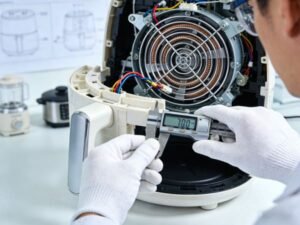
Worried that after-sales issues with an overseas supplier could hurt your brand? A lack of support leads to unhappy customers and rising costs, but it doesn’t have to be this way.
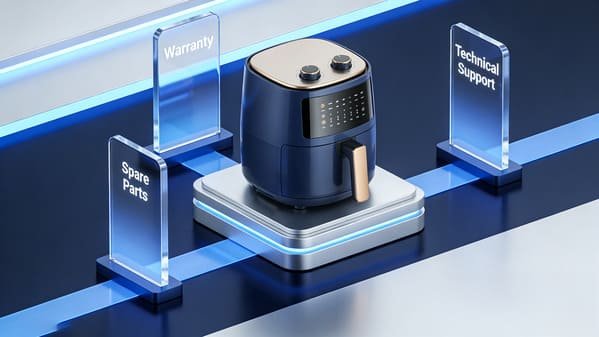
When buying air fryers from China, focus on three key areas of after-sales support: a clear warranty policy, guaranteed availability of spare parts, and responsive technical assistance. These elements are crucial for managing returns, performing repairs, and protecting your brand’s reputation with end-users.
Understanding these details before you place an order is the best way to secure a reliable partnership. Let’s break down what you need to look for.
What types of after-sales support are most important for my business?
Not all support is created equal, and focusing on the wrong areas can leave your business exposed. Protecting your investment means knowing which services truly impact your bottom line and customer satisfaction.
The most critical after-sales support types are a comprehensive warranty, a reliable supply of spare parts, and accessible technical assistance. These directly affect your operational costs, ability to service products, and your brand’s long-term reputation with customers.
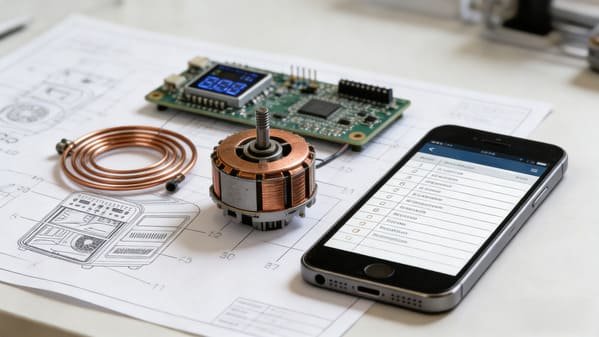
The right support structure protects your business from the financial and reputational damage of defective products. For B2B buyers, these three pillars form the foundation of a successful supplier relationship. When we design a new air fryer model, we consider not just its features but also its serviceability, because we know our partners’ success depends on it.
Prioritizing Support for Your Business Model
Your business model determines which support elements are most vital. An e-commerce seller who deals directly with consumers will have different priorities than a wholesaler supplying retail stores.
- Warranty1: This is your primary financial protection against manufacturing defects. A clear warranty that defines coverage, duration, and the claims process is non-negotiable. It allows you to replace or refund customer units without absorbing the full cost yourself.
- Spare Parts2: Your ability to repair units is impossible without a steady supply of parts. This is crucial for businesses that want to offer repairs instead of just replacements. It reduces waste and can be a more cost-effective solution for out-of-warranty issues.
- Technical Assistance3: When a customer has an issue, your team needs answers. Quick access to the manufacturer’s technical team for troubleshooting help, repair guides, or schematics is invaluable. It empowers your staff to solve problems efficiently.
Below is a breakdown of how each support type impacts key business metrics.
| Support Type | Impact on Operational Costs4 | Impact on Customer Satisfaction | Impact on Brand Reputation |
|---|---|---|---|
| Warranty1 | Reduces cost of replacing defective units. | High; provides confidence and a clear path for issues. | Strong; shows you stand behind your product. |
| Spare Parts2 | Lowers long-term costs by enabling repairs over replacements. | Moderate to High; enables timely, affordable repairs. | Positive; positions you as a sustainable, helpful brand. |
| Technical Assistance3 | Reduces staff time spent on troubleshooting. | High; leads to faster problem resolution. | Excellent; builds trust through expert support. |
How can I verify the supplier’s capability to provide effective after-sales service?
A supplier can promise excellent service, but how can you be sure they’ll deliver? In our production process, quality checks are built-in at every stage; you should apply the same diligence when vetting a partner.
To verify a supplier’s after-sales capability, review their documentation, ask specific questions about their process, check for existing service infrastructure, and run a small trial order. Their responsiveness and transparency during the sales process often predict future support quality.
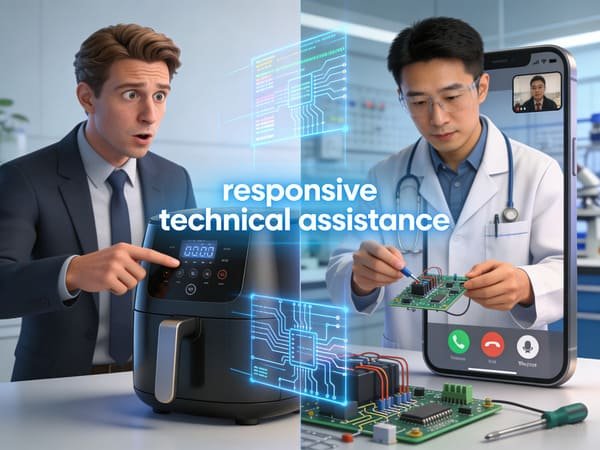
Verifying a supplier’s claims before you commit is a critical risk-management step. A promise on a website is not a guarantee of service. You need to dig deeper to find objective proof. This proactive approach separates reliable long-term partners from suppliers who disappear after shipment.
The Verification Checklist
Before signing a contract, go through a systematic verification process. Each step gives you a clearer picture of what you can expect when an issue arises.
- Request and Review Documentation5: Ask for their official warranty policy, a sample claims form, and any technical manuals. Pay attention to the level of detail. Vague or incomplete documents are a red flag.
- Conduct a "Support" Interview6: Ask direct questions about their after-sales team. Who is your point of contact? What is their typical response time? How do they handle language barriers? We assign dedicated account managers to our partners to ensure communication is always clear and fast.
- Check for Existing Infrastructure: Ask if they have any authorized service centers or parts distributors in your region. While rare, some larger manufacturers have a global network. This can drastically simplify logistics.
- Inquire About Past Issues7: Ask them to describe a recent after-sales issue they resolved for another client. A competent supplier will be able to explain their process clearly. A supplier who claims they’ve "never had any problems" is not being truthful.
- Run a Trial Order8: The ultimate test is a small trial order. It allows you to experience their entire process, from communication and production to shipping and quality. If you find a defect in a sample, it’s a perfect opportunity to test their claims process in a low-risk scenario.
| Verification Method | What It Reveals | Red Flag Example |
|---|---|---|
| Documentation Review | The supplier’s level of organization and commitment to formal processes. | No written warranty policy available; "we’ll discuss if it happens." |
| Direct Questions | The clarity of their internal procedures and the expertise of their team. | Unable to name a specific contact for after-sales support. |
| Trial Order & Test Claim | Real-world performance of their support system under low-risk conditions. | Slow response to a sample defect; asks you to pay for return shipping. |
What should I clarify regarding spare parts and technical assistance?
Assuming a defective air fryer will simply be replaced is a costly mistake. For a scalable business, you need a plan for repairs, which hinges on spare parts and technical knowledge from your supplier.
You must clarify the ordering process for spare parts, including pricing, MOQ, and lead times. For technical assistance, establish a dedicated contact, confirm the availability of repair guides and schematics, and agree on a guaranteed response time for inquiries.
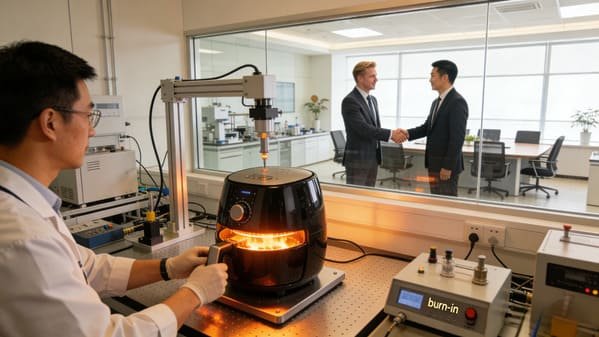
Without clear agreements on these two points, your "after-sales support" is incomplete. A warranty may cover a replacement unit, but what about a simple fix? Or a customer who is just outside the warranty period? Having access to parts and information allows you to service your products effectively, control costs, and provide a better customer experience. We often provide our partners with a starter kit of common replacement parts, like fuses or heating elements, with their first major order.
Building a Spare Parts Strategy
A reliable supply of parts is the backbone of any repair program. You need to treat this as a separate procurement process.
- Part Identification9: Ensure the supplier can provide a detailed list of all replaceable components with part numbers. An exploded-view diagram is ideal.
- Pricing and MOQ: Get a price list for spare parts. Understand if there is a Minimum Order Quantity (MOQ). Can you order a single heating element, or do you need to buy 100?
- Lead Time and Logistics10: How long does it take to get parts from their factory to your warehouse? Who covers the shipping cost? These factors determine how long a customer’s unit will be out of service.
Establishing a Technical Support Channel
Fast access to technical information can turn a potential return into a satisfied customer.
- Dedicated Contact: You need a specific person or email address for technical questions, not a general sales inbox. This person should have engineering or product knowledge.
- Available Resources11: Ask for troubleshooting guides, repair manuals, and electrical schematics. These resources empower your own technical team.
- Response Time SLA12: Get a commitment on response time in writing. A "Service Level Agreement" (SLA) of 24-48 hours for technical inquiries is a reasonable expectation.
| Topic | Key Questions to Ask Your Supplier | Ideal Response |
|---|---|---|
| Spare Parts List | Can you provide a complete, itemized list of spare parts with part numbers and prices? | "Yes, here is the exploded-view diagram and a price list for all serviceable parts." |
| Ordering Parts | What is the MOQ and lead time for ordering spare parts? Who is responsible for shipping costs? | "There is no MOQ for most parts. Lead time is 5 days, and we can add them to your next shipment." |
| Technical Contact | Who is our dedicated technical contact, and what is your guaranteed response time for questions? | "You will have direct access to our engineer, David. He will respond within 24 hours." |
| Technical Docs | Do you provide repair manuals, troubleshooting guides, or schematics for your air fryers? | "Yes, we provide a full technical service manual for our partners with every order." |
How do I handle after-sales issues with overseas suppliers?
Even with the best supplier, issues can still happen. Knowing the correct procedure to handle a problem efficiently is key. A disorganized approach can lead to delays, misunderstandings, and denied claims.
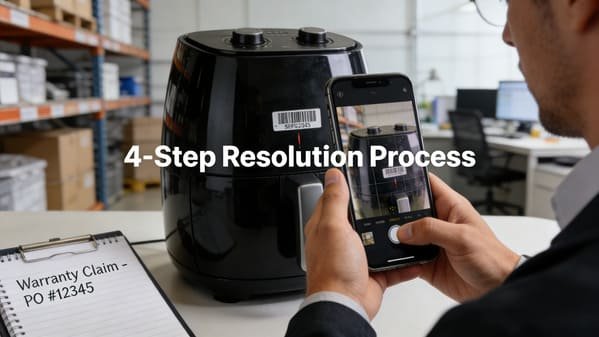
To handle after-sales issues, immediately document the problem with clear photos and videos. Contact your dedicated sales or support representative via email, referencing your PO number and the specific defect. Follow the agreed-upon claims process outlined in your contract.
A systematic and professional approach is the best way to get a quick resolution. When we receive a claim, the first thing we look for is clear evidence of the problem. A well-documented claim allows our engineering team to diagnose the issue quickly and approve a solution, whether it’s shipping a replacement part or crediting an account. Panicked phone calls or vague emails only create confusion.
The 4-Step Resolution Process
When you discover a defect, don’t delay. Follow these steps for a smooth and effective claims process13.
-
Document Everything Immediately:
- Take high-resolution photos and videos of the defect. If it’s a functional problem, record a video showing the malfunction.
- Note the serial number of the affected unit(s).
- Write a clear, concise description of the problem. Avoid emotional language.
-
Initiate Formal Contact:
- Draft a professional email to your designated supplier contact.
- Use a clear subject line, such as "Warranty Claim14 for PO #12345 – Defective Heating Element."
- Attach all your documentation (photos, videos, description).
-
Follow the Agreed-Upon Process:
- Refer to the warranty and claims process13 defined in your purchase agreement.
- If the supplier requires you to fill out a specific form, do it promptly and completely.
- Keep all correspondence in a single email thread for easy tracking.
-
Escalate if Necessary:
- If your primary contact is unresponsive or unhelpful after a reasonable amount of time (e.g., 3-5 business days), escalate the issue.
- Send a follow-up email and CC their manager or the company owner if you have their contact information.
- Refer back to the terms of your contract, politely but firmly stating their obligations.
Remember that patience and professionalism are your greatest assets. Building a good relationship with your supplier contact during the sales process pays dividends when you need their help later.
Conclusion
Focusing on warranty, parts, and technical help before you buy is key. Verifying these details protects your business and ensures you have a reliable partner for the long term.
-
Understanding warranty best practices can help you protect your business and enhance customer trust. ↩ ↩
-
Effective spare parts management can significantly reduce costs and improve service efficiency. ↩ ↩
-
Exploring the benefits of technical assistance can enhance customer satisfaction and brand loyalty. ↩ ↩
-
Learning strategies to reduce operational costs can improve your bottom line and increase profitability. ↩
-
Understanding the significance of documentation can help you avoid potential pitfalls in contracts. ↩
-
Learn how to ask the right questions to gauge supplier reliability and support quality. ↩
-
Exploring past issues can provide insights into a supplier’s problem-solving abilities and transparency. ↩
-
Discover how a trial order can reveal a supplier’s true capabilities and reliability. ↩
-
Understanding part identification helps ensure you receive the correct components, streamlining repairs and reducing downtime. ↩
-
Exploring this topic reveals how timely delivery impacts service efficiency and customer satisfaction. ↩
-
Discovering essential resources can empower your team, enhancing repair capabilities and customer service. ↩
-
Learning about SLAs can help you set expectations for response times, ensuring better service and support. ↩
-
Exploring the claims process can provide insights into best practices and help you manage your claims efficiently. ↩ ↩
-
Understanding the warranty claim process can help you navigate issues effectively and ensure your rights are protected. ↩