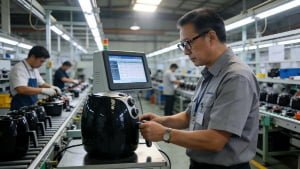

Struggling with production delays from Chinese suppliers? These holdups can cause stockouts and hurt your brand. On our own production lines, we’ve seen how clear communication prevents these issues.
To communicate effectively, provide detailed specifications and desired timelines upfront. For urgent orders, clearly state the need and negotiate solutions like air freight. Use a mix of instant messaging for speed and email for formal records to ensure clarity and accountability with your supplier.
Effective communication is the foundation of a successful partnership with any supplier. Let’s explore the specific details you need to provide and the questions you should ask to ensure your air fryer orders stay on track, even when urgency strikes.
What information should I provide to set production timelines?
Vague requests often lead to uncertain timelines. This ambiguity can derail your launch schedule, a problem we work hard to avoid by asking for specifics. Providing precise details from the start ensures clarity.
Provide a comprehensive brief including product specifications, order quantity, packaging requirements, quality standards, and your desired delivery date. Sharing a clear milestone chart helps align both parties and prevents misunderstandings, ensuring a smoother production process from start to finish.
To ensure your supplier can give you an accurate and reliable production schedule, you need to provide a complete picture of your project. From our perspective as a manufacturer, the more detailed the information we receive, the better we can allocate resources, order raw materials, and schedule time on the production line. Ambiguity is the enemy of efficiency.
Key Information Checklist
Start with the basics. Your supplier needs to know the exact product model, desired modifications (colors, logos, features), and the total order quantity. Don’t forget technical details like voltage and plug type specific to your target market. Next, detail your packaging requirements, including artwork files, box dimensions, and user manual language. Finally, specify your quality control standards and any third-party inspection requirements. Providing this upfront saves weeks of back-and-forth communication.
The Importance of a Milestone Chart
A simple timeline isn’t enough. A shared milestone chart creates mutual accountability. This document should break down the entire process into key stages. It helps both you and the supplier track progress and identify potential bottlenecks early. When we work with clients on an ODM project, a clear milestone chart is one of the first things we establish.
Here is a sample milestone chart you can adapt:
| Milestone | Target Completion Date | Responsible Party | Status |
|---|---|---|---|
| Final Product Specs Confirmed | Week 1 | Buyer/Supplier | Completed |
| Packaging Artwork Approved | Week 2 | Buyer | In Progress |
| Raw Material Procurement | Week 4 | Supplier | Pending |
| Pre-Production Sample Ready | Week 5 | Supplier | Pending |
| Mass Production Start | Week 6 | Supplier | Pending |
| Final QC Inspection | Week 9 | Buyer/3rd Party | Pending |
| Goods Ready for Shipment | Week 10 | Supplier | Pending |
How can I negotiate priority handling for urgent orders?
An unexpected sales surge leaves you needing stock fast, but your supplier says it’s impossible. With the right negotiation strategy, we often find ways to accommodate these urgent requests for our partners.
Clearly explain the reason for the urgency and offer incentives. Propose tangible solutions like paying for air freight or offering a deposit for expedited material sourcing. Highlighting your long-term partnership value can also persuade the supplier to prioritize your order.
When an urgent need arises, how you approach your supplier makes all the difference. Simply demanding faster production is rarely effective. A factory’s schedule is a complex puzzle of different clients’ orders, material availability, and labor capacity. Asking to jump the queue affects other customers. Therefore, your request must be framed as a collaborative problem-solving effort.
Be Clear and Specific
Start by explaining why the order is urgent. Is it for a major retail promotion? Are you about to run out of stock, risking delisting from an e-commerce platform? Sharing the business context helps the supplier understand the stakes. Instead of saying "I need this urgently," say "We have a guaranteed promotion with a major retailer starting on [Date], and we need 1,000 units in our warehouse by [Date] to avoid penalties."
Offer Solutions, Not Just Demands
Show that you are willing to share the burden. The fastest way to expedite an order is often by changing the shipping method. While much more expensive, air freight can cut transit time from over 30 days to just 7-15 days. You can also offer to pay an "expedite fee" to cover overtime for our workers or the higher cost of rush-ordered components. This demonstrates that you value their extra effort.
Leverage Your Relationship
If you are a loyal, long-term customer, remind them of your partnership. A good supplier values reliable clients who provide consistent business. You can frame your request by saying, "As a partner for the past three years, we’re facing a critical situation and would greatly appreciate your support." You can also incentivize them with future benefits, such as guaranteeing a larger order next quarter if they can help you now.
What questions should I ask about production flexibility?
Don’t assume a supplier is flexible until you’ve verified it. This assumption can lead to major disappointment when you need to make a change. We build flexibility into our processes, but it’s crucial to ask the right questions upfront.
Ask about their capacity for rush orders, their minimum order quantity (MOQ) for custom changes, and their process for handling mid-production adjustments. Inquire about their supply chain stability and if they have backup suppliers for critical components to gauge their resilience.
Understanding a supplier’s production flexibility before you place an order is critical for long-term planning and risk management. Their answers to these questions will reveal how well they can adapt to the unpredictable nature of the market. Don’t wait for an emergency to discover your supplier is rigid.
Probing for Real Flexibility
When discussing flexibility, you need to move beyond simple "yes" or "no" answers. Dig deeper to understand their actual capabilities and processes. A truly flexible partner can articulate their policies and limitations clearly. This transparency is a sign of a mature and reliable manufacturer. We always prefer to be upfront with our clients about what is and isn’t possible.
Key Questions to Ask
Here are some specific questions to vet a potential supplier’s flexibility. Their responses will give you a clear picture of what you can expect when changes are needed.
| Category | Question to Ask | What a Good Answer Looks Like |
|---|---|---|
| Urgent Orders | "What is your process and potential lead time for an urgent order of 500 extra units?" | "We can typically fit it in within 2-3 weeks, but it may require an expedite fee of X%." |
| Change Orders | "How do you handle a change to the product color after production has started?" | "Changes are possible before the painting stage, but will incur a fee and add 5 days." |
| MOQ Flexibility | "If we need a small test run of 100 units with a new feature, is that possible?" | "Our standard MOQ is 500, but we can support a trial run for long-term partners." |
| Supply Chain | "Do you have alternate suppliers for key components like the heating element or MCU?" | "Yes, we have 2-3 pre-vetted suppliers for all critical parts to prevent disruptions." |
| Production Capacity | "What is your current capacity utilization, and how much buffer do you have?" | "We are at 80% capacity. We reserve 10% for urgent orders and can scale up with overtime." |
By asking these detailed questions, you are not just vetting a supplier; you are setting the stage for a transparent and resilient partnership.
How do I monitor and adjust schedules for changing needs?
Setting a schedule is easy; keeping it on track is the hard part. Assuming everything will go as planned is a common mistake. Regular monitoring and open communication are what keep our projects aligned with clients’ goals.
Establish a weekly communication rhythm with your supplier for progress updates, including photos or videos from the production line. Use a shared project management tool or spreadsheet to track milestones and address deviations from the schedule immediately to make timely adjustments.
Your production schedule is a living document, not a static one. Market demands shift, logistics face unexpected delays, and even minor design tweaks can have a ripple effect. Actively monitoring progress and maintaining open lines of communication are essential to navigate these changes without derailing your entire project. A passive approach almost guarantees that small issues will snowball into major delays.
Establish a Communication Rhythm
Don’t wait for the supplier to update you. Proactively establish a regular check-in schedule. A weekly email or a quick call on WhatsApp can make a huge difference. Ask for specific updates on the milestones you previously agreed upon. Requesting visual proof, such as photos of the raw materials, components on the assembly line, or finished products being packaged, provides tangible evidence that things are moving forward as planned. This builds trust and gives you a real-time view of your investment.
Email chains and chat messages can become confusing. Use a simple, shared tool to maintain a single source of truth for your production schedule. A Google Sheet or a basic project management tool like Trello works perfectly.
Create a sheet that tracks each production stage against its target date. Update it after every weekly check-in. This makes it easy for both you and the supplier to see if you are on track, ahead of schedule, or falling behind.
| Stage | Target Date | Actual Date | Status | Notes |
|---|---|---|---|---|
| Deposit Paid | Oct 1 | Oct 1 | ✅ On Track | |
| Materials Arrived | Oct 15 | Oct 18 | ⚠️ Delayed | Supplier holiday caused 3-day delay. |
| Production Start | Oct 20 | Oct 21 | ✅ On Track | Made up 1 day with overtime. |
| Final Inspection | Nov 10 | – | Pending | Scheduled for Nov 10. |
| Shipment | Nov 15 | – | Pending |
When a delay occurs, the shared tracker makes it instantly visible. This allows you to immediately discuss solutions, such as approving air freight for a portion of the order to meet an immediate need, while the rest ships by sea.
Conclusion
Clear communication, detailed planning, and proactive monitoring are essential. By providing precise information, negotiating smartly, and asking the right questions, you can build a resilient and reliable supply chain for your air fryers.