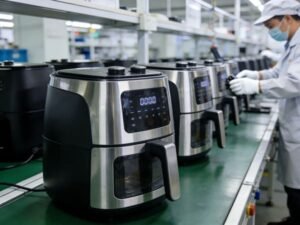
A sample can look acceptable and still hide a weak supplier. I have learned that the real risk often appears in how the supplier reacts to feedback, not in the first sample itself.
I use sample feedback as a screening tool before mass production. The real goal is not only to improve one air fryer sample. The goal is to see whether the supplier can explain problems clearly, fix them with evidence, update documents correctly, and lock the changes into mass production control.
When I review a sample, I never treat feedback as a simple comment list. I treat it as a low-cost stress test for the supplier’s engineering, quality, and production discipline. In our daily work, a weak supplier can often make a better-looking second sample. That part is not hard. The hard part is whether the supplier can show what went wrong, why it went wrong, what changed, how the fix was verified, and how the same issue will be prevented later on the real production line. That is why I do not use sample feedback to help every supplier pass. I use it to reveal which suppliers can truly control mass production and which suppliers only know how to improve a prototype.
What Should Air Fryer Sample Feedback Measure Beyond Appearance and Basic Function?
If I only comment on appearance and basic function, I miss the real production risks. A smooth finish and a working power-on test do not tell me enough.
Air fryer sample feedback should also measure system-risk issues such as BOM stability, key-component consistency, fit repeatability, heat-related materials, labeling control, food-contact parts, and whether the sample reflects the real production plan.
I always divide my sample feedback into three clear groups: cosmetic issues, functional issues, and system-risk issues. Cosmetic issues include gaps, scratches, poor alignment, rough edges, uneven finish, and basket fit. Functional issues include power-on behavior, heating response, fan performance, timer accuracy, control logic, and basic user operation. These are important, but they are not enough.
The third group is where I learn the most. I want to know whether the sample uses the same heater, motor or fan, thermostat, thermal fuse, power cord, basket, coating, tray, silicone parts, and plastics near hot zones that will be used in mass production. I also want to know whether the label version, warning content, manual version, and food-contact material setup are already aligned with the destination market. In our factory reviews, this is where weak suppliers start to struggle, because they can polish a sample surface more easily than they can explain system consistency.
That is why I always ask the supplier to respond not only to what is visible, but also to what could drift later in production.
| Feedback category | What I check | Why it matters |
|---|---|---|
| Cosmetic issues | Gaps, scratches, finish, alignment | Protects retail appearance |
| Functional issues | Heating, fan, timer, controls | Protects user experience |
| System-risk issues | BOM, key parts, labels, food-contact materials | Protects mass-production consistency |
| Compliance-related points | Warnings, rating labels, material setup | Protects market readiness |
| Repeatability concerns | Fit stability, assembly consistency | Protects batch-to-batch quality |
How Can Sample Feedback Reveal Weak Process Control Before Air Fryer Mass Production Starts?
A supplier’s first sample may look acceptable, but the feedback cycle often shows whether the supplier has real process control or only temporary patchwork.
Sample feedback reveals weak process control when the supplier cannot explain the issue source, cannot connect it to process steps, or improves the sample without showing how the same fix will be controlled during mass production.
I learn a lot from the way a supplier answers one simple problem. Let us say I report unstable basket fit, uneven heating response, or rough casing finish. A strong supplier will usually explain where the issue came from. It may point to tooling tolerance, assembly method, material variation, inspection gap, or operator handling. A weak supplier usually says only, “We will improve it next time.”
That difference matters. In our production work, a real process-controlled factory can connect the problem to the process. It can tell me whether the root cause came from tooling, incoming material, assembly method, testing method, or inspection standard. It can also tell me what checkpoint will prevent the issue later. If the supplier only sends back a nicer sample with no explanation, then I assume the process is still unstable.
This is why sample feedback is so useful before mass production. It forces the supplier to move from selling mode into control mode. A weak supplier often fails this step because it does not have strong engineering coordination, QC follow-up, or document discipline behind the sample team.
| Supplier response type | What it shows | What I conclude |
|---|---|---|
| Clear issue explanation | Supplier understands the process | Better control maturity |
| Root-cause linkage | Problem tied to material, tooling, or assembly step | Real production knowledge |
| Updated checkpoint | Prevention added to QC or process flow | Better mass-production readiness |
| Vague promise only | No real process understanding | High future risk |
| Better sample, no records | Cosmetic recovery without control | Weak production discipline |
Which Supplier Responses to Air Fryer Sample Feedback Indicate Strong Corrective Action Capability?
The real test is not whether the supplier says yes. The real test is whether the supplier responds with structure, evidence, and prevention.
Strong corrective action capability shows up when the supplier answers each sample issue with root cause, corrective action, validation result, and mass-production prevention, supported by updated technical and QC documents.
When I send sample feedback, I want the supplier to answer each point in a disciplined way. I expect four things for every issue: root cause, corrective action, validation result, and mass-production prevention. If the supplier can give me those four parts clearly, I gain confidence fast.
In our projects, the best suppliers usually go one step further. They also show what documents changed. That may include a revised drawing, a new BOM version, an updated inspection standard, a changed work instruction, or a note about whether the fix affects critical components, certification, or food-contact materials. This matters because some changes are not just cosmetic. A changed coating, silicone part, heater, or cord can affect compliance and long-term risk.
A weak supplier often avoids structure. It may send a short message, promise improvement, or send a replacement sample without explaining anything. That tells me the supplier may solve problems by trial and error, not by system control. In mass production, that kind of behavior creates drift, delay, and repeat defects.
| Strong response element | What I expect to see | Why it matters |
|---|---|---|
| Root cause | Clear explanation of why the issue happened | Shows real technical understanding |
| Corrective action | Specific fix, not general promise | Shows action discipline |
| Validation result | Test or review proving the fix works | Shows evidence-based control |
| Prevention plan | How the issue will be blocked in production | Shows system thinking |
| Updated documents | BOM, drawing, inspection criteria, work instruction | Shows controlled implementation |
How Should Buyers Use Repeat Samples to Separate Coachable Air Fryer Suppliers From High-Risk Ones?
A second sample is not only a product check. It is a supplier behavior check. I use it to see who can learn and who only reacts.
Buyers should compare repeat samples against the supplier’s written change summary, not just visual feeling, and use the quality of the response process to separate coachable suppliers from high-risk suppliers.
I never judge the second sample alone. I compare the first and second samples with the supplier’s written change list beside me. That is very important. In our work, a supplier may improve something visible while leaving the deeper issue unchanged. For example, it may polish a surface defect but ignore the tooling cause. It may tighten basket fit in one unit but still leave the assembly method unstable. That is why I want to see whether the physical change matches the written explanation.
A coachable supplier usually responds in a structured way, updates the right documents, explains internal approval, and stays consistent between the written summary and the new sample. A high-risk supplier often changes the sample without version control, cannot explain what changed, or gives different answers from sales, engineering, and QC. That is a serious warning sign.
In our supplier selection, I do not need every first sample to be perfect. I need the supplier to be teachable, controlled, and honest. A supplier that can absorb feedback and lock the correction into the system is often a much safer choice than one with a nicer first sample but weak control behind it.
| Repeat-sample pattern | What it means | My decision signal |
|---|---|---|
| Written changes match sample changes | Controlled improvement | Positive sign |
| Documents updated with version control | Supplier manages change properly | Positive sign |
| Cross-team answers stay consistent | Better coordination | Positive sign |
| Sample improved, no written summary | Weak control behind correction | Warning sign |
| Different answers from different people | Poor internal coordination | High-risk signal |
What Documentation Changes Should Follow Air Fryer Sample Feedback Before Order Approval?
If the supplier changes the sample but not the documents, I assume the risk is still open. A real correction must appear in the controlled files.
Before order approval, sample feedback should lead to updated drawings, BOM versions, component lists, inspection criteria, test requirements, and change approvals wherever the correction affects production or quality control.
I always check whether the supplier updates documents together, not one by one. If a basket fit issue leads to a tooling or structure change, then the drawing should change. If a component changes, then the BOM and approved component list should change. If the feedback changes the acceptance standard, then the inspection criteria should change too. In our production system, this document linkage is what turns a one-time fix into a controlled production standard.
I also ask whether the change affects any critical part, certified part, label content, warning statement, or food-contact material. For air fryers, that question matters a lot. A coating change, silicone change, heater change, or cord change is not a small adjustment. It may affect compliance, safety, or target-market approval. I want to know who approved the change internally. Was it engineering, QC, purchasing, or management? If nobody can answer that clearly, the change process is weak.
Before I approve an order, I need to see that the sample feedback has become part of the production system, not just part of a chat history.
| Document type | What should be updated | Why I check it |
|---|---|---|
| Drawing version | Structure, fit, appearance details | Locks physical changes |
| BOM version | Changed components or materials | Locks parts used in production |
| Component list | Approved key parts and sources | Prevents silent substitution |
| Inspection criteria | New defect standard or checkpoints | Locks QC expectations |
| Change approval record | Internal sign-off for key changes | Confirms controlled decision-making |
Which Red Flags in the Sample Feedback Cycle Show an Air Fryer Supplier Should Be Eliminated Early?
Some suppliers should not move forward, even if the sample improves. I would rather stop early than pay for chaos later.
The biggest red flags are vague answers, undocumented fixes, inconsistent explanations, missing version control, no root-cause logic, and no proof that sample corrections will be carried into mass production.
I have learned that weak suppliers often show the same pattern during the sample feedback cycle. They answer slowly and vaguely. They focus only on surface appearance. They send a revised sample without any written change summary. They cannot explain whether the fix changed the BOM, tooling, labeling, certification status, or food-contact materials. They also fail to update drawings and inspection standards together. These are not small administrative issues. They show weak engineering coordination and weak production discipline.
Another major red flag is uncontrolled change. If the supplier makes changes but cannot tell me who approved them internally, I assume the same thing can happen later during mass production without notice. That is dangerous for air fryers because changes to heaters, motors, coatings, cords, baskets, trays, or silicone parts can create performance or compliance problems very fast.
In our sourcing process, I treat vague answers, undocumented fixes, and version-uncontrolled changes as elimination signals. I would rather remove that supplier before the order than spend months fixing preventable problems after production starts.
| Red flag | What it suggests | Why I eliminate early |
|---|---|---|
| Vague response | Weak technical ownership | Problems may repeat later |
| Replacement sample only | Cosmetic fix without system control | Mass-production risk stays open |
| No updated documents | Change not locked into production | Drift risk remains high |
| No clear approver | Uncontrolled internal change process | Future surprises likely |
| Inconsistent answers | Weak coordination across teams | Poor execution under volume |
Conclusion
I use sample feedback to test the supplier, not just the sample, because the strongest air fryer partner is the one that can turn comments into controlled production action.
FAQ
Why should I use air fryer sample feedback to screen suppliers instead of only improve the sample?
Because the supplier’s response quality reveals far more than the sample itself. I can see whether the supplier has real engineering, QC, and mass-production discipline before I place a bulk order.
What should air fryer sample feedback include besides appearance comments?
I include cosmetic issues, functional issues, and system-risk issues such as BOM consistency, key components, food-contact materials, labels, and whether the sample reflects the real production plan.
What is the strongest sign that an air fryer supplier has good corrective action capability?
The strongest sign is a structured response for each issue that includes root cause, corrective action, validation result, mass-production prevention, and updated controlled documents.
How should I compare the first and second air fryer samples?
I compare them against the supplier’s written change summary, not only by visual feeling. The physical improvements should match the documented changes and updated versions.
What documentation should change after sample feedback before I approve an air fryer order?
I expect updates to drawings, BOM versions, approved component lists, inspection criteria, and change-approval records whenever the correction affects production, quality, safety, or compliance.
What if the supplier sends a better second sample but no documents?
I treat that as a warning sign. A better sample without controlled records often means the supplier improved one unit but did not build the fix into the mass-production system.
How can repeat samples help me separate coachable air fryer suppliers from risky ones?
A coachable supplier usually responds with clear logic, consistent team answers, and updated documents. A risky supplier often reacts with vague promises, undocumented changes, or inconsistent explanations.
Which sample feedback red flags mean I should eliminate the air fryer supplier early?
I would treat vague answers, no root-cause analysis, undocumented fixes, missing version control, and unclear internal approval for changes as strong red flags to eliminate the supplier early.