A polished website can hide a weak supplier. I have seen buyers pay deposits too fast, then find out the “factory” was only a sales office with a borrowed story.
To spot a fake China air fryer manufacturer, I check one thing first: whether the same legal entity appears across the business license, registry record, certifications, bank details, factory address, and export evidence. If those records do not match, I treat the supplier as a trader at best and a fake factory at worst.
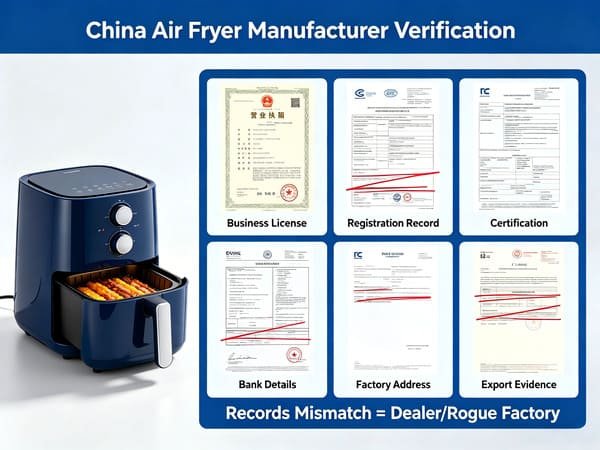
In our daily work with air fryer projects, I do not judge a supplier by its Alibaba badge, website photos, or a smooth sales pitch. I judge it by whether its identity holds together under simple checks. That is where many fake manufacturers fail. They may show a factory video, but the company name is missing. They may send a certificate, but it belongs to another legal entity. They may offer a great price, but the bank account belongs to a different company. For air fryers, this is not a small issue. It touches electrical safety, fire risk, product liability, and shipment compliance. A bad supplier can cost far more than a bad quote. That is why I always start with legal identity, then move to production proof, then finish with certification and shipment evidence.
How to Verify Whether a China Air Fryer Supplier Is a Real Manufacturer or a Shell Company?
Many suppliers say they are factories. I have learned that the claim means little unless the same company can prove it across records, documents, and real production evidence.
I verify a China air fryer supplier by matching its Chinese legal company name, Unified Social Credit Code, business scope, factory address, certifications, bank account, and production proof. If the same entity appears everywhere, the supplier may be a real manufacturer. If key details conflict, I assume risk.
When I screen a new supplier, I start with its Chinese legal company name, not its English trade name. Many buyers miss this point. The English name on a website is often only branding. The real traceable identity in China is the registered Chinese company name plus the 18-digit Unified Social Credit Code. That code works like the anchor for almost every next step. I use it to check whether the company is active, what its business scope says, where it is registered, who the legal representative is, and when it was established.
Then I look at the business scope. If a supplier says it is a manufacturer of air fryers, I expect to see wording related to production, manufacturing, processing, or assembly of home appliances or kitchen appliances. If the scope only talks about trading, consulting, e-commerce, or import and export, I become careful. That does not prove fraud by itself, because some real groups use separate sales companies. Still, if the supplier claims “we are the factory” while the legal record only supports trading, I want a clear explanation and supporting proof from the production entity.
I also compare the company identity across every document they send. The sample sender, proforma invoice issuer, certificate holder, and bank account name should make sense together. If one company sends samples, another takes payment, and a third owns the test report, I do not accept vague stories. I ask who does what and why. In our own projects, when we support buyers with OEM or ODM work, we know this chain must be clean. A serious buyer needs to know exactly which entity designs, produces, tests, invoices, and ships the goods.
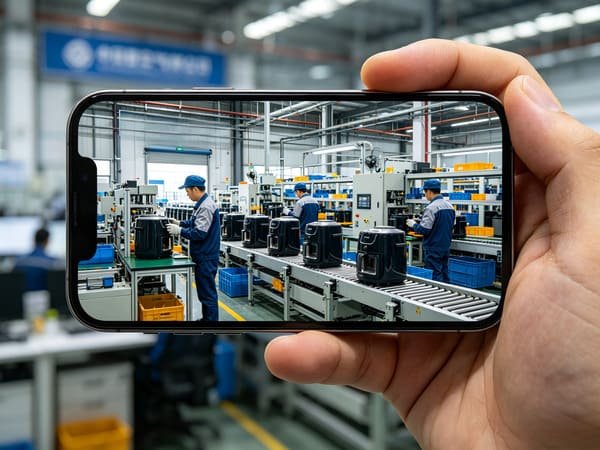
The last part is real factory proof. I do not accept only a front gate photo. I ask for a live video call or a same-day video that shows the company sign, workshop, assembly line, aging test area, QC station, packaging area, and warehouse marks. I want continuity. A fake manufacturer often sends edited clips from different sites. A real one can move from signboard to line to finished cartons in one shot.
Here is the basic way I think about it:
| Check point | What I want to see | Why it matters | Red flag |
|---|---|---|---|
| Legal identity | Chinese company name + 18-digit code | This is the traceable core identity | English name only |
| Business scope | Manufacturing or production wording | Supports factory claim | Only trading or consulting |
| Address | Industrial area or factory site | Helps confirm real operations | Virtual office or vague address |
| Payment entity | Same or clearly linked legal entity | Lowers fraud risk | Personal account or unrelated company |
| Certifications | Holder name matches supplier story | Confirms product compliance chain | Certificate belongs to another company |
| Factory evidence | Live line, QC, packaging, signage | Shows real capability | Edited clips or refusal |
When these details line up, I move forward. When they do not, I slow down. In my experience, shell companies fail not because they have no documents at all, but because their documents do not tell one consistent story.
Which Business License Fields Reveal a Fake Air Fryer Factory in China?
A business license looks simple, but it can reveal a lot. I often find the first warning signs there before I even review the product or quote.
The most useful business license fields are the Chinese legal company name, Unified Social Credit Code, registered address, legal representative, establishment date, business scope, and registration status. These fields show whether the supplier’s “factory” story matches its legal identity.
When I review a Chinese business license, I do not just ask whether it exists. I ask what it says and whether it supports the supplier’s claim. A fake or weak supplier may happily send a stamped license because many buyers never read it closely. I always read the details.
The first field is the legal company name in Chinese. I use this exact name for all later checks. If the supplier cannot explain its Chinese name or only pushes an English brand name, that is already a problem. The second field is the Unified Social Credit Code. This 18-digit code is the most practical record link across registration and many public references. If the code is blurry, incomplete, or does not match the company name, I stop there.
The third field is registration status. I want to see that the company is active and not canceled, revoked, or flagged for abnormal operation. The fourth field is establishment date. A very new company is not automatically bad, but I become more careful if it claims deep manufacturing history while the license shows it was set up only recently. In that case, I ask whether the factory was renamed, restructured, or split from another entity. If so, I ask for proof.
The fifth field is the registered address. Many real factories register at industrial parks or factory buildings. A shell company may use an office tower, apartment-style address, co-working location, or an address that does not sound like a production site. Again, this does not prove fraud alone, because some sales companies are registered away from the plant. But if the supplier says “this is our factory address” and the address does not look industrial, I investigate more.
The sixth and most revealing field is business scope. I want words that support making goods, not just selling them. A true air fryer factory or a company closely tied to one should be able to explain where manufacturing sits in the scope. If the scope focuses only on trade, technology service, domestic commerce, or e-commerce, then the factory claim is weak unless backed by a separate production entity.
I use a simple reading framework:
| License field | What supports a real factory story | What makes me cautious |
|---|---|---|
| Company name | Clear Chinese legal entity | Only English name used in sales |
| Credit code | Full 18-digit code visible | Missing or mismatched code |
| Status | Active and normal | Revoked, canceled, abnormal |
| Establishment date | Matches claimed history | New company with old “factory” story |
| Address | Industrial or factory area | Office tower or vague location |
| Business scope | Production, assembly, manufacturing | Trading only |
In our own line of work, these license details matter because they affect who can legally invoice, who can appear on compliance files, and who takes responsibility if something goes wrong. Buyers often focus too much on catalog images and too little on the business license. I do the opposite. The product comes later. The identity comes first.
How to Check Whether the Claimed Air Fryer Factory Address, Staff, and Production Lines Are Real?
A fake supplier can copy a catalog and borrow factory photos. It is much harder for them to prove a real address, stable staff, and working production lines under simple live checks.
I check the factory story through address logic, live video evidence, workshop flow, staffing details, and third-party verification. A real air fryer factory should show a believable production environment, not only polished images or isolated machines.
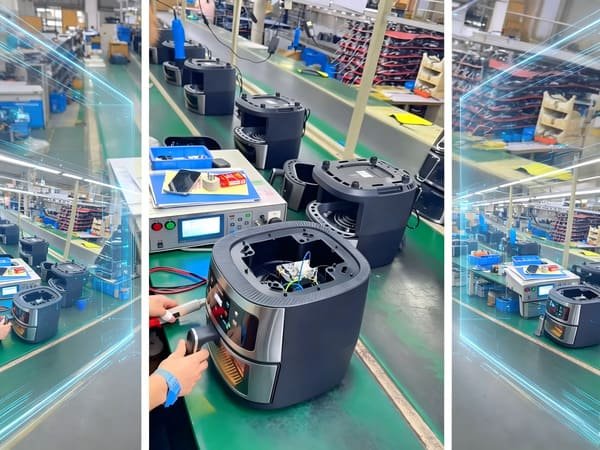
I have seen many supplier presentations that look impressive on paper. They show large workshops, neat lines, and smiling workers. Still, one thing is missing: proof that those assets belong to the company taking my order. That is why I never rely on brochure photos alone.
I start with the address. I put the claimed location into a map and look for context. Is it in an industrial zone? Does the building size fit the claimed output? Does the address appear consistent across the license, website, quotation, and shipping marks? If one document shows Zhongshan and another shows Shenzhen, I want a reason. If the supplier says the factory moved, I ask when and under which entity. A real business can explain that clearly.
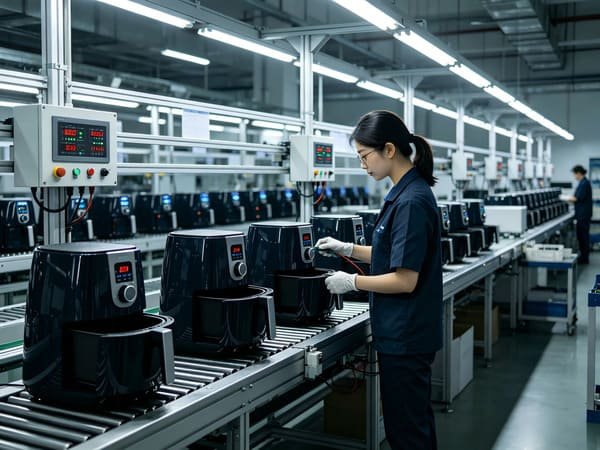
Then I ask for live evidence. My favorite method is a live video call through WhatsApp or WeChat. I ask the salesperson or project manager to begin outside or at the entrance, show the company sign, then walk into the workshop without cutting the video. I want to see incoming materials, metal or plastic parts, assembly, testing, quality checks, and packaging. For air fryers, I also want to see safety-related control points such as heating element handling, wiring checks, temperature test setups, and aging tests. A trader can often show a showroom. A real factory can show process flow.
Staffing is another clue. I ask how many workers are in assembly, how many are in QC, how many engineers support ODM, and how many lines are dedicated to heating appliances. I do not need exact HR records, but I want answers that fit what I see. If a supplier claims six lines and 200 workers but the live video shows only one small room, that gap matters.
I also listen for operational details. A real production team usually knows cycle time, typical daily output, peak season staffing, common defect points, and packaging sequence. In our production discussions, these details come out naturally because they affect lead time and quality control. A fake manufacturer often stays at the marketing level and avoids specifics.
This checklist helps me organize the review:
| Area | What I ask for | Good sign | Bad sign |
|---|---|---|---|
| Address | Exact site with map context | Industrial area, consistent records | Office-like or inconsistent location |
| Entrance proof | Signboard with company identity | Matches legal entity or linked site | No sign or blurred sign |
| Production flow | Continuous video from line to packing | Clear process sequence | Edited clips only |
| Staff story | Roles and rough headcount | Answers fit what is shown | Numbers feel inflated |
| Equipment | Assembly, test, packing tools | Category-specific setup | Generic machines only |
| QC proof | In-line checks and aging test | Real control points visible | No visible testing |
When I cannot visit in person, I use this method before any deposit. If the supplier still looks promising, I add a third-party audit or local inspection. In air fryers, that extra step is worth the cost because the category has safety risk and strong after-sales exposure. A supplier that cannot prove a real operating site is not ready for serious orders.
Which Air Fryer Certifications and Factory Audit Reports Should Match the Supplier’s Legal Entity?
Many suppliers flash logos. I never accept logos as proof. I want certificate numbers, report details, and the exact company name behind them.
For air fryers, the certificate holder, factory name, model references, and legal entity should match the supplier’s story. I check product certifications, test reports, and audit reports against the same legal company or a clearly explained related entity.
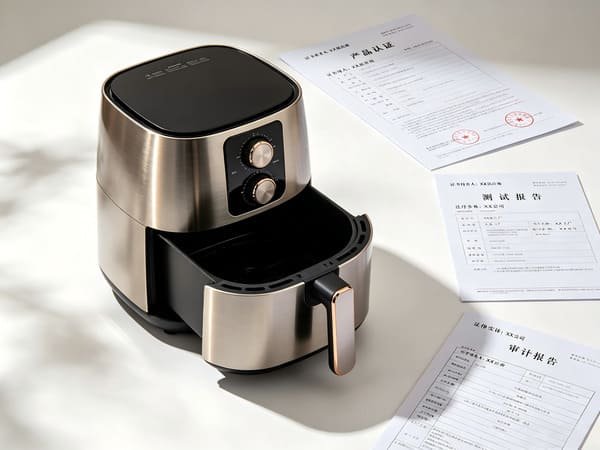
Air fryers sit in a product category where compliance is not just a sales tool. It is part of user safety and market access. That is why I treat certification review as an identity check, not only a technical check. A supplier may send beautiful logos for CE, CB, ETL, LFGB, RoHS, or other marks. Those logos alone mean nothing. What matters is who holds the file, what model it covers, which standard was used, and whether the factory information makes sense.
I always ask for the certificate number or report number, never just a PDF screenshot. Then I compare the holder name with the legal company name on the business license. If it is different, I ask why. There are valid cases. For example, one group company may hold the certificate while another handles export sales. But the supplier should explain the relationship clearly and show authorization or entity linkage. If they cannot, I assume the file may belong to another factory entirely.
I also check whether the model on the certificate is close to the offered product. Some suppliers recycle old reports for unrelated models. That is common in low-trust situations. For air fryers, I want the rated power, voltage, structure, and model family to make sense. I pay attention to the factory name and address listed in reports and audit files too. They should connect with the same operation that claims to produce the goods.
Factory audits matter as well. Social audits, quality system audits, and customer audits can support the production story, but only if the audited site and company are clear. I ask which entity and which address were audited. A fake supplier often sends a generic audit cover page with key details hidden.
This is the structure I use:
| Document type | What should match | Why I care | Common trick |
|---|---|---|---|
| Product certificate | Holder name, model, standard | Confirms compliance ownership | Shows logo only |
| Test report | Model details, applicant, lab info | Checks product relevance | Uses unrelated model |
| CB/ETL/CQC/CCC files | Legal entity or linked group company | Supports traceability | File belongs to another supplier |
| Factory audit | Audited entity and site address | Supports real operations | Sends cover page only |
| Authorization letter | Clear relationship between entities | Explains shared files | No formal link provided |
In our own development work, we know buyers need more than a pass/fail document. They need a clean compliance chain. If the company taking the order cannot show how the product, factory, and certificate holder connect, I do not treat that as a small paperwork issue. I treat it as a serious trust issue.
What Quote, MOQ, and Sampling Red Flags Often Expose Fake China Air Fryer Manufacturers?
The quote often tells the truth before the factory does. When I see pricing, MOQ, and samples that do not fit real production logic, I become very careful.
Red flags include unrealistically low pricing, vague tooling or certification cost logic, inconsistent MOQ claims, generic samples, and a sales process that pushes deposit before technical alignment. These often expose traders or fake manufacturers pretending to be direct factories.
I have learned to read a quotation like a production document, not just a price sheet. A real factory usually prices with some structure. It knows how material cost, heating system, basket coating, control panel type, mold status, carton spec, testing requirement, and order size affect the number. A fake manufacturer often sends a quick low price with weak detail because it is trying to win the deposit first and solve the sourcing problem later.
The first red flag is a price that is too good without clear assumptions. If one supplier is far below the rest, I ask what exactly is included. Is the thermostat spec the same? Is basket coating the same? Is the plug standard included? Does the quote include packaging drop test level, barcode labeling, spare parts, and compliance support? For air fryers, small changes in heating parts, plastics, controls, and certification support can move cost fast. A vague cheap offer is often not the same product.
The second red flag is MOQ logic that does not fit tooling or material reality. A supplier may promise extremely low MOQ on a deeply customized model without explaining how it handles color box, injection parts, private mold parts, or PCB change cost. In our own OEM discussions, low MOQ can be real, but it needs a real cost structure and a launch plan. If the supplier says “anything is possible” without numbers, I do not trust it.
The third red flag is the sample process. I look at who sends the sample, how fast they can modify it, and whether the sample matches the claimed factory capability. If a supplier says it owns R&D and lines but can only send a market-bought sample with a sticker, that tells me a lot. A real manufacturer usually speaks clearly about sample stage, modification scope, lead time, and approval points.
I also watch behavior. Shell companies push hard for deposit but stay shallow on BOM discussion, compliance path, artwork checkpoints, and pre-production validation. Real suppliers may still move fast, but they usually know the technical road between sample and mass production.
Here is how I sort common signals:
| Area | Healthy sign | Warning sign |
|---|---|---|
| Price | Structured quote with assumptions | Lowest number with weak detail |
| MOQ | Explained by tooling and materials | “Any MOQ is fine” with no logic |
| Sample | Traceable sample process | Generic sample with no engineering depth |
| Deposit request | Comes after alignment | Pushed too early |
| Customization | Clear limits and lead time | Promises everything instantly |
| Mass production path | Discusses QC and pre-production | Focuses only on closing the order |
A fake manufacturer may still sound confident. That is normal. What gives them away is not confidence. It is the lack of production logic behind the quote.
How to Build a Prepayment Verification Checklist Before Ordering Air Fryers From China?
The best time to catch a fake supplier is before the deposit leaves your account. After payment, your options get smaller and slower.
Before prepayment, I verify legal identity, bank account matching, production proof, certifications, sampling traceability, and shipment evidence. I use one checklist so I do not let a good price or smooth sales process rush me past basic control points.
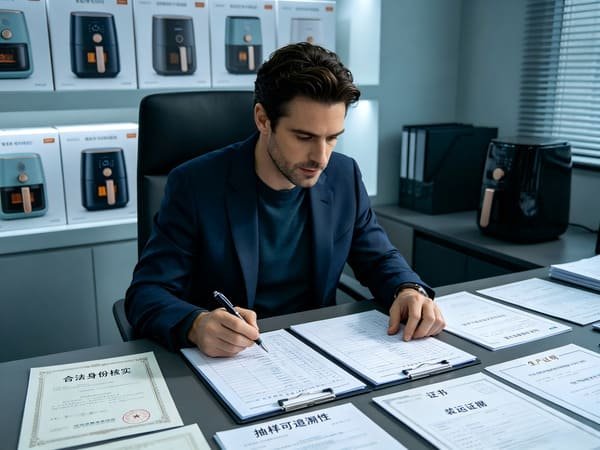
I believe the deposit stage is where discipline matters most. Buyers often do many checks at the start, then relax when the sample looks fine or the salesperson becomes responsive. I do the opposite. I become stricter right before payment. That is because prepayment is the moment when trust becomes exposure.
My checklist starts with entity matching. The company on the proforma invoice, company chop, bank account, business license, and certification chain should be the same entity or a clearly linked one. If payment goes to a personal account, I stop. If payment goes to a different company, I want a written reason and supporting link. I do not accept “this is our finance company” without proof.
Then I confirm product traceability. The approved sample should connect to the same supplier, not to an unknown third party. I ask who built the sample, where it was built, and which changes are still pending before mass production. I also want the critical product specs in writing: voltage, wattage, plug, basket size, controls, packaging, carton marks, and test standards. Too many disputes start because the deposit was paid before the spec froze.
Next comes production proof and delivery logic. I ask for estimated lead time based on line capacity, not only a sales promise. I ask how raw material booking works, what the key production milestones are, and when inspection can happen. In our own order flow, this is where project control becomes real. A good supplier can explain the path from deposit to parts to assembly to inspection to loading.
Then I cross-check export or shipping ability. I want to know whether the supplier has real export experience for the target market and product type. Shipment records, customer references, or a third-party audit can help here. I do not need perfect history, but I do need evidence stronger than words.
This is the checklist I would use before sending money:
| Step | What I verify | Pass standard |
|---|---|---|
| 1 | Business license and legal company name | Active entity, traceable code |
| 2 | Bank account name | Matches invoice issuer or explained linked entity |
| 3 | Business scope | Supports production or explained structure |
| 4 | Factory address | Real and believable production site |
| 5 | Live factory evidence | Signage, line, QC, packing shown clearly |
| 6 | Certificate numbers | Traceable and linked to same entity or approved group relation |
| 7 | Sample traceability | Sample source and spec are clear |
| 8 | Quote structure | Price, MOQ, tooling, packaging all defined |
| 9 | Inspection plan | Pre-shipment or in-line QC arranged |
| 10 | Export proof or audit | Final cross-check before deposit |
My rule is simple. If the supplier cannot prove legal identity, manufacturing scope, certification ownership, and real factory evidence with matching records, I do not pay as if I am dealing with a manufacturer. I either treat them as a trader and price the risk accordingly, or I walk away. In air fryers, that discipline saves far more money than bargain hunting ever will.
Conclusion
I trust matching records, not polished stories. When legal identity, factory proof, certifications, and payment details line up, I move forward. When they conflict, I step back.
FAQ
How can I quickly tell if a China air fryer supplier is probably a shell company?
I start with identity matching. I ask for the Chinese business license, legal company name, and 18-digit Unified Social Credit Code. Then I compare that identity with the bank account, quotation, certifications, and factory address. If those records do not match, I do not treat the supplier as a real manufacturer.
Is a trading company always a bad choice for air fryer sourcing?
Not always. Some traders are organized and useful. The problem starts when a trader pretends to be a factory and hides the real production party. I want transparency. If I know I am dealing with a trader, I can judge the price, control path, and risk in a more honest way.
Which business license detail matters most when checking a fake factory claim?
The most important detail is the exact Chinese legal company name linked to the Unified Social Credit Code. That identity lets me check registration status, business scope, address, and consistency across other documents. Without it, the rest of the verification process is weak.
Why are certifications so important for air fryers?
Air fryers involve heat, electricity, and real safety risk. That means compliance is not just a marketing issue. It affects market access, customs clearance, product liability, and after-sales risk. I always ask for certificate numbers and holder names, not just logos on a brochure.
What is the biggest red flag in supplier documents?
The biggest red flag is conflicting information. For example, one company appears on the invoice, another on the bank account, and a third on the certificate. Missing documents are a problem, but conflicting documents are worse because they often show the supplier’s story does not hold together.
How should I verify the real factory if I cannot visit China in person?
I ask for a live video call or a same-day continuous video that starts at the company sign and moves through the workshop, assembly line, QC station, and packing area. After that, I add a third-party audit or inspection as the final cross-check before payment.
Can a low MOQ still be real for a customized air fryer project?
Yes, it can be real, but it needs logic behind it. I want to know how the supplier handles mold cost, packaging, PCB changes, plastic color changes, and certification impact. If the supplier offers a very low MOQ without any cost explanation, I become cautious.
What should match before I send a deposit for an air fryer order?
Before prepayment, I want the business license, invoice issuer, bank account name, factory story, certifications, and sample source to connect clearly. I also want the product specification, lead time, and inspection plan in writing. I never rely on verbal promises at the deposit stage.