
Sourcing from China feels like a challenge. You need a hit product, but you’re worried about quality issues, delivery delays, and suppliers who disappear after you pay. We see this concern often from new partners.
To find a reliable air fryer manufacturer in China, you must verify their business license, check for valid international certifications like CE and ISO 9001, and confirm they are a real factory, not a trading company. Prioritize suppliers who offer transparency and support third-party audits.
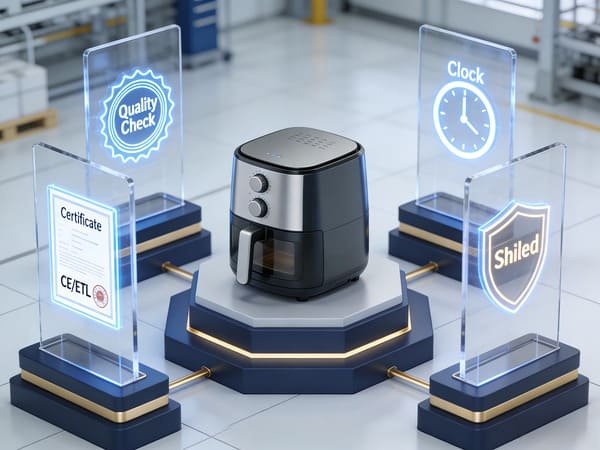
Finding the right partner is the most critical step for your business. It’s more than just finding the lowest price. A great manufacturing partner helps you build a successful brand, ensures your customers are happy, and ultimately drives your profits. An unreliable one can destroy your reputation and cash flow with a single bad shipment. I’ve been in this industry for over a decade, and I’ve seen both sides of the story. The key is to have a systematic process. It’s not about luck; it’s about knowing what to look for and what questions to ask. This guide will walk you through the exact process we recommend to our partners when they evaluate potential suppliers, ensuring you find a factory that is not just a supplier, but a true asset to your business.
What “reliable” means for importers, distributors, and private-label buyers?
You are investing significant capital and your brand’s reputation is on the line. The term "reliable" feels vague, but a factory’s failure can directly cause your business to fail.
For buyers, "reliable" means a manufacturer delivers consistent quality, meets deadlines, and provides transparent communication and documentation. It’s about having a partner who protects your brand, secures your supply chain, and helps you grow without unexpected, costly problems.
The definition of a "reliable" supplier isn’t universal. It changes based on your business model. Over the years, we’ve worked with many different types of clients—from established brand owners to fast-growing e-commerce sellers—and we’ve learned that their definitions of reliability have specific nuances. Understanding these differences is the first step in finding a partner that truly fits your needs. A distributor might prioritize logistics and on-time delivery above all else, while a private-label brand owner will be laser-focused on product quality and customization capabilities.
I remember a client from the United States, a growing e-commerce brand, who was preparing for the Black Friday sales season. Their previous supplier delayed a shipment by three weeks, causing them to miss the most profitable sales window of the year. For them, "reliable" meant a factory with a proven track record of on-time delivery, even during peak season. When they partnered with us, we established a clear production schedule and provided weekly updates, ensuring their products arrived at the Amazon FBA warehouse a full month ahead of schedule. That experience taught me that reliability is ultimately about trust and fulfilling promises.
A Deeper Look at Reliability for Different Buyers
To find the right partner, you first need to define what reliability means for your specific business. Let’s break it down for the main types of buyers we serve.
For Private-Label Brand Owners
If you’re building your own brand, your reputation is everything. A single product recall can be devastating.
- Product Quality and Consistency1: You need every single unit to be identical in performance, appearance, and safety. A reliable manufacturer achieves this through rigorous quality control at every stage: incoming materials, in-process assembly, and final pre-shipment inspection. On our lines, for example, every air fryer undergoes a 100% function test to verify temperature accuracy and timer functionality.
- Compliance and Certification2: Your partner must provide valid, verifiable certifications for your target market (e.g., CE for Europe, ETL/UL for North America). This is non-negotiable. Ask for the actual test reports, not just a logo on a sales sheet. We always provide our clients with the complete documentation package from accredited labs.
- Confidentiality and IP Protection3: Your unique design or feature is your competitive advantage. A reliable factory will respect your intellectual property and sign a Non-Disclosure Agreement (NDA). They won’t sell your custom model to your competitors.
For Wholesalers and Distributors
Your business model is based on volume and logistics. You need a smooth, predictable supply chain to keep your retail partners stocked.
- On-Time Delivery4: Your biggest concern is stockouts. A reliable manufacturer must have a clear understanding of production lead times and shipping logistics. Our factory is strategically located in Guangdong, just 100km from major ports, which helps us ensure consistent delivery schedules for our partners worldwide.
- Packaging and Labeling Accuracy5: Products must arrive ready for distribution. This means correct barcodes, shipping marks, and durable packaging that can withstand transit. Any errors here create costly rework for you. We often work with clients to design custom packaging and multi-language manuals to meet specific retail requirements.
- Stable Pricing: While prices for raw materials can fluctuate, a good partner will work with you to provide stable pricing and give you advance notice of any necessary changes, allowing you to manage your margins effectively.
For E-commerce Platform Sellers
You operate in a fast-paced environment where customer reviews are king. Your needs combine elements from both brand owners and distributors.
- Low Defect Rate6: Negative reviews about a product that arrives broken or stops working can kill your listing’s ranking. You need a manufacturer with extremely low defect rates, backed by thorough safety and durability testing like drop tests and lifecycle tests.
- Flexible MOQ (Minimum Order Quantity)7: When testing a new product or market, you don’t want to tie up capital in thousands of units. A good partner is willing to grow with you, offering a lower MOQ to start. We support this with flexible MOQs, often starting from 500-1000 pieces.
- Responsive After-Sales Support8: When a customer has an issue, you need answers fast. A reliable supplier provides clear warranty terms and has a system for providing spare parts or technical support.
Here is a summary of what "reliable" looks like for different buyers:
| Buyer Type | Top Priority | Key Indicators of a Reliable Manufacturer |
|---|---|---|
| Private-Label Brand | Brand Reputation | Consistent quality, verifiable certifications, IP protection, strong R&D. |
| Wholesaler/Distributor | Supply Chain Stability | On-time delivery, accurate packaging, stable costs, large production capacity. |
| E-commerce Seller | Customer Reviews | Low defect rate, flexible MOQ, fast and responsive support, good packaging. |
Ultimately, a reliable manufacturer is one whose processes and priorities align with your own. By defining your needs first, you can filter out unsuitable suppliers and focus on finding a true long-term partner.
Where to source initial air fryer supplier leads without wasting time on low-quality listings?
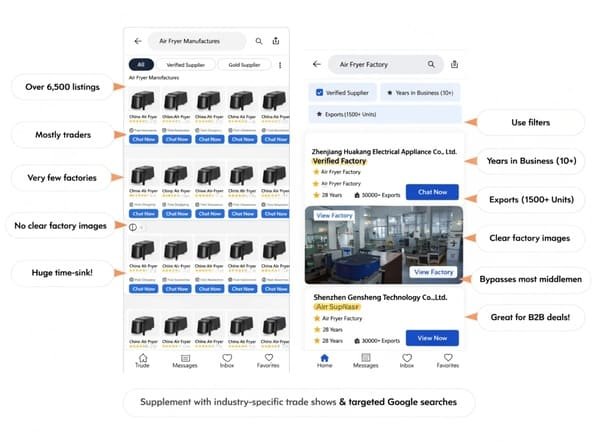
You start searching on a B2B platform and are immediately overwhelmed. Thousands of "air fryer manufacturers" appear, but many are just traders with stock photos and no real factory.
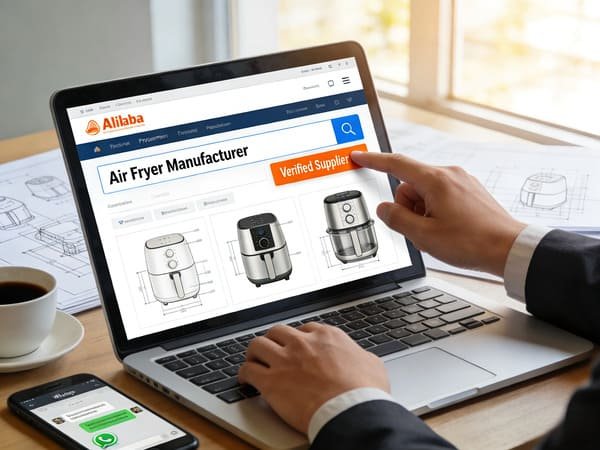
Focus your search on curated platforms like Alibaba and Global Sources, but use filters like "Verified Supplier" and years in business. Supplement this with industry-specific trade shows and targeted Google searches to find factories directly, bypassing most middlemen.
Finding the starting point for your search is crucial. Wasting weeks vetting unqualified suppliers is a common and expensive mistake for importers. The goal is not to find every possible supplier, but to create a high-quality shortlist of potential partners quickly. From our perspective as a manufacturer, we see buyers come to us through several channels. Some are very effective, while others are filled with noise. The key is to use a multi-channel approach and know the strengths and weaknesses of each. You can’t rely on a single source. Combining online platforms with offline methods gives you a much clearer picture of the landscape. It’s about working smarter, not harder, to find suppliers who are genuinely invested in manufacturing quality products.
A Strategic Guide to Sourcing Channels
Building a strong initial list of potential suppliers is the foundation of your entire sourcing project. A weak foundation leads to problems later. Let’s explore the most effective channels and how to use them properly.
1. Major B2B Platforms9 (Alibaba, Made-in-China, Global Sources)
These platforms are the go-to for most importers, and for good reason. They offer a massive directory of suppliers. However, their size is also their biggest weakness. You must be strategic.
-
How to Use Them Effectively:
- Use Advanced Filters: Don’t just search for "air fryer." Filter for "Verified Supplier10" or "Audited Supplier." This means the platform has used a third-party to confirm the supplier’s business license and factory location exist.
- Check Company Profile: Look for suppliers with a significant number of years on the platform (e.g., 5+ years). This suggests stability. Check their main products. Are they a specialist in kitchen appliances, or do they sell everything from phone cases to socks? A specialist is almost always better.
- Analyze the Product Page: Look for real photos and videos of their factory, production lines, and QC processes. Stock photos are a red flag. Look for detailed specifications and mentions of certifications like CE, RoHS, or ETL11.
-
Pros: Huge selection, built-in communication tools, some level of supplier verification.
-
Cons: Many trading companies posing as factories, information can be outdated, fierce competition can sometimes lead to misleading claims.
2. Industry Trade Shows12 (Canton Fair, IFA Berlin)
There is no substitute for meeting a potential partner in person. Before the pandemic, I spent weeks every year at trade shows like the Canton Fair in Guangzhou and international shows in Hong Kong. It’s the most efficient way to gauge a company’s professionalism and see their products firsthand.
-
How to Use Them Effectively:
- Prepare in Advance: Research the exhibitor list before you go. Schedule meetings with your top prospects.
- Observe the Team: At the booth, how knowledgeable is the sales staff? Can they answer technical questions about the product, or do they just quote prices? A professional team from a real factory will know their product inside and out.
- Examine the Samples: This is your chance to touch and feel the product quality. Check the materials, the finish, and the user interface. How does it compare to other suppliers at the show?
-
Pros: Face-to-face interaction, ability to inspect products, meet senior management.
-
Cons: Can be expensive (travel and time), only happens a few times a year.
3. Targeted Google Searches13
Don’t underestimate the power of a well-crafted Google search. Many excellent, export-focused factories have their own websites but may not invest heavily in B2B platform marketing. This is how many of our long-term European partners first found us.
- How to Use Them Effectively:
- Be Specific: Use keywords like "air fryer manufacturer China," "OEM air fryer factory Guangdong14," or "private label kitchen appliance supplier Zhongshan15." The more specific your search term, the better the results.
- Analyze the Website: A professional website is a good sign. Look for an "About Us" page that details their history, factory size, and R&D capabilities.Look for a detailed "Products" section and a "Certifications" page. Is their contact information clear? A factory proud of its operations will show it.
- Pros: Can lead you directly to high-quality factories, bypasses middlemen.
- Cons: Requires more effort to vet each result, top results are often just traders with good SEO.
Comparison of Sourcing Channels
| Sourcing Channel | Best For | Pros | Cons |
|---|---|---|---|
| B2B Platforms9 | Building a large initial list quickly. | Massive selection, easy filtering, transaction history. | Many trading companies, requires careful vetting. |
| Trade Shows12 | In-depth evaluation and relationship building. | Face-to-face meetings, physical product inspection. | Expensive and time-consuming. |
| Google Search | Finding hidden gems and direct manufacturers. | Direct contact, less competition. | More manual vetting, results can be mixed. |
By combining these three channels, you create a robust sourcing strategy. Start with B2B platforms to build a broad list, then use targeted Google searches to find direct factories. Finally, if possible, attend a trade show to meet your top candidates in person. This approach ensures you are not just finding any supplier, but the right supplier.
How to screen air fryer factories by product focus, certifications, and customization ability?
You have a list of 20 potential suppliers. They all look good on paper, with professional websites and nice product photos. Now you need to separate the real factories from the intermediaries.
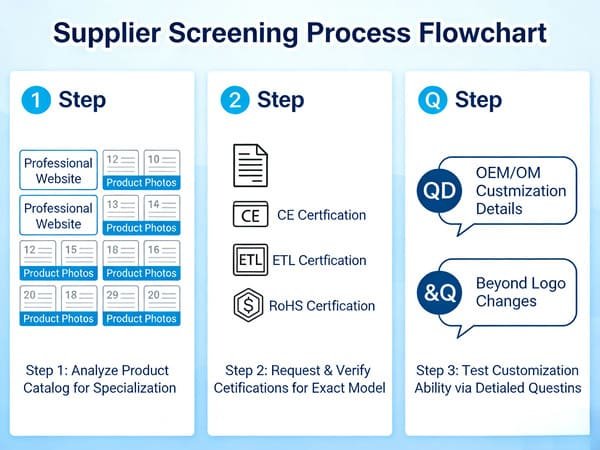
Screen suppliers by analyzing their product catalog for specialization. Request and verify specific certifications (CE, ETL, RoHS) for the exact model you want. Finally, test their customization ability by asking detailed questions about OEM/ODM changes beyond just a logo.
This is the critical filtering stage. A factory’s website is a marketing tool; your job is to look past the marketing and evaluate their true capabilities. As a manufacturer, our capabilities are our identity. When a serious buyer asks about our production lines, our mold development process, or our specific testing protocols for EU compliance, we welcome it. It shows they know what they’re doing. Suppliers who are vague or evasive about these details are often hiding something. This screening process is about asking the right questions to uncover a factory’s true strengths and weaknesses before you invest time and money in samples.
A Three-Step Screening Process
To efficiently narrow down your list, focus on three core areas: product specialization16, verifiable certifications17, and true customization capabilities18.
1. Assess Their Product Focus
A supplier’s core competence is revealed by what they make. Be wary of the factory that claims to make everything.
- Specialist vs. Generalist: A factory that specializes in small kitchen appliances will have deeper engineering knowledge, more refined production processes, and better-established supply chains for relevant components (like heating elements and motors) than a generalist factory that also produces lighting and textiles. Check the "Product Categories" section on their website or Alibaba page. If you see air fryers alongside office chairs and phone chargers, that’s a major red flag. They are almost certainly a trading company.
- Depth of Product Line: Within their specialty, do they offer a range of products? For instance, a good air fryer manufacturer will likely also produce other small cooking appliances like ovens, toasters, or pressure cookers. This shows a focused R&D strategy and an understanding of the overall market. It suggests they are invested in the industry for the long term.
2. Scrutinize Their Certifications
Certifications are a key indicator of a professional, export-oriented factory. But you cannot take them at face value.
- Request Model-Specific Documents: Don’t accept a general "We are CE certified" statement. Ask for the CE or ETL certificate and the full test report for the exact model you are interested in. A reliable manufacturer will have this ready.
- Verify the Certificate: Anyone can photoshop a certificate. A real certificate will have a certificate number and list the name of the issuing laboratory (e.g., TÜV, Intertek, SGS). Go to the lab’s website and use their public database to verify the certificate number is valid and matches the supplier’s company name. This simple step weeds out a surprising number of fakers.
- Check for Quality Management Systems: Beyond product-specific certifications, ask if they have a quality management system certification like ISO 9001. This shows they have documented and standardized processes for quality control, which is crucial for ensuring consistency across large production runs.
3. Evaluate Their Customization (OEM/ODM) Ability
Many suppliers claim to offer OEM/ODM, but their definition can vary wildly. You need to determine if they are capable of true partnership or just basic branding.
- Beyond the Logo: Ask questions that test their technical depth. Instead of "Can you put my logo on it?", ask:
- "Can we change the plastic from ABS to PP for better heat resistance?"
- "Can you develop a new UI for the digital display with three preset cooking functions?"
- "What is the process for creating a new mold for a custom-shaped basket? What is the timeline and cost?"
- In-House R&D and Mold Making: A factory with a genuine R&D department and its own mold-making facility19 is a powerful partner. It means they can help you develop unique products and bring them to market faster. Ask to see photos or have a video call with their R&D center. A supplier who outsources all design and mold work will have less control over quality and longer lead times.
By systematically applying this three-step screening process, you can quickly and effectively cut your long list of suppliers down to a short list of 3-5 highly qualified potential partners.
| Screening Area | What to Look For | Red Flags |
|---|---|---|
| Product Focus | Specialization in kitchen appliances. | Sells unrelated product categories. |
| Certifications | Verifiable, model-specific test reports from accredited labs. | Vague claims, refuses to share documents, self-issued certificates. |
| Customization | In-house R&D, ability to discuss technical modifications20. | Only offers logo/packaging changes, cannot answer technical questions. |
This rigorous approach saves you from wasting time on suppliers who cannot meet your fundamental requirements for quality, compliance, and product development.
What needs to be verified before requesting samples or paying a deposit from an air fryer manufacturer?
You’ve narrowed it down to a few promising suppliers. Before you spend money on samples or a deposit, one final round of verification is needed to avoid scams or critical misunderstandings.
Before sending money, verify their business license and ensure the bank account name matches the company name. Conduct a virtual or third-party factory audit to confirm they are a real manufacturer. Finally, get a detailed quote in writing.
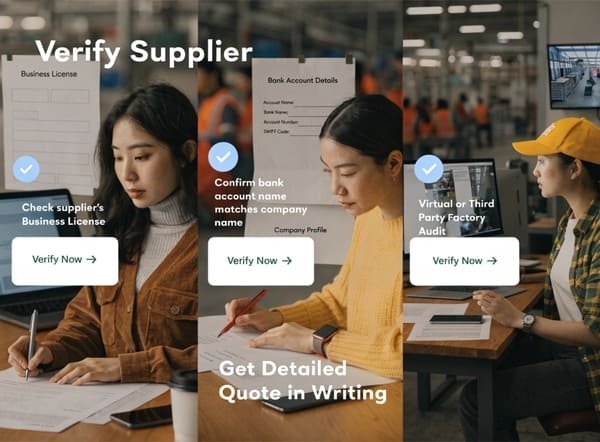
This is your last chance to back out easily. Once money changes hands, your leverage decreases significantly. I’ve heard horror stories from clients who paid a deposit to a company that turned out to be a middleman, only to face endless delays and quality problems. A professional manufacturer expects this level of due diligence. We readily provide our business license and welcome factory audits because we are proud of our operations and want to build long-term trust. Any supplier who pushes back on these final verification steps should be immediately disqualified.
Your Final Verification Checklist
Think of this as your pre-flight check before committing resources. These steps protect you from fraud and ensure the supplier’s claims match reality.
1. Legal and Financial Verification
This step confirms you are dealing with a legitimate, registered business entity.
- Request the Business License21: Ask for a clear copy of their business license. The key fields to check are the Company Name, Registered Address, and Business Scope. A real manufacturer’s business scope will explicitly include words like "manufacturing," "production," or "assembly" . If it only says "sales," "wholesale," or "trading," they are a trading company.
- Match Company Details: The company name on the business license must be the exact same name on their invoices and, most importantly, on the bank account details they provide for payment. If they ask you to pay a different company or a personal account, this is a massive red flag for a scam.
- Use Third-Party Verification22 (Optional but Recommended): For large orders, consider using a service to pull the company’s official registration files from the local government database (the AIC – Administration for Industry and Commerce). This will confirm their registered capital, legal representative, and any legal disputes.
2. Operational Verification (Factory Audit)
You need to confirm that the factory you see in the pictures is their own, not one they are borrowing for show.
- Virtual Factory Tour23: The easiest first step is to request a live video call where a representative walks you through their facility. Ask them to show you the raw material warehouse, the injection molding machines, the assembly lines, and the quality control testing area. Ask specific questions during the tour, like "Can you show me the QC checklist you use on that line?" or "Can you show me your inventory of heating elements?"
- Third-Party Factory Audit24: For a more formal assessment, hire a third-party inspection company (like QIMA, V-Trust, or AQI Service). For a few hundred dollars, they will send a professional auditor to the factory. They will verify its existence, assess its quality management systems, check its production capacity, and provide you with a detailed report with photos. This is the single best way to get an unbiased view of their capabilities. It’s an investment that can save you tens of thousands of dollars later.
3. Product and Commercial Verification
Finally, make sure all commercial terms are crystal clear before any commitment.
- Request a Proforma Invoice25 (PI): This document should formalize your potential order. It must include:
- A detailed product description (model number, specifications, colors).
- Unit price.
- Minimum Order Quantity (MOQ).
- Incoterms (e.g., FOB Shenzhen, EXW).
- Payment terms (e.g., 30% deposit, 70% balance before shipment).
- Estimated production lead time.
- Sample Inspection26: Before placing a bulk order, always order a sample. When it arrives, don’t just see if it turns on. Test it rigorously. Check its build quality, measure its temperature accuracy, test all functions, review the manual’s quality, and ensure the plug and voltage are correct for your market. This sample represents their best work; if it has flaws, the mass-produced units will likely be worse.
By completing this final verification checklist, you can move forward with a high degree of confidence, knowing that you have thoroughly vetted your potential partner and minimized your risk.
How to inquire about minimum order quantity, delivery time, warranty, and after-sales support from air fryer suppliers?
You’ve confirmed your potential partner is a legitimate factory. Now, you need to align on the business terms that will define your relationship for years to come.
Ask specific, direct questions: "What is your MOQ for this model, and is it negotiable for a trial order?" "What is the production lead time after the deposit is paid?" "What is your warranty policy, and how do you handle defective units?"
This conversation is about setting expectations. As a manufacturer, clear communication at this stage prevents future conflict. We prefer clients who ask these questions because it shows they are thinking about a long-term partnership, not just a one-time transaction. A supplier’s answers will reveal their flexibility, their commitment to quality, and how they treat their partners after the sale is complete. Vague answers are a warning sign. Detailed, confident answers are a hallmark of a professional and reliable factory.
Key Questions to Define Your Partnership
This is not an interrogation. It’s a professional dialogue to ensure both parties are aligned. Here are the essential questions to ask, and what to listen for in the answers.
1. Minimum Order Quantity (MOQ)27
This determines the barrier to entry for working with a supplier.
- The Question: "What is your standard MOQ for this air fryer model? Are you open to a smaller trial order28 for our first purchase to test the market?"
- What to Listen For: A rigid, non-negotiable MOQ might indicate a large, inflexible factory or one that isn’t interested in building relationships with new or growing businesses. A factory willing to discuss a lower MOQ for a trial order28 (e.g., 500 units instead of 1000) shows flexibility and a desire to build a partnership.At Aidkitchens, we often work with clients on flexible initial orders because we believe in growing together.
2. Production Lead Time29
This directly impacts your cash flow and ability to manage inventory.
- The Question: "What is your average production lead time from the date the deposit is paid until the goods are ready for inspection? Does this change during peak seasons like before the Christmas holidays?"
- What to Listen For: A professional supplier will give you a clear window, such as "25-35 days." They should also be transparent about peak season pressures. A vague answer like "soon" or "about a month" is a red flag. An experienced factory understands its production capacity30 and can give you a reliable estimate. This allows you to plan your launch and marketing efforts effectively.
3. Quality Control Process31
This is your window into how they prevent defects.
- The Question: "Can you describe your quality control process? What specific checks and tests do you perform during production and before shipment?"
- What to Listen For: Look for a multi-stage process. A good answer will sound something like this: "We perform an incoming quality check (IQC) on all key components like motors and heating elements. During assembly, we have on-line QC staff and conduct 100% function testing. Finally, we do a final pre-shipment inspection (PSI) on a sample of the finished goods based on AQL standards32, checking for cosmetic defects, function, and packaging." A supplier who only mentions a final check is more likely to have quality issues.
4. Warranty and After-Sales Support33
This defines what happens if something goes wrong.
- The Question: "What is your warranty policy? If we find a certain percentage of defective units34 in an order, how is that handled? Do you provide spare parts?"
- What to Listen For: A reliable partner will have a clear policy. For example, "We offer a 1-year warranty. For a small number of defective units34, we will provide spare parts like new PCBs or motors free of charge in your next shipment. For a major quality issue, we will work with you on a solution, which could include rework or replacement." A supplier who avoids the question or says "don’t worry, our quality is perfect" is not being realistic. Problems can happen; a good partner has a plan for dealing with them.
Here’s a quick reference table for your supplier interviews:
| Topic | Key Question | A Good Answer Looks Like | A Red Flag Looks Like |
|---|---|---|---|
| MOQ | Is the MOQ negotiable for a trial order28? | "Yes, we can support a smaller first order of 500 units." | "No, 2000 units is our absolute minimum." |
| Lead Time | What is the lead time, and does it vary? | "30 days, but it can extend to 40 days from Sept-Nov." | "Don’t worry, it will be fast." |
| Quality Control | Can you describe your QC process? | "We have IQC, in-process checks, and a final AQL inspection." | "We check everything at the end." |
| Warranty | What is your warranty and defect policy? | "1-year warranty. We provide spare parts for defects." | "Our quality is perfect, there are no defects." |
Asking these questions helps you assess not just the supplier’s terms, but their entire business philosophy. It allows you to find a partner who is transparent, professional, and genuinely invested in your success.
what is a shortlisting process buyers can use before air fryer supplier outreach?
Taking a systematic approach from the beginning is the key to finding a great supplier without wasting months of your time. This process organizes your search and evaluation into clear, manageable stages.
By following this disciplined process, you move from a sea of thousands of potential suppliers to a shortlist of 2-3 highly qualified partners who have been thoroughly vetted.
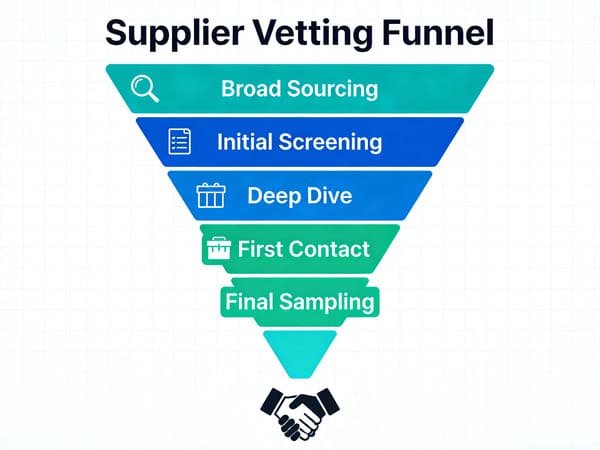
Over the years, I’ve seen successful buyers use a funnel-like approach. They start broad and then apply progressively stricter filters at each stage. This method is efficient because it eliminates unqualified suppliers early on, so you only invest significant time and effort in the most promising candidates. It transforms a chaotic search into an organized project. Adopting this structured process will dramatically increase your chances of finding a reliable, long-term manufacturing partner who can help you build your brand and grow your business. It’s the same kind of systematic process we use in our own factory to ensure quality and efficiency on the production line.
The 5-Stage Supplier Vetting Funnel
Follow these five stages to systematically find and vet your ideal air fryer manufacturer.
Stage 1: Broad Sourcing (The Goal: 20-30 Suppliers)
This is the initial research phase. The goal is to cast a wide net to gather as many potential leads as possible.
- Actions:
- Perform searches on 2-3 major B2B platforms35 (Alibaba, Global Sources, etc.). Use filters like "Verified Supplier" and "≥5 Years."
- Conduct specific Google searches like "OEM air fryer factory Guangdong36."
- If applicable, review exhibitor lists from upcoming trade shows.
- Output: A spreadsheet with the names, websites, and contact information of 20-30 potential suppliers. Don’t spend too much time on any single one yet.
Stage 2: Initial Screening (The Goal: 8-10 Suppliers)
Now, you apply the first layer of filters to remove the obvious non-starters. This stage should be fast, about 10-15 minutes per supplier.
- Actions:
- Check Product Focus: Review their main product categories. Eliminate any suppliers that are not specialists in kitchen or home appliances.
- Review Website/Profile: Look for signs of a real factory: photos of their production facility, an "About Us" page detailing their history, and clear contact information. Eliminate any that look like amateurish trading companies.
- Check for Certification Claims: Look for mentions of key certifications like CE, RoHS, ETL, or ISO 900137. Note them down.
- Output: Your list is now narrowed down to 8-10 suppliers who appear to be specialized, professional factories.
Stage 3: Deep Dive Vetting (The Goal: 3-5 Suppliers)
This is where you do your detailed homework before making first contact.
- Actions:
- Analyze Product Details: Look at the specifications of their air fryer models. Do they offer a range of sizes and features? Does the design look modern and well-considered?
- Search for Reviews/History: Do a quick Google search for "[Supplier Name] reviews" to see if any negative feedback appears in forums or other platforms.
- Prepare Initial Questions: For each remaining supplier, draft a few specific questions based on your findings (e.g., "I saw on your site you have model X. Can you confirm if the ETL certificate is available for this model?").
- Output: A strong shortlist of 3-5 suppliers that you are ready to engage with, along with a set of tailored questions for each.
Stage 4: First Contact & RFQ (The Goal: 2-3 Qualified Quotes)
Now you reach out with a professional Request for Quotation (RFQ)38.
- Actions:
- Send a concise, professional RFQ email to your shortlisted suppliers. Introduce your company, specify the product you’re interested in, state your estimated quantity, and ask your key questions regarding MOQ, certifications, and customization.
- Evaluate their response time, professionalism, and the quality of their answers. Did they answer all your questions directly?
- Output: You now have 2-3 suppliers who have responded professionally and provided a detailed quotation that meets your initial requirements.
Stage 5: Final Verification & Sampling (The Goal: 1-2 Finalists)
This is the final due diligence phase before you choose your partner.
- Actions:
- Request and verify their business license.
- Conduct a virtual factory tour39 or order a third-party audit40.
- Order a physical sample from your top two candidates.
- Rigorously test the samples side-by-side for performance, build quality41, and user experience.
- Output: You have identified one or two top-tier suppliers that have passed every stage of your vetting process. You are now ready to negotiate a trial order with a high degree of confidence.
This structured funnel turns a daunting task into a clear, step-by-step plan, ensuring you build your business on a foundation of a truly reliable manufacturing partnership.
Conclusion
Finding a reliable air fryer manufacturer is about a systematic process, not luck. By defining your needs, screening diligently, and verifying everything, you can secure a great partner.
-
Understanding product quality and consistency is crucial for maintaining brand reputation and customer satisfaction. ↩
-
Explore how compliance and certification ensure safety and legality in product manufacturing, protecting your business. ↩
-
Learn about the measures manufacturers take to safeguard your unique designs and competitive advantages. ↩
-
Discover how on-time delivery can enhance your business operations and customer satisfaction. ↩
-
Accurate packaging and labeling prevent costly errors and ensure smooth distribution processes. ↩
-
Find out how maintaining a low defect rate can improve customer reviews and boost sales. ↩
-
Explore how flexible MOQs can help businesses test new products without significant financial risk. ↩
-
Learn how effective after-sales support can enhance customer loyalty and resolve issues quickly. ↩
-
Explore this link to discover top B2B platforms that can streamline your supplier sourcing process. ↩ ↩
-
Understanding verified suppliers can help you make informed decisions when sourcing products. ↩
-
Learn about essential certifications that ensure product quality and compliance in manufacturing. ↩
-
Learn how attending trade shows can enhance your supplier evaluation and relationship-building efforts. ↩ ↩
-
Find out how to optimize your Google searches to uncover high-quality manufacturers and suppliers. ↩
-
Discover leading OEM air fryer factories in Guangdong to enhance your sourcing options. ↩
-
Explore this resource to find reputable private label suppliers in Zhongshan for your kitchen appliance needs. ↩
-
Understanding product specialization helps you identify suppliers with focused expertise, ensuring better quality and innovation. ↩
-
Learn how to verify certifications to ensure your supplier meets industry standards and maintains quality assurance. ↩
-
Explore the meaning of true customization to find suppliers that can genuinely partner with you in product development. ↩
-
Learn about mold-making facilities and their role in ensuring quality and efficiency in product development. ↩
-
Understanding technical modifications can help you assess a supplier’s ability to meet your specific product requirements. ↩
-
Understanding the significance of a business license can help you ensure you’re dealing with a legitimate supplier. ↩
-
Exploring third-party verification can provide insights into how to confirm a supplier’s legitimacy effectively. ↩
-
Learn how a virtual factory tour can help you assess a supplier’s operational capabilities without being there physically. ↩
-
A third-party factory audit can provide an unbiased assessment of a supplier’s capabilities, protecting your investment. ↩
-
Understanding a proforma invoice is crucial for ensuring all commercial terms are clear before making commitments. ↩
-
Discover the importance of sample inspection to ensure product quality before committing to large orders. ↩
-
Understanding MOQ helps you gauge supplier flexibility and partnership potential. ↩
-
Trial orders can minimize risk and help assess supplier reliability. ↩ ↩ ↩
-
Knowing lead times is crucial for effective cash flow and inventory planning. ↩
-
Understanding production capacity helps in planning and managing expectations. ↩
-
Exploring quality control practices ensures you partner with reliable suppliers. ↩
-
AQL standards ensure that quality checks meet industry benchmarks. ↩
-
A solid warranty and support policy can save you from future headaches. ↩
-
Knowing how to handle defects is essential for maintaining product quality. ↩ ↩
-
Explore this link to discover top B2B platforms that can help you find reliable suppliers efficiently. ↩
-
Learn more about OEM air fryer factories in Guangdong to understand their manufacturing capabilities. ↩
-
This resource will help you understand essential certifications that ensure product quality and safety. ↩
-
Find tips on crafting a professional RFQ to get the best responses from suppliers. ↩
-
Discover how virtual factory tours can provide insights into a supplier’s operations and quality. ↩
-
Learn about the benefits of third-party audits to ensure supplier reliability and compliance. ↩
-
This link offers guidance on evaluating build quality, crucial for selecting the right supplier. ↩