Finding a quality air fryer supplier in China requires evaluating manufacturing capability, strict quality control procedures, and market-specific export experience. Reliable suppliers provide matching safety certifications, support third-party inspections, and demonstrate mass production consistency to ensure a secure B2B procurement process.
Focusing exclusively on low FOB prices often exposes overseas buyers to severe risks. Sourcing unverified electrical heating appliances can lead to compliance failures at customs, inconsistent mass production quality, electrical hazards, and costly product recalls in your target market.
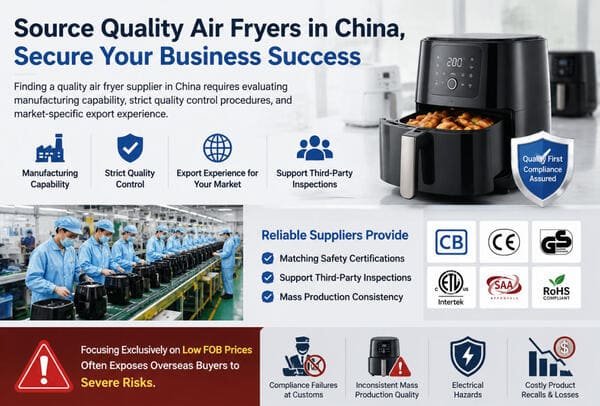
Evaluating a supply partner involves looking deeply into their operations rather than just checking their catalog. This comprehensive guide addresses every critical step of the sourcing process, helping wholesale buyers, distributors, and private label brands make safer and more profitable purchasing decisions.
Where Can You Buy Air Fryer Wholesale?
Reliable wholesale air fryer suppliers are predominantly located in established small household appliance manufacturing hubs across Guangdong and Zhejiang provinces. Buyers can find these suppliers through B2B platforms like Alibaba, international trade shows like the Canton Fair, or targeted search engine inquiries.
Failing to verify the supplier’s actual location and business type leads to communication delays and accountability issues. Partnering with a poorly managed factory increases the risk of receiving substandard components and zero support during quality disputes.
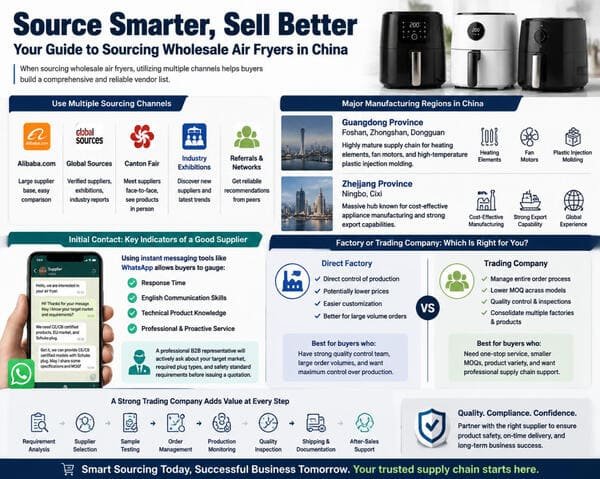
When sourcing wholesale air fryers, utilizing multiple channels helps buyers build a comprehensive and reliable vendor list. Guangdong province, specifically cities like Foshan, Zhongshan, and Dongguan, possesses a highly mature supply chain for heating elements, fan motors, and high-temperature plastic injection molding.1 Zhejiang province, particularly Ningbo and Cixi, is another massive hub known for cost-effective appliance manufacturing and strong export capabilities.2
Initial contact methods are excellent indicators of supplier suitability. Using instant messaging tools like WhatsApp allows buyers to gauge response time, English communication skills, and technical product knowledge. A professional B2B representative will actively ask about your target market, required plug types, and safety standard requirements before issuing a quotation.
It is also crucial to evaluate whether you are dealing with a direct factory or a trading company. While many buyers insist on working only with direct factories, capable trading companies often add significant value. A strong trading company can manage the entire order process, negotiate better minimum order quantities across different models, and proactively control product quality through independent inspections. The choice depends on whether you prioritize direct factory control or comprehensive supply chain management.
Why Buy Air Fryers from Chinese Suppliers?
Buying air fryers from Chinese suppliers provides access to a complete, mature supply chain that offers flexible customization, scalable production capacity, and competitive manufacturing costs. These suppliers have extensive experience meeting global electrical standards and adapting designs for different international retail markets.
Ignoring the advantages of a consolidated supply chain limits a brand’s ability to scale. Sourcing components from fragmented regions increases lead times, complicates quality control, and makes OEM or ODM customization significantly more expensive and difficult to manage.
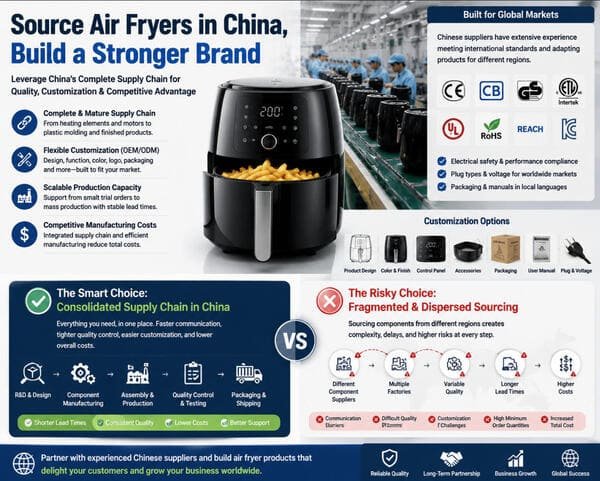
The primary reason global appliance brands and importers rely on Chinese suppliers is the unparalleled concentration of the manufacturing ecosystem3. In China’s small appliance hubs, every component required to build an air fryer—from the PCBA (printed circuit board assembly) and copper heating tubes to the non-stick coated baskets and fire-retardant plastic housings—is produced within a short radius. This proximity drastically reduces material transit times and lowers overall production costs.
Furthermore, Chinese suppliers offer unmatched flexibility in customization. Whether a buyer needs simple private labeling on existing models or complex ODM services involving new mold creation, Chinese manufacturers have the technical engineering teams to execute the project. They understand how to adjust heating algorithms and fan speeds to meet specific cooking performance requirements.
Another critical factor is export compliance experience. Established Chinese manufacturers are deeply familiar with international regulatory frameworks4. They already know the specific wiring thickness required for UL certification in North America, the food-contact material testing needed for LFGB in Germany, and the energy efficiency standards for CE in Europe. This accumulated experience helps overseas buyers avoid compliance delays and ensures that the imported products can be legally and safely sold in their destination markets.
Which Company Manufactures the Best Air Fryer?
No single company manufactures the definitive "best" air fryer for every market. The ideal manufacturer is the one whose production capabilities, quality control standards, pricing structure, and export certifications precisely match your specific target audience and regional compliance requirements.
Choosing a manufacturer based solely on generic claims of being "the best" creates misaligned expectations. A supplier producing high-end, smart-enabled models may lack the cost efficiency needed for a buyer targeting budget-conscious retail chains.
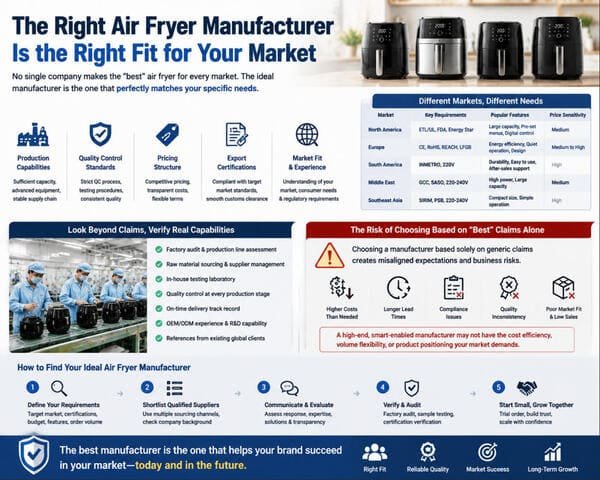
Identifying the right manufacturer requires matching supplier capabilities with the buyer’s strategic goals. The "best" supplier for a premium private label brand will differ entirely from the "best" supplier for a high-volume promotional wholesaler. When evaluating companies, buyers must focus on specific operational strengths rather than marketing slogans.
A top-tier manufacturer demonstrates strict quality control at every stage. This includes incoming material inspections (IQC) to verify plastic quality, in-process quality control (IPQC) to monitor assembly lines, and final QA testing to check heating performance and electrical safety. Buyers should request audit reports or arrange third-party factory inspections5 to verify these procedures exist in reality, not just on paper.
Additionally, the best manufacturers maintain a transparent approach to certifications. They can readily provide test reports from recognized laboratories (like SGS, TUV, or Intertek)6 that match the exact models they are selling. They also communicate honestly about their production capacity and lead times. A reliable partner will proactively warn buyers about potential delays caused by raw material shortages or peak season bottlenecks, allowing the buyer to plan their inventory and retail distribution without sudden disruptions.
What are the Types of Air Fryers to Buy from China?
Chinese suppliers offer several types of air fryers, including traditional mechanical dial models, digital touchscreen units, dual-basket configurations, and larger air fryer toaster ovens. Selecting the right type depends on retail price points, consumer cooking habits, and target market preferences.
Ordering the wrong type of air fryer for your market results in poor retail sales and dead inventory. Consumers in different regions have distinct preferences regarding kitchen space, family size, and technological features, making product selection a critical sourcing decision.
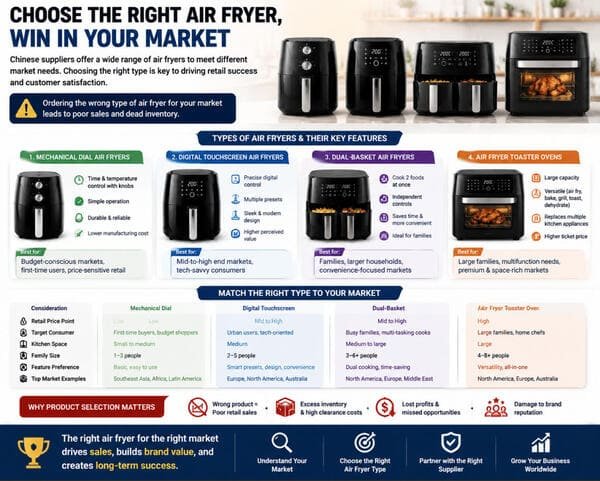
Understanding the product categories is essential for building a profitable wholesale portfolio. Mechanical air fryers are the most basic and cost-effective option.7 They use simple rotary dials for temperature and timer settings. These models are highly durable, easy to use, and ideal for entry-level markets or promotional retail campaigns where price is the primary purchasing driver.
Digital air fryers represent the mid-to-high-end segment. They feature LED touchscreens and pre-programmed cooking functions for specific foods like fries, chicken, and fish. These models appeal to modern consumers looking for convenience and a sleek aesthetic. Digital models often command higher retail margins but require more rigorous testing of the PCBA components to ensure long-term reliability.
Dual-basket air fryers have surged in popularity for larger families.8 These units allow users to cook two different foods at different temperatures simultaneously, finishing at the exact same time. Sourcing dual-basket models requires a supplier with strong technical expertise in power distribution and heat isolation. Finally, air fryer toaster ovens offer a multi-functional approach, combining baking, toasting, and air frying in a larger footprint, catering to consumers looking to replace multiple kitchen appliances with a single versatile unit.
What Technologies Do Air Fryers Have?
Air fryers primarily utilize rapid air circulation technology, combining an electric heating element with a high-speed fan to distribute hot air evenly. Advanced models may incorporate smart Wi-Fi connectivity, halogen heating tubes, dual-sensor temperature control, and steam-injection functions for improved cooking results.
Misunderstanding the internal technology can lead to sourcing products with poor cooking performance. If the fan motor is too weak or the heating element is improperly positioned, the appliance will fail to crisp food evenly, leading to negative consumer reviews.
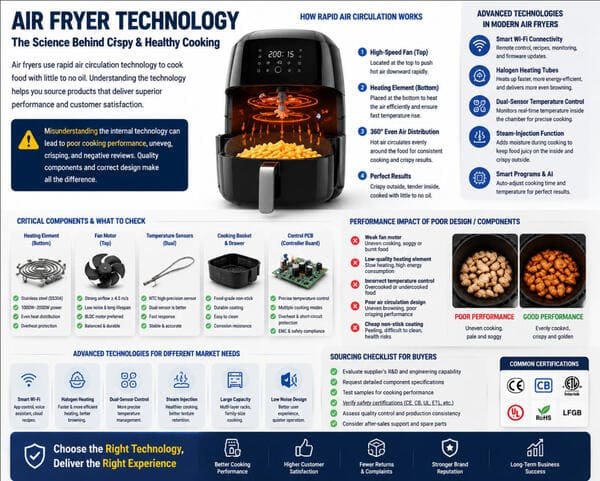
The core technology behind every air fryer is the convection mechanism.9 A heating coil (typically made of stainless steel) generates intense heat directly above the food chamber. A powerful fan then forces this hot air down and around the food at high speeds. This rapid circulation creates the Maillard reaction, giving food a crispy exterior while maintaining a moist interior, simulating the effect of deep-frying but using minimal oil.
When evaluating supplier technology, pay attention to the fan speed and blade design. Higher RPM (revolutions per minute) generally results in faster and more even cooking. Additionally, the design of the air fryer basket—specifically the vents and the shape of the bottom—plays a crucial role in how efficiently the air bounces back up through the food.
More advanced technologies are increasingly available for B2B buyers. Some models use halogen heating elements which heat up faster and emit a bright light, allowing users to monitor the cooking process through a viewing window. High-end units incorporate NTC (Negative Temperature Coefficient) thermistors for precise temperature regulation, preventing burning.10 Smart air fryers integrated with Wi-Fi allow users to control the device via smartphone apps or voice assistants, a feature that significantly boosts the retail appeal for tech-savvy consumer demographics.
Best Wholesale Air Fryer in China
Identifying the best wholesale air fryer in China requires evaluating the defect rate, material safety, and compliance with target market regulations. The best model balances reliable rapid air technology, durable non-stick coatings, and cost-effective packaging to maximize your retail profit margins.
Purchasing a popular-looking model without verifying its internal component quality leads to severe after-sales problems. Low-quality non-stick coatings that peel after a few washes will instantly ruin brand reputation and generate massive return rates.
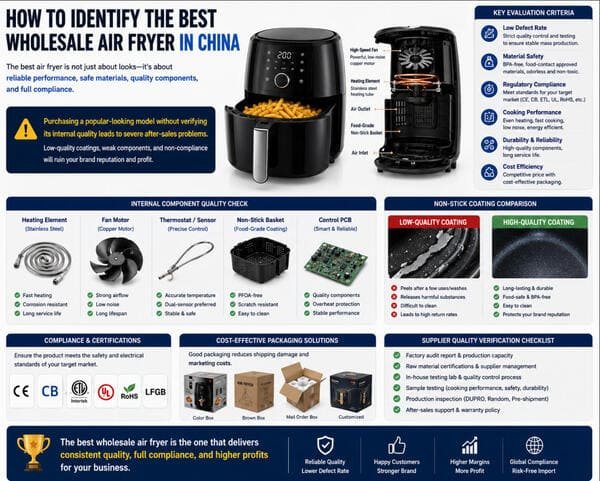
To find the most profitable and reliable wholesale air fryer, buyers must look past the exterior design and analyze the bill of materials (BOM). The best wholesale products use pure copper wiring instead of copper-clad aluminum11, ensuring long-term electrical safety and reducing the risk of fire hazards during prolonged use.
The quality of the frying basket coating is another major differentiator. Standard PTFE (Teflon) is common, but the application process matters. The best manufacturers apply multiple layers of coating and cure it at high temperatures to ensure it withstands repeated washing and high friction. Ceramic coatings are also an excellent option for buyers targeting health-conscious markets, as they are naturally free of PFOA and PFAS chemicals12.
Furthermore, the best wholesale air fryer comes from a supplier who understands international shipping logistics. A well-designed product will have optimized packaging that protects the unit from drop damage while maximizing the number of units that can fit into a 40HQ shipping container. Efficient container loading directly reduces the landed cost per unit, which is a critical factor for wholesale distributors operating on tight margins.
What is the Cost of an Air Fryer?
The wholesale cost of an air fryer ranges significantly based on capacity, control type, and required certifications. Basic mechanical models typically cost between $15 and $25 FOB, while advanced digital or dual-basket models can range from $30 to $60 or more.
Accepting a quotation that is drastically lower than the market average is a major risk. Unusually cheap air fryers often use thinner plastics that melt under high heat, recycled internal wires, and generic certifications that will not pass customs inspections.
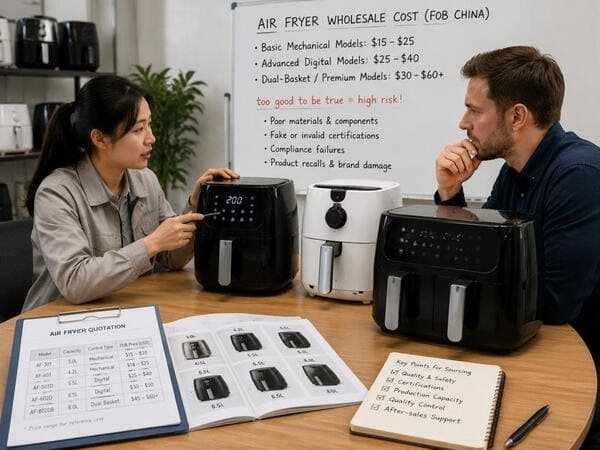
Understanding the cost structure of an air fryer helps buyers negotiate effectively without compromising product safety. The price is dictated primarily by the size of the unit and the complexity of the control panel. A compact 2-liter mechanical air fryer uses less plastic housing and a smaller heating element, keeping the cost low. Conversely, a 7-liter digital model requires a larger mold, a more powerful motor, and a sophisticated PCBA, driving the price higher.
Safety certifications also impact the final FOB price.13 If your market requires strict certifications like UL (for the US) or ETL, the manufacturer must use specific, approved internal components like fire-retardant plastics and thicker power cords. These certified materials cost more than standard components. Additionally, the cost of the laboratory testing itself is often amortized into the unit price.
Packaging customization is another variable.14 Standard brown cartons with simple black printing are cheap, but full-color retail boxes with molded pulp inserts for drop protection will add to the unit cost. When comparing quotes from different suppliers, buyers must request a detailed itemized breakdown. Ensure that the quoted price explicitly includes the correct plug, the required certifications, the specific non-stick coating type, and the exact packaging method agreed upon.
Why Should You Buy an Air Fryer Wholesale?
Buying air fryers wholesale directly from manufacturers allows brands to secure lower unit costs, control product quality, and customize features for specific retail markets. It provides the necessary profit margins to support marketing campaigns, distributor networks, and retail shelf placement.
Relying on local middlemen or small domestic distributors instead of wholesale importing severely limits your profit margins. Without direct factory pricing, it becomes mathematically impossible to compete with established brands on major e-commerce platforms or in large retail chains.
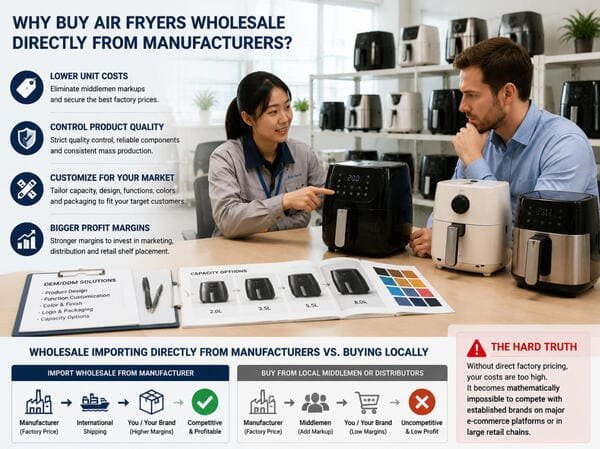
The primary advantage of purchasing air fryers wholesale is absolute control over the unit economics. By importing in bulk containers (like a 20FT or 40HQ), buyers minimize the per-unit shipping cost15, which is crucial for bulky items like kitchen appliances. This cost advantage provides the financial breathing room needed to invest in local advertising, honor warranty claims, and offer competitive retail pricing.
Wholesale purchasing also enables private labeling (OEM). Instead of selling another company’s brand, wholesale buyers can print their own logo on the machine, design their own retail packaging, and write localized instruction manuals. This builds long-term brand equity. When consumers like the product, they search for your brand again, not the generic factory name.
Furthermore, direct wholesale relationships allow buyers to influence product development16. As your order volume grows, you can request specific modifications—such as unique housing colors, custom cooking presets, or specialized accessories like baking pans. This differentiation helps your products stand out in a crowded marketplace, allowing you to avoid direct price wars with sellers offering identical generic models.
What Should You Know Before Engaging in Air Fryer Wholesale?
Before engaging in air fryer wholesale, buyers must understand destination market compliance, forecast accurate inventory needs, and establish clear quality inspection protocols. You must verify that the supplier’s electrical safety certificates match your specific region before paying any deposit.
Jumping into wholesale without understanding regional compliance laws leads to disastrous financial losses. Customs authorities will seize and destroy entire containers of electrical appliances if they lack proper testing reports, leaving the buyer with no product and no refund.
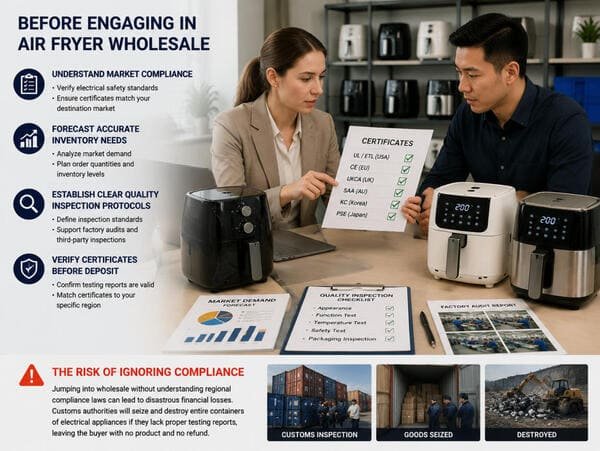
Successfully engaging in air fryer wholesale requires thorough preparation. First, identify the exact certifications required by your country’s regulations. For heating appliances, electrical safety is paramount. In Europe, this means CE (LVD and EMC) and RoHS17. For food-contact materials, you need LFGB (Europe) or FDA (USA) compliance18 to prove the basket coating does not release toxins when heated.
Second, understand the logistics and cash flow requirements. Air fryers are voluminous. A 40-foot High Cube (40HQ) container might only hold 1,500 to 2,500 units depending on the model’s size. Buyers must calculate the total landed cost, which includes the factory FOB price, ocean freight, import duties, and final warehouse delivery. Payment terms typically require a 30% deposit before production and a 70% balance before shipment, requiring solid cash flow management.
Finally, establish a rigid quality control system. Never trust a factory’s internal inspection alone. Always budget for a third-party pre-shipment inspection (PSI) based on AQL (Acceptable Quality Limit) standards. The inspector should check for electrical function, cosmetic defects, packaging strength, and accessory completeness. Catching a defect while the goods are still in China costs a fraction of what it would cost to handle consumer returns in your home market.
What is the Minimum Order Quantity (MOQ) for Buying a Wholesale Air Fryer?
The Minimum Order Quantity (MOQ) for a wholesale air fryer typically ranges from 1,000 to 2,000 units per specific model. This volume is necessary to cover the factory’s material sourcing minimums, plastic injection machine setup, and custom packaging printing requirements.
Misunderstanding MOQ structures can stall negotiations or force buyers to accept generic packaging. If a buyer assumes they can order 300 units with full custom branding, the factory will likely reject the order or heavily increase the unit price to cover wasted materials.
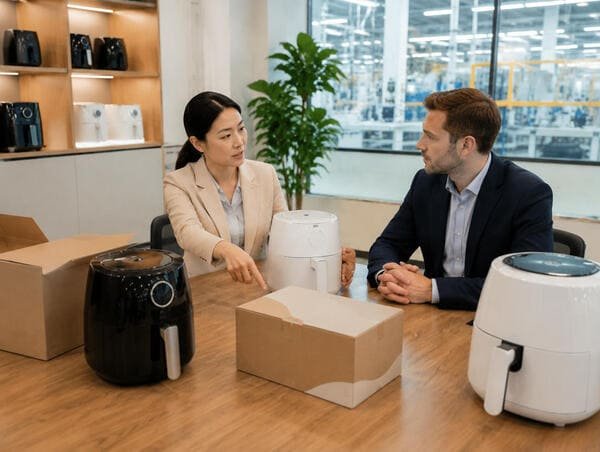
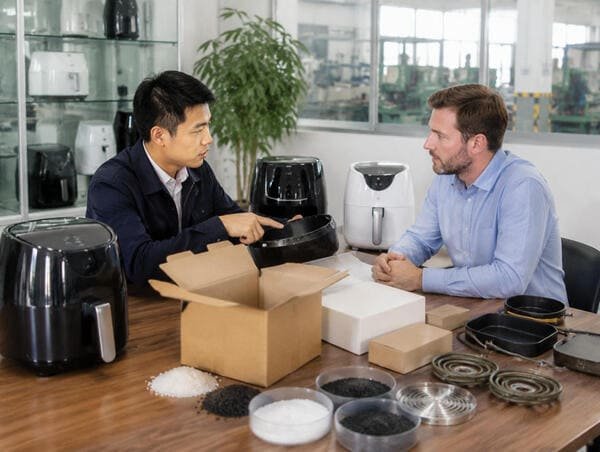
MOQ is rarely an arbitrary number set by the supplier; it is deeply tied to the realities of industrial manufacturing. The outer housing of an air fryer is made using large plastic injection molding machines. Changing the color of the plastic requires purging the machine of the previous color19, which wastes raw material and labor time. Therefore, factories require a minimum run (often 1,000 units) to justify this setup cost for a specific color.
Packaging is another major driver of MOQ. Suppliers outsource the production of color boxes and printed manuals to specialized printing factories. These printing facilities have their own MOQs, usually set at 1,000 or 2,000 pieces20. If you order only 500 air fryers, the supplier still has to buy 1,000 custom boxes, leaving them with dead packaging inventory.
For buyers looking to start with smaller quantities, there are workarounds. You can negotiate to use the factory’s standard housing colors (usually black or white) and request generic brown or white packaging with a simple custom logo sticker. Alternatively, if the factory is already running a large production batch of a specific model for another client, they might allow you to "piggyback" on that run with a smaller order, provided you accept the same technical specifications.
Are there In-stock Air Fryers for Air Fryer Wholesale?
In-stock air fryers are rarely available for international B2B wholesale because electrical requirements, plug types, and safety certifications vary drastically by country. Professional suppliers operate on a make-to-order basis to ensure compliance with the buyer’s specific regional standards.
Attempting to buy "ready-to-ship" stock often results in purchasing domestic Chinese market models or rejected batches. These units will have incorrect voltages (e.g., 220V instead of 110V) or lack the legal safety labels required for retail sale in your country.
The nature of the electrical appliance industry makes holding finished inventory for international buyers highly impractical. An air fryer built for the United States requires 110V components, a Type B plug, and UL certification labels.21 An air fryer built for the UK requires 240V components, a Type G plug, and UKCA labels. Because a factory cannot predict which country the next buyer will come from, they do not mass-produce and warehouse finished goods.
When you place an order, the factory purchases the correct motors, heating tubes, and power cords designed specifically for your target voltage. They then assemble the units, print the appropriate legal rating labels, and pack them in localized instruction manuals.
If a supplier claims to have thousands of units "in stock" and ready to ship immediately, buyers should be extremely cautious. This usually indicates one of two things: the supplier is trying to sell off inventory that was rejected by another buyer due to quality issues, or they are selling models designed for the domestic market, which may violate international safety standards. Always plan your procurement timeline around a standard 30-to-45-day production lead time.22
How to Import Air Fryers from China?
Importing air fryers from China requires verifying supplier credentials, confirming product safety certifications, managing international freight, and clearing local customs. Buyers must work with a reliable freight forwarder to handle ocean shipping logistics and ensure all compliance documents are prepared accurately.
Failing to prepare the correct import documentation will cause your shipment to be held at the destination port. Demurrage charges (storage fees at the port) accumulate rapidly, easily erasing any profit margin you expected from the wholesale purchase.

The importing process requires structured coordination between the buyer, the supplier, and logistics partners. Once you have negotiated the price, MOQ, and specifications, sign a formal Proforma Invoice (PI) that clearly outlines the product details, payment terms, and the agreed-upon shipping term (usually FOB – Free On Board). Under FOB terms, the supplier pays to transport the goods to the Chinese port and clear them for export.23
Next, hire a reputable freight forwarder. The forwarder will book space on a container ship, manage the ocean freight, and handle the complex paperwork. Air fryers are bulky, so they are almost exclusively shipped via ocean freight.24 You will need to decide between FCL (Full Container Load) if you have enough volume, or LCL (Less than Container Load) if you are sharing container space.
Customs clearance is the final hurdle. Your customs broker will need the Commercial Invoice, Packing List, Bill of Lading, and, crucially, the product safety certifications and test reports. Ensure the supplier provides these documents well before the ship arrives. Once customs duties and import taxes are paid, the container is released and trucked to your final warehouse.
How to Get Sample Air Fryer from an Air Fryer Supplier?
To get a sample, contact the supplier with your specific model, voltage, and plug requirements, then pay the required sample fee and express shipping cost. Reliable suppliers usually refund this sample cost when you place your first official bulk order.
Approving a bulk production run without physically testing a sample is a massive procurement error. Photos cannot reveal cheap plastic odors, inaccurate temperature dials, or uneven heating performance that will cause consumer complaints and returns.

Requesting a sample is the only way to verify that the supplier’s actual manufacturing quality matches their marketing claims. When requesting the sample, be explicitly clear about the specifications. Do not accept a generic 220V sample if your market requires 110V; the internal heating dynamics will be different.
Expect to pay a premium for the sample itself (often double the wholesale price) plus international courier fees (DHL, FedEx).25 Factories charge this to filter out consumers looking for a cheap single unit and to cover the manual labor of preparing a one-off unit.
Once the sample arrives, conduct rigorous testing. Do not just look at it—use it heavily. Test the accuracy of the thermostat using an oven thermometer.26 Check if the exterior housing becomes dangerously hot during operation. Run several consecutive cycles at maximum heat to test the motor’s endurance and to see if the plastic emits any burning smells. Finally, evaluate the packaging by conducting a simple drop test from waist height to ensure the internal foam or pulp protects the unit sufficiently for e-commerce shipping.
Can I Request Custom Design Air Fryers in China?
Yes, buyers can request custom designs ranging from simple OEM private labeling (custom logos and packaging) to complex ODM projects (new exterior molds and unique features). Customization requires meeting specific MOQs and may involve upfront tooling costs for structural changes.
Failing to clearly document customization requirements leads to factory errors and production delays. If you alter the internal structure or electrical components without planning for recertification, the final product will be illegal to import into your target market.

Customization in China is highly flexible, allowing brands to differentiate themselves in a competitive market. OEM (Original Equipment Manufacturer) is the most common and straightforward path. This involves taking a supplier’s existing, proven internal structure and customizing the exterior. You can specify exact Pantone colors for the plastic housing, design a custom control panel interface, and create fully localized retail packaging. OEM generally requires standard MOQs (1,000-2,000 units) and has no significant tooling costs.27
ODM (Original Design Manufacturer) is for brands that want a completely unique product. The buyer provides industrial design sketches, and the factory engineers the internal components to fit the new shape. This requires paying for new plastic injection molds, which can cost thousands of dollars and take 30 to 60 days to complete.28
When requesting customization, use a detailed specification sheet. Never rely on verbal agreements or vague descriptions. Provide exact artwork files for logos, define the exact cooking preset temperatures for digital models, and specify the exact material for the basket coating. Remember that significant structural or electrical changes will mandate new safety testing (like UL or CE), which adds both time and expense to the product development cycle.
Does Air Fryer Manufacturers Offer Warranty?
Professional air fryer manufacturers offer a standard one-year warranty covering internal component failures and manufacturing defects. However, international B2B warranties are fulfilled by providing free replacement spare parts in bulk shipments rather than returning individual defective units to China.
Assuming a Chinese manufacturer will automatically cover all your local consumer refund costs is a dangerous misconception. If you do not negotiate for spare parts upfront, you will be forced to absorb the full financial loss of any defective units locally.
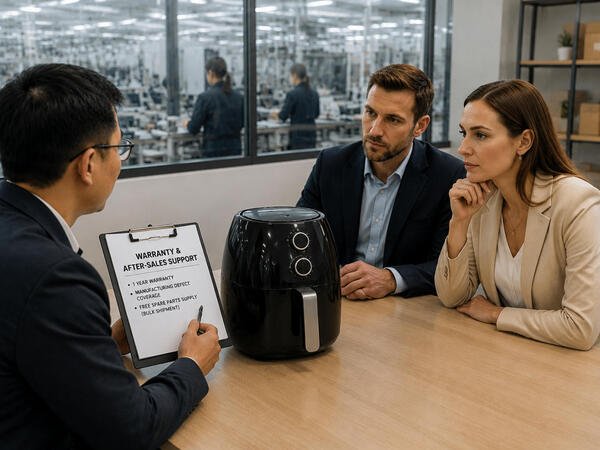
Understanding how B2B warranties function is crucial for managing after-sales costs. In domestic retail, a consumer returns a broken item to the store for a refund. In international trade, shipping a single broken air fryer back to China costs far more than the value of the appliance itself29. Therefore, physical returns are generally not part of the warranty agreement.
Instead, reliable manufacturers handle warranties through spare parts provisioning. A standard practice is to negotiate 1% to 2% of FOC (Free of Charge) easily damaged spare parts30 to be loaded directly into your bulk container. These parts typically include frying baskets, crisper plates, timer knobs, and sometimes PCBA boards. This allows your local team to quickly repair minor issues and keep the customer satisfied.
If a severe, batch-wide defect occurs—such as a specific internal wire melting consistently—the manufacturer will require photo and video evidence, along with the serial numbers of the affected units. Upon verification of a manufacturing error, a responsible supplier will issue a credit note for the value of the defective goods, to be deducted from your next order, or they will provide complete replacement units in the subsequent shipment.
Will Air Fryer Manufacturers Replace Damaged Parts?
Manufacturers will replace parts damaged due to production defects by including free spare parts in your initial shipment or adding replacements to your next bulk order. They will not ship individual replacement parts internationally via express courier due to excessive logistics costs.
Failing to stock spare parts locally creates a massive bottleneck for your customer service team. If a consumer breaks a basket handle and you have no replacements, you may be forced to replace the entire unit, destroying your profit margin on that sale.

The logistics of replacing damaged parts must be negotiated before the Proforma Invoice is signed. Because international express shipping (like DHL or FedEx) for a single replacement basket can easily exceed $5031, manufacturers will refuse to send individual parts when consumer complaints arise.
The industry solution is the preemptive spare parts strategy. A quality supplier will analyze their historical defect data and recommend which parts are most likely to fail or be damaged by users. You should request that these parts be included free of charge with your main shipment.
If parts are damaged during ocean transit due to poor factory packaging (e.g., cartons crushed because the factory used weak corrugated cardboard), the supplier is liable. In this case, you must document the damage immediately upon unloading the container. The supplier will typically manufacture the replacement parts and load them into your next container shipment. To avoid transit damage entirely, buyers should insist on high-quality 5-ply corrugated master cartons and perform a pre-shipment inspection to verify carton strength before loading.
Air Fryer Distributor Support
A quality manufacturer provides extensive air fryer distributor support, including high-resolution product imagery, detailed technical specifications, marketing materials, and localized certification documents. Strong suppliers also offer territory protection to prevent market saturation and direct price competition.
Entering a market without adequate supplier support leaves distributors struggling to build brand trust. If the factory cannot provide clear technical manuals or proof of certification, local retailers will refuse to stock the product, stalling your sales efforts.
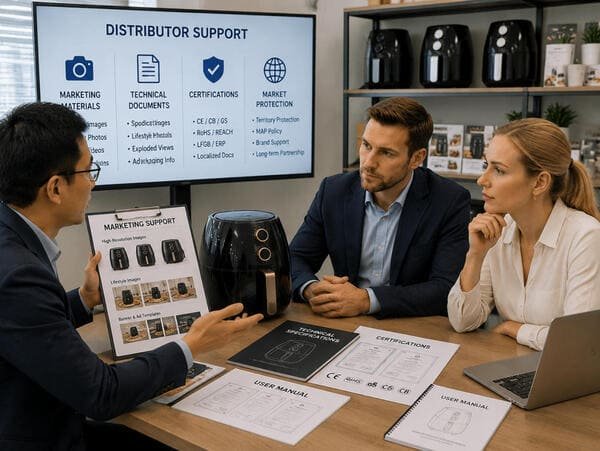
Effective distributor support bridges the gap between manufacturing and retail sales. When you partner with a top-tier Chinese supplier, they should provide more than just the physical product. Technical support is paramount; the supplier must supply comprehensive spec sheets outlining power consumption, material composition, and heating algorithms32 to help your sales team answer retailer questions.
Marketing support is equally important. Capable suppliers will provide high-resolution "white background" product images, lifestyle photography, and even promotional videos. This saves the distributor significant time and money in local content creation, allowing them to list the products on e-commerce platforms or in retail catalogs immediately.
Territory protection is the most valuable form of support for serious distributors. If you invest heavily in marketing a specific air fryer model in your country, the last thing you want is the factory selling the exact same model to your direct competitor down the street. A supportive manufacturer will sign an exclusivity agreement (often tied to annual purchasing volume targets), ensuring you have the sole right to distribute that specific design within your designated region33.
How to Become an Air Fryer Distributor?
To become an air fryer distributor, you must identify a reliable manufacturer, establish a registered business entity capable of importing, and sign a distribution agreement outlining minimum purchasing volumes, territory exclusivity, and warranty support terms.
Trying to act as a distributor without committing to consistent order volumes will result in factories ignoring your exclusivity requests. Suppliers will not reserve a market territory for a buyer who only orders a few hundred units sporadically.
Becoming a successful air fryer distributor requires a strategic transition from a simple buyer to a supply chain partner. The first step is assessing your local market demand34 and establishing your sales channels, whether that means supplying regional retail chains, managing a strong e-commerce presence, or selling to local hospitality businesses.
Once your sales channels are clear, approach manufacturers with a professional business proposal. Do not just ask for prices; present your company’s background, your target sales volume for the first year, and your marketing strategy. Factories are far more willing to offer favorable terms, lower MOQs, and better payment structures to distributors who demonstrate a clear plan for moving volume.
The core of the distributor relationship is the distribution contract. This agreement must clearly define the territory (e.g., exclusive rights in Germany), the Annual Minimum Quantity (AMQ) required to maintain that exclusivity, the protocol for handling defective units, and the timeline for new product development. A strong distributor relationship is mutually beneficial: the factory gains stable, predictable production orders, and the distributor secures a reliable product line with protected profit margins.
Your Best Air Fryer Distributor
Choosing your best air fryer distributor partner—or becoming one—depends on shared commitment to quality control, transparent communication, and long-term volume growth. The best partnerships occur when the manufacturer provides consistent quality and the distributor provides deep local market penetration.
A fractured relationship between a manufacturer and a distributor usually stems from poor communication regarding quality expectations.35 If the factory secretly changes a component to save money and the distributor faces local backlash, the partnership will instantly collapse.
| Factor | Reliable Distributor Partnership | High-Risk Partnership |
|---|---|---|
| Quality Alignment | Clear standards and pre-shipment inspections agreed upon. | Factory changes materials without notifying the distributor. |
| Communication | Fast, transparent updates on production delays or issues. | Ignoring messages until the shipment is already late. |
| Market Protection | Strict adherence to signed territorial exclusivity agreements.36 | Factory sells the same model to a competitor in the same city. |
Building the "best" distributor relationship requires viewing the supplier as an extension of your own business. Regular communication is vital.37 Schedule quarterly video calls to discuss market trends, upcoming retail promotions, and feedback from end-consumers. This allows the factory to adjust their production schedules and suggest new models that fit your market’s evolving tastes.
Furthermore, transparency regarding quality control builds lasting trust. The best manufacturers welcome third-party inspections and proactively share internal testing data.38 In return, the best distributors provide accurate sales forecasts, allowing the factory to secure raw materials at better prices. Ultimately, the strongest distributor networks are built on a foundation of mutual profitability and shared risk management, ensuring that both parties can scale their operations smoothly over time.
Air Fryer Wholesale & Distributor: Ultimate FAQ Guide
What is the MOQ for private label air fryers?
The MOQ for private label air fryers usually ranges from 1,000 to 2,000 units. This volume is required because factories need to meet minimums for customized color box printing and setting up plastic injection machines for specific housing colors.
How can buyers verify a real air fryer manufacturer in China?
Buyers can verify a manufacturer by checking their business license, requesting ISO9001 certificates, and arranging a live video factory audit. A real factory will clearly demonstrate their assembly lines, testing labs, and plastic injection equipment, rather than just showing a finished product showroom.
What certifications are required for importing air fryers?
Certification requirements depend entirely on your destination market. Generally, the US requires UL or ETL, Europe mandates CE (LVD/EMC), RoHS, and LFGB (for food-contact safety), while the UK requires UKCA. Always verify the certificate matches the exact product model.
Can one air fryer certificate be used for different models?
No, one certificate cannot cover entirely different models. Safety certificates are tied to specific internal structures, heating elements, and capacities. If a supplier tries to use a 5-liter model’s certificate for a 7-liter model, it will fail customs compliance.
What should buyers check before approving an air fryer sample?
Buyers should check heating stability, temperature accuracy, plastic odor during maximum heat, and the durability of the non-stick basket coating. Operating the sample for several continuous cycles reveals potential overheating issues and confirms long-term safety.
How long does private label air fryer production usually take?
Standard mass production for an OEM air fryer order takes between 30 to 45 days. This lead time depends on material readiness, custom packaging confirmation, and the factory’s peak season schedule (especially before major holidays like Chinese New Year).
What packaging options are available for OEM air fryer orders?
Packaging options include basic brown corrugated cartons, standard white boxes, or fully customized full-color retail boxes with glossy or matte finishes. Inside, buyers can choose between standard EPS foam or environmentally friendly molded pulp to protect the unit during transit.
How can buyers reduce quality risks before air fryer shipment?
Buyers can reduce risks by hiring a third-party inspection agency to perform a Pre-Shipment Inspection (PSI) based on AQL standards. The inspector will verify electrical function, cosmetic appearance, packaging strength, and accessory completeness before the container is loaded.
Conclusion
Finding a quality air fryer supplier requires rigorous verification of safety certifications, strict sample testing, and a deep understanding of B2B procurement risks. Prioritizing consistent manufacturing capabilities over the absolute lowest price guarantees a secure, profitable, and compliant supply chain.
Send Your Inquiry
Ready to source reliable and compliant air fryers for your retail network? Send us an inquiry to receive accurate quotations and practical supply chain advice. To help us provide the most efficient solution, please include your target market, required certifications, expected order quantity, preferred product type (mechanical or digital), and any specific packaging or plug requirements. We look forward to supporting your procurement process with transparent communication and consistent product quality.
-
"Custom Heating Element Suppliers: Strategic Sourcing Guide for …", https://www.alibaba.com/price-comparison/custom-made-heating-elements. This source provides an overview of Guangdong province’s supply chain capabilities, particularly in heating elements, fan motors, and high-temperature plastic injection molding. Evidence role: general_support; source type: encyclopedia. Supports: Guangdong province, specifically cities like Foshan, Zhongshan, and Dongguan, possesses a highly mature supply chain for heating elements, fan motors, and high-temperature plastic injection molding.. Scope note: The source may not cover all cities or industries in Guangdong province. ↩
-
"Zhejiang – Wikipedia", https://en.wikipedia.org/wiki/Zhejiang. This source discusses Zhejiang province’s role in cost-effective appliance manufacturing and its export strengths, particularly in Ningbo and Cixi. Evidence role: general_support; source type: encyclopedia. Supports: Zhejiang province, particularly Ningbo and Cixi, is another massive hub known for cost-effective appliance manufacturing and strong export capabilities.. Scope note: The source may focus on specific industries or exclude smaller manufacturing hubs in Zhejiang. ↩
-
"Industry in China – Wikipedia", https://en.wikipedia.org/wiki/Industry_in_China. This source explains the concentration of manufacturing ecosystems in China and how it benefits global appliance brands by reducing transit times and production costs. Evidence role: mechanism; source type: research. Supports: The primary reason global appliance brands and importers rely on Chinese suppliers is the unparalleled concentration of the manufacturing ecosystem.. ↩
-
"China – U.S. Export Controls – International Trade Administration", https://www.trade.gov/country-commercial-guides/china-us-export-controls. This source discusses the expertise of Chinese manufacturers in navigating international regulatory frameworks, including UL, LFGB, and CE standards. Evidence role: expert_consensus; source type: education. Supports: Established Chinese manufacturers are deeply familiar with international regulatory frameworks.. Scope note: The source may not cover all Chinese manufacturers but focuses on established ones. ↩
-
"Quality Control Audit – ProjectManagement.com", https://www.projectmanagement.com/wikis/966854/quality-control-audit. This source supports the recommendation for buyers to verify manufacturers’ quality control processes through audits or third-party inspections. Evidence role: mechanism; source type: education. Supports: Buyers should request audit reports or arrange third-party factory inspections to verify these procedures exist in reality, not just on paper.. ↩
-
"List of CPSC-Accepted Testing Laboratories", https://www.cpsc.gov/cgi-bin/labsearch/. This source supports the claim that manufacturers should provide test reports from recognized laboratories to validate product quality and compliance. Evidence role: general_support; source type: institution. Supports: Additionally, the best manufacturers maintain a transparent approach to certifications. They can readily provide test reports from recognized laboratories (like SGS, TUV, or Intertek) that match the exact models they are selling.. Scope note: The source may not specifically address the named laboratories but should confirm the general practice of using recognized labs for product testing. ↩
-
"7 Best Air Fryers, Tested by Our Cooking Experts", https://www.goodhousekeeping.com/appliances/a24630295/best-air-fryers-reviews/. This source explains the basic functionality and market positioning of mechanical air fryers, including their cost-effectiveness and suitability for entry-level markets. Evidence role: general_support; source type: encyclopedia. Supports: Mechanical air fryers are the most basic and cost-effective option.. ↩
-
"The Air Fryer Revolution: Shifting Consumer Behavior and Culinary …", https://foodhq.world/issue-sections/articles/food-tech/the-air-fryer-revolution-shifting-consumer-behavior-and-culinary-trends/. This source provides data or trends on the rising popularity of dual-basket air fryers, particularly among larger households. Evidence role: statistic; source type: research. Supports: Dual-basket air fryers have surged in popularity for larger families.. Scope note: The source may not provide specific sales figures or demographic breakdowns. ↩
-
"Air fryer – Simple English Wikipedia, the free encyclopedia", https://simple.wikipedia.org/wiki/Air_fryer. This source explains the convection mechanism as the primary technology in air fryers, detailing how heated air circulates to cook food. Evidence role: mechanism; source type: encyclopedia. Supports: The core technology behind every air fryer is the convection mechanism.. ↩
-
"Ntc Thermistor Sensor For Air Fryer – Shiheng Electronics", https://www.ntcshiheng.com/ntc-thermistor-sensor-for-air-fryer. This source discusses the use of NTC thermistors in high-end air fryers for temperature regulation, explaining their role in preventing overheating. Evidence role: mechanism; source type: research. Supports: High-end units incorporate NTC (Negative Temperature Coefficient) thermistors for precise temperature regulation, preventing burning.. Scope note: The source may not cover all air fryer models or brands that use NTC thermistors. ↩
-
"[PDF] repairing aluminum wiring | cpsc", https://www.cpsc.gov/s3fs-public/516.pdf. This source explains the advantages of using pure copper wiring over copper-clad aluminum in electrical appliances, particularly in terms of safety and durability. Evidence role: mechanism; source type: education. Supports: The best wholesale products use pure copper wiring instead of copper-clad aluminum, ensuring long-term electrical safety and reducing the risk of fire hazards during prolonged use.. ↩
-
"Presence of Perfluoroalkyl and Polyfluoroalkyl Substances (PFAS …", https://pmc.ncbi.nlm.nih.gov/articles/PMC8306913/. This source provides an overview of ceramic coatings and their chemical properties, including their lack of PFOA and PFAS, which are often found in other non-stick coatings. Evidence role: definition; source type: encyclopedia. Supports: Ceramic coatings are also an excellent option for buyers targeting health-conscious markets, as they are naturally free of PFOA and PFAS chemicals.. ↩
-
"Flame Retardant Chemicals and Fabrics | OSFM – CA.gov", https://osfm.fire.ca.gov/what-we-do/fire-engineering-and-investigations/flame-retardant-chemicals-and-fabrics. This source explains how safety certifications like UL and ETL influence manufacturing costs by requiring specific materials and testing. Evidence role: mechanism; source type: education. Supports: Safety certifications impact the final FOB price by necessitating the use of approved materials and laboratory testing.. Scope note: The source may not cover all possible certifications or their cost implications. ↩
-
"Consumer Electronic Packaging Market Size, Forecast, 2034", https://www.fortunebusinessinsights.com/consumer-electronic-packaging-market-108074. This source discusses how different packaging options, such as retail boxes and molded inserts, influence product costs. Evidence role: mechanism; source type: education. Supports: Packaging customization affects the unit cost of air fryers by adding expenses for materials like full-color boxes and molded inserts.. Scope note: The source may not address all types of packaging or their specific cost impacts. ↩
-
"[PDF] The impact of container shipping costs on import and consumer prices", https://www.oecd.org/content/dam/oecd/en/publications/reports/2025/08/the-impact-of-container-shipping-costs-on-import-and-consumer-prices_dfc467b3/957f0c0c-en.pdf. This source provides data on how bulk shipping reduces per-unit costs for large items like kitchen appliances. Evidence role: mechanism; source type: research. Supports: By importing in bulk containers (like a 20FT or 40HQ), buyers minimize the per-unit shipping cost, which is crucial for bulky items like kitchen appliances.. ↩
-
"Linking product design to consumer behavior: the moderating role of …", https://pmc.ncbi.nlm.nih.gov/articles/PMC5957053/. This source discusses how wholesale buyers can negotiate product modifications based on order volume. Evidence role: mechanism; source type: education. Supports: Direct wholesale relationships allow buyers to influence product development.. Scope note: The support may vary depending on the specific industry or supplier practices. ↩
-
"CE marking", https://en.wikipedia.org/wiki/CE_marking. This source explains the CE marking requirements for electrical appliances in Europe, including the Low Voltage Directive (LVD) and Electromagnetic Compatibility (EMC) standards, as well as the RoHS directive for hazardous substances. Evidence role: definition; source type: government. Supports: In Europe, this means CE (LVD and EMC) and RoHS.. ↩
-
"Food Packaging & Other Substances that Come in Contact …", https://www.fda.gov/food/food-ingredients-packaging/food-packaging-other-substances-come-contact-food-information-consumers. This source outlines the LFGB requirements for food-contact materials in Europe and FDA compliance standards in the USA, ensuring safety in heated applications. Evidence role: definition; source type: government. Supports: For food-contact materials, you need LFGB (Europe) or FDA (USA) compliance to prove the basket coating does not release toxins when heated.. ↩
-
"Injection moulding – Wikipedia", https://en.wikipedia.org/wiki/Injection_moulding. This source explains the process of purging plastic injection molding machines when changing colors, including the associated material and labor costs. Evidence role: mechanism; source type: education. Supports: Changing the color of the plastic requires purging the machine of the previous color, which wastes raw material and labor time.. ↩
-
"Minimum Order Quantities: What They Are and Why We Have Them", https://www.ecoenclose.com/blog/minimum-order-quantities-what-they-are-and-why-we-have-them/?srsltid=AfmBOooarqSM5aLmfImctV5rJepgHglC3kZnZJHGoPQ–Elb407Xm7Sy. This source provides information on the minimum order quantities typically required by printing facilities for custom packaging and manuals. Evidence role: statistic; source type: research. Supports: These printing facilities have their own MOQs, usually set at 1,000 or 2,000 pieces.. Scope note: The MOQ values may vary depending on the region and specific printing facility. ↩
-
"Air Fryers and Food Safety", http://www.fsis.usda.gov/food-safety/safe-food-handling-and-preparation/food-safety-basics/air-fryers-and-food-safety. This source confirms the specific electrical and certification requirements for air fryers intended for the U.S. market, including voltage, plug type, and safety labeling. Evidence role: definition; source type: government. Supports: An air fryer built for the United States requires 110V components, a Type B plug, and UL certification labels.. ↩
-
"Air Fryers and Food Safety", http://www.fsis.usda.gov/food-safety/safe-food-handling-and-preparation/food-safety-basics/air-fryers-and-food-safety. This source provides an industry benchmark for production lead times in the electrical appliance sector, specifically for international orders. Evidence role: general_support; source type: research. Supports: Always plan your procurement timeline around a standard 30-to-45-day production lead time.. Scope note: Lead times may vary depending on the specific factory or region. ↩
-
"FOB (shipping) – Wikipedia", https://en.wikipedia.org/wiki/FOB_(shipping). This source explains the responsibilities of the supplier under FOB terms, including transportation to the port and export clearance. Evidence role: definition; source type: encyclopedia. Supports: Under FOB terms, the supplier pays to transport the goods to the Chinese port and clear them for export.. ↩
-
"Air Freight vs Sea Freight: Cost, Shipping, Carbon Footprint & More", https://www.freightos.com/freight-resources/air-freight-vs-ocean-freight-making-the-decision/. This source provides data or expert consensus on the shipping methods typically used for bulky consumer goods like air fryers. Evidence role: expert_consensus; source type: research. Supports: Air fryers are bulky, so they are almost exclusively shipped via ocean freight.. Scope note: The source may not specifically address air fryers but should cover similar bulky consumer goods. ↩
-
"Alibaba manufacturer sample price 100$ : r/ecommerce – Reddit", https://www.reddit.com/r/ecommerce/comments/11zf7mk/alibaba_manufacturer_sample_price_100/. This source provides data on typical sample pricing practices in international manufacturing, including the rationale for higher costs. Evidence role: general_support; source type: research. Supports: Factories charge a premium for samples to filter out non-serious buyers and cover preparation costs.. Scope note: The exact premium percentage may vary by industry and supplier. ↩
-
"Food Thermometers – Food Safety and Inspection Service – USDA", http://www.fsis.usda.gov/food-safety/safe-food-handling-and-preparation/food-safety-basics/food-thermometers. This source explains how oven thermometers can be used to verify thermostat accuracy in appliances. Evidence role: mechanism; source type: education. Supports: Using an oven thermometer is a reliable way to test thermostat accuracy.. Scope note: The method may not apply to all types of thermostats or appliances. ↩
-
"Original equipment manufacturer – Wikipedia", https://en.wikipedia.org/wiki/Original_equipment_manufacturer. This source confirms the typical MOQ range for OEM manufacturing and explains why tooling costs are minimal in such arrangements. Evidence role: statistic; source type: education. Supports: OEM generally requires standard MOQs (1,000-2,000 units) and has no significant tooling costs.. Scope note: The MOQ range may vary depending on the industry or product type. ↩
-
"Injection Molding approximate costs : r/manufacturing – Reddit", https://www.reddit.com/r/manufacturing/comments/16iwlt3/injection_molding_approximate_costs/. This source provides an overview of the costs and timelines associated with creating new plastic injection molds for ODM projects. Evidence role: statistic; source type: education. Supports: This requires paying for new plastic injection molds, which can cost thousands of dollars and take 30 to 60 days to complete.. Scope note: Costs and timelines may vary based on the complexity of the mold and the manufacturing location. ↩
-
"Penalty Offenses Concerning Damaged or Defective Merchandise", https://www.ftc.gov/enforcement/penalty-offenses/damagedmerchandise. This source provides data on the cost of international shipping for small consumer goods, supporting the claim that returning a single item can exceed its value. Evidence role: statistic; source type: research. Supports: In international trade, shipping a single broken air fryer back to China costs far more than the value of the appliance itself.. Scope note: The data may vary depending on specific shipping routes and service providers. ↩
-
"Provisioning | www.waru.edu – Defense Acquisition University", https://www.waru.edu/acquipedia-article/provisioning. This source explains the standard practice of including a percentage of free spare parts in bulk shipments to address warranty issues. Evidence role: mechanism; source type: education. Supports: A standard practice is to negotiate 1% to 2% of FOC (Free of Charge) easily damaged spare parts to be loaded directly into your bulk container.. Scope note: The percentage may vary by industry and specific supplier agreements. ↩
-
"International Mail Services & Shipping Rates – USPS", https://www.usps.com/international/mail-shipping-services.htm. This source provides data on the typical costs of international express shipping for small packages, supporting the claim that such costs can exceed $50. Evidence role: statistic; source type: institution. Supports: International express shipping for a single replacement basket can easily exceed $50.. Scope note: Shipping costs may vary based on destination, package size, and carrier. ↩
-
"The Importance of Product Specifications in Wholesale Purchasing", https://www.kahruman.com/blog/the-importance-of-product-specifications-in-wholesale-purchasing?srsltid=AfmBOook-plG-FsQCHHUO0pcOyMufUZ4AAmI-yM8OkJG0ISmLjP1CbyZ. This source explains the importance of technical documentation, such as spec sheets, in facilitating distributor and retailer communication. Evidence role: expert_consensus; source type: education. Supports: Technical support is paramount; the supplier must supply comprehensive spec sheets outlining power consumption, material composition, and heating algorithms to help your sales team answer retailer questions.. ↩
-
"EXCLUSIVE DISTRIBUTOR AGREEMENT – SEC.gov", https://www.sec.gov/Archives/edgar/data/1169394/000108503705001442/laseragt.htm. This source discusses the role of exclusivity agreements in protecting distributor investments and ensuring market stability. Evidence role: mechanism; source type: research. Supports: A supportive manufacturer will sign an exclusivity agreement (often tied to annual purchasing volume targets), ensuring you have the sole right to distribute that specific design within your designated region.. Scope note: The source may not address air fryer distribution specifically but can provide general insights into exclusivity agreements. ↩
-
"Market research and competitive analysis | U.S. Small Business …", https://www.sba.gov/business-guide/plan-your-business/market-research-competitive-analysis. This source explains the importance of evaluating local market demand as a foundational step in establishing a successful distribution business. Evidence role: mechanism; source type: education. Supports: Assessing local market demand is the first step in becoming a successful air fryer distributor.. ↩
-
"Managing Relationships with Suppliers and Vendors You Use", https://www.apu.apus.edu/area-of-study/business-and-management/resources/managing-relationships-with-suppliers-and-vendors-you-use/. This source explains how miscommunication about quality standards can lead to conflicts between manufacturers and distributors. Evidence role: mechanism; source type: education. Supports: A fractured relationship between a manufacturer and a distributor usually stems from poor communication regarding quality expectations.. ↩
-
"Exclusive Territory Distribution Agreement – SEC.gov", https://www.sec.gov/Archives/edgar/data/1384356/000138435609000023/xcho_mineral.htm. This source explains the importance of territorial exclusivity agreements in maintaining trust between manufacturers and distributors. Evidence role: mechanism; source type: education. Supports: Strict adherence to signed territorial exclusivity agreements.. Scope note: The source may focus on specific industries or regions. ↩
-
"Mastering the Art of Supply Chain Collaboration and Teamwork", https://www.ucumberlands.edu/blog/mastering-the-art-of-supply-chain-collaboration-and-teamwork. This source highlights the role of regular communication in strengthening manufacturer-distributor relationships. Evidence role: general_support; source type: education. Supports: Regular communication is vital.. Scope note: The source may not address all forms of communication or industries. ↩
-
"FTC Takes Action Against General Motors for Sharing Drivers …", https://www.ftc.gov/news-events/news/press-releases/2025/01/ftc-takes-action-against-general-motors-sharing-drivers-precise-location-driving-behavior-data. This source supports the claim that leading manufacturers often adopt third-party inspections and share testing data to ensure quality control. Evidence role: expert_consensus; source type: research. Supports: The best manufacturers welcome third-party inspections and proactively share internal testing data.. Scope note: The source may not cover all manufacturers or industries. ↩