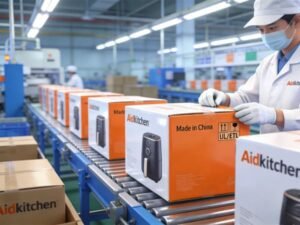
A supplier claim can sound complete, but it may not protect your EU air fryer order. I always check the evidence behind it.
Air fryer importers can avoid EU compliance gaps by turning supplier claims into verified evidence. Each claim should match the exact model, BOM, components, coating, factory, production batch, and EU sales country.

When we prepare air fryer projects for EU buyers, I do not treat supplier documents as final proof at first sight. I treat them as starting evidence. A supplier may say “CE passed,” “RoHS compliant,” “food grade,” “REACH OK,” or “WEEE available.” These words are useful only when they match the real product that will be shipped.
An air fryer has many compliance layers. It has electrical parts, food-contact parts, coatings, plastics, labels, packaging, manuals, traceability codes, and waste obligations. So I prefer a requirement-by-requirement compliance matrix before mass production. This matrix should cover CE, LVD, EMC, RoHS, food-contact materials, REACH SVHC, SCIP, WEEE, packaging EPR, labeling, manuals, importer information, and supplier change control. The goal is simple. Move from supplier claims to verified, component-level, country-specific evidence.
What Supplier Claims Commonly Create EU Compliance Gaps for Air Fryer Importers?
The biggest compliance gaps often begin with simple words. I do not reject these words, but I ask for proof.
Common supplier claims that create EU compliance gaps include “CE passed,” “RoHS compliant,” “food grade,” “REACH OK,” “WEEE available,” “PFOA-free,” and “EU compliant” without exact model, component, test, or country evidence.
Many supplier claims are not wrong, but they are incomplete. “CE passed” may not show whether the LVD, EMC, RoHS, risk assessment, technical file, and Declaration of Conformity are complete. “Food grade” may not prove that the basket, crisper tray, inner pot, coating, and silicone parts passed migration testing. “WEEE available” may not cover the importer’s own producer registration in each EU country.
| Supplier Claim | Common Gap | What I Ask For |
|---|---|---|
| CE passed | No full technical file | CE DoC, LVD, EMC, risk documents |
| RoHS compliant | No component-level proof | RoHS report and material declarations |
| Food grade | No migration report | Food-contact test for exact parts |
| REACH OK | No SVHC article-level check | Latest SVHC declaration |
| SCIP not needed | No article-by-article basis | SCIP assessment or data support |
| WEEE available | Supplier certificate does not cover importer | Product weight and importer registration plan |
| PFOA-free | No PFAS or PTFE disclosure | Chemical declaration and test report |
| EU compliant | Too broad | Requirement-by-requirement evidence |
In our production work, I always ask buyers to avoid one vague question: “Do you have CE and RoHS?” A better request is much clearer. The buyer should ask for EU compliance documents for the exact model and production materials. This should include CE DoC, LVD/EMC/RoHS reports, food-contact migration tests, REACH SVHC declaration, SCIP assessment, WEEE data, label artwork, manual, and component-level material declarations.
A strong supplier should be able to answer these requests in an organized way. If the supplier only sends one certificate and says everything is fine, I see a gap that needs more checking.
How Can Importers Match Air Fryer Supplier Claims to Actual EU Legal Requirements?
A claim only matters when it connects to a real requirement. I use a simple matrix to link each claim with evidence.
Importers can match supplier claims to EU requirements by building a compliance matrix that lists each legal duty, related product part, required evidence, responsible party, sales country, and pre-shipment verification step.
A compliance matrix helps buyers avoid confusion. It turns broad claims into clear checkpoints. For example, CE is not one test. It can involve LVD, EMC, RoHS, risk assessment, instructions, labeling, and a Declaration of Conformity. Food-contact compliance is also not one statement. It should cover the real food-contact parts. WEEE is not a supplier test report. It often needs importer or producer registration in each country.
| EU Requirement | Product Area | Evidence to Match |
|---|---|---|
| CE | Whole appliance | DoC, technical file, label, manual |
| LVD | Electrical safety | Safety test report and risk review |
| EMC | Electromagnetic performance | EMC test report |
| RoHS | Electrical and electronic materials | RoHS report and homogeneous material data |
| Food contact | Basket, tray, coating, silicone, pot | Migration reports and declarations |
| REACH SVHC | Articles and materials | Latest Candidate List declaration |
| SCIP | Articles with SVHC above 0.1% w/w | SCIP assessment or notification data |
| WEEE | Waste electrical equipment | Registration, marking, product weight |
| Packaging EPR | Packaging placed on market | Packaging material and weight data |
| Labeling and manual | Product information | EU language and importer details |
I also like to add one column for the responsible party. Some tasks belong mainly to the supplier, such as providing test reports and material declarations. Some tasks may belong to the importer, such as WEEE registration or local packaging EPR duties. Some tasks need both sides, such as label artwork, manuals, product weight, and traceability.
This matrix should be made before sourcing is locked. If the buyer waits until shipment, missing documents can delay the launch. Early checking gives the supplier time to update reports, correct labels, or test the right components.
Which Air Fryer Documents Should Prove CE, RoHS, Food-Contact, WEEE, and SCIP Compliance?
A complete EU file should not be a folder of random certificates. I want each document to support a specific requirement.
Air fryer EU compliance should be supported by CE DoC, LVD and EMC reports, RoHS report, food-contact migration tests, REACH SVHC declaration, SCIP assessment, WEEE data, label artwork, manuals, and material declarations.
For EU air fryer imports, I usually organize the documents by requirement. This makes the file easier to review. It also helps when a retailer, marketplace, customs partner, or compliance consultant asks for proof. A messy document folder can hide gaps. A structured file shows whether each duty has evidence.
| Compliance Area | Documents I Request | Key Matching Point |
|---|---|---|
| CE | CE Declaration of Conformity and technical file support | Exact model and brand |
| LVD | Electrical safety report | Voltage, plug, construction |
| EMC | EMC test report | Exact model and PCB structure |
| RoHS | RoHS report and material declarations | Homogeneous materials |
| Food contact | Overall and specific migration reports | Basket, tray, coating, silicone, pot |
| REACH SVHC | Component-level SVHC declaration | Latest Candidate List |
| SCIP | Article-level assessment and SCIP data if needed | SVHC above 0.1% w/w |
| WEEE | Product weight, marking artwork, registration support data | Sales country and producer role |
| Packaging EPR | Packaging weight and material data | Country-specific EPR file |
| Label and manual | Rating label, warnings, instructions, importer details | EU language and responsible information |
For food-contact parts, I focus on the exact basket, crisper tray, inner pot, rack, coating, and silicone parts. For RoHS, I focus on PCB, solder, cable, plug, housing, coatings, labels, screws, and homogeneous materials. For SCIP, I want article-level SVHC information. For WEEE, I want product weight and marking support, but I also remind buyers that registration is often their own market duty.
The document file should also include a change-control agreement. If the supplier changes the coating, cable, plug, PCB, plastic resin, silicone, adhesive, label, or packaging material, the compliance file may become invalid. So the supplier should not change materials without written approval.
How Should Buyers Verify That Test Reports Match the Exact Air Fryer Model, BOM, and Components?
A real report can still be the wrong report. I always match the report against the model, BOM, and production materials.
Buyers should verify test reports by matching the model number, factory, brand, BOM, component names, material codes, coating codes, supplier names, test dates, report scope, and production batch before shipment.
This is one of the most important steps in EU air fryer sourcing. A supplier may send many test reports, but some may belong to another model, another factory, another coating, or an old component supplier. The buyer should not only check whether the report exists. The buyer should check whether the report applies to the bulk order.
| Matching Point | What to Compare | Common Gap |
|---|---|---|
| Model number | Report vs. purchase order | Similar but different model |
| Factory name | Report vs. actual production site | Trader report or wrong factory |
| Brand or product name | Report vs. label and DoC | Unclear product identity |
| BOM | Report scope vs. product structure | Missing component coverage |
| Coating code | Report vs. basket production record | Different coating in bulk |
| PCB version | EMC/RoHS report vs. actual PCB | Updated PCB not tested |
| Plug and cord | Report vs. EU market version | Wrong plug type |
| Food-contact parts | Report vs. basket, tray, pot, gasket | Only raw material tested |
| Test date | Report date vs. current production | Old report after material change |
| Batch record | Production lot vs. approved materials | No traceability |
I also suggest random pre-shipment sample checks. The samples should come from the actual production batch, not from a special sample room. The buyer or third-party inspector can record carton numbers, batch numbers, photos, and labels. If needed, the samples can be sent to an independent lab for spot testing.
For serious importers, document verification should be part of the purchase order. The contract should state that the supplier must use the approved BOM and cannot change materials or suppliers without written approval. This protects the buyer when raw material prices change or production pressure increases.
What Labeling, Manual, and Importer Information Gaps Can Block EU Air Fryer Sales?
A product can pass lab tests and still fail market checks because the label or manual is incomplete. I review artwork before mass production.
EU air fryer sales can be blocked by missing CE marking, wrong rating label data, missing importer information, unclear warnings, missing local language manuals, missing WEEE symbol, and inconsistent model or brand details.
Labeling and manuals are often checked too late. Buyers may focus on test reports, then discover that the product label, gift box, manual, or importer information does not match EU expectations. Reprinting labels or manuals after packing is costly and slow.
| Label or Manual Item | What Buyers Should Check | Risk if Missing |
|---|---|---|
| CE marking | Correct placement and artwork | Sales or customs issue |
| Rating label | Voltage, power, model, brand | Product identity problem |
| Importer information | EU responsible company details where required | Market access gap |
| WEEE symbol | Crossed-out wheeled bin where needed | WEEE marking gap |
| Safety warnings | Heat, electrical, cleaning, user safety | Product safety claim risk |
| Language | Sales-country language needs | Retailer or authority rejection |
| Manual consistency | Same model and specifications | Confusing product file |
| Traceability | Batch code, serial code, production record | Hard recall or claim handling |
| Packaging claims | PFOA-free, PFAS-free, food safe, eco | Claim must match evidence |
I like to review the product label, carton mark, color box, manual, warranty card, and online claim list together. This helps find mismatches. For example, the packaging may say “PFAS-free,” but the supplier may only have a PFOA-free declaration. The manual may show one model number, while the rating label shows another. These gaps can create trouble even when the product itself is well made.
Importers should also confirm country language needs before printing. If the product will be sold in several EU countries, manual and safety information may need more than one language. This should be planned before production, not after shipment.
How Can Air Fryer Importers Build a Pre-Shipment Compliance Gap Checklist?
Pre-shipment checking should not only inspect appearance. I use it to confirm that the compliance file still matches the real goods.
Air fryer importers can build a pre-shipment compliance checklist covering model identity, BOM, reports, labels, manuals, food-contact parts, RoHS materials, REACH and SCIP data, WEEE marking, packaging, and random sample testing.
Before shipment, I suggest checking both documents and products. The inspection should confirm that the goods in cartons match the approved compliance file. This is the last practical chance to catch a wrong label, changed component, missing WEEE symbol, wrong manual, or coating mismatch before the container leaves.
| Checklist Area | What to Verify | Best Evidence |
|---|---|---|
| Model identity | Model number, brand, SKU | PO, label, carton, report |
| BOM | Approved components used | BOM and production records |
| CE file | DoC, LVD, EMC, label | Exact model match |
| RoHS | Component and material control | Report and declarations |
| Food contact | Basket, tray, coating, silicone | Migration reports and sample check |
| REACH SVHC | Latest Candidate List basis | Component declarations |
| SCIP | Article-level SVHC review | Assessment or SCIP data |
| WEEE | Symbol, product weight, country plan | Label and weight record |
| Packaging EPR | Packaging material and weight | Packaging data sheet |
| Manual | Language, warnings, importer info | Final printed manual |
| Traceability | Batch code and production lot | Inspection record |
| Random testing | Real production sample | Lab result or retained sample |
I also like to lock the approved coating, cable, plug, PCB, plastic resin, silicone, adhesive, label, and packaging materials in the purchase contract. The supplier should confirm that no material or supplier has changed without written approval. If a change happened, the buyer should review the compliance file again.
The safest approach is not complicated. Treat every supplier claim as a question. Ask what requirement it supports. Ask which document proves it. Ask whether the document matches the exact product. Ask whether the duty belongs to the supplier, importer, or both. Then check the real goods before shipment. This is how importers move from trust-based sourcing to verified EU compliance control.
Conclusion
I avoid EU air fryer compliance gaps by using a requirement matrix, matching evidence to components, checking labels, and verifying real production before shipment.
FAQ:
How can air fryer importers avoid EU compliance gaps?
Air fryer importers can avoid EU compliance gaps by treating supplier claims as starting evidence, then matching each claim to exact model reports, component data, labels, manuals, sales countries, and pre-shipment verification.
Why is “CE passed” not enough for EU air fryer import?
“CE passed” is too broad unless it is supported by a CE Declaration of Conformity, LVD report, EMC report, RoHS evidence, technical file support, correct label, and manual for the exact air fryer model.
What documents should prove RoHS compliance for air fryers?
RoHS compliance should be supported by a RoHS test report, RoHS Declaration of Conformity, homogeneous material data, component-level declarations, BOM, batch traceability, and material change-control agreement.
What food-contact documents should EU air fryer importers request?
EU air fryer importers should request food-contact migration reports for the basket, crisper tray, inner pot, rack, silicone parts, and coatings. Reports should match the exact model, material, and coating code.
Does WEEE belong to the supplier or the EU air fryer importer?
WEEE often belongs to the producer, importer, brand owner, or seller placing the air fryer on the EU market. A supplier can support data, but importer country registration may still be required.
How should importers verify air fryer test reports?
Importers should verify air fryer test reports by checking model number, factory, BOM, component names, material codes, coating codes, supplier names, test dates, report scope, and actual production batch.
What labeling gaps can block EU air fryer sales?
Labeling gaps include missing CE marking, wrong rating label, missing importer details, missing WEEE symbol, inconsistent model number, weak safety warnings, wrong language manuals, and unsupported packaging claims.
Why should importers lock air fryer materials in the purchase contract?
Importers should lock air fryer materials because any change to coating, cable, plug, PCB, plastic resin, silicone, adhesive, label, or packaging can make previous test reports and declarations invalid.
What should a pre-shipment EU compliance checklist include for air fryers?
A pre-shipment checklist should include CE, LVD, EMC, RoHS, food-contact reports, REACH SVHC, SCIP, WEEE marking, packaging data, labels, manuals, BOM, traceability, and random production sample checks.