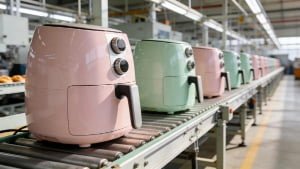
A low unit price can look very attractive at the start. Then the real project begins, and extra costs start appearing from samples, packaging, tooling, and compliance work.
A full air fryer cost structure usually has four main parts: sample cost, mold or tooling cost where needed, packaging cost, and mass-production unit price. In practical sourcing, many importers work in three models: stock or light ODM with little or no tooling, private-label ODM with small per-unit customization charges, and full OEM with real tooling cost, longer lead times, and higher MOQ. Alibaba marketplace and seller guidance also show standard air fryer unit prices commonly in the teens to low-$30s, with fuller OEM projects carrying much higher setup cost.
When I review an air fryer project with a buyer, I never treat the mass-production unit price as the whole answer. I break the project into stages. First comes the sample stage. Then comes the setup stage. Then comes the packaging and compliance stage. Only after that do I look at the repeatable production price. This method keeps the sourcing logic clear. It also helps buyers avoid a very common mistake: they focus on the unit price while the real project cost is still hiding in other places. My simple formula is always the same: total project cost = sample cost + tooling or mold cost + packaging development cost + (mass-production unit price × order quantity).
What Cost Items Are Included in a Full Air Fryer Development-to-Production Budget?
Many buyers ask for “the price” as if one number can describe the whole air fryer project. In real sourcing, one number is rarely enough.
A full air fryer development-to-production budget should include sample cost, sample freight, tooling or mold cost if required, packaging design and print cost, label and manual cost, certification and testing cost, QC cost, and the mass-production unit price multiplied by order quantity. The supplier’s first unit-price quote is only one part of that full budget.
In our own quotation work, I like to separate the budget into one-time costs and recurring costs. One-time costs are the amounts that help start the project. These can include samples, prototype revisions, mold work, packaging artwork setup, and some certification preparation. Recurring costs are the amounts that repeat with each order. These usually include the bulk unit price, ongoing packaging materials, certain labeling items, and routine inspection or shipping-related costs.
This structure matters because buyers often confuse project-entry cost with real repeat-order cost. A new air fryer project may look expensive at the beginning because the first order carries setup charges. That does not always mean the repeat order will remain equally expensive. On the other side, a supplier may quote a very attractive unit price, but if the project still needs paid samples, packaging development, or compliance work, the true launch budget may be much higher than expected.
That is why I prefer buyers to ask for a full project cost map from the start. When every cost is visible, the sourcing decision becomes more commercial and less emotional.
| Cost item | One-time or recurring? | Why I separate it |
|---|---|---|
| Sample fee | One-time | Early evaluation cost |
| Sample courier freight | One-time | Needed before approval |
| Mold or tooling cost | One-time | Project-entry setup cost |
| Packaging artwork and setup | Often one-time | Launch preparation cost |
| Unit production price | Recurring | Repeats with each order |
| Packaging materials per unit | Recurring | Part of normal production |
| QC and inspection | Recurring or per shipment | Control cost by order |
How Sample Cost and Sample Freight Affect Early Air Fryer Sourcing Decisions
A sample may look like a small step. In many projects, it is the first real cost signal buyers should pay attention to.
Sample cost and sample freight affect early air fryer sourcing decisions because samples are usually priced above bulk production levels and often carry separate courier charges. Many suppliers also credit or refund the sample fee after the first production order, but buyers should confirm that in writing before treating the sample as a recoverable cost. Alibaba marketplace listings for air fryers show everything from very low entry quantities to production MOQs of 100, 500, or 1,000 units, which is why sample pricing often sits outside normal production pricing.
When we send samples, I usually explain to buyers that the sample is not a miniature bulk order. It often needs special handling. A sample may be pulled from stock, rebuilt for a specific plug, adjusted for artwork review, or packed for express delivery. That makes the sample cost feel high compared with the later unit price. But I do not see that as a problem. I see it as an early test of how the factory handles detail and communication.
Sample freight matters too. An air fryer is not a very small or very light product, so express freight can become a visible part of the early-stage budget. If the project goes through two or three sample rounds, the buyer can spend a meaningful amount before mass production starts. That is why I always suggest treating the sample stage as a real project phase, not just a casual pre-order step.
The key question is not only “How much is the sample?” The better question is “Will the sample fee be credited later, and how many sample rounds are likely before approval?”
| Sample-stage cost | Why it matters early |
|---|---|
| Sample unit fee | Often priced above bulk level |
| Sample customization | Raises pre-order cost |
| Courier freight | Can be significant for air fryers |
| Repeat sample revisions | Adds time and budget pressure |
| Sample fee credit | Can reduce first-order effective cost |
When Air Fryer Mold Cost Is Required and How It Changes OEM Project Economics
Some buyers hear “OEM” and assume mold cost is always part of the project. That is not true. The real answer depends on how deep the customization goes.
For air fryers, mold cost is often zero in stock or ODM projects because the supplier already owns the design and tooling. In those cases, customization is usually handled through small per-unit add-ons such as logo, carton, labels, plug version, or color change. Mold cost becomes relevant when the buyer wants a true OEM air fryer with new housing parts, a new appearance structure, or substantial product redesign. Recent Alibaba seller guidance says OEM tooling costs commonly range from about $5,000 to $50,000 depending on product complexity.
In our daily project review, I usually divide air fryer sourcing into three paths. The first path is stock or light ODM. This uses an existing product and existing tooling. The second path is private-label ODM. This still uses the supplier’s existing product platform, but it adds branded packaging, printing, or small visual changes. The third path is true OEM. This is where the buyer wants a clearly different product identity or mechanical structure. That is when tooling becomes a major cost driver.
Once mold cost enters the project, everything around the economics changes. MOQ often rises. Lead time gets longer. Sample development becomes more serious. Engineering review becomes more important. A low bulk unit price may still be possible later, but the first-order cost rises because the project has to absorb development work.
That is why I always ask one direct question when a buyer requests a highly customized air fryer: is this really a branding project, or is it a new-product project? The answer changes the cost model completely.
| Project type | Typical mold-cost situation |
|---|---|
| Stock model | No new mold cost |
| Private-label ODM | Usually no new mold cost |
| Color, plug, logo changes | Usually handled as small add-ons |
| Structure or shell redesign | Mold cost may be required |
| Full OEM new product | Mold cost becomes a major item |
How Packaging Design, Gift Box, and Labeling Add to Air Fryer Total Cost
Buyers often focus on the product body first. But packaging can change the real air fryer budget faster than they expect.
Packaging design, gift box printing, labels, manuals, and warning artwork all add to air fryer total cost because they create design work, print setup, material cost, and market-specific adjustments. Recent private-label and packaging references on Alibaba show very low entry costs for basic labels, while marketplace-style sourcing references commonly present packaging and customization as separate quote items rather than something automatically included in the core appliance price.
When I discuss packaging with buyers, I usually start with one simple point: a plain export carton and a retail-ready gift box are not the same cost item. A stock air fryer may come with a basic carton that is good enough for transport, but a private-label product often needs a better presentation, stronger artwork control, warning text, barcode planning, and cleaner inserts. These changes are not always expensive one by one, but together they create a real budget line.
This is especially true when the buyer wants North American packaging. Then the project may need the correct plug description, bilingual or market-specific warnings, revised manual pages, and stronger packaging logic for e-commerce or retail handling. In our experience, packaging cost is one of the easiest areas to underestimate because buyers often think only about the printed box itself. The real cost also includes artwork development, file corrections, print approval, and sometimes carton-strength upgrades.
That is why I prefer to ask about the full packaging package early. A low appliance quote can stop being attractive if the packaging work is still missing.
| Packaging element | How it adds cost |
|---|---|
| Gift box printing | Adds visual-packaging cost |
| Manual customization | Adds language and print cost |
| Warning labels | Adds compliance and print work |
| Barcode or sticker system | Adds setup and handling |
| Stronger export carton | Adds material cost |
| Artwork revision | Adds launch-stage development work |
Which Certification, Testing, and QC Costs Should Be Added to the Air Fryer Cost Structure
A project can look affordable on paper and still become expensive later if compliance and inspection were treated as an afterthought.
Certification, testing, and QC costs should be added to the air fryer cost structure because these items are often outside the base unit quote. Depending on the market, the project may need testing, certification support, factory assessment, follow-up services, label review, and third-party inspection before shipment. Intertek’s ETL materials describe product certification as involving testing and follow-up services, which is why I do not treat compliance as only a one-time lab fee.
In practical sourcing, I usually separate compliance cost into three layers. The first layer is entry cost. This includes the testing and submission work needed to start the approval path. The second layer is support cost. This includes label review, file matching, artwork correction, and supplier coordination. The third layer is ongoing control cost. This can include follow-up services or recurring quality checks tied to shipments and project maintenance.
QC deserves the same level of attention. A pre-shipment inspection is not always a huge number on the budget sheet, but it protects a much bigger amount of product value, freight, and market timing. If the buyer saves money by cutting QC, the project may pay later through rework, delay, or replacement claims. That is why I always include inspection in the real cost structure.
A strong cost model does not only capture what is paid to produce the air fryer. It also captures what is paid to make the air fryer safe, consistent, and market-ready.
| Compliance or QC item | Why I include it |
|---|---|
| Product testing | Entry approval cost |
| Certification support | Needed for real market access |
| Label review | Prevents mismatch and rework |
| Factory assessment or follow-up | Part of some certification paths |
| Third-party inspection | Protects shipment quality |
| Re-inspection or rework | Can appear if first QC fails |
How Importers Should Separate One-Time Air Fryer Setup Costs from Recurring Unit Costs
Many sourcing mistakes happen because buyers mix startup cost and repeat-order cost into one unclear number.
Importers should separate one-time air fryer setup costs from recurring unit costs so they can see the true launch budget and the true repeat-order economics. One-time costs usually include samples, tooling, prototype changes, packaging development, and some approval work. Recurring costs usually include the mass-production unit price, normal packaging materials, and order-based inspection or logistics items. This separation helps buyers judge whether a project is expensive only at launch or expensive every time.
I think this is one of the most useful habits in all air fryer sourcing. If the buyer sees only one blended price, it becomes hard to know whether the project improves after the first order. A development-heavy OEM project may look expensive at launch but become attractive on repeat orders. A light private-label project may look easy at launch and still remain efficient later because there is almost no tooling burden. These are very different commercial cases.
My usual method is simple. I put all launch-only items into one block and all repeatable items into another. Then I calculate the first-order effective cost and the repeat-order effective cost separately. This gives the buyer a much cleaner picture of margin, reorder potential, and negotiation space.
It also helps buyers ask better supplier questions. If the supplier says the unit price is low but the project is highly customized, I ask immediately whether the quote excludes tooling, packaging artwork, carton upgrades, and sample or prototype charges. That question often reveals the real cost structure much faster than another round of unit-price negotiation.
| Cost category | Examples |
|---|---|
| One-time setup costs | Samples, tooling, artwork, development changes |
| Recurring unit costs | Unit production price, packaging materials, logo print add-ons |
| Per-order control costs | Inspection, shipment prep, some logistics handling |
| First-order effective cost | Setup costs + recurring costs for the first quantity |
| Repeat-order effective cost | Mostly recurring costs, with fewer launch expenses |
Conclusion
Air fryer cost is never just the bulk unit price. A clear project budget separates sample, tooling, packaging, compliance, and recurring production cost before the first order is placed.
FAQ
What is included in a full air fryer project cost?
A full air fryer project cost usually includes sample fee, sample freight, tooling or mold cost where needed, packaging development, compliance work, QC, and the mass-production unit price. I always calculate the full air fryer launch budget before I judge whether the quote is really competitive.
Is air fryer mold cost always required for private label projects?
No. In many private-label air fryer projects, the supplier already owns the tooling, so mold cost is zero. The air fryer is then customized through logo, packaging, color, plug type, or label changes instead of new mold development.
Why is the air fryer sample cost higher than the bulk price?
The air fryer sample cost is often higher because the factory handles it as a small special job, not a mass-production run. The air fryer sample may also include setup effort and courier freight that do not apply in the same way to the bulk order.
How does packaging affect the total cost of an air fryer order?
Air fryer packaging affects total cost through gift box printing, manuals, labels, stronger export cartons, and artwork setup. A plain-pack air fryer and a retail-ready private-label air fryer do not carry the same packaging budget.
Which air fryer costs are one-time and which are recurring?
One-time air fryer costs usually include samples, tooling, artwork, and some launch-stage development work. Recurring air fryer costs usually include the bulk unit price, packaging materials, and order-based QC or shipping-related support.
What is the best question to ask when a customized air fryer quote looks too low?
I ask whether the air fryer quote excludes tooling, packaging artwork, carton upgrade, and sample or prototype charges. That question usually shows whether the air fryer unit price is real or only looks low because key project costs are still outside the quote.