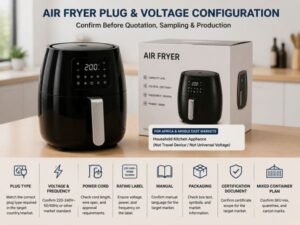
Many air fryer quotes look cheap at first. Then you notice the specs, terms, and risks are different, and the lowest number stops looking like the best deal.
To compare air fryer supplier quotes correctly, I first make every quote match the same product specification, MOQ, packaging, certification target, lead time, and Incoterm. Then I compare the full commercial package, not just the unit price. In real sourcing, the best air fryer quote is the one with the lowest normalized cost and the lowest execution risk.
When I compare air fryer quotes on our side, I do not let the discussion start with price alone. I start with sameness. If two suppliers are not quoting the same air fryer, the same package, and the same trade term, the numbers are not really comparable. I have seen buyers collect five quotes and still learn nothing because each factory quoted a different product scope. One used a thinner basket coating. One used a different plug. One included a standard carton. Another included a retail-ready box. One quoted FOB. Another quoted DDP. The unit prices looked clear, but the business decision was still blurry. That is why I always use one buyer rule first: compare FOB-to-FOB or DDP-to-DDP only. Anything else is noise.
What Must Be Standardized Before Comparing Air Fryer Supplier Quotes?
Many buyers ask several factories for quotes, then compare the replies line by line. That only works if the suppliers quoted the same thing in the first place.
Before I compare air fryer supplier quotes, I standardize the full product and commercial specification: capacity, wattage, voltage, plug type, controls, basket material, coating, accessories, logo method, packaging, manuals, certification target, MOQ, and lead time. If these items are not aligned, the quote comparison is weak from the start.
In practice, I treat quote comparison like a controlled test. I want each supplier answering the same request, not their own version of it. For an air fryer, that means I pin down the technical side first. Is it a 4-liter model or an 8-liter model? Is it mechanical or digital? What is the rated wattage? What basket coating is required? Which plug is needed for the market? If those details drift, the price will drift too.
Then I move to the commercial side. Does the quote include a logo on the housing or only on the carton? Is the manual standard or customized? Is the packaging mail-order safe or only good for pallet distribution? Does the supplier assume ETL, UL, or no certification support at all? Even lead time needs to be standardized because a low price tied to a weak delivery promise is not really the same offer.
I prefer buyers to issue one quote request sheet and ask every supplier to fill the same fields. This saves time and cuts misunderstandings. A normalized comparison starts with a normalized inquiry.
| Item to standardize | Why it matters |
|---|---|
| Capacity and wattage | Changes product cost directly |
| Voltage and plug | Changes market version and compliance |
| Controls and features | Changes electronics and assembly cost |
| Basket material and coating | Changes quality level and lifespan |
| Accessories | Changes packing and unit cost |
| Packaging and manuals | Changes print cost and retail readiness |
| MOQ and lead time | Changes commercial feasibility |
How MOQ, OEM Scope, and Packaging Change an Air Fryer Quote
A buyer may think two factories are quoting the same air fryer because the product photo looks similar. In reality, the cost structure can be very different.
MOQ, OEM scope, and packaging change an air fryer quote because they affect material planning, print setup, production scheduling, and risk sharing. A lower MOQ often raises unit cost. A deeper OEM request raises setup and management cost. Better packaging can raise the quote, but it can also lower damage and claim risk later.
On our line, MOQ is one of the first reasons quotes separate. A supplier quoting 1,000 units may give a lower unit price than a supplier quoting 200 units, but that does not mean the first offer is always better. It only means the supplier is spreading setup cost across more units. Buyers need to decide which order size fits their test plan and cash flow. A small MOQ can be useful, but I always check what the supplier removed or increased to make that small MOQ work.
OEM scope matters just as much. A stock model with a carton sticker is not the same quote as a custom shell color, custom panel, custom manual, and market-specific plug version. The more the project moves into OEM or ODM work, the more the quote starts to include engineering time, sourcing risk, and production control work. That is normal.
Packaging also changes everything more than buyers expect. A plain brown carton, a standard export carton, and a retail color box are three very different choices. So when I compare quotes, I never treat packaging as a side detail. I treat it as part of the product.
| Quote variable | Typical effect on pricing |
|---|---|
| Lower MOQ | Higher unit cost |
| Higher MOQ | Lower unit cost, higher total exposure |
| Stock model | Lowest setup cost |
| Private label | Medium cost increase |
| Full OEM / ODM | Higher setup and management cost |
| Standard carton | Lower packaging cost |
| Retail-ready box | Higher packaging cost, better shelf value |
Why Air Fryer Unit Price Alone Does Not Show the Best Supplier Offer
The cheapest number in the first column often wins too much attention. That is where many sourcing mistakes begin.
Air fryer unit price alone does not show the best supplier offer because it ignores tooling, packaging, certification, sample fees, QC support, lead time risk, and payment terms. A low visible unit price can still produce a weaker deal if the supplier adds cost elsewhere or carries higher execution risk.
I have seen buyers choose a low unit price and then discover the quote excluded almost everything that mattered. The carton was too basic. The sample fee was high and not refundable. Spare parts were not included. The lead time was long and vague. The supplier had no clear certification support. At that point, the low price stopped being helpful.
That is why I always compare the full commercial package. I look at tooling fees, sample charges, payment structure, warranty terms, parts support, and how the supplier handles inspection. I also look at the communication quality during the quotation stage. A factory that answers clearly, updates drawings fast, and flags risks early often gives me more confidence than a factory that only sends a short cheap quote.
The best supplier offer is not the one that looks cheapest before questions. It is the one that stays strongest after all the questions are asked.
| Quote area beyond unit price | Why I check it |
|---|---|
| Tooling fee | Changes first-order economics |
| Sample cost | Affects development budget |
| Packaging cost | Affects landed cost and sell-through |
| QC support | Affects defect risk |
| Payment terms | Affects cash flow and trust |
| Warranty and spare parts | Affects after-sales cost |
| Lead time reliability | Affects inventory risk |
How to Compare Air Fryer Quotes Across FOB, CIF, and DDP Terms
Many quote sheets look confusing for one simple reason. The suppliers are not quoting under the same trade term.
To compare air fryer quotes across FOB, CIF, and DDP terms, I first normalize them to the same Incoterm. I do not compare EXW, FOB, CIF, and DDP as raw unit prices because each term includes different cost, responsibility, and risk transfer points. My rule is simple: compare FOB-to-FOB or DDP-to-DDP only.
This point saves a lot of wasted analysis. FOB means the supplier usually covers the goods up to loading at the named port. CIF usually adds main carriage and insurance to the named port, but not all destination-side cost. DDP goes much further and can include import clearance and duty to the named destination. So a $19 FOB air fryer and a $24 DDP air fryer are not really five dollars apart in the way many buyers assume. They are different service packages.
In our export work, I like to separate the product quote from the logistics quote when possible. That gives buyers more visibility. Still, if a buyer prefers one all-in route such as DDP, then every supplier should be asked to quote the same destination and same delivery assumption. Otherwise, the comparison becomes messy fast.
A clean quote decision needs one logistics language. Without that, price discussion turns into noise.
| Incoterm | What it usually includes |
|---|---|
| EXW | Factory-side goods only |
| FOB | Goods through loading at export port |
| CIF | FOB scope plus main freight and insurance to named port |
| DDP | Broad delivery scope to named destination |
Which Certification, Lead Time, and QC Terms Should Be Checked in Every Air Fryer Quote
A quote can look complete and still hide major commercial risk. That risk often sits in three areas: compliance, delivery, and quality control.
In every air fryer quote, I check whether certification support is included, what market the product is prepared for, what the promised lead time really means, and what QC terms apply before shipment. These points are critical because a cheap air fryer quote loses value fast if the product is late, non-compliant, or inconsistent.
For certification, I want clarity, not loose wording. Does the quote include valid ETL or other NRTL-related support for North America, or is the supplier only saying the product is “certifiable”? That is a big difference. If the buyer sells into U.S. retail or major marketplaces, compliance value matters a lot. A quote with usable certification support may be more valuable than a slightly cheaper quote with none.
For lead time, I ask what the days are counted from. Is it from deposit, from artwork approval, from sample sign-off, or from packaging confirmation? One supplier may say 30 days and another says 45 days, but the starting point may be different. I also ask what happens if material lead time changes.
For QC, I want to know whether the supplier supports in-line inspection, pre-shipment inspection, spare parts coverage, and defect response terms. A quote is not only a price offer. It is also an execution promise.
| Quote term | What I want clarified |
|---|---|
| Certification included | Exact market and scope |
| Mark and labeling support | Whether the product is market-ready |
| Lead time basis | What event starts the clock |
| Delay handling | Whether the supplier gives clear recovery support |
| QC stage | In-line, final, or both |
| Defect handling | Spare parts, credit, or replacement terms |
How to Build a Quote Comparison Sheet for Air Fryer Suppliers
Without a structured sheet, buyers often compare quotes from memory or scattered emails. That makes strong decisions harder than they need to be.
I build an air fryer quote comparison sheet with standardized columns for supplier identity, product specification, pricing, trade term, MOQ, lead time, certification, QC, and risk notes. A good sheet turns scattered supplier replies into one clean decision tool.
I like quote sheets because they force discipline. Every supplier gets reduced to the same frame. That makes differences visible fast. The buyer no longer needs to remember which factory included the manual update, which one quoted a stronger carton, or which one promised faster delivery with no written condition. The sheet makes all of that visible.
A simple version should include these columns:
| Supplier | Model | Capacity | Wattage | Voltage-Plug | Certification included | MOQ | Unit price | Incoterm | Tooling fee | Packaging cost | Sample cost | Lead time | Payment terms | Warranty | Spare parts | QC support | Notes on risks |
|---|
After that, I usually add two more internal columns for decision-making: Normalized Cost and Risk Score. Normalized cost means I convert the quote to the same basis, such as FOB-to-FOB or DDP-to-DDP. Risk score means I rate the supplier on compliance clarity, delivery confidence, and communication quality. This keeps the decision balanced. A spreadsheet cannot make the decision by itself, but it can stop the wrong deal from looking better than it is.
Conclusion
The best air fryer supplier quote is not the lowest visible unit price. It is the most comparable offer with the strongest balance of cost, compliance, and execution reliability.
FAQ
What is the first step in comparing air fryer supplier quotes?
The first step is to standardize the air fryer specification and commercial scope. I make every supplier quote the same air fryer capacity, plug, wattage, packaging, certification target, MOQ, and lead time before I compare any price.
Why should I not compare air fryer quotes by unit price only?
Because unit price alone hides too much. An air fryer quote can differ in tooling fees, packaging, certification support, QC terms, and delivery risk. I compare the full air fryer package, not just the first number in the quote.
How do FOB and DDP air fryer quotes affect comparison?
FOB and DDP air fryer quotes include very different responsibilities and costs. I only compare air fryer quotes on the same Incoterm basis, such as FOB-to-FOB or DDP-to-DDP. Anything else creates noise in the comparison.
Do MOQ and OEM scope change the value of an air fryer quote?
Yes. A lower MOQ air fryer quote may raise unit cost, while a deeper OEM air fryer project usually adds setup and management cost. That is why I always compare MOQ, customization scope, and packaging together with the unit price.
Which quote terms matter most for North American air fryer buyers?
For North American air fryer buyers, I pay close attention to certification support, lead time definition, QC terms, and labeling readiness. A compliant air fryer quote with lower execution risk is often more valuable than a cheaper quote with weak compliance support.
What columns should an air fryer quote comparison sheet include?
A practical air fryer quote sheet should include supplier, model, capacity, wattage, voltage-plug, certification included, MOQ, unit price, Incoterm, tooling fee, packaging cost, sample cost, lead time, payment terms, warranty, spare parts, QC support, and risk notes.