When I see buyers pick the wrong supplier type, I usually see the same result. They lose time, lose margin, and then face quality problems when the market is already waiting.
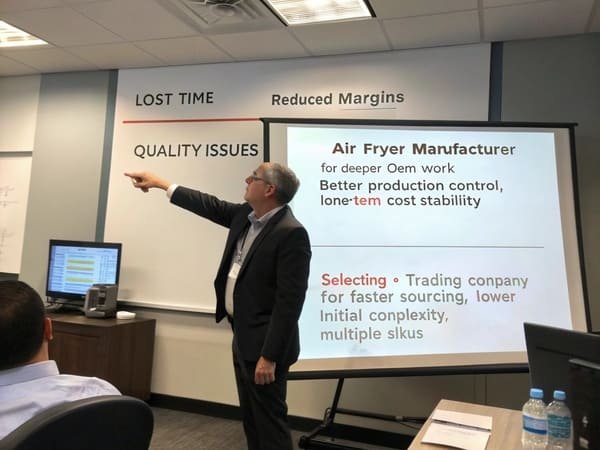
The best choice depends on your goal. I would choose an air fryer manufacturer for deeper OEM work, stronger production control, and long-term cost stability. I would choose a trading company for faster sourcing, lower early complexity, and easier multi-SKU coordination.
I have worked with buyers who only asked, “Are you a factory or a trader?” That question sounds useful, but it is too shallow. In real sourcing, I care more about who controls product quality, who manages compliance documents, who can solve production problems fast, and who can keep delivery stable when order volume grows. In our own work on kitchen appliances, I have seen direct factories perform very well, and I have also seen some factories fail basic communication and planning. I have seen trading companies move fast and save a project, and I have also seen weak middlemen create confusion because they did not really control anything. That is why I always tell buyers to judge the supply partner by proof, process, and response, not by label alone.
When Should I Choose an Air Fryer Manufacturer for OEM, Compliance, and Long-Term Volume Orders?
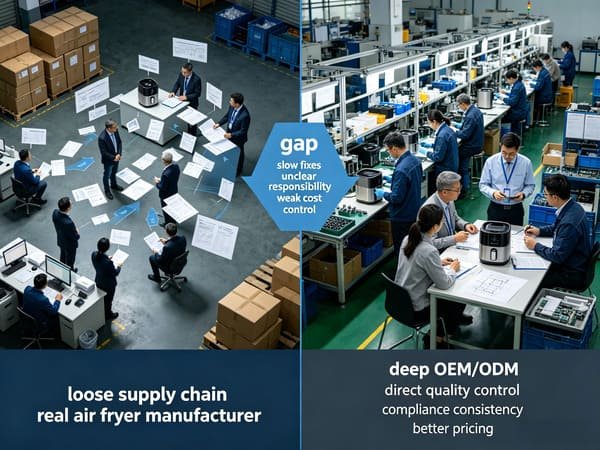
Many buyers want custom products and stable quality, but they still buy through a loose supply chain. That gap often leads to slow fixes, unclear responsibility, and weak cost control later.
I would choose a real air fryer manufacturer when I need deep OEM or ODM work, direct quality control, compliance consistency, and better pricing over time. This is usually the stronger path for brand owners and buyers planning repeat orders at scale.
When I work on an air fryer project that needs custom housing, control panel changes, heating performance targets, or packaging built for a brand launch, I prefer dealing with the team that actually runs the line. That matters because air fryers are not simple plastic goods. They are electrical appliances with heating systems, food-contact parts, power requirements, and safety risks. In our product work, a small design change can affect tooling, wiring layout, airflow, basket fit, or test results. If I need to solve those issues, I want the engineering team, production team, and quality team in one chain of control.
A real manufacturer is often the better fit in these cases:
| Buying need | Why a manufacturer is often better |
|---|---|
| Deep OEM customization | The factory can work directly on tooling, structure, firmware, and assembly details |
| Long-term volume orders | The unit cost can become more competitive as volume grows |
| Tight quality control | The factory can manage in-line inspection, final inspection, and corrective action faster |
| Compliance consistency | The team can follow the exact material, component, and process records used in production |
| Delivery planning | Production schedules are easier to confirm when I talk to the owner of capacity |
I also think about what happens when something goes wrong. If a sample fails a cooking test, if the basket coating has an issue, or if a carton drop test fails, I need fast root cause analysis. A real factory usually has a better chance of tracing the issue to a process point. It can check incoming materials, line records, test data, and worker instructions. That direct link becomes more valuable as the order gets bigger.
I have also found that manufacturers make more sense when the buyer wants to build a product roadmap, not just place a single order. In that case, the value is not only today’s price. The value is stable output, better engineering memory, and the ability to improve the next model from real production feedback. When we review repeat projects, the best results usually come when both sides treat the product as a long-term program and not a one-time purchase.
When Should I Choose an Air Fryer Trading Company for Faster Sourcing and Lower Initial Complexity?
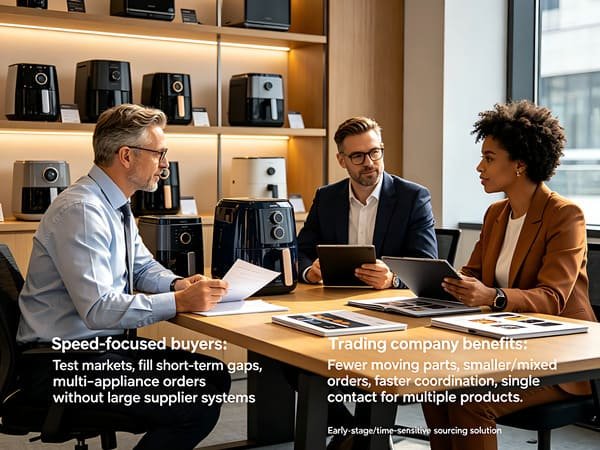
Some buyers need speed more than deep factory control. They need to test a market, fill a short-term gap, or buy several appliance types without building a large supplier system first.
I would choose a strong trading company when I need fewer moving parts, smaller or mixed orders, faster supplier coordination, and one contact point across several products. This can be the better option in early-stage or time-sensitive sourcing.
I do not treat trading companies as a weak option by default. I have seen skilled trading teams add real value. A good one can reduce sourcing friction in ways that matter a lot for busy buyers. If I need an air fryer, kettle, toaster, and blender in one shipment, a trading company may handle that more smoothly than four separate factories. If I need quick sample collection from several sources, a good trading company can move faster because it already has an active supplier network.
This option becomes useful in cases like these:
| Buying situation | Why a trading company may help |
|---|---|
| Small trial order | It may accept lower starting complexity and combine resources |
| Multiple SKUs | It can manage several factories through one contact person |
| Limited sourcing staff | It reduces the buyer’s coordination workload |
| Fast market test | It can help pull existing models together quickly |
| New importer stage | It can guide packaging, paperwork, and shipment flow more simply |
Still, I only trust a trading company when it can prove supplier management ability. I want to know how it selects factories, how it checks quality, how it manages inspections, and how it handles claims. A trading company is not useful just because it answers messages fast. It is useful when it can control risk better than the buyer could alone.
I also look at communication quality. In our industry, a strong trading company often performs well because it speaks both languages well. It understands what the buyer needs, and it can translate that into factory action. That sounds basic, but it is not. Many sourcing failures happen because the requirement was not passed clearly. I have seen wrong plug types, wrong carton marks, wrong coating colors, and wrong manuals because no one managed the detail chain well. A capable trader can prevent that.
So I would not ask only, “Is this partner a trader?” I would ask, “Can this team reduce the total workload and still protect compliance, quality, and schedule?” If the answer is yes, then the trading company may be the smarter option for that stage of the business.
How Can I Verify Whether an Air Fryer Manufacturer Really Owns Production Capacity?
Many suppliers say they are factories. Some are real producers. Some only assemble. Some outsource most work. If I do not verify this early, I can lose control before mass production even starts.
I verify production capacity by checking legal records, factory evidence, shipment clues, process details, team depth, and consistency across all documents. Real capacity leaves a trail, and I want that trail before I commit.
This is one of the most important checks in appliance sourcing. I do not rely on one factory photo or one sales claim. I want a full pattern of evidence. In our daily work, I know that a real production site has details that are hard to fake over time. The business license should match the company name and business scope. The facility video should show real production flow, not just a showroom. The sample shipment location should make sense. The answers about assembly steps, testing points, and line layout should sound specific, not vague.
Here is how I usually break it down:
| What I check | What I want to see |
|---|---|
| Business license | Business scope includes manufacturing or production-related activity |
| Factory video | Real workshops, workers, assembly lines, testing areas, packing areas |
| Sample shipping point | Origin aligns with claimed factory location or operating structure |
| Production process explanation | Clear steps for assembly, testing, inspection, and packaging |
| Team structure | Sales, engineering, QC, production planning, and after-sales roles are clear |
| Audit or site visit support | Willingness to arrange video audit, third-party audit, or visit |
I also ask questions that expose whether the supplier truly controls the line. For example, I may ask how it handles heating element incoming checks, how it verifies thermostat performance, how it controls basket coating defects, or how it records burn-in or functional test results. A real factory usually answers in a practical way. A weak middleman often gives general answers.
Another useful check is consistency. If the supplier claims large output but cannot show production schedules, line photos, or quality records that match that scale, I become careful. If it says it owns tooling but cannot explain tooling lead time or maintenance, I keep digging. If it claims strong R&D but can only offer cosmetic changes, I adjust my view.
I have learned that verification is not about catching people in one lie. It is about building a clear picture of who really controls the product. For air fryers, that matters because the cost of poor control is high. One compliance issue or one safety problem can damage a brand fast. I would rather spend more effort checking early than spend months fixing avoidable issues later.
How Do I Compare MOQ, Pricing, and Lead Time Between an Air Fryer Manufacturer and Trading Company?
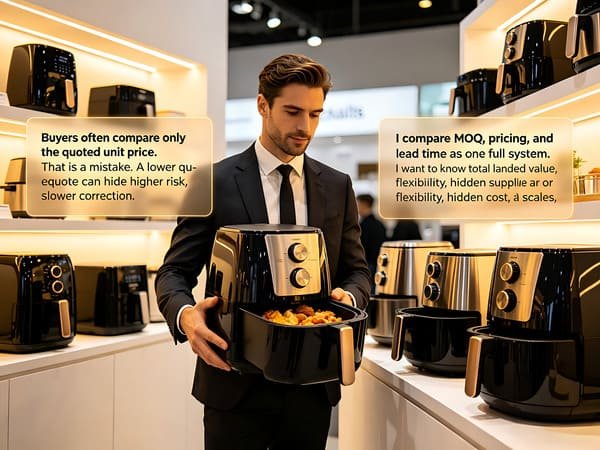
Buyers often compare only the quoted unit price. That is a mistake. A lower quote can hide higher risk, slower corrections, or weak delivery control that costs more later.
I compare MOQ, pricing, and lead time as one full system. I want to know total landed value, flexibility, hidden cost, and how each supplier will perform when the order changes or scales.
When I compare a manufacturer and a trading company, I do not expect one to win in every category. A manufacturer may offer a better unit price for larger orders, but it may ask for higher MOQ. A trading company may offer easier starting terms, but the unit price may include an extra margin. The right choice depends on what I am optimizing for.
This is how I look at it:
| Factor | Manufacturer tendency | Trading company tendency |
|---|---|---|
| MOQ | Often higher for custom work or dedicated materials | Often more flexible, especially for mixed or existing items |
| Unit price | Often better at scale | Often higher due to coordination margin |
| Lead time | Can be strong if production is planned well | Can be faster for ready supplier networks or stock-based options |
| Change control | Stronger when factory owns tooling and process | Can be slower if changes must pass through layers |
| Mix-and-match support | Usually weaker across many categories | Usually stronger for multi-SKU buying |
Then I go deeper. I ask what the MOQ really covers. Is it for product only, gift box only, carton only, color box printing only, or custom color parts? Many buyers hear one MOQ number and think it applies to the whole project. In practice, each custom element can have its own threshold.
I also compare price beyond the unit figure. I check sample fees, mold cost, packaging cost, spare parts terms, inspection cost, and payment terms. Sometimes a factory quote looks lower, but the buyer then has to manage more steps alone. Sometimes a trading company quote is higher, but it includes support that reduces the internal workload.
Lead time also needs detail. I separate sample lead time, order lead time, peak-season lead time, and correction lead time. A supplier that quotes 35 days but needs 20 more days every time artwork changes is not really a 35-day supplier. I also ask what materials or parts are long lead items. For air fryers, key parts like heating systems, motors for certain models, coated baskets, control boards, or packaging components can shift the real schedule.
In our own planning, the best comparisons come from scenario-based questions. I ask: What happens if I double volume in the next order? What happens if I add a custom color? What happens if I need shipment split into two destinations? The supplier that answers those questions clearly is often the one with the better real value.
Which Certifications and Quality Documents Should Each Air Fryer Supplier Type Be Able to Provide?
Many sourcing problems start when a buyer asks for compliance too late. By then, samples are made, packaging is printed, and shipment dates are already under pressure.
Both supplier types should provide clear compliance and quality documents, but I expect stronger direct traceability from the party that controls production. For air fryers, safety, food-contact compliance, and test consistency should never be treated as optional.
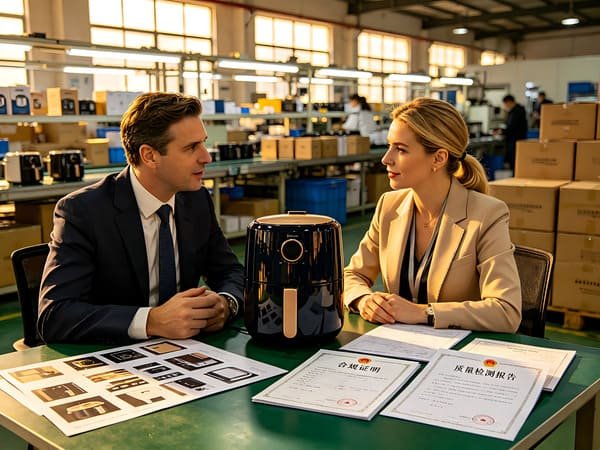
I treat document readiness as a sign of management quality. Air fryers touch both safety and consumer trust, so I want documents that support legal sale, product consistency, and claim handling. The exact document set depends on the target market, but the supplier should already understand that these products require more than a nice sample and a low price.
Here are the document groups I usually ask about:
| Document type | Why I ask for it |
|---|---|
| Product safety certificates or test reports | To support market access and electrical safety claims |
| Food-contact material reports | To confirm the basket, tray, or other contact parts meet applicable rules |
| Factory quality records | To show inspection standards and production controls |
| Bill of materials or key component list | To connect certified or tested product structure to real production |
| User manual and label review | To reduce warning, rating, and instruction errors |
| Business license and company records | To verify who is responsible for the product |
For the United States, Europe, and other markets, the exact compliance path is different. So I do not assume one report fits all. I ask whether the existing test reports match the exact model, voltage, plug type, and material structure I plan to buy. I also ask whether the report belongs to the supplier, the factory, or another party. That matters more than many buyers think.
A manufacturer should usually be able to explain how the tested sample matches mass production. It should also explain how component changes are controlled. A trading company should be able to gather the same documents and explain the chain of responsibility, but I pay close attention to whether it truly understands the file set or is only forwarding PDFs without review.
In our development work, I also watch for document freshness and consistency. Do the rating label details match the quotation? Does the manual match the real functions? Do the food-contact reports match the actual materials used in the basket and tray? Small mismatches can create bigger problems later. Good suppliers know that documents are not just for passing customs. They are part of product control.
What Risks Should I Check Before Combining an Air Fryer Manufacturer and Trading Company in One Supply Plan?
Using both types can look smart on paper, but it can create confusion if roles are not clear. Then the buyer gets overlap, blame shifting, or quality gaps at the worst time.
I can combine a manufacturer and a trading company, but only when I define responsibility, communication flow, quality control, and document ownership from the start. A mixed plan works only when every risk point has one clear owner.
I understand why buyers do this. One partner may be strong in custom air fryers. Another may be better for add-on appliances, packaging support, or logistics coordination. In some cases, the mixed model works well. But I have seen it fail when no one sets the rules early.
These are the main risks I check:
| Risk point | What can go wrong | What I do |
|---|---|---|
| Responsibility split | Each side blames the other for delays or defects | Define owner for product, quality, shipment, and documents |
| Version control | Wrong artwork, wrong manual, or old spec sent to production | Use one approved master file set and change log |
| Quality standard gaps | Different AQL or inspection points between parties | Align inspection checklist and acceptance rules before order |
| Compliance confusion | Reports belong to one party, production belongs to another | Confirm legal entity, document owner, and product traceability |
| Communication delay | Messages pass through too many layers | Set one decision flow and response window |
| Cost duplication | Hidden margin or repeated service charges | Break out all costs line by line |
I also check how problems will be handled after shipment. If a claim comes from the market, who investigates? Who pays for replacement parts? Who issues corrective action? If the factory made the unit, but the trading company sold it, I need that path defined before anything ships.
One more risk is data loss. If technical files, approved samples, packaging layouts, and inspection reports sit in different inboxes, the next repeat order becomes unstable. In our own operations, I have learned that repeat success depends on keeping one clean project record. That record should include approved sample details, BOM versions, artwork approvals, packaging specs, test references, and final inspection rules.
A mixed supply plan can work very well when it is built on structure. I may use the manufacturer for core production and the trading company for coordination across accessory items or multi-category consolidation. That can save time and increase flexibility. Still, I only do it when the buyer stays in control of the information flow and makes each party’s duty measurable. Without that, the model becomes convenient at the start and expensive later.
Conclusion
I do not choose between a manufacturer and a trading company by label alone. I choose by control, proof, compliance strength, and fit with the real buying goal.