

Struggling with unexpected fees when importing air fryers from China? Hidden charges can quickly erase your profits, turning a promising order into a financial headache. On our production lines, we see firsthand how crucial accurate cost planning is for our clients’ success.
To calculate total costs, combine the product price with shipping fees (based on weight/volume and method like sea or air) and import duties. Use the product’s HTS code (e.g., 8516.60.40) to find the correct tariff rate and add customs brokerage fees for a complete picture.
Understanding these costs upfront is the key to protecting your margins and ensuring a smooth import process. In this guide, we’ll break down each component so you can build an accurate, comprehensive budget for your next air fryer shipment.
What methods can I use to estimate shipping costs for air fryers?
Choosing the wrong shipping method can either delay your stock for months or completely destroy your budget. When we prepare shipments for our partners, the first question is always about balancing speed and cost, as this is crucial for their profitability.
Estimate shipping costs by choosing a method—Express for samples, Air Freight for speed, or Ocean Freight for bulk orders. Then, get quotes from freight forwarders based on the shipment’s actual weight or dimensional weight, whichever is greater.
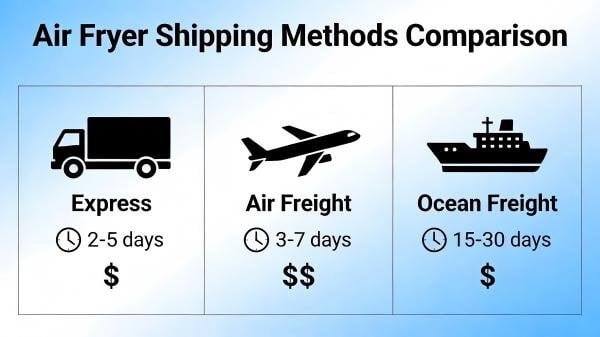
To accurately estimate your shipping expenses, you need to understand the main methods and how they are priced. The choice you make will have the biggest impact on your total landed cost.
Comparing the Main Shipping Methods
Your ideal shipping method depends on your order volume, urgency, and budget. Here’s a breakdown of the three primary options we coordinate for our clients:
| Shipping Method | Best For | Speed | Cost per KG (Estimate) | Key Consideration |
|---|---|---|---|---|
| Express | Samples, very small orders | 3-7 days | $8 – $12+ | Fastest and simplest, but highest cost. All-inclusive pricing. |
| Air Freight1 | Medium-volume, urgent stock | 7-15 days | $4 – $8 | A balance between speed and cost. Good for high-value goods. |
| Ocean Freight2 | Bulk orders (LCL/FCL) | 25-40+ days | $1 – $3 | Most cost-effective for large quantities, but requires long-term planning. |
- Express Courier (DHL, FedEx, UPS)3: This is perfect for getting initial product samples quickly. The cost is high, but it’s a door-to-door service that simplifies the process.
- Air Freight1: A good middle ground. It’s faster than the sea but cheaper than express for moderately sized shipments (e.g., a few pallets). You’ll work with a freight forwarder who handles booking and customs clearance.
- Ocean Freight2: This is the backbone of global trade and the most common method for our large-volume clients. You can ship via LCL (Less than Container Load) for smaller orders or FCL (Full Container Load) for large ones, which offers the lowest per-unit cost.
Understanding Weight Calculations
Carriers charge based on chargeable weight4, which is the greater of two measurements:
- Actual Weight: The real weight of the package when placed on a scale.
- Dimensional (Volumetric) Weight: This reflects the amount of space the package occupies. The formula is typically (Length x Width x Height) / Divisor. The divisor varies by carrier (e.g., 5000 or 6000).
Air fryers are relatively bulky for their weight, so dimensional weight often applies. We always provide both the gross weight and carton dimensions so your forwarder can give you an accurate quote.
How do I determine applicable tariffs and import duties?
Navigating customs tariffs can feel like decoding a secret language, and a mistake here can lead to costly delays or penalties. When we export to the U.S. or Europe, we always double-check the product classification, as this is the foundation for all duty calculations.
To determine tariffs, you must identify the correct Harmonized Tariff Schedule (HTS) code for your product. For air fryers, this is often 8516.60.40. Then, check your country’s customs website for the associated duty rate and any additional tariffs.
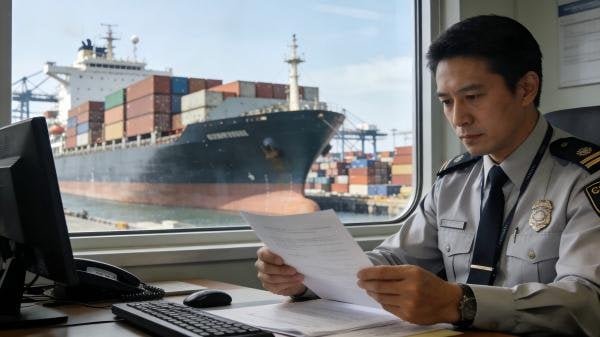
Calculating tariffs is a non-negotiable step. It’s a direct tax on your imported goods, and for electronics from China, these duties can be significant. Failing to account for them will result in a major financial surprise when your goods land.
Finding the Right HTS Code
The Harmonized Tariff Schedule (HTS) code is a universal system for classifying traded products. Every product has a specific code that determines its import duty rate.
For electric kitchen appliances, the relevant chapter is usually 8516. Air fryers, which are essentially small convection ovens, typically fall under:
- HTS Code: 8516.60.405 (Other ovens; cooking stoves, ranges, cooking plates, boiling rings, grillers, and roasters)
It’s crucial to confirm this code with your supplier and freight forwarder. We always include the HTS code on our commercial invoices to prevent customs classification issues. You can verify codes using your country’s official government trade database, such as the U.S. International Trade Commission’s HTS search tool.
Calculating the Duty Payable
Once you have the HTS code, you can find the corresponding duty rate. The calculation is generally:
Duty Payable = (Product Value + Shipping Cost + Insurance Cost) x Tariff Rate
The "Product Value" is the cost on the commercial invoice. Note that the total dutiable value includes the cost of getting the goods to the port of import (CIF value).
Let’s take an example for the U.S. market. The standard duty for HTS code 8516.60.40 might be low, but products from China are often subject to additional "Section 301" tariffs.
- Product Cost: $50 per unit
- Units: 200
- Total Product Value: $10,000
- Shipping + Insurance: $1,500
- Total Dutiable Value: $11,500
- Assumed Total Tariff Rate (Base + Section 301): 25%
- Total Duty Payable: $11,500 x 0.25 = $2,875
This $2,875 is a direct cost you must add to your budget. Rates change, so always check for the most current information.
What information do I need from suppliers to calculate total landed costs?
Trying to get a shipping quote without complete product details is like asking for a map without a destination. We’ve learned that providing comprehensive information upfront saves our clients time and money, ensuring the first quote they get is the most accurate one.
From your supplier, you need the product’s gross weight, carton dimensions (L x W x H), number of cartons, total volume (CBM), the pickup address (factory location), and the product’s HTS code to calculate the total landed cost accurately.

To calculate your total landed cost—the final price of the product at your warehouse door—you need to gather specific data points from your supplier. Your freight forwarder will require this information to create a precise quote that covers everything from factory pickup to final delivery. Incomplete information leads to estimates, and estimates often lead to surprise costs later on.
Essential Information Checklist
When you request a quote from us or any other supplier, make sure you receive the following details. This is the minimum information your freight forwarder will need.
| Information Needed | Why It’s Important | Example |
|---|---|---|
| Gross Weight & Net Weight | Determines shipping cost, especially for air freight. | GW: 5.5 kg, NW: 4.8 kg |
| Carton Dimensions (L x W x H) | Calculates dimensional weight and total volume. | 35 x 35 x 40 cm |
| Units per Carton | Helps calculate the total number of cartons. | 1 pc/carton |
| Total Cartons & Volume (CBM) | Crucial for booking LCL or FCL ocean freight. | 500 cartons, 24.5 CBM |
| Factory Pickup Address | Needed to calculate inland transportation costs in China. | Zhongshan, Guangdong, China |
| HTS Code | Required for customs declaration and tariff calculation. | 8516.60.40 |
| Incoterms1 | Defines who pays for shipping stages (e.g., FOB, EXW). | FOB Zhongshan Port |
Understanding Incoterms6 (FOB vs. EXW7)
The Incoterm quoted by your supplier significantly impacts your costs. The two most common are:
- EXW (Ex Works): You are responsible for all costs from the factory door. This includes picking up the goods, transporting them to the port, clearing China customs, and all subsequent shipping.
- FOB (Free On Board): The supplier is responsible for getting the goods to the designated port and clearing them for export. Your responsibility starts once the goods are "on board" the vessel.
For most new importers, FOB is simpler because the supplier handles local logistics in China, which can be complex to manage from abroad. We typically quote FOB prices to streamline the process for our partners, as it provides a clear handover point.
How can I optimize shipping and customs expenses?
After helping clients ship thousands of air fryers globally, we know that simply accepting the first quote isn’t enough. Proactive optimization is where you can gain a real competitive edge, turning saved expenses directly into profit.
Optimize costs by consolidating shipments to use FCL ocean freight, negotiating FOB terms with your supplier, using a reliable freight forwarder to find the best rates, and ensuring your customs paperwork is perfectly accurate to avoid fines and delays.

Saving money on logistics isn’t about cutting corners; it’s about being smarter with your planning and execution. A few strategic decisions can significantly reduce your per-unit shipping cost and minimize the risk of expensive customs issues. Even a 5% reduction in landed cost can substantially boost your bottom line.
Smart Shipping Strategies
- Plan Ahead for Ocean Freight: The single biggest cost-saver is avoiding air freight. By planning your inventory needs 2-3 months in advance, you can leverage the low cost of ocean shipping. This requires disciplined forecasting but offers massive savings.
- Consolidate and Aim for FCL: If your order isn’t large enough for a Full Container Load (FCL)8, consider consolidating it with other products or increasing your order volume to fill a container. FCL offers a much lower cost per cubic meter (CBM) than LCL.
- Choose the Right Forwarder: Don’t just go with the cheapest option. An experienced freight forwarder has established relationships with carriers and a deep understanding of customs. They can advise you on the best routes and help you avoid common pitfalls, saving you money in the long run.
Minimizing Customs Costs
Customs can be a source of unexpected expenses, but with proper preparation, you can keep them under control.
| Action | Benefit | How to Do It |
|---|---|---|
| Ensure Accurate Paperwork | Avoids fines, delays, and inspections. | Double-check that the commercial invoice, packing list, and bill of lading are 100% accurate and consistent. |
| Pay Duties on Time | Prevents storage fees (demurrage) at the port. | Work with your customs broker8 to pre-pay duties or have funds ready as soon as the invoice is issued. |
| Understand Product Classification | Ensures you pay the correct tariff rate. | Confirm the HTS code with your supplier and broker before shipping. An incorrect code can lead to overpayment or penalties. |
By working closely with a supplier who provides clear and accurate documentation, you eliminate a major source of potential friction. We make it a priority to provide flawless paperwork because we know it’s essential for a smooth and cost-effective import process for our clients.
Conclusion
Calculating shipping and tariffs is a critical skill for profitable importing. By understanding shipping methods, finding the correct HTS code, and gathering key data from your supplier, you can build a reliable budget and protect your margins.
-
Learn about Air Freight to see how it balances speed and cost for your shipping needs, especially for medium-volume orders. ↩ ↩ ↩
-
Discover the benefits of Ocean Freight, the most cost-effective method for large shipments, and how it supports global trade. ↩ ↩
-
Explore this link to understand how Express Courier services can streamline your shipping process and ensure timely delivery. ↩
-
Understanding chargeable weight is crucial for accurate shipping costs; this link will clarify the calculations involved. ↩
-
Understanding this HTS code is essential for accurate customs classification and duty calculations. ↩
-
Understanding Incoterms is crucial for managing shipping costs and responsibilities effectively. ↩
-
Exploring this topic will clarify shipping responsibilities and help you choose the best option for your needs. ↩
-
Exploring this link will help you understand how FCL can significantly reduce shipping costs and improve efficiency. ↩ ↩